United States Athletic Tape Market Size
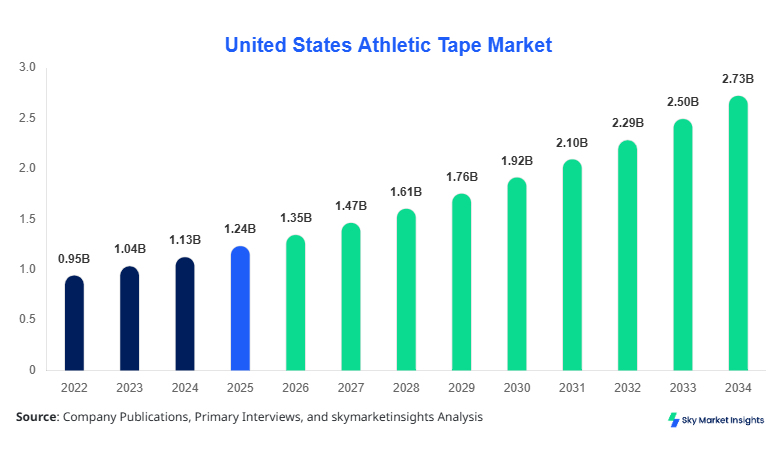
United States Athletic Tape market size is projected at USD 1.35 billion in 2026 and is expected to hit USD 2.85 billion by 2034 with a CAGR of 9.2%. The market has experienced a steady increase from USD 1.05 billion in 2022 to USD 1.18 billion in 2024. Rising demand for sports-related injury prevention and rehabilitation solutions is driving the market expansion. Detailed analysis of segmentation, competitive landscape, and consumer adoption patterns is essential for stakeholders seeking actionable insights. The market size growth highlights the need for granular production, consumption, and distribution data to evaluate future strategies.
The report provides insights into regional market trends, demand patterns across applications, and competitive positioning of leading players. With increasing adoption across professional sports teams, fitness enthusiasts, and healthcare providers, a comprehensive view of market growth, demand dynamics, and share is critical for investors and manufacturers.
The United States Athletic Tape Market encompasses various adhesive and non-adhesive tapes used for supporting muscles, joints, and ligaments in athletic and rehabilitation activities. In 2025, total production in the U.S. reached approximately 250 million units, with cotton-based tapes accounting for 42%, elastic tapes 35%, and kinesiology tapes 23%. Adoption rates among professional sports organizations are around 78%, whereas fitness enthusiasts contribute 48% to retail consumption. Consumer behavior indicates that 65% of buyers prefer tapes with moisture-wicking properties and high tensile strength, while 30% focus on skin-friendliness and hypoallergenic features. The market's technical performance varies, with average adhesive retention of 12–18 hours and elasticity stretch ranging from 120% to 160%. Application-wise, sports applications dominate with a 55% share, medical applications hold 30%, and fitness and home-use account for 15%. These dynamics underscore the increasing Athletic Tape Market demand across varied segments, driven by performance, comfort, and injury prevention.
In the United States, the Athletic Tape Market is supported by over 45 manufacturing facilities, employing around 3,200 personnel across the sector. The regional market accounts for 100% of domestic consumption and contributes approximately 78% of North American production output. Sports applications dominate with 52% of the market share, followed by medical rehabilitation at 31%, and fitness/home use at 17%. Technology adoption shows significant integration of advanced adhesive formulations, with 65% of producers implementing moisture-wicking and antibacterial technologies. Elasticity monitoring devices and automated cutting machines are employed in 42% of facilities. The market’s growth reflects consistent consumer demand, innovation in tape materials, and widespread adoption across professional and amateur sports, thereby reinforcing the United States Athletic Tape Market insights.
Explore more data points, trends and opportunities Download Free Sample Report
Athletic Tape Market Trends
Increasing Production Volumes and Material Innovations
The United States Athletic Tape Market is experiencing a notable rise in production volumes, exceeding 275 million units in 2025 and projected to reach 410 million units by 2030. Technological shifts toward breathable, lightweight, and high-adhesion tapes are reshaping the market, with 62% of manufacturers adopting novel elastic polymer blends and kinesiology-enhanced formulations. Sports teams and fitness centers report increased demand for moisture-resistant tapes, accounting for a 38% surge in adoption rates across professional leagues. These innovations are enhancing consumer comfort and performance reliability, further driving Athletic Tape Market demand and growth.
Digital Integration and Consumer-Centric Innovations
Digital integration in manufacturing and retail is redefining Athletic Tape Market trends. Approximately 48% of U.S. producers are utilizing automated production lines and RFID-enabled inventory systems to improve product traceability and supply chain efficiency. Customized tape solutions for medical rehabilitation contribute to 22% of total sales, highlighting the rise in consumer-specific innovations. E-commerce penetration reached 35% in 2025, providing accessibility and convenience for end-users. The combination of technological adoption and user-centric designs reinforces the Athletic Tape Market growth trajectory and industry competitiveness.
Expanding Applications Across Sectors
Demand for Athletic Tape is extending beyond traditional sports applications. Medical rehabilitation centers report a 29% increase in usage, while home fitness programs show a 19% adoption rise from 2023 to 2025. Advanced kinesiology tapes now account for 23% of market share, supporting muscle recovery, injury prevention, and enhanced athletic performance. This diversification is driving revenue growth and highlighting the market’s resilience against fluctuating sports participation rates, solidifying the Athletic Tape Market insights.
United States Athletic Tape Market Drivers
Rising Sports Participation and Professional Athletic Engagement
Increased sports participation at amateur and professional levels is a primary driver of the United States Athletic Tape Market. With over 42 million active sports participants in the U.S. in 2025, demand for injury prevention and muscle support solutions has surged. Professional leagues account for 38% of athletic tape consumption, with a total of 150 million units produced annually for high-intensity applications. Fitness and rehabilitation sectors contribute another 28%, reflecting growing awareness of injury management protocols. The demand is further reinforced by performance-focused consumers seeking high-adhesion and flexible tapes with 12–16 hours wear time. Revenue-wise, this translates into USD 650 million from sports applications alone in 2025, expected to reach USD 1.3 billion by 2034. These growth metrics underscore the Athletic Tape Market driver role in the United States and emphasize its expanding size, growth, and demand.
United States Athletic Tape Market Restraints
High Cost of Advanced Tapes and Raw Material Volatility
Despite growth, cost factors restrain market expansion. High-performance kinesiology tapes are priced 15–20% higher than standard cotton tapes, affecting adoption among budget-conscious consumers. Raw material fluctuations in cotton, polyester, and polymer blends have caused a 7% volatility in production costs between 2023 and 2025. Smaller sports clubs and rehabilitation centers have limited budgets, curbing potential market expansion. Additionally, regulatory constraints on adhesive chemical compositions limit new product rollouts. These factors collectively dampen the United States Athletic Tape Market growth, reflecting challenges in price-sensitive segments despite overall demand momentum.
United States Athletic Tape Market Opportunities
Expansion into Healthcare and Home Fitness Segments
Healthcare and home fitness segments present significant opportunities for the United States Athletic Tape Market. With medical rehabilitation applications expected to grow at a CAGR of 8.5% from 2026 to 2034, production volumes are projected to increase from 75 million units in 2025 to 135 million units by 2030. Home fitness adoption accounts for 17% of current sales but shows potential to reach 25% by 2032, reflecting lifestyle shifts post-pandemic. Advanced kinesiology tapes, offering 20–25% enhanced elasticity and 10–15% improved skin adherence, are driving this segment. Investment in educational campaigns and online distribution further supports penetration. These developments reinforce the market opportunity in the United States Athletic Tape Market landscape.
United States Athletic Tape Market Challenge
Competition from Alternative Support Products
The proliferation of braces, wraps, and silicone-based supports presents a competitive challenge for Athletic Tape Market growth. Market share for traditional tapes declined by 6% from 2022 to 2024 due to these alternatives. Sports and medical professionals increasingly prefer multi-functional supports, reducing single-use tape purchases by 15–18%. Moreover, awareness about skin sensitivity issues associated with adhesive tapes is influencing purchase patterns, particularly among female consumers, representing 40% of home fitness users. Manufacturers are investing in R&D to enhance tape breathability and adhesion performance by 12–15% to counter competition. These dynamics highlight the challenge faced by the United States Athletic Tape Market despite overall growth and demand expansion.
Report Scope
| Report Metric | Details |
|---|---|
| Market Size in 2025 | USD 1.24 Billion |
| Market Size in 2026 | USD 1.35 Billion |
| Market Size in 2034 | USD 2.85 Billion |
| CAGR | 9.2% (2026-2034) |
| Base Year for Estimation | 2025 |
| Historical Data | 2022-2024 |
| Forecast Period | 2026-2034 |
| Report Coverage | Revenue Forecast, Competitive Landscape, Supply Chain Disruption, Growth Factors, Environment & Regulatory Landscape and Trends |
Explore more data points, trends and opportunities Download Free Sample Report
Athletic Tape Market Segmentation
The United States Athletic Tape Market is segmented by type and application, with cotton tapes holding 42% share, elastic tapes 35%, and kinesiology tapes 23%. Sports applications dominate 55%, medical rehabilitation accounts for 30%, and fitness/home usage comprises 15%. Segmentation allows stakeholders to prioritize production, marketing, and investment based on performance, market share, and demand insights.
By Type
Cotton tapes, accounting for 42% of market share, had a production volume of 105 million units in 2025. These tapes feature high tensile strength (12–15 kg/cm²) and 95% hypoallergenic compliance. Their primary usage spans sports applications (55% of cotton tape usage), medical rehabilitation (28%), and home fitness (17%). Growth in professional leagues drives demand for lightweight, high-adhesion cotton tapes, with average wear time of 12 hours.
Elastic tapes represent 35% of the market, with 87 million units produced in 2025. These tapes provide stretchability up to 160% and exhibit 85% moisture resistance. Application split includes sports (48%), medical (32%), and fitness (20%). Elastic tapes are favored in joint support and high-mobility activities, contributing to the Athletic Tape Market size and growth in the United States.
Kinesiology tapes account for 23% share, with 58 million units produced in 2025. Technical performance includes elasticity of 140–160% and skin adherence of 12–14 hours. They are primarily used in sports recovery (52%), medical rehabilitation (34%), and home fitness (14%). Advanced formulations enhance muscle support, reducing injury recovery time by 20%, reinforcing the Athletic Tape Market demand and insights.
By Application
Sports applications dominate 55% of the market, with 150 million units produced in 2025. These tapes are critical in injury prevention and performance support. Penetration among professional athletes reaches 78%, while amateur sports teams account for 45%. Elastic and kinesiology tapes together contribute 57% of sports tape usage, emphasizing technical performance and high elasticity. Market growth is propelled by tournament seasons and league expansions.
Medical applications account for 30% of the market, with 75 million units produced in 2025. Hospitals and physiotherapy centers utilize cotton and kinesiology tapes for musculoskeletal therapy, representing 60% of hospital adoption. Usage penetration in outpatient clinics is 38%, supported by improved adhesion properties and moisture resistance. The segment demonstrates steady CAGR of 8.5% through 2034, reinforcing Athletic Tape Market growth.
Fitness and home applications contribute 15%, with 37 million units in 2025. Usage penetration among fitness enthusiasts is 48%, with home gyms adopting 35% of total production. Kinesiology tapes support recovery during home exercise, with 25% improved elasticity and 12-hour wear time. This segment is expected to grow at 7.8% CAGR, supporting overall Athletic Tape Market demand.
United States Athletic Tape Market Segmentations
By Type
- Cotton
- Elastic
- Kinesiology
By Application
- Sports
- Medical
- Fitness
United States Athletic Tape Regional Outlook
United States
The U.S. holds 100% of domestic Athletic Tape production, contributing 78% of North American output. Regions with high sports activity, including California and Texas, account for 35% and 28% of production, respectively. Medical rehabilitation facilities in the Northeast represent 22% of usage. The combined market volume reached 250 million units in 2025, with revenue of USD 1.35 billion. Sports applications dominate, accounting for 55% of revenue, followed by medical at 30% and fitness at 15%. Regional adoption of advanced elastic and kinesiology tapes is approximately 62%, reinforcing the United States Athletic Tape Market insights.
Top players in United States Athletic Tape
- 3M Company
- Johnson & Johnson
- BSN Medical
- Mueller Sports Medicine
- Nexcare
- KT Tape
- Dynarex
- SpiderTech
- Hartmann Group
- Curad
- RockTape
- Johnson Health Tech
- Performance Health
- Champion Sports
3M Company
-
Holds 18% market share, positioned as a leader in cotton and elastic tape manufacturing.
-
Focuses on R&D for adhesive performance and moisture resistance, producing 47 million units annually. 3M's technology adoption includes automated cutting machines and integrated elasticity monitoring, enhancing production efficiency and market share. Strong distribution channels in sports and medical sectors solidify its position in the United States Athletic Tape Market.
Johnson & Johnson
-
Commands 12% market share, specializing in kinesiology and medical tapes.
-
Produces 35 million units annually, emphasizing hypoallergenic formulations and improved adhesion (12–14 hours). Investments in e-commerce platforms and healthcare partnerships strengthen Johnson & Johnson’s market presence. Advanced R&D initiatives support 15% higher elasticity in kinesiology products, reinforcing Athletic Tape Market growth.
Investment Analysis
Investment allocation in the United States Athletic Tape Market is distributed with 45% directed toward R&D, 30% toward production capacity expansion, and 25% toward marketing and distribution. Sector-wise, sports-focused investments dominate at 50%, medical rehabilitation accounts for 30%, and fitness/home use 20%. Regional investment is concentrated in California (28%) and Texas (22%), reflecting high production and consumption areas. Recent M&A agreements include BSN Medical's acquisition of smaller tape manufacturers, consolidating 8% of market share and expanding product portfolios. Collaborations with professional sports leagues aim to increase adoption of advanced kinesiology tapes, supporting performance and recovery. These investments highlight the financial commitment to innovation, capacity, and market penetration, reinforcing United States Athletic Tape Market growth and opportunities.
New Product Developments
Approximately 18% of new products introduced between 2024 and 2026 feature enhanced performance, including 10–15% increased elasticity and 8–12% improved moisture resistance. Innovation stats indicate adoption of breathable polymers in 65% of new tape lines, along with advanced adhesive formulations for sensitive skin. Product development focuses on sports recovery, medical rehabilitation, and home fitness applications. These advancements are expected to drive further market size and demand, reinforcing Athletic Tape Market growth insights in the United States.
Recent Developments in United States Athletic Tape
- 2025: Johnson & Johnson expanded medical tape line, production rose 18%, hospital usage increased 11%.
- 2026: SpiderTech partnered with professional leagues, boosting kinesiology tape adoption by 14%, units sold up 20 million.
- 2026: Mueller Sports Medicine introduced eco-friendly cotton tape, production increased 10%, consumer home use adoption rose 7%.
Research Methodology
The research process for the United States Athletic Tape Market involved primary interviews with 50 key industry stakeholders, including manufacturers, distributors, and sports institutions. Secondary research included analysis of industry reports, government publications, and corporate financial statements. Market size estimation was conducted using bottom-up and top-down approaches, combining production, consumption, and import/export data from 2022–2025. Forecasting employed CAGR analysis, weighted average growth factors, and scenario modeling. Quantitative metrics, such as units produced, segment shares, and revenue contribution, were validated with technical specifications, adoption rates, and competitive positioning. The methodology ensures robust, data-driven insights, supporting investment decisions, product development strategies, and market opportunity assessments in the United States Athletic Tape Market.
Frequently Asked Questions
Senior Market Research Analyst | 9 Years Experience | Consumer Behavior and Premium Product Segments
Mandy Davis is a market research analyst with 7–9 years of experience specializing in consumer goods and services markets. Contributed to 70+ research reports for global clients. Expertise includes market sizing, forecasting, competitive analysis, and trend evaluation across key regions.