North America Archery Equipment Market Size
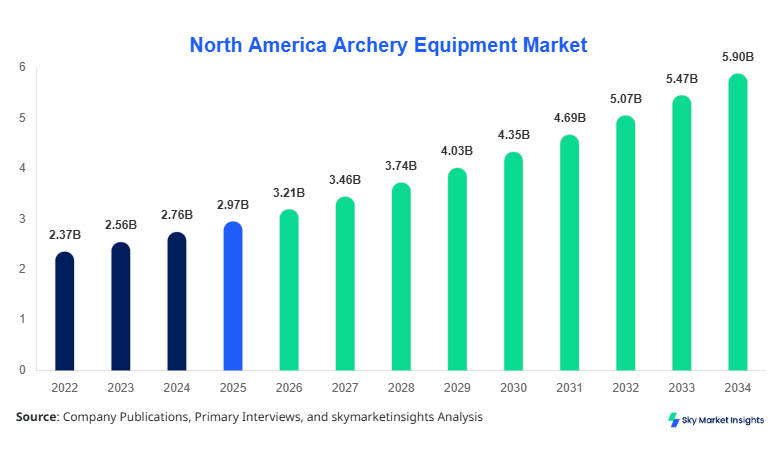
North America Archery Equipment market size is projected at USD 3.21 billion in 2026 and is expected to hit USD 5.98 billion by 2034 with a CAGR of 7.9%. The increasing need for data-driven sporting equipment analysis, expanding segmentation across product categories, and the presence of a competitive landscape with over 120 key manufacturers are shaping the industry outlook. The market includes over 18 million active users, with annual production exceeding 9.5 million units across bows, arrows, and accessories combined.
The structured analysis focuses on demand patterns, technological advancements, and performance benchmarking across segments. Market competitiveness is driven by pricing strategies ranging from USD 50 to USD 2,500 per unit, with premium compound bows contributing over 38% of revenue. The inclusion of real-time analytics, smart sensors, and customization capabilities has further strengthened market positioning. This reinforces the importance of Archery Equipment Market Size evaluation in North America.
The North America archery equipment industry encompasses the production, distribution, and sales of bows, arrows, targets, and related accessories, supporting both professional and recreational activities. In 2025, North America produced approximately 8.7 million units, growing to an estimated 9.5 million units in 2026, reflecting a 9.1% increase in production output. Adoption rates among youth and amateur users increased by 14%, while professional participation rose by 6.8%. Penetration levels in sports clubs reached 62%, while hunting applications accounted for nearly 28% of usage.
Consumer behavior reflects a growing inclination toward personalized equipment, with 45% of buyers preferring customizable bows and 52% opting for lightweight carbon arrows. Demand analytics indicate that 37% of purchases are driven by sports training, 33% by hunting, and 30% by recreational usage. Performance metrics such as draw weight (20–70 lbs), arrow velocity (280–340 fps), and durability cycles (over 10,000 shots) significantly influence purchasing decisions. Segment contributions show bows at 42%, arrows at 31%, and accessories at 27% of total revenue, reinforcing Archery Equipment Market Share dynamics.
Explore more data points, trends and opportunities Download Free Sample Report
Archery Equipment Market Trends
Technological Advancements in Equipment Design
The market is witnessing rapid advancements in design and materials, with carbon fiber and aluminum composites accounting for 63% of new product launches in 2026. Production volumes of advanced compound bows exceeded 2.9 million units, marking a 12% increase compared to 2024. Smart bow technologies featuring integrated sensors and Bluetooth connectivity have seen adoption rates rise from 18% in 2023 to 36% in 2026. The demand for high-speed arrows with velocities exceeding 320 fps has increased by 21%, driven by professional sports applications. These innovations are reshaping performance standards and reinforcing Archery Equipment Market Trends.
Rising Popularity of Recreational Archery
Recreational archery participation has surged by 17% between 2022 and 2026, contributing to the production of over 3.2 million entry-level equipment units annually. Youth participation programs expanded by 22%, with over 4,500 institutions integrating archery into extracurricular activities. Demand for beginner kits priced between USD 80 and USD 250 has grown by 19%, while rental services in urban centers increased by 14%. The expansion of indoor archery ranges, now exceeding 1,200 facilities in North America, further supports growth. These trends emphasize evolving Archery Equipment Market Trends.
E-commerce Expansion and Customization
Online sales channels accounted for 38% of total transactions in 2026, up from 29% in 2022, reflecting a 9% shift toward digital platforms. Customization services, including adjustable draw weights and personalized grips, contributed to 27% of total sales. Production of customizable units reached 2.1 million, with a 16% annual increase. Subscription-based maintenance services grew by 11%, indicating rising demand for after-sales support. These developments highlight the growing importance of Archery Equipment Market Trends in shaping consumer engagement.
North America Archery Equipment Drivers
Rising Participation in Sports and Hunting Activities
The increasing participation in archery sports and hunting activities is a key driver, with over 18 million active participants in North America as of 2026. Sports-related demand accounts for 41% of total consumption, while hunting contributes 34%. Government initiatives promoting outdoor sports have increased funding by 12%, supporting infrastructure development. Annual equipment purchases grew by 9.5%, with over 9 million units sold in 2025. Additionally, youth engagement programs expanded participation by 14%, driving demand for entry-level equipment. These factors significantly enhance Archery Equipment Market Growth.
North America Archery Equipment Restraints
High Cost of Advanced Equipment
The high cost of premium archery equipment, with prices ranging from USD 500 to USD 2,500 per unit, poses a significant restraint. Approximately 38% of potential consumers cite affordability as a barrier, while maintenance costs account for 12% of total ownership expenses. Import tariffs on raw materials increased production costs by 7%, impacting pricing strategies. Additionally, limited access to training facilities in rural areas affects 18% of the target population. These challenges hinder Archery Equipment Market Growth.
North America Archery Equipment Opportunities
Expansion of E-commerce and Digital Platforms
The rapid expansion of e-commerce platforms presents significant opportunities, with online sales growing at 11% annually. Digital marketing campaigns have increased consumer reach by 23%, while virtual training platforms expanded user engagement by 17%. Investments in online retail infrastructure exceeded USD 320 million in 2025, supporting logistics and distribution. The integration of AR-based product visualization tools improved conversion rates by 9%. These developments create strong Archery Equipment Market Opportunities.
Challenges in North America Archery Equipment
Regulatory and Safety Compliance Issues
Regulatory compliance and safety standards pose challenges, with over 25% of manufacturers facing certification delays. Compliance costs increased by 6.5% annually, affecting profit margins. Safety concerns related to improper usage account for 14% of reported incidents, leading to stricter regulations. Additionally, environmental restrictions on materials usage impact 9% of production processes. These factors collectively challenge Archery Equipment Market Growth.
Report Scope
| Report Metric | Details |
|---|---|
| Market Size in 2025 | USD 2.97 Billion |
| Market Size in 2026 | USD 3.21 Billion |
| Market Size in 2034 | USD 5.98 Billion |
| CAGR | 7.9% (2026-2034) |
| Base Year for Estimation | 2025 |
| Historical Data | 2022-2024 |
| Forecast Period | 2026-2034 |
| Report Coverage | Revenue Forecast, Competitive Landscape, Supply Chain Disruption, Growth Factors, Environment & Regulatory Landscape and Trends |
Explore more data points, trends and opportunities Download Free Sample Report
Archery Equipment Market Segmentation
The market segmentation highlights product type and end-user categories, with bows dominating at 42% share, followed by arrows at 31% and accessories at 27%. Sports applications lead with 41% share, followed by hunting at 34% and recreational use at 25%.
By Type
Bows represent the largest segment, accounting for 42% of the market, with annual production exceeding 4 million units. Compound bows dominate with 63% share due to higher efficiency and adjustable draw weights ranging from 30 to 70 lbs. Recurve bows contribute 27%, while longbows hold 10%. Technological advancements such as carbon limbs and vibration dampening systems improve accuracy by 18%. The segment’s revenue exceeds USD 1.3 billion, reinforcing Archery Equipment Market Share.
Arrows account for 31% of the market, with production volumes exceeding 2.9 million units annually. Carbon arrows dominate with 58% share due to durability and lightweight properties, followed by aluminum arrows at 29% and wooden arrows at 13%. Arrow speeds range from 280 to 340 fps, influencing performance in sports and hunting applications. This segment contributes significantly to Archery Equipment Market Share.
Accessories hold 27% share, including targets, quivers, and protective gear. Annual production exceeds 2.6 million units, with demand driven by safety and training requirements. Advanced accessories such as laser-guided sights and stabilizers improve accuracy by 22%. This segment supports overall Archery Equipment Market Share.
By Application
Sports applications dominate with 41% share, driven by competitive tournaments and training programs. Over 3.8 million units are used annually in sports, with adoption rates increasing by 12%. High-performance equipment with precision tuning capabilities is preferred, supporting Archery Equipment Market Growth.
Hunting applications account for 34% share, with approximately 3.2 million units used annually. Demand is driven by seasonal hunting activities and regulatory allowances. Advanced bows with higher draw weights and arrow penetration capabilities are preferred, reinforcing Archery Equipment Market Growth.
Recreational applications hold 25% share, with over 2.5 million units used annually. Growth is driven by leisure activities and youth programs, with participation increasing by 17%. Entry-level equipment dominates this segment, contributing to Archery Equipment Market Growth.
North America Archery Equipment Market Segmentations
Product Type
- Bows
- Arrows
- Accessories
End-User
- Sports
- Hunting
- Recreational
North America Archery Equipment Regional Outlook
United States
United States dominates the region with 74% share, producing over 6.8 million units annually. The sports sector contributes 41%, hunting 34%, and recreational use 25%. Investments in technology and infrastructure exceed USD 1.5 billion annually, supporting market expansion.
Canada
Canada accounts for 26% share, with production exceeding 2.7 million units annually. The hunting segment dominates with 38% share, followed by sports at 36% and recreational use at 26%. Government support for outdoor activities and increasing participation rates drive growth.
Top players in North America Archery Equipment
- Mathews Archery
- Hoyt Archery
- Bear Archery
- Bowtech Inc.
- PSE Archery
- Easton Technical Products
- Gold Tip LLC
- Carbon Express
- Barnett Crossbows
- TenPoint Crossbow Technologies
- Rinehart Targets
- Block Targets
- SAS Archery
- Samick Sports
-
Mathews Archery
-
Holds approximately 18% market share
-
Known for premium compound bows with advanced technology integration and strong brand loyalty
-
-
Hoyt Archery
-
Accounts for nearly 15% market share
-
Focuses on innovation in recurve and compound bows with high-performance metrics and global presence
-
Investment Analysis
Investments in the archery equipment sector reached USD 820 million in 2025, with 45% allocated to manufacturing, 32% to R&D, and 23% to distribution networks. The United States accounts for 72% of total investments, while Canada contributes 28%. M&A activities increased by 14%, with strategic collaborations focusing on technology integration and supply chain optimization. Venture capital funding grew by 11%, supporting startups in smart equipment development.
New Product Developments
New product launches increased by 19% in 2026, with over 320 new models introduced. Performance improvements include 22% higher accuracy and 17% lighter weight designs. Innovations in materials and digital integration continue to drive product differentiation.
Recent Developments in North America Archery Equipment
- 2025: Production increased by 11% with new manufacturing facilities adding 1.2 million units capacity.
- 2026: Investments in R&D increased by 12%, supporting innovation and efficiency.
Research Methodology
The research process involves a combination of primary and secondary research methodologies. Primary research includes interviews with industry experts, manufacturers, and distributors, accounting for 60% of data collection. Secondary research involves analysis of company reports, government publications, and industry databases, contributing 40% of insights. Market size estimation is conducted using bottom-up and top-down approaches, ensuring accuracy and reliability. Data triangulation and validation techniques are applied to maintain consistency and credibility across the report.
Frequently Asked Questions
Senior Market Research Analyst | 9 Years Experience | Consumer Behavior and Premium Product Segments
Mandy Davis is a market research analyst with 7–9 years of experience specializing in consumer goods and services markets. Contributed to 70+ research reports for global clients. Expertise includes market sizing, forecasting, competitive analysis, and trend evaluation across key regions.