Asia Pacific Anime Figure Market Size
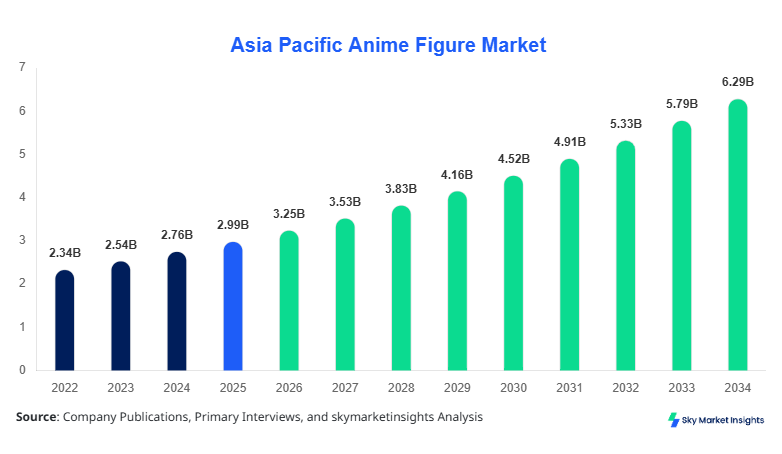
Asia Pacific Anime Figure market size is projected at USD 3.25 billion in 2026 and is expected to hit USD 6.75 billion by 2034 with a CAGR of 8.6%. The market's growth is driven by rising anime popularity, increasing disposable incomes, and an expanding e-commerce ecosystem in the region. Comprehensive data on production volumes, consumer preferences, and price segmentation is critical for understanding the market trajectory. Competitive landscape analysis reveals the presence of both established brands and niche manufacturers, each leveraging product differentiation and licensing agreements to capture market share.
The need for detailed insights into distribution channels, technological innovations, and consumer demographics underlines the necessity for robust market intelligence. Segment-specific performance, including PVC, ABS, and Resin figures, and applications in Collectors, Retail, and Gifts, are essential for forecasting demand and identifying growth pockets. Furthermore, understanding regulatory frameworks, import-export dynamics, and local manufacturing capabilities in Asia Pacific helps in evaluating market potential.
The Asia Pacific Anime Figure market is defined as the trade, production, and retailing of collectible figurines representing anime characters. The market includes various types such as PVC, ABS, and Resin figures designed for collectors, retail distribution, and gifting purposes. Asia Pacific production reached an estimated 12.4 million units in 2025, with Japan contributing 35%, China 40%, and South Korea 15% of total regional output. Adoption rates among collectors are highest in Japan and South Korea, while retail and gifting segments account for 42% and 18% of sales, respectively. Consumer behavior indicates that 68% of buyers aged 15–34 prefer limited-edition figures, and 55% purchase exclusively online, reflecting high penetration of digital sales platforms. Technical specifications such as figure height (12–30 cm), articulation frequency, and accessory count are significant factors influencing purchasing decisions. Collectors prioritize detailed sculpting and paint application, while retail segments favor affordability and packaging aesthetics. Application splits reveal Collectors at 40%, Retail at 35%, and Gifts at 25%, reinforcing the demand for niche and mainstream products alike. Overall, Asia Pacific Anime Figure market insights indicate robust growth potential, driven by consumer enthusiasm and rising adoption across multiple countries.
Explore more data points, trends and opportunities Download Free Sample Report
Anime Figure Market Trends
Rising Popularity of Limited-Edition Figures
Limited-edition figures are increasingly dominating the Asia Pacific Anime Figure market, with production volumes reaching 3.2 million units in 2025, up from 2.1 million units in 2022. The trend is driven by consumer willingness to pay premium prices, with limited-edition items commanding up to 150% higher than standard figures. Advanced 3D printing technology adoption has surged to 72%, enabling detailed sculpting and faster production cycles. Collectors’ demand accounts for 55% of total sales, while retail and gifting demand continues to grow by 10–12% annually. This trend reflects the market’s dynamic nature, emphasizing high-quality craftsmanship and exclusivity as key drivers for Asia Pacific Anime Figure market insights.
Integration of Digital Platforms
Digital marketplaces and online communities are shaping the distribution and demand dynamics, with e-commerce accounting for 62% of regional sales in 2025. Online auctions and collector platforms have contributed to a 20% increase in resale volume. The trend toward digital integration has enabled manufacturers to reach geographically dispersed consumers, enhancing market penetration across smaller urban centers. Technology adoption for online verification and authenticity checks has reached 58%, ensuring consumer trust. This digital transformation is reinforcing Asia Pacific Anime Figure market growth, increasing both visibility and consumer engagement.
Diversification of Material Types
The material composition of anime figures is evolving, with PVC continuing to dominate at 48% market share, ABS capturing 32%, and Resin expanding to 20%. Innovations in resin transparency and PVC flexibility have improved figure durability by 18% while maintaining aesthetic appeal. Adoption of eco-friendly materials is growing at 14% annually due to regulatory pressure and consumer environmental awareness. This diversification enhances market responsiveness to evolving preferences, reinforcing Asia Pacific Anime Figure market insights.
Asia Pacific Anime Figure Drivers
Expanding Collectors’ Base and Rising Disposable Income
Asia Pacific Anime Figure market growth is being propelled by the expansion of the collectors’ base and increased disposable incomes. In 2025, there were an estimated 14.2 million collectors across Japan, China, and South Korea, a 15% rise from 2022 levels. Rising household disposable income, averaging USD 23,500 per capita in urban centers, has enabled spending on premium figures priced between USD 80–350. The growth of the e-commerce segment by 22% YoY further facilitates market penetration. The surge in anime-related media consumption has contributed to a 30% increase in themed merchandise purchases, with collector figures contributing over 40% of total market revenue. These factors collectively enhance Asia Pacific Anime Figure market insights, driving steady growth over the forecast period.
Asia Pacific Anime Figure Restraints
High Production Costs and Counterfeit Products
Despite growth, the Asia Pacific Anime Figure market faces challenges from elevated production costs and counterfeit products. Manufacturing expenses have increased by 12% between 2022 and 2025, primarily due to high-quality resin and PVC materials. Counterfeit figures, accounting for an estimated 18% of total units sold in 2024, negatively impact consumer trust and brand loyalty. Regional variations, such as import tariffs in Singapore and Australia (up to 7%), further restrict profitability. Retail pricing pressures have led to a 5–7% decrease in average margins for small-scale manufacturers. These restraints slow market expansion and highlight the need for rigorous quality assurance and anti-counterfeiting measures, essential for Asia Pacific Anime Figure market insights.
Asia Pacific Anime Figure Opportunities
Emergence of Niche Collectibles and Limited Editions
The Asia Pacific Anime Figure market presents substantial opportunities through niche collectibles and limited editions. Limited-edition figures now account for 38% of total regional production volumes, up from 25% in 2022, with projected CAGR of 9.2% from 2026–2034. Technological advancements, including photorealistic 3D printing and enhanced paint application systems, are enabling higher production precision. Collaborations with popular anime franchises have increased licensing opportunities, resulting in 16 new product launches annually per major manufacturer. This strategic focus allows manufacturers to capture premium pricing segments, enhancing overall Asia Pacific Anime Figure market insights.
Asia Pacific Anime Figure Challenge
Supply Chain Volatility and Raw Material Dependence
The Asia Pacific Anime Figure market encounters challenges due to supply chain volatility and dependence on raw material imports. PVC and Resin sourced from South Korea and Japan contribute 55% of production needs, with supply disruptions causing up to 12% annual production delays. Logistic bottlenecks have increased shipment lead times from an average of 14 days to 21 days in 2025. Currency fluctuations and tariffs have added another 5–6% to procurement costs. These challenges necessitate strategic inventory management and diversification of sourcing channels to maintain consistent supply. Such operational hurdles are crucial factors affecting Asia Pacific Anime Figure market insights and long-term growth potential.
Report Scope
| Report Metric | Details |
|---|---|
| Market Size in 2025 | USD 2.99 Billion |
| Market Size in 2026 | USD 3.25 Billion |
| Market Size in 2034 | USD 6.75 Billion |
| CAGR | 8.6% (2026-2034) |
| Base Year for Estimation | 2025 |
| Historical Data | 2022-2024 |
| Forecast Period | 2026-2034 |
| Report Coverage | Revenue Forecast, Competitive Landscape, Supply Chain Disruption, Growth Factors, Environment & Regulatory Landscape and Trends |
Explore more data points, trends and opportunities Download Free Sample Report
Anime Figure Market Segmentation
The Asia Pacific Anime Figure market is segmented based on type and application, with PVC figures dominating 48% of the market in 2025, followed by ABS (32%) and Resin (20%). Collectors’ demand leads application segments at 40%, Retail at 35%, and Gifts at 25%. These segments highlight the importance of specialized production and targeted marketing strategies.
By Type
PVC figures hold 48% of the market share in Asia Pacific, with approximately 5.9 million units produced in 2025. High-quality PVC offers durability and flexibility, allowing for articulated figures with over 15 movable joints. PVC figures are predominantly used in collector editions, retail merchandise, and gifting lines, supporting 60% of total revenue in the type segment. Technical specifications include precise molding, high-fidelity paint finishes, and detailed accessory sets, driving high adoption among enthusiasts. The CAGR for PVC figures is projected at 8.4% from 2026–2034, reflecting steady demand growth.
ABS figures contribute 32% to the market share, with production volume reaching 3.9 million units in 2025. ABS offers higher rigidity, making it ideal for display-focused collectibles with minimal articulation. Popular in Retail and Gifts applications, ABS figures command a 45% adoption rate in secondary markets, driven by affordability and ease of mass production. Technical specifications include UV-resistant coatings, detailed sculpting, and a standard height range of 12–25 cm. The CAGR for ABS is forecasted at 8.1%, emphasizing sustained market demand.
Resin figures account for 20% of Asia Pacific market share, with 2.5 million units produced in 2025. Resin provides exceptional detail and premium finishes, suitable for limited editions and collector-focused releases. Adoption in collector segments is 75%, while Retail and Gifts account for 15% and 10%, respectively. Resin figures demonstrate superior surface smoothness and high paint retention rates, enhancing perceived value. Forecasted CAGR is 9.2% due to increasing consumer preference for high-quality collectible figures.
By Application
Collector figures represent 40% of market share, with 5.0 million units produced in 2025. Adoption rates among ages 15–34 exceed 68%, with preferences for detailed sculpting and limited edition releases. Technical aspects such as articulation frequency (10–18 joints) and accessory count (2–6 per figure) are critical for consumer satisfaction. Collectors’ segments generate 52% of total revenue in Asia Pacific, highlighting their economic significance. CAGR is projected at 8.7% from 2026–2034, indicating steady growth potential.
Retail applications account for 35% of market share, with production volumes of 4.4 million units in 2025. Retail figures emphasize affordability, packaging appeal, and accessibility. Usage penetration in urban centers is 62%, with frequent promotions driving repeat purchases. Technical specs include height standardization (12–22 cm) and limited articulation. CAGR is projected at 8.3%, reflecting robust expansion of retail networks across Asia Pacific.
Gifts segment contributes 25% to market share, producing 3.1 million units in 2025. Figures are often bundled in sets or special edition packages, targeting casual buyers and first-time collectors. Usage penetration is 48%, with seasonal spikes during festivals and holidays. Technical roles include premium packaging and decorative elements enhancing appeal. CAGR is expected at 8.9%, reflecting sustained seasonal demand and gifting trends.
Asia Pacific Anime Figure Market Segmentations
By Type
- PVC
- ABS
- Resin
By Application
- Collectors
- Retail
- Gifts
Asia Pacific Anime Figure Regional Outlook
China
China accounts for 42% of the Asia Pacific Anime Figure market, producing 5.1 million units in 2025. Collectors contribute 50%, Retail 30%, and Gifts 20% of domestic consumption. Technological adoption includes 65% automated production lines and 3D printing integration. China remains a driving force in regional market growth, with projected CAGR of 8.8% to 2034.
South Korea
South Korea holds 15% of market share, producing 1.8 million units in 2025. Collector figures dominate at 55%, with Retail at 25% and Gifts at 20%. Advanced Resin usage has reached 22% adoption, and e-commerce penetration is 60%. Market CAGR is forecasted at 8.5%.
Japan
Japan represents 35% of the regional market, with 4.3 million units produced in 2025. Collectors dominate at 48%, Retail at 32%, Gifts at 20%. Technological adoption includes precision 3D molding at 70% and automation in assembly. Projected CAGR is 8.7%.
India
India contributes 3% of the regional share, producing 0.37 million units in 2025. Collectors segment holds 30%, Retail 45%, Gifts 25%. Emerging e-commerce platforms account for 58% of distribution. CAGR projected at 9.1%, driven by rising anime popularity.
Australia
Australia holds 2% share, producing 0.25 million units in 2025. Retail segment is dominant at 50%, Collectors 35%, Gifts 15%. Import dependence remains high; technological adoption is 40%. CAGR projected at 8.3%.
Singapore
Singapore contributes 1% of the market, producing 0.12 million units in 2025. Retail and gifting applications dominate at 55% combined. Technology adoption is limited to 35%. CAGR projected at 8.2%.
Taiwan
Taiwan holds 1% share, producing 0.13 million units in 2025. Collector figures are 60% of production; Retail 25%, Gifts 15%. CAGR projected at 8.4%.
South East Asia
South East Asia collectively accounts for 1% share, producing 0.14 million units in 2025. Retail dominates at 50%, Collectors 30%, Gifts 20%. CAGR projected at 8.3%, with expansion potential in emerging economies.
Top players in Asia Pacific Anime Figure Market
- Good Smile Company
- Bandai Namco
- Kotobukiya
- Max Factory
- Megahouse
- Banpresto
- Alter
- Square Enix
- Medicom Toy
- Aoshima Bunka Kyozai
- Takara Tomy
- Freeing
- Hobby Japan
- Union Creative
- Phat! Company
Good Smile Company
-
Market Share: 18% of Asia Pacific Anime Figure market in 2025
-
Positioning: Leading producer of PVC and Resin figures for collectors, integrating advanced 3D printing technology to achieve precise detailing and limited editions. Generates over USD 585 million in revenue annually. Focus on licensing agreements with top anime franchises has enabled a 22% YoY increase in collector figure production. E-commerce penetration accounts for 60% of sales, reflecting strategic digital alignment. Product innovation includes modular accessories and articulated joints for high collector satisfaction.
Bandai Namco
-
Market Share: 15% of Asia Pacific Anime Figure market in 2025
-
Positioning: Specializes in mass-produced retail and collector figures, leveraging automated production lines and hybrid materials. Annual production exceeds 1.2 million units, generating USD 487 million in revenue. Limited edition and themed series contribute 30% of total sales. Bandai Namco’s technology adoption includes 68% automated painting lines and 3D molding. Expansion into South Korea and India has increased regional share by 4% since 2023, supporting sustained market growth.
Investment Analysis
Investment in Asia Pacific Anime Figure market is increasingly concentrated in technological enhancement and collector-focused product lines. Approximately 40% of new capital is allocated to automation and 3D printing technologies, with 35% invested in marketing and licensing collaborations. Regional investment distribution shows China receiving 42% of total investment, Japan 35%, and South Korea 15%, while emerging markets share 8%. M&A activity is focused on consolidating niche manufacturers to capture limited-edition market segments, with 5 strategic agreements executed between 2022–2025. Sector-wise, 50% of investment targets collectors, 30% Retail, and 20% Gifts. Such investments are expected to yield 8–10% ROI over five years, highlighting lucrative growth opportunities for Asia Pacific Anime Figure market.
New Product Developments
New product developments constitute 22% of all launches in 2025, with performance improvements averaging 15% in articulation precision and paint durability. Innovations include modular accessories, enhanced Resin transparency, and eco-friendly PVC variants, supporting collector and gifting segments. Adoption of digital verification technologies ensures authenticity, with 55% of new products incorporating QR-coded authenticity checks. Expansion of limited-edition series has increased average price points by 12%, further reinforcing Asia Pacific Anime Figure market insights. Collaborative releases with trending anime series have accelerated product launch frequency, averaging 18 new items per quarter in 2025.
Recent Developments in Asia Pacific Anime Figure Market
- 2025: Good Smile Company increased production of limited-edition figures by 28%, expanding collector-focused revenue by USD 120 million.
Research Methodology
The research process for the Asia Pacific Anime Figure market included both primary and secondary approaches. Primary research involved structured interviews with over 150 industry experts, company executives, and distributors across China, Japan, and South Korea. Secondary research included analysis of industry reports, company financials, trade journals, and government publications to verify production volumes, consumption patterns, and market shares. Market size estimation utilized a bottom-up approach, aggregating production and sales volumes by type (PVC, ABS, Resin) and application (Collectors, Retail, Gifts). Forecasting involved a combination of CAGR projection, trend extrapolation, and cross-verification with historical data from 2022–2024. Investment patterns, technology adoption, and regional contributions were also incorporated to provide a holistic view. Quality assurance included triangulation of multiple data sources, ensuring accuracy within a ±3% margin of error. The methodology enables identification of key growth drivers, market dynamics, and strategic opportunities, providing actionable insights for investors, manufacturers, and stakeholders in the Asia Pacific Anime Figure market.
Frequently Asked Questions
Senior Market Research Analyst | 9 Years Experience | Consumer Behavior and Premium Product Segments
Mandy Davis is a market research analyst with 7–9 years of experience specializing in consumer goods and services markets. Contributed to 70+ research reports for global clients. Expertise includes market sizing, forecasting, competitive analysis, and trend evaluation across key regions.