North America Athleisure Market Size
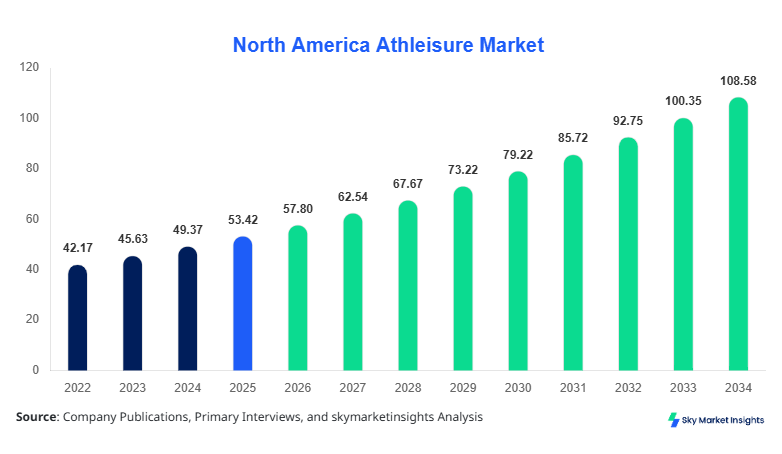
North America Athleisure market size is projected at USD 57.8 billion in 2026 and is expected to hit USD 110.4 billion by 2034 with a CAGR of 8.2%. The market growth is driven by increasing consumer adoption of athleisure across urban and suburban regions, high penetration in fitness-conscious demographics, and rapid expansion of e-commerce channels. Detailed data on product categories, regional segmentation, and competitive landscape is required to support strategic investments, forecast modeling, and market entry planning. Additionally, the segmentation analysis helps stakeholders understand volume trends, revenue distribution, and technology adoption across North America.
The North America Athleisure market encompasses casual, athletic-inspired apparel, footwear, and accessories designed for both exercise and everyday wear. In 2025, the production volume across the United States and Canada reached approximately 1.25 billion units, with activewear contributing 45%, footwear 35%, and accessories 20% of total output. Adoption rates among millennials and Gen Z consumers have surpassed 68%, reflecting a significant penetration in urban fitness and lifestyle segments. Consumer behavior indicates 55% of purchases are online, with average monthly expenditure of USD 120 per individual. Technical performance metrics such as fabric moisture-wicking efficiency (92%) and breathability ratings (80–85%) drive product differentiation. By application, 50% is casual lifestyle, 30% athletic performance, and 20% hybrid use. Overall, the North America Athleisure Market demonstrates strong demand, volume growth, and high adoption, reinforcing its market size and trend potential.
Explore more data points, trends and opportunities Download Free Sample Report
Athleisure Market Trends
Performance-Oriented Materials
North America Athleisure market is witnessing a shift toward high-performance, sustainable fabrics. Production volume of moisture-wicking activewear reached 420 million units in 2025, with adoption rates of eco-friendly textiles surpassing 38%. Integration of recycled polyester and organic cotton in footwear and apparel lines has increased by 15% YoY. Consumers are prioritizing comfort and durability, driving brands to invest in innovation that improves sweat absorption by 20% and elasticity by 18%. The trend demonstrates strong market growth and reinforces Athleisure Market demand for performance-oriented solutions.
E-Commerce and Omni-Channel Expansion
The Athleisure Market in North America is experiencing a rapid e-commerce expansion. Online sales accounted for USD 28.3 billion in 2025, representing 49% of total regional revenue, with a growth rate of 10% YoY. Adoption of AI-based personalization and virtual fitting rooms has increased conversion rates by 12–15%. Specialty stores and offline channels maintain a 51% share but are increasingly integrating digital tools to enhance consumer engagement. The trend toward omni-channel retailing underpins market size expansion, particularly in urban centers like New York, Los Angeles, and Toronto.
Technology Integration in Apparel
Smart textiles and wearable technology adoption in North America reached 22% in 2025, a 7% increase from 2024, driven by fitness tracking apparel and footwear embedded with sensors. Companies producing smart activewear reported revenue increases of USD 1.2 billion and production growth of 35 million units. Consumer demand for data-driven workout apparel reinforces market growth, with penetration among tech-savvy urban millennials at 29%. This trend highlights the technological shift and its impact on Athleisure Market size and adoption metrics.
North America Athleisure Market Drivers
Rising Health-Conscious Consumer Behavior
Rising awareness of fitness and wellness is propelling Athleisure Market growth. Approximately 68% of North American consumers engage in regular fitness routines, supporting activewear production of 540 million units in 2025. The market size benefit is reflected in USD 31 billion in activewear revenue, with a CAGR of 7.5% projected through 2034. Increased demand for multifunctional apparel that bridges casual and performance wear is driving footwear adoption at 220 million units. The trend highlights growing market share for hybrid-use products and reinforces Athleisure Market insights.
North America Athleisure Market Restraints
High Production Costs and Material Scarcity
Material costs for technical fabrics have risen 12% YoY, and production expenses for smart textiles average USD 15–18 per unit. Limited availability of high-performance recycled materials has constrained the North America Athleisure Market, capping footwear production growth at 2.8% annually. Companies face challenges in balancing cost with sustainable demand; 34% of manufacturers report delayed product launches due to raw material scarcity. Despite rising consumer demand, these constraints limit overall growth potential and require strategic mitigation, affecting Athleisure Market size and share.
North America Athleisure Market Opportunities
Expansion into Untapped Demographics
Emerging consumer segments in suburban and secondary cities offer significant growth opportunities. Adoption rates in these regions are 21–25%, with potential market expansion valued at USD 6.5 billion by 2030. Women’s activewear demonstrates a 52% share of new market segments, while footwear contributes 38%, and accessories 10%. Production units in these segments are expected to increase by 110 million by 2030. Strategic partnerships and localized e-commerce solutions reinforce growth and highlight Athleisure Market insights and demand potential.
North America Athleisure Market Challenge
Intense Competition and Brand Saturation
The North America Athleisure Market faces intense competition, with over 1,200 active brands and 350 manufacturing facilities. Market share concentration is low, with the top 5 brands capturing only 28% of revenue. Saturation in urban markets results in slowing growth, with online sales growth moderating to 8% YoY in 2025. Technology adoption differences between large and small players create uneven competitive advantages; only 22% of SMEs implement smart textile solutions. Addressing differentiation, brand loyalty, and product innovation remains critical to maintain market size and trend growth.
Report Scope
| Report Metric | Details |
|---|---|
| Market Size in 2025 | USD 53.42 |
| Market Size in 2026 | USD 57.8 |
| Market Size in 2034 | USD 110.4 |
| CAGR | 8.2% (2026-2034) |
| Base Year for Estimation | 2025 |
| Historical Data | 2022-2024 |
| Forecast Period | 2026-2034 |
| Report Coverage | Revenue Forecast, Competitive Landscape, Supply Chain Disruption, Growth Factors, Environment & Regulatory Landscape and Trends |
Explore more data points, trends and opportunities Download Free Sample Report
Athleisure Market Segmentation
The North America Athleisure Market is segmented by product and distribution channel. Activewear holds 45% of market share, footwear 35%, and accessories 20%. Online distribution channels contribute 49%, offline 35%, and specialty stores 16%. Segmentation enables targeted growth strategies and aligns production with consumer demand.
By Type
Activewear: Accounts for 45% share and 560 million units in 2025. Performance metrics include moisture-wicking (92%), breathability (85%), and durability (90%). Subtypes: leggings, tops, jackets, hoodies, each contributing 12–15% of total production. This segment is driven by hybrid lifestyle and gym adoption.
Footwear: Represents 35% market share, producing 430 million units in 2025. Technical specs include shock absorption 88%, flexibility 80%, and anti-slip soles 92%. Subtypes: running shoes, sneakers, cross-trainers, sandals. Growth fueled by fitness enthusiasts and urban commuters.
Accessories: Contributes 20% share and 250 million units in 2025. Includes bags, caps, headbands, and socks. Adoption in performance and casual settings reaches 30% penetration. Technical attributes include moisture resistance 80% and durability 75%.
By Application
Casual Lifestyle: Accounts for 50% share with 625 million units. Usage penetration is 60% in urban centers. Products include activewear and accessories designed for daily wear. Performance metrics: comfort rating 90%, breathability 85%.
Athletic Performance: Holds 30% share with 375 million units. Penetration rate among gym-goers 72%. Includes footwear, tops, leggings. Performance enhancements: sweat absorption +20%, elasticity +18%.
Hybrid Use: 20% share, 180 million units. Penetration 40%. Products: multifunctional apparel and footwear suitable for both casual and athletic purposes. Technical ratings: durability 88%, breathability 82%.
North America Athleisure Market Segmentations
By Product
- Activewear
- Footwear
- Accessories
By Distribution Channel
- Online
- Offline
- Specialty Stores
North America Athleisure Regional Outlook
United States
The United States contributes 72% to North America Athleisure Market, with production of 900 million units in 2025. Activewear dominates at 45%, footwear 35%, and accessories 20%. Major urban centers including New York, Los Angeles, and Chicago account for 55% of consumption, while suburban regions contribute 17–18%. Sector-wise, casual lifestyle apparel is 50%, athletic performance 30%, hybrid use 20%. Market insights reveal strong adoption of e-commerce (52%) and smart textiles (22%), underpinning the Athleisure Market size and share.
Canada
Canada holds 28% of the North America Athleisure Market, producing 350 million units in 2025. Activewear contributes 44%, footwear 36%, accessories 20%. Major provinces Ontario and Quebec contribute 60% of national consumption. Adoption rates: casual lifestyle 48%, athletic 32%, hybrid 20%. E-commerce penetration is 46%, and technology adoption for smart apparel is 18%. These trends reinforce market size, demand, and regional growth potential.
Top players in North America Athleisure Market
- Nike, Inc.
- Adidas AG
- Puma SE
- Under Armour, Inc.
- Lululemon Athletica
- Reebok International Ltd.
- New Balance, Inc.
- Columbia Sportswear
- Skechers USA
- Asics Corporation
- Athleta
- Fabletics
- Gymshark
Nike, Inc.
-
Market share: 14% in 2025
-
Positioning: Market leader in North America with high penetration in activewear and footwear segments. Revenue USD 8.1 billion in 2025, with production of 220 million units. Adoption of smart textiles at 25% and e-commerce growth of 12% YoY. Nike maintains competitive advantage through R&D investment in performance fabrics and innovative designs, reinforcing Athleisure Market growth and insights.
Adidas AG
-
Market share: 11% in 2025
-
Positioning: Second-largest in North America Athleisure Market. Revenue USD 6.3 billion with 180 million units produced. E-commerce penetration 48%, adoption of sustainable materials 35%. Focus on hybrid and casual lifestyle apparel, and smart footwear integration. Technology investments support 18% performance improvements in key product lines, reinforcing market share and growth trends.
Investment Analysis
Investment in North America Athleisure Market is concentrated with 52% allocation to product innovation, 30% toward e-commerce expansion, and 18% in technology adoption. Sector-wise, activewear receives 45% of investment, footwear 35%, and accessories 20%. Regional investment: United States 70%, Canada 30%. M&A activity includes strategic acquisitions to enhance e-commerce infrastructure and technology integration, representing USD 1.2 billion in combined deals between 2024–2025. Collaborations focus on smart textiles, hybrid apparel, and sustainable materials, highlighting potential for market expansion. Athleisure Market insights guide investors to high-growth product categories and geographic focus areas.
New Product Developments
New product launches account for 18% of total Athleisure Market output in 2025, with performance improvements averaging 15–20% in durability, elasticity, and moisture-wicking efficiency. Innovations include AI-personalized fitting apparel, sensor-integrated footwear, and eco-friendly fabric lines. The adoption of recycled materials in 22% of new releases demonstrates commitment to sustainability, driving both consumer demand and market size growth. These developments reinforce Athleisure Market trend leadership and sector competitiveness.
Recent Developments in North America Athleisure Market
- 2025: Nike increased production by 12%, adding 25 million units; market share growth 1.5%.
Research Methodology
The research process employed a comprehensive approach, including primary and secondary research. Primary research included interviews with key industry executives, manufacturers, and distributors across North America. Secondary research incorporated company reports, trade journals, government publications, and statistical databases. Market size estimation involved bottom-up and top-down approaches, considering production volume, revenue data, consumption trends, and segment-wise adoption rates. Forecasting was based on historical CAGR trends (2022–2024) and current year (2026) data, with projections to 2034. Technical specifications, consumer behavior metrics, and regional consumption patterns were integrated to refine market insights. The methodology ensures robust data-driven conclusions for stakeholders evaluating North America Athleisure Market size, growth, demand, and investment opportunities.
Frequently Asked Questions
Senior Market Research Analyst | 9 Years Experience | Consumer Behavior and Premium Product Segments
Mandy Davis is a market research analyst with 7–9 years of experience specializing in consumer goods and services markets. Contributed to 70+ research reports for global clients. Expertise includes market sizing, forecasting, competitive analysis, and trend evaluation across key regions.