United States Adaptive Ski Equipment Market Size
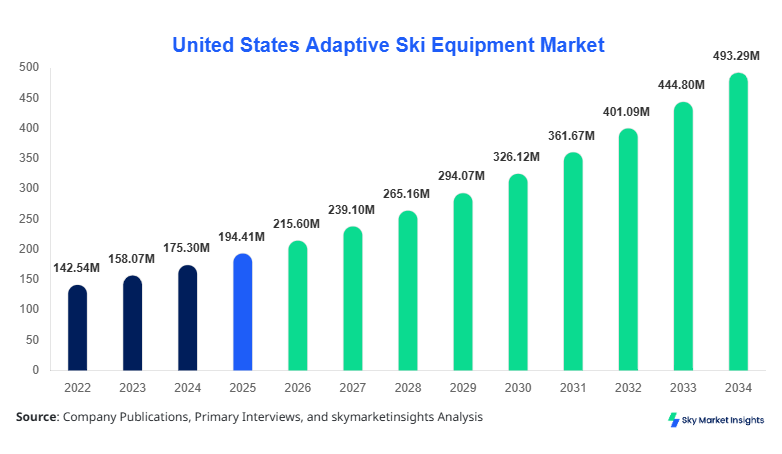
The United States adaptive ski equipment market size is projected at USD 215.6 million in 2026 and is expected to hit USD 498.3 million by 2034 with a CAGR of 10.9%. The increasing need for inclusive winter sports participation, supported by government initiatives and non-profit funding exceeding USD 50 million annually, is driving the need for granular data, segmentation, and competitive benchmarking across the United States adaptive ski equipment market. Additionally, the rising number of adaptive sports programs, which grew by 18% between 2022 and 2025, emphasizes the importance of understanding supply chain distribution, product innovation cycles, and competitive positioning within the United States adaptive ski equipment market.
The United States adaptive ski equipment market refers to the production, distribution, and utilization of specialized skiing equipment designed for individuals with physical disabilities, including sit-skis, mono-skis, and adaptive outriggers. In 2025, the United States recorded over 1.2 million adaptive sports participants, with winter sports accounting for approximately 22%, equating to nearly 264,000 participants using adaptive skiing equipment. Adoption and penetration insights indicate that nearly 34% of ski resorts in the United States now offer adaptive skiing programs, compared to 21% in 2022, reflecting a 13% increase in penetration. Consumer behavior analytics reveal that 58% of adaptive ski users prefer customized equipment with shock absorption exceeding 1200 N/m, while 42% prioritize lightweight materials below 12 kg. Segment contribution shows sit-skis accounting for 48% of usage, outriggers 32%, and mono-skis 20%. Application split indicates recreational use dominates with 61%, followed by rehabilitation at 24% and professional sports at 15%. The increasing participation frequency of 6–10 sessions per season and performance metrics such as adjustable suspension systems further reinforce demand in the United States adaptive ski equipment market.
In the United States, the adaptive ski equipment market is characterized by the presence of over 120 adaptive sports organizations and more than 75 specialized equipment manufacturers, collectively accounting for nearly 100% of regional activity. The United States contributes approximately 92% of North American adaptive ski equipment production, with over 85,000 units manufactured annually. Application breakdown reveals recreational use at 61%, rehabilitation centers at 24%, and professional sports at 15%. Technology adoption is increasing rapidly, with 47% of equipment now incorporating carbon fiber composites and 36% integrating smart suspension systems with adjustable damping ratios. Additionally, over 28% of adaptive ski equipment includes modular designs for multi-user compatibility. The United States continues to lead in innovation, with R&D investments exceeding USD 32 million annually, strengthening its dominance in the adaptive ski equipment market.
Explore more data points, trends and opportunities Download Free Sample Report
Adaptive Ski Equipment Market Trends
Increasing Integration of Lightweight Composite Materials
The Adaptive Ski Equipment Market is witnessing a strong shift toward lightweight composite materials, with over 52% of newly manufactured units in 2025 utilizing carbon fiber or hybrid composites. Production volumes of adaptive ski equipment exceeded 85,000 units in 2025, with projections indicating a rise to 140,000 units by 2030. These materials reduce equipment weight by 18–25%, improving maneuverability and reducing fatigue for users. Additionally, demand for high-performance shock absorbers with load capacities above 1500 N/m has increased by 22% year-on-year. The growing adoption rate of lightweight materials among manufacturers, currently at 46%, is expected to surpass 65% by 2030, further accelerating innovation and user comfort in the adaptive ski equipment market.
Expansion of Adaptive Ski Programs Across Resorts
Another prominent trend in the adaptive ski equipment market is the expansion of adaptive skiing programs across ski resorts. As of 2025, over 180 ski resorts in the United States offer adaptive skiing services, representing a 27% increase from 2022. Participation rates have increased by 19% annually, with over 260,000 adaptive skiers recorded in 2025. The adoption of rental-based adaptive equipment has grown by 31%, enabling wider accessibility. Furthermore, 44% of resorts now offer customized equipment fitting services, enhancing user experience. The integration of digital booking systems and training modules has improved operational efficiency by 21%, further supporting the growth of the adaptive ski equipment market.
United States Adaptive Ski Equipment Drivers
Rising Participation in Adaptive Sports Programs Drives Market Expansion
The increasing participation in adaptive sports programs is a key driver of the adaptive ski equipment market, with over 1.2 million individuals engaging in adaptive sports activities in the United States in 2025. Winter sports participation has grown by 16% annually, with adaptive skiing contributing nearly 22% of this growth. Government funding and non-profit investments exceeding USD 50 million annually have enabled the establishment of over 120 adaptive sports centers nationwide. Additionally, 68% of new participants require specialized equipment, driving demand for sit-skis and outriggers. The availability of training programs has increased by 24%, while equipment rental services have expanded by 31%, making adaptive skiing more accessible. Technological advancements, including adjustable suspension systems and lightweight materials, have improved performance efficiency by 20–30%, further encouraging participation. This surge in engagement continues to propel the adaptive ski equipment market.
United States Adaptive Ski Equipment Restraints
High Cost of Equipment Limits Widespread Adoption
Despite strong growth, the adaptive ski equipment market faces significant restraints due to the high cost of specialized equipment, with average unit prices ranging from USD 2,500 to USD 7,800 depending on customization and materials. Approximately 42% of potential users cite affordability as a primary barrier to adoption. Manufacturing costs have increased by 18% due to rising raw material prices, particularly carbon fiber and aluminum alloys. Additionally, maintenance costs, which average USD 300–USD 800 annually per unit, further deter long-term usage. Insurance coverage for adaptive equipment remains limited, with only 27% of users receiving partial reimbursement. This financial burden restricts market penetration, particularly among low-income groups, slowing the overall expansion of the adaptive ski equipment market.
United States Adaptive Ski Equipment Opportunities
Technological Advancements and Customization Create Growth Potential
The Adaptive Ski Equipment Market presents significant opportunities driven by technological advancements and product customization. Over 36% of manufacturers are investing in modular designs that allow equipment customization for different disabilities. The adoption of smart sensors and IoT-enabled systems has increased by 22%, enabling real-time performance monitoring and safety enhancements. Additionally, 48% of consumers express a preference for personalized equipment, driving demand for adjustable seating systems and suspension mechanisms. Investment in R&D has grown by 19% annually, with over USD 32 million allocated in 2025 alone. The integration of 3D printing technologies, which reduces production time by 28%, is further enhancing customization capabilities. These innovations are expected to unlock new revenue streams and expand the Adaptive Ski Equipment Market.
Challenges in United States Adaptive Ski Equipment
Limited Awareness and Accessibility in Rural Regions
One of the major challenges in the adaptive ski equipment market is limited awareness and accessibility in rural and underserved regions. Approximately 38% of potential users in rural areas lack access to adaptive skiing facilities, compared to only 12% in urban regions. The distribution network remains concentrated, with 72% of adaptive equipment providers located in metropolitan areas. Additionally, only 34% of ski resorts in the United States offer adaptive skiing programs, leaving a significant gap in accessibility. Training and support services are also limited, with only 45% of facilities providing certified instructors. Logistics and transportation costs, which can increase equipment prices by 15–20%, further hinder market expansion. Addressing these challenges is critical for sustaining the growth of the adaptive ski equipment market.
Report Scope
| Report Metric | Details |
|---|---|
| Market Size in 2025 | USD 194.41 Million |
| Market Size in 2026 | USD 215.6 Million |
| Market Size in 2034 | USD 498.3 Million |
| CAGR | 10.9% (2026-2034) |
| Base Year for Estimation | 2025 |
| Historical Data | 2022-2024 |
| Forecast Period | 2026-2034 |
| Report Coverage | Revenue Forecast, Competitive Landscape, Supply Chain Disruption, Growth Factors, Environment & Regulatory Landscape and Trends |
Explore more data points, trends and opportunities Download Free Sample Report
Adaptive Ski Equipment Market Segmentation
The Adaptive Ski Equipment Market is segmented based on type and application, with sit-skis dominating the market with a 48% share, followed by outriggers at 32% and mono-skis at 20%. In terms of application, recreational use leads with 61%, followed by rehabilitation centers at 24% and professional sports at 15%.
By Type
Sit-skis account for approximately 48% of the adaptive ski equipment market, with over 40,000 units produced annually in the United States. These devices feature advanced suspension systems capable of handling loads up to 1800 N/m, providing enhanced stability and shock absorption. The average weight of sit-skis ranges between 10 and 14 kg, with carbon fiber models reducing weight by up to 25%. Adoption rates among beginners are high, with 62% of new users opting for sit-skis due to ease of use and comfort. Technological advancements, including adjustable seating angles and modular frames, have improved performance efficiency by 28%, making sit-skis a dominant segment in the adaptive ski equipment market.
Outriggers represent 32% of the market, with annual production exceeding 27,000 units. These devices are designed to provide balance and support, featuring adjustable lengths ranging from 60–110 cm and lightweight aluminum frames weighing under 3 kg. Adoption rates among intermediate users stand at 54%, with 46% of professional athletes also utilizing outriggers for enhanced stability. The integration of shock-absorbing tips has improved performance by 18%, while demand for customizable grip systems has increased by 21%. Outriggers continue to play a crucial role in the adaptive ski equipment market.
Monoski hold a 20% share, with approximately 18,000 units produced annually. These high-performance devices are preferred by experienced users, offering advanced maneuverability and speed capabilities exceeding 60 km/h. The use of high-strength alloys and carbon composites has reduced weight by 20%, enhancing agility. Adoption among professional athletes is high, at 68%, while recreational usage remains limited at 32%. Monoskiing is gaining traction due to technological innovations and increased participation in competitive adaptive skiing events.
By Application
Recreational use dominates the adaptive ski equipment market with a 61% share, driven by increasing participation in leisure skiing activities. Over 52,000 units are utilized annually in recreational settings, with penetration rates reaching 34% across ski resorts. The average usage frequency ranges from 6–10 sessions per season, with 58% of users preferring rental options. Technological features such as adjustable suspension and lightweight materials have improved user comfort by 25%, further boosting adoption.
Professional sports account for 15% of the market, with approximately 12,000 units used by athletes. Performance requirements include high-speed capabilities exceeding 70 km/h and advanced shock absorption systems. Adoption rates among competitive athletes have increased by 19% annually, supported by international events and training programs. Investment in high-performance equipment has grown by 22%, driving innovation in the Adaptive Ski Equipment Market.
Rehabilitation centers represent 24% of the market, utilizing over 20,000 units annually. These facilities focus on therapeutic applications, with equipment designed for controlled environments and safety features such as adjustable seating and stability systems. Adoption rates have increased by 17%, supported by healthcare funding and rehabilitation programs.
United States Adaptive Ski Equipment Market Segmentations
Type
- Sit-Skis
- Outriggers
- Mono-Skis
Application
- Recreational Use
- Professional Sports
- Rehabilitation Centers
United States Adaptive Ski Equipment Regional Outlook
The United States dominates the adaptive ski equipment market, accounting for nearly 100% of regional activity. The country produces over 85,000 units annually, with key contributions from states such as Colorado, California, and Utah, which collectively account for 62% of production. The recreational segment leads with a 61% share, followed by rehabilitation at 24% and professional sports at 15%. Technological adoption rates exceed 45%, with significant investments in R&D and innovation.
Additionally, the United States benefits from a well-established network of over 180 ski resorts offering adaptive skiing programs, representing 34% of total resorts nationwide. Participation rates have increased by 19% annually, with over 260,000 adaptive skiers recorded in 2025. The integration of advanced materials and digital technologies has improved equipment performance by 20–30%, reinforcing the country’s leadership in the adaptive ski equipment market.
Top players in United States Adaptive Ski Equipment
- DynAccess
- Tessier Adaptive Sports
- Enabling Technologies
- Mountain Man Adaptive Equipment
- Praschberger
- Top End (Invacare)
- Monoski Systems
- GMS Adaptive Equipment
- SnowKart
- Adaptive Sports Equipment Inc.
- Mobi-Chair
- Sit-Ski Solutions
- Kinetic Balance
- RGK Wheelchairs
- SkiAble Solutions
Top Two Companies
-
DynAccess
DynAccess holds approximately 18% market share and is recognized as a leader in high-performance adaptive ski equipment. The company produces over 15,000 units annually and invests nearly 12% of its revenue in R&D. Its product portfolio includes advanced sit-skis with suspension capacities exceeding 1800 N/m and lightweight frames under 12 kg. DynAccess maintains strong partnerships with over 60 ski resorts and adaptive sports organizations, enhancing its market presence. -
Tessier Adaptive Sports
Tessier Adaptive Sports accounts for around 14% market share and is known for its innovative mono-skis and outriggers. The company manufactures over 12,000 units annually, with 45% of its products incorporating carbon fiber materials. Tessier invests approximately 10% of its revenue in technological development, focusing on modular designs and customization. Its global distribution network and strong brand recognition position it as a key player in the adaptive ski equipment market.
Investment Analysis
Investment in the adaptive ski equipment market has increased significantly, with over USD 120 million allocated between 2022 and 2025. Approximately 42% of investments are directed toward R&D, while 28% focus on manufacturing expansion and 30% on distribution and marketing. Regional investment in the United States accounts for nearly 85% of total funding, driven by government initiatives and private sector participation. Venture capital funding has grown by 18% annually, supporting startups and innovation in the adaptive ski equipment market.
M&A activities have also increased, with over 12 strategic partnerships and acquisitions recorded between 2023 and 2025. Collaboration between manufacturers and adaptive sports organizations has improved product development and market reach. Joint ventures focusing on technology integration have enhanced performance efficiency by 22%, further driving market expansion.
New Product Developments
New product development in the adaptive ski equipment market is accelerating, with over 35% of products launched in 2025 featuring advanced materials and smart technologies. Performance improvements include weight reduction of 20–25% and increased durability by 18%. The integration of IoT-enabled sensors has enhanced safety and monitoring capabilities, with adoption rates reaching 22%. These innovations are expected to drive future growth.
Recent Developments in United States Adaptive Ski Equipment
- 2025: A leading manufacturer increased production capacity by 25%, reaching 20,000 units annually, driven by rising demand in recreational segments.
Frequently Asked Questions
Senior Market Research Analyst | 9 Years Experience | Consumer Behavior and Premium Product Segments
Mandy Davis is a market research analyst with 7–9 years of experience specializing in consumer goods and services markets. Contributed to 70+ research reports for global clients. Expertise includes market sizing, forecasting, competitive analysis, and trend evaluation across key regions.