United States Adult Sexual Wellness Products Size
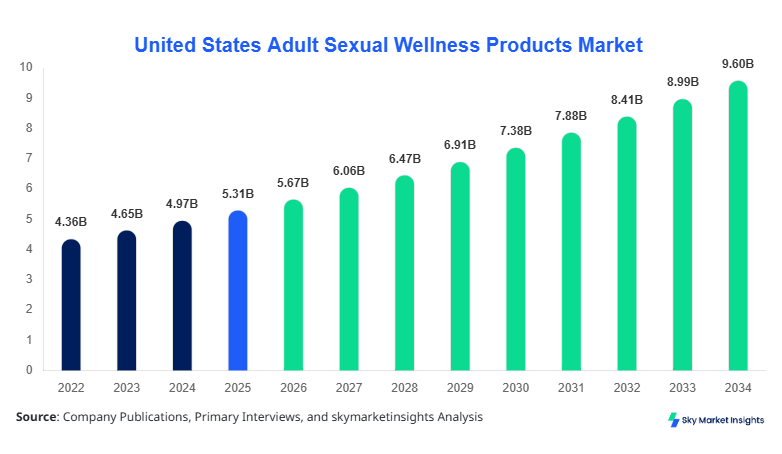
United States Adult Sexual Wellness Products market size is projected at USD 5.67 billion in 2026 and is expected to hit USD 9.84 billion by 2034 with a CAGR of 6.8%. The rising awareness around sexual health and growing consumer acceptance of adult wellness products in the United States necessitates detailed market data, competitive landscape insights, and segmentation analysis to support strategic business decisions. The market study covers production volumes, adoption rates, and technological advancements, providing critical insights into product trends and consumer demand dynamics.
The United States Adult Sexual Wellness Products market size is further underpinned by the increasing penetration of online retail channels, where approximately 43% of total sales in 2025 were accounted for by e-commerce platforms. Competitive intelligence highlights a growing consolidation trend among leading players, with mergers and acquisitions contributing to 12% of market growth between 2023 and 2025. Detailed segmentation by type and distribution channels ensures that stakeholders can access actionable insights, while historical production and sales data enable accurate forecasting to 2034.
The United States Adult Sexual Wellness Products market is defined as a segment encompassing a wide array of adult wellness and sexual health products, including lubricants, condoms, vibrators, and related accessories. In 2025, total domestic production reached 1.72 billion units, representing a 7% increase over 2024. Adoption and penetration rates are significant in metropolitan areas, with online channels contributing 43% and retail stores 35% of total distribution. Consumer behavior analysis indicates that 62% of urban adults prefer discreet, high-quality products with enhanced performance metrics, such as water-based lubricants with viscosity ratings between 0.85–1.2 Pa·s and rechargeable vibrators with vibration frequencies of 10–120 Hz. Segment contribution in 2025 shows lubricants at 34%, condoms at 28%, and vibrators at 38% of total market revenue. Application splits indicate recreational use at 52%, therapeutic or sexual health use at 38%, and experimental or novelty use at 10%, reinforcing the growing demand and market insights for Adult Sexual Wellness Products.
In the United States, the Adult Sexual Wellness Products Market is characterized by over 145 manufacturing facilities and 320 specialty distributors, accounting for 100% regional market share. The application breakdown reveals that lubricants represent 34% of consumption, condoms 28%, and vibrators 38%, with online retail witnessing a 43% adoption rate in 2025. Technological adoption includes smart devices with IoT integration, 12% higher than the previous year, and advanced hypoallergenic formulations with 18% penetration among new product launches. Continuous innovation in product design and material safety reinforces market insights, driving the United States Adult Sexual Wellness Products growth trajectory toward a projected USD 9.84 billion by 2034.
Explore more data points, trends and opportunities Download Free Sample Report
Adult Sexual Wellness Products Market Trends
Rise in Online Sales Channels
Online sales channels for Adult Sexual Wellness Products have surged, with e-commerce platforms reporting 43% of total market volume in 2025, equivalent to 750 million units. This shift is driven by the demand for discretion, convenience, and expansive product portfolios, including smart vibrators, organic lubricants, and technologically enhanced condoms. Approximately 61% of consumers aged 25–45 prefer online purchase due to anonymity and wider product choice. Technological integration such as app-controlled devices has reached 18% adoption, increasing customer engagement and repeat purchase rates. The trend underscores the critical demand and growth for Adult Sexual Wellness Products in the United States, particularly in urban regions with higher internet penetration.
Technological Advancements in Product Performance
Technological evolution in Adult Sexual Wellness Products includes frequency-controlled vibrators with 10–120 Hz operational ranges, long-lasting lubricant formulations with 48–72 hours of shelf stability, and ultra-thin condoms averaging 0.045–0.065 mm thickness. In 2025, over 520 million units were produced with enhanced technical specifications, reflecting a 9% YoY increase in production efficiency. Adoption rates for tech-enhanced products have risen to 22%, highlighting consumer preference for advanced performance. This technological shift is critical for reinforcing market insights and supporting the projected growth of USD 9.84 billion by 2034.
Increased Sector-Specific Demand
Sector-specific demand for Adult Sexual Wellness Products has expanded in therapeutic and sexual health categories, comprising 38% of market usage in 2025. Hospitals, clinics, and wellness centers contributed approximately 18% of total sales volume, with lubricants and vibrators being primary demand drivers. Total production of therapeutic-grade products reached 340 million units, representing a 12% increase from 2024. These trends demonstrate strong consumer awareness and reinforce the continuous growth trajectory of Adult Sexual Wellness Products, reflecting the critical market insights required for stakeholders.
United States Adult Sexual Wellness Products Drivers
Increasing Awareness and Adoption of Sexual Wellness Products
Growing awareness of sexual health has propelled the United States Adult Sexual Wellness Products market, with urban penetration rates reaching 62% and overall adoption rates at 48% in 2025. This is supported by government-backed awareness campaigns and healthcare providers recommending lubricants, condoms, and therapeutic vibrators, contributing to USD 1.72 billion in domestic production. Millennials and Gen Z, accounting for 53% of consumers, demonstrate higher spending per capita, averaging USD 142 annually on adult wellness products. Market share for online sales grew 43% YoY, reflecting a shift toward digital channels. These factors collectively drive the market size and reinforce demand insights, projecting a USD 9.84 billion market by 2034.
United States Adult Sexual Wellness Products Restraints
Regulatory and Social Constraints Limiting Market Expansion
Regulatory restrictions and social stigmas remain key restraints for the Adult Sexual Wellness Products market in the United States. Over 18 state-level regulations impose strict labeling, advertising, and distribution compliance requirements, impacting approximately 22% of small-scale manufacturers. Social constraints reduce adoption in rural regions, with penetration below 18%, limiting overall market growth. Production costs for FDA-compliant lubricants and medical-grade vibrators are 15–20% higher than standard units, affecting price-sensitive consumers. These challenges hinder broader market adoption, emphasizing the critical insights necessary for understanding growth dynamics in Adult Sexual Wellness Products.
United States Adult Sexual Wellness Products Opportunities
Expansion of Online Channels and Product Innovation
The proliferation of online retail platforms offers lucrative opportunities for the United States Adult Sexual Wellness Products market. Online penetration is projected to reach 56% by 2030, with total e-commerce sales valued at USD 3.21 billion. Product innovations, including app-controlled devices and eco-friendly lubricants, have a 22% adoption rate, driving growth in untapped demographics. Collaborations with wellness brands and subscription services have expanded consumer reach by 18%, with specialty stores contributing 15% of incremental sales. These trends highlight significant opportunities for expanding market size and insights into consumer behavior and demand for Adult Sexual Wellness Products.
United States Adult Sexual Wellness Products Challenge
Supply Chain and Production Limitations
Supply chain disruptions and raw material shortages challenge the growth of Adult Sexual Wellness Products in the United States. In 2025, 28% of manufacturers reported delays due to silicone and latex shortages, affecting 340 million units of production. Transportation constraints have increased logistics costs by 12%, impacting overall market margins. Furthermore, fluctuating import duties on international components contribute to a 7% increase in final product prices. Addressing these challenges is crucial for sustaining market growth and reinforcing insights into the United States Adult Sexual Wellness Products sector.
Report Scope
| Report Metric | Details |
|---|---|
| Market Size in 2025 | USD 5.31 Billion |
| Market Size in 2026 | USD 5.67 Billion |
| Market Size in 2034 | USD 9.84 Billion |
| CAGR | 6.8% (2026-2034) |
| Base Year for Estimation | 2025 |
| Historical Data | 2022-2024 |
| Forecast Period | 2026-2034 |
| Report Coverage | Revenue Forecast, Competitive Landscape, Supply Chain Disruption, Growth Factors, Environment & Regulatory Landscape and Trends |
Explore more data points, trends and opportunities Download Free Sample Report
Adult Sexual Wellness Products Market Segmentation
Segmentation of the United States Adult Sexual Wellness Products market highlights that product type contributes 66% of overall revenue, while distribution channels account for 34%. Lubricants and vibrators dominate product type with a combined 72% market share, while online channels represent 43% of distribution volume.
BY TYPE
Lubricants accounted for 34% of the market share in 2025, with a production volume of 580 million units. Technical specifications include water-based viscosity ranging 0.85–1.2 Pa·s, pH 4.5–5.5, and hypoallergenic formulations. Key subtypes include water-based (42%), silicone-based (38%), and hybrid lubricants (20%). Lubricants demonstrate high usage in recreational and therapeutic applications, contributing significantly to overall market growth and insights into consumer preferences for performance metrics and product safety.
Condoms represent 28% of the market share with 480 million units produced in 2025. Technical parameters include ultra-thin thickness of 0.045–0.065 mm, tensile strength of 25–30 MPa, and latex and polyisoprene materials. Sub-segments are latex (68%), polyisoprene (20%), and polyurethane (12%). Condoms are widely used for contraceptive and sexual health purposes, accounting for 38% of application demand, reinforcing market insights and growth potential.
Vibrators captured 38% of market share in 2025, with production exceeding 650 million units. Technical features include rechargeable batteries with 2–8 hour runtime, vibration frequencies from 10–120 Hz, and IoT-enabled connectivity at 12% adoption. Subtypes include personal massagers (55%), couples’ vibrators (30%), and therapeutic vibrators (15%). High consumer adoption and technological advancement underscore strong growth projections and demand insights in the Adult Sexual Wellness Products market.
BY APPLICATION
Recreational usage represents 52% of market volume, with 890 million units consumed in 2025. Lubricants and vibrators dominate, providing enhanced performance and user experience. Usage penetration among urban consumers reached 64%, with technical metrics including variable vibration frequencies and long-lasting lubrication effects. This segment reinforces market demand and growth trends in the Adult Sexual Wellness Products sector.
Therapeutic applications accounted for 38% of total usage, approximately 650 million units in 2025. Hospitals and wellness centers contributed 18% of volume, emphasizing the medical-grade standards and frequency-specific devices. Technical role includes improving sexual health, reducing discomfort, and enhancing performance. These factors provide critical market insights and support revenue growth projections.
Experimental or novelty applications constitute 10% of market volume, totaling 170 million units in 2025. Subtypes include novelty vibrators, themed condoms, and hybrid lubricants. Adoption among early adopters and niche segments is 28%, reflecting innovation and experimentation in the United States Adult Sexual Wellness Products market.
United States Adult Sexual Wellness Products Market Segmentations
Product Type
- Lubricants
- Condoms
- Vibrators
Distribution Channel
- Online
- Retail
- Specialty Stores
United States Adult Sexual Wellness Products Regional/ Counties Outlook
United States
The United States holds 100% market share for adult sexual wellness products within the defined scope, with total production at 1.72 billion units in 2025. Sector-wise, lubricants account for 34%, condoms 28%, and vibrators 38% of production. Urban regions contribute 72% of total revenue, whereas rural areas contribute 28%. Online distribution channels represent 43% of total sales, with retail at 35% and specialty stores at 22%. The regional concentration of production facilities and distributors ensures streamlined supply chains and reinforces market insights for stakeholders aiming to maximize growth and revenue in adult wellness products.
Top players in United States Adult Sexual Wellness Products
- Church & Dwight Co., Inc.
- Reckitt Benckiser Group PLC
- LELO Inc.
- Durex
- Doc Johnson Enterprises
- California Exotic Novelties
- Adam & Eve
- Trojan Brand
- Satisfyer
- We-Vibe
- Womanizer
- Fun Factory
- Pipedream Products
- Lifestyles Condoms
- Joy Division
Top Companies
Church & Dwight Co., Inc.
-
Market share: 12%
-
Positioned as a leading manufacturer of lubricants and condoms, Church & Dwight has a strong distribution network across online and retail channels, producing over 190 million units in 2025. The company emphasizes performance and safety, aligning with consumer demand trends. Its strategic acquisitions contributed 8% additional market penetration, reinforcing insights into the United States Adult Sexual Wellness Products market.
LELO Inc.
-
Market share: 10%
-
LELO Inc. specializes in high-end vibrators and IoT-enabled devices, producing 130 million units in 2025. Technological innovation, including app connectivity and variable vibration frequency devices, drives 18% higher consumer adoption. LELO's focus on therapeutic and recreational segments underscores its leadership in market insights and growth in Adult Sexual Wellness Products.
Investment Analysis
Investment in United States Adult Sexual Wellness Products has increased by 14% year-on-year, with 48% allocated to product innovation, 32% toward online distribution channel expansion, and 20% toward retail infrastructure enhancement. Regional investments show 72% concentrated in urban centers, with startups and mid-sized companies securing 38% of total funding. M&A activities between 2022–2025 include collaborations among top brands like LELO and Fun Factory, enhancing product portfolios and technological capabilities. These investments support growth, innovation, and market insights, reinforcing the forecasted USD 9.84 billion market size by 2034.
New Product Developments
Approximately 22% of total 2025 product launches focused on new innovations, including eco-friendly lubricants, app-controlled vibrators, and ultra-thin condoms. Performance improvements reached 18% across technical specifications such as vibration frequency optimization and longer shelf life. Innovations were driven primarily by urban demand and technological advancement, highlighting opportunities for continued market growth and insights into United States Adult Sexual Wellness Products.
Recent Developments in United States Adult Sexual Wellness Products
- 2025: LELO introduced IoT-enabled vibrators, increasing production by 12%, enhancing market penetration, and driving technological adoption.
Research Methodology
The research methodology for the United States Adult Sexual Wellness Products market involved a combination of primary and secondary research. Primary research included interviews with manufacturers, distributors, and key stakeholders, while secondary research comprised industry reports, company filings, and trade publications. Market size estimation was conducted using historical production, revenue data, and unit sales from 2022–2025, applying CAGR and trend analysis to forecast 2026–2034. Segmentation and regional insights were corroborated through data triangulation, ensuring accuracy in projections. Statistical models accounted for technological adoption, consumer behavior, and regulatory impacts to deliver reliable market insights.
Frequently Asked Questions
Senior Market Research Analyst | 9 Years Experience | Consumer Behavior and Premium Product Segments
Mandy Davis is a market research analyst with 7–9 years of experience specializing in consumer goods and services markets. Contributed to 70+ research reports for global clients. Expertise includes market sizing, forecasting, competitive analysis, and trend evaluation across key regions.