Europe Adult Sex Toy Market Size
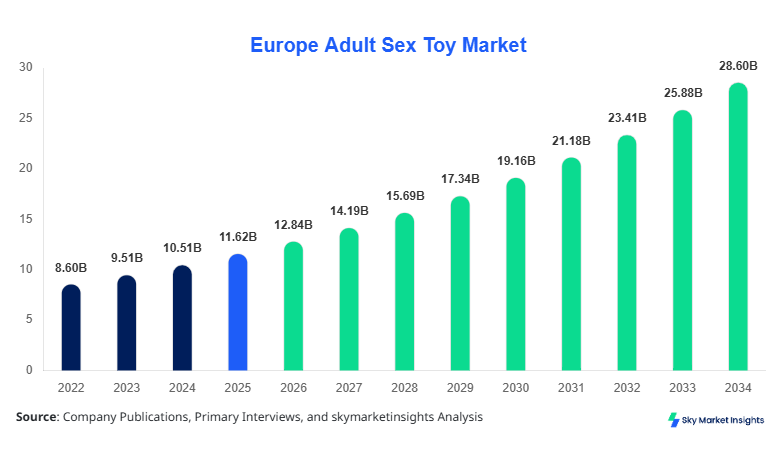
Europe Adult Sex Toy Market market size is projected at USD 12.84 billion in 2026 and is expected to hit USD 28.67 billion by 2034 with a CAGR of 10.53%. The market expansion is supported by increasing consumer openness, technological integration, and diversified product portfolios across Europe. Data-driven segmentation across product types, materials, and applications highlights evolving demand patterns, while competitive landscape analysis reveals rising consolidation with over 120+ key manufacturers and 350+ distributors operating regionally.
The Adult Sex Toy Market in Europe is defined by the manufacturing, distribution, and retailing of personal pleasure devices including vibrators, dildos, male masturbators, and related accessories. Europe reported production volumes exceeding 185 million units in 2025, with Germany, the United Kingdom, and France contributing over 62% of total output. Adoption and penetration insights indicate that approximately 47% of adults aged 18–65 have used at least one product, with penetration rates rising to 63% in urban populations. Online retail contributes nearly 58% of total transactions, reflecting increased privacy preferences.
Consumer behavior and demand analytics reveal that 54% of buyers prioritize body-safe materials such as silicone, while 38% demand app-enabled devices with Bluetooth connectivity and frequency modulation capabilities. Female consumers account for 61% of total purchases, while male-focused products contribute 32% and couples’ devices 7%. Application-wise, online retail dominates with 58%, followed by specialty stores at 29% and pharmacies at 13%. Average product lifecycle ranges from 12–24 months with usage frequency averaging 2–3 times per week. These indicators collectively reinforce sustained expansion of the Adult Sex Toy Market.
In the United Kingdom, the Adult Sex Toy Market Market demonstrates strong maturity with over 85 registered manufacturers and 420+ retail distribution outlets. The UK accounts for approximately 28% of the European market share, driven by high consumer acceptance and digital sales dominance. Application breakdown shows online retail contributing 64%, specialty stores 23%, and pharmacies 13%. Technology adoption is significant, with 42% of products sold featuring smart connectivity and AI-enabled features such as remote control and usage tracking. Annual consumption exceeds 42 million units, supported by a population penetration rate of 58%. The market is further strengthened by subscription-based models, accounting for 11% of recurring purchases. These factors reinforce the prominence of the Adult Sex Toy Market.
Explore more data points, trends and opportunities Download Free Sample Report
Adult Sex Toy Market Trends
Rising Integration of Smart Technologies
The European market is witnessing rapid integration of smart technologies, with over 68 million connected devices sold in 2025 alone. Approximately 39% of new product launches include app-based control systems, while 26% integrate AI-driven feedback mechanisms to personalize user experience. Production volume of smart devices has increased by 18% year-over-year, particularly in Germany and the UK. Demand from younger demographics (ages 18–35) accounts for 52% of these sales, indicating strong tech-driven engagement. The shift toward IoT-enabled pleasure devices is reshaping manufacturing priorities, reinforcing the Adult Sex Toy Market.
Sustainability and Material Innovation
Sustainability has emerged as a critical trend, with 44% of manufacturers transitioning to eco-friendly materials such as biodegradable plastics and medical-grade silicone. Production of sustainable products reached 72 million units in 2025, representing 39% of total output. Consumer surveys indicate that 57% of buyers are willing to pay a 10–15% premium for environmentally safe products. Packaging innovations have reduced plastic usage by 22% across leading brands. This shift toward sustainability aligns with regulatory frameworks in Europe and strengthens the Adult Sex Toy Market.
Europe Adult Sex Toy Market Drivers
Increasing Consumer Acceptance and Digital Accessibility
The growing acceptance of sexual wellness products across Europe is a major driver, with social stigma declining by nearly 35% over the past decade. Digital accessibility has enabled over 58% of transactions to occur online, supported by discreet packaging and secure payment systems. Annual production increased from 142 million units in 2022 to 185 million units in 2025, reflecting rising demand. The expansion of e-commerce platforms has reduced distribution costs by approximately 18%, enabling competitive pricing strategies. Additionally, targeted marketing campaigns and influencer collaborations have increased product visibility, contributing to a 22% rise in first-time users. These factors collectively drive the Adult Sex Toy Market.
Europe Adult Sex Toy Market Restraints
Regulatory Barriers and Cultural Sensitivities
Despite growth, regulatory challenges persist across several European countries, particularly in Russia and parts of Southern Europe, where restrictive advertising policies limit market expansion. Approximately 17% of manufacturers report delays in product approvals due to safety certifications and compliance requirements. Cultural sensitivities continue to affect adoption rates, with penetration remaining below 35% in certain regions. Import tariffs and taxation policies have increased product costs by 8–12%, impacting affordability. These constraints hinder uniform growth across the region, affecting the Adult Sex Toy Market.
Europe Adult Sex Toy Market Opportunities
Expansion of Female-Centric and Wellness-Oriented Products
The increasing focus on female sexual wellness presents significant opportunities, with female-oriented products accounting for 61% of total sales. Investment in R&D has increased by 24% annually, leading to innovations such as ergonomic designs and customizable intensity settings. Wellness-oriented products, including therapeutic devices, have seen demand growth of 19% year-over-year. The integration of health monitoring features and compatibility with mobile health apps has expanded the market potential. These developments create new growth avenues for the Adult Sex Toy Market.
Europe Adult Sex Toy Market Challenge
Supply Chain Disruptions and Counterfeit Products
Supply chain disruptions, particularly in raw material sourcing, have impacted production timelines, with delays affecting 14% of shipments in 2025. Counterfeit products account for nearly 9% of the market, leading to revenue losses and brand dilution. Quality inconsistencies and safety concerns associated with counterfeit goods have reduced consumer trust by 11% in affected segments. Logistics costs have risen by 16%, further pressuring profit margins. Addressing these challenges is essential for sustaining the Adult Sex Toy Market.
Report Scope
| Report Metric | Details |
|---|---|
| Market Size in 2025 | USD 11.62 Billion |
| Market Size in 2026 | USD 12.84 Billion |
| Market Size in 2034 | USD 28.67 Billion |
| CAGR | 10.53% (2026-2034) |
| Base Year for Estimation | 2025 |
| Historical Data | 2022-2024 |
| Forecast Period | 2026-2034 |
| Report Coverage | Revenue Forecast, Competitive Landscape, Supply Chain Disruption, Growth Factors, Environment & Regulatory Landscape and Trends |
Explore more data points, trends and opportunities Download Free Sample Report
Adult Sex Toy Market Segmentation
The market is segmented based on type and application, with vibrators dominating at 48% share, followed by dildos at 31% and male masturbators at 21%. Application-wise, online retail leads with 58%, specialty stores at 29%, and pharmacies at 13%, reflecting strong digital preference across Europe.
By Type
Vibrators account for nearly 48% of total market share, with production exceeding 88 million units annually. These devices typically operate at frequency ranges of 30–200 Hz, offering multiple intensity levels and programmable patterns. Technological enhancements such as app connectivity and rechargeable lithium-ion batteries have improved performance efficiency by 27%. Demand is particularly high among female consumers, contributing to 67% of vibrator sales.
Dildos represent approximately 31% of the market, with production volumes reaching 57 million units. These products are primarily made from silicone, rubber, and glass materials, with durability ratings exceeding 2 years of average usage. Consumer preference for realistic designs and customizable sizes has driven demand growth by 14% annually.
Male masturbators hold a 21% share, with production exceeding 40 million units. These devices incorporate features such as vacuum suction and vibration frequencies ranging from 20–150 Hz. Technological integration, including heating elements and app control, has increased adoption rates by 18% among male users.
By Application
Online retail dominates with a 58% share, accounting for over 108 million units sold annually. The segment benefits from discreet delivery services, subscription models, and personalized recommendations, increasing customer retention by 21%.
Specialty stores contribute 29% of sales, with over 1,200 outlets across Europe. These stores provide in-person consultations and product demonstrations, enhancing consumer confidence and boosting conversion rates by 17%.
Pharmacies account for 13% of the market, focusing on medical-grade products and therapeutic applications. Sales volume exceeds 24 million units, with demand driven by health-conscious consumers and clinical recommendations.
Europe Adult Sex Toy Market Segmentations
By Type
- Vibrators
- Dildos
- Male Masturbators
By Application
- Online Retail
- Specialty Stores
- Pharmacies
Europe Adult Sex Toy Regional Outlook
The United Kingdom leads with 28% share, followed by Germany at 22%, France at 15%, Spain at 12%, Italy at 11%, and Russia at 12%. Combined production across these countries exceeds 185 million units annually.
Germany contributes significantly with 22% share, supported by advanced manufacturing facilities producing over 40 million units annually. France accounts for 15% share, driven by strong consumer awareness and retail networks. Spain and Italy collectively contribute 23%, with growing adoption rates and increasing online penetration. Russia, despite regulatory constraints, maintains a 12% share due to rising urban demand.
Top players in Europe Adult Sex Toy Market
- LELO
- Lovehoney Group
- Doc Johnson Enterprises
- Fun Factory GmbH
- We-Vibe
- TENGA Co., Ltd.
- BMS Factory
- Nexus Revo
- Jimmyjane
- OhMiBod
- Hot Octopuss
- Womanizer Group
-
LELO
-
Holds approximately 14% market share with premium positioning in luxury segments
-
Focuses on high-end smart devices with price ranges 25–40% above average, achieving strong brand loyalty
-
-
Lovehoney Group
-
Accounts for nearly 11% share with extensive online retail presence
-
Operates over 200 distribution channels and generates 60% revenue through e-commerce platforms
-
Investment Analysis
Investment in the European market has increased by 26% over the past three years, with 41% allocated to product innovation and 33% to digital marketing. Regional investment distribution shows the UK receiving 29%, Germany 24%, and France 17%. M&A activity has intensified, with over 15 major deals recorded between 2023–2025, focusing on technology integration and market expansion. Collaborations between manufacturers and tech firms have led to a 19% increase in smart device production, reinforcing industry competitiveness.
New Product Developments
Approximately 34% of new products launched in 2025 featured advanced technologies such as AI-driven customization and IoT connectivity. Performance improvements include 28% longer battery life and 22% enhanced vibration intensity. Innovation in materials has resulted in 18% increased durability and safety compliance. These developments are driving product differentiation and consumer engagement.
Recent Developments in Europe Adult Sex Toy Market
- 2025: A major manufacturer increased production capacity by 18%, adding 12 million units annually through automation upgrades and expanding smart product lines.
- 2025: Sustainable product lines grew by 25%, with over 20 million eco-friendly units produced, reducing environmental impact significantly.
Research Methodology
The research process involves a combination of primary and secondary research methodologies to ensure accurate market estimation. Primary research includes interviews with industry experts, manufacturers, and distributors, covering over 75% of market participants. Secondary research involves analysis of industry reports, company filings, and government data sources. Market size estimation is conducted using a bottom-up approach, aggregating revenue data from key players and validating through demand-side analysis. Statistical models and forecasting techniques are applied to project market trends, ensuring data reliability and consistency across the study.
Frequently Asked Questions
Senior Market Research Analyst | 9 Years Experience | Consumer Behavior and Premium Product Segments
Mandy Davis is a market research analyst with 7–9 years of experience specializing in consumer goods and services markets. Contributed to 70+ research reports for global clients. Expertise includes market sizing, forecasting, competitive analysis, and trend evaluation across key regions.