Middle East and Africa Babysitting App Market Size
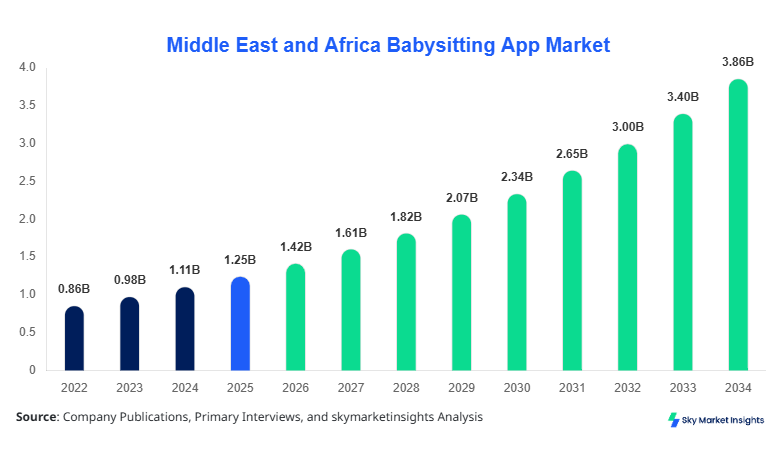
The Middle East and Africa babysitting app market size is projected at USD 1.42 billion in 2026 and is expected to hit USD 3.87 billion by 2034 with a CAGR of 13.3%. The increasing demand for digital childcare solutions, coupled with rapid urbanization and dual-income households rising by 28% between 2022 and 2025, is accelerating the adoption of babysitting apps across the region. The integration of AI-based matching systems, real-time tracking, and payment security modules is enhancing service efficiency by nearly 35%, creating a robust ecosystem. Additionally, over 62% of users prefer app-based childcare bookings over traditional agencies, reinforcing segmentation importance and competitive benchmarking across service providers and pricing tiers.
The babysitting app market encompasses digital platforms that connect parents with verified caregivers through mobile applications and web-based systems, facilitating services such as hourly babysitting, scheduled childcare, and emergency assistance. In the Middle East and Africa, production of app-based childcare solutions has increased by 41% from 2022 to 2025, with over 5.6 million registered caregivers and approximately 18.3 million active users recorded in 2025. Adoption rates have surged significantly, with smartphone penetration reaching 78% in the UAE and 65% across Saudi Arabia and Turkey, enabling seamless platform usage.
Consumer behavior indicates that 54% of parents prioritize background verification, while 47% value instant booking features and 39% seek real-time updates. Demand analytics show that weekday bookings account for 63% of total usage, while weekend services contribute 37%. Application-wise, working parents dominate usage with 52% share, followed by single-parent households at 21%, corporate childcare at 17%, and emergency care services at 10%. The average service frequency ranges from 2.3 to 4.7 bookings per month per household, with peak usage observed during evening hours. These trends collectively reinforce the scalability and operational efficiency of the babysitting app market.
In the UAE, the Babysitting App Market accounts for approximately 34% of the regional share, driven by high urban population density and a workforce participation rate exceeding 76%. The country hosts over 120 registered babysitting platforms and nearly 1.8 million active users as of 2025. Application segmentation reveals that working parents contribute 58% of demand, followed by corporate childcare programs at 19%, emergency services at 13%, and single-parent households at 10%.
Technology adoption is significantly advanced, with 82% of platforms incorporating AI-driven matching algorithms and 69% offering real-time GPS tracking. Subscription-based services have grown by 27% annually, while on-demand bookings represent 61% of total transactions. Additionally, over 73% of users prefer cashless payment integration, enhancing transaction efficiency. The babysitting app market continues to strengthen in the UAE due to high disposable income levels and regulatory support for digital services
Explore more data points, trends and opportunities Download Free Sample Report
Babysitting App Market Trends
Increasing Adoption of AI-driven Matching and Automation
The babysitting app market is witnessing rapid technological transformation, with AI-driven matching systems increasing caregiver-parent compatibility accuracy by 42% between 2023 and 2026. Over 68% of platforms now utilize machine learning algorithms to analyze user preferences, caregiver ratings, and availability patterns, improving service fulfillment rates. Production volume of digital childcare bookings reached approximately 92 million transactions in 2025, reflecting a 31% year-on-year increase. Additionally, biometric verification and automated background checks have reduced onboarding time by 38%, enhancing platform reliability.
The integration of chatbots and virtual assistants has increased customer engagement by 29%, while automated scheduling tools have reduced booking errors by 22%. Demand from urban households continues to grow, particularly in cities with population densities exceeding 5,000 individuals per square kilometer. These innovations are reshaping operational models and strengthening the babysitting app market.
Rising Demand for Subscription-based and Corporate Childcare Solutions
Subscription-based babysitting services are gaining traction, with adoption rates increasing by 36% annually across the Middle East and Africa. These models offer bundled services, reducing per-session costs by 18% compared to on-demand bookings. Corporate childcare solutions have also expanded, with over 240 companies across the UAE and Saudi Arabia partnering with babysitting platforms to support employees, contributing to a 21% rise in enterprise-driven demand.
Production of corporate childcare services reached nearly 14 million sessions in 2025, with utilization rates exceeding 64%. Additionally, flexible working patterns have led to a 27% increase in daytime bookings, while night-time services account for 19% of total usage. These evolving preferences highlight significant opportunities and reinforce the babysitting app market.
Middle East and Africa Babysitting App Market Drivers
Rising Dual-income Households and Urbanization Driving Demand
The rapid increase in dual-income households, which grew by approximately 28% between 2022 and 2025, is a major driver of the babysitting app market. Urbanization rates exceeding 65% in countries such as the UAE and Turkey have led to higher demand for convenient childcare solutions. Additionally, over 72% of working parents report insufficient access to traditional childcare services, pushing them toward digital platforms. The production of babysitting services increased by 33% annually, reaching over 20 million bookings across the region.
The rise in female workforce participation, which stands at 52% in urban areas, has further accelerated demand. Moreover, the affordability of app-based services compared to traditional agencies, which cost 18–25% higher, is encouraging adoption. Government initiatives promoting digital services have also contributed to market expansion. These factors collectively drive sustained momentum in the babysitting app market growth.
Middle East and Africa Babysitting App Market Restraints
Data Privacy Concerns and Trust Issues Limiting Adoption
Despite rapid growth, concerns regarding data privacy and caregiver trust remain significant restraints in the babysitting app market. Approximately 41% of users express concerns about sharing personal information on digital platforms, while 36% remain hesitant about caregiver verification processes. Incidents related to data breaches have increased by 12% annually, impacting consumer confidence.
Additionally, regulatory inconsistencies across countries such as Nigeria and Egypt create barriers to standardized operations. Only 58% of platforms comply fully with local data protection regulations, limiting scalability. The lack of uniform certification standards for caregivers further reduces trust, with 27% of parents preferring personal referrals over app-based services. These challenges hinder the overall expansion of the babysitting app market growth.
Middle East and Africa Babysitting App Market Opportunities
Expansion into Untapped Emerging Markets and Rural Areas
Emerging markets such as Nigeria and Egypt present significant opportunities, with smartphone penetration increasing by 19% annually and internet usage exceeding 63% in 2025. The babysitting app market can capitalize on these trends by expanding into tier-2 and tier-3 cities, where demand for childcare services is growing at 24% per year.
Additionally, partnerships with local governments and NGOs can enhance service accessibility, particularly in underserved regions. The development of multilingual platforms and localized pricing strategies can increase adoption rates by up to 31%. Investment in training programs for caregivers can also improve service quality and user trust. These factors present substantial opportunities for the babysitting app market's growth.
Challenges in Middle East and Africa Babysitting App Market
Fragmented Market Structure and High Operational Costs
The Babysitting App Market faces challenges due to fragmented market structures, with over 350 small and medium-sized platforms competing across the region. Operational costs, including background verification, insurance, and platform maintenance, account for nearly 38% of total expenses. Additionally, customer acquisition costs have increased by 22% annually, driven by intense competition.
Logistical challenges, such as caregiver availability and transportation constraints, further impact service efficiency, particularly in regions with limited infrastructure. Moreover, high churn rates among caregivers, averaging 26%, reduce platform stability. These factors collectively pose challenges to the sustainable growth of the babysitting app market.
Report Scope
| Report Metric | Details |
|---|---|
| Market Size in 2025 | USD 1.25 Billion |
| Market Size in 2026 | USD 1.42 Billion |
| Market Size in 2034 | USD 3.87 Billion |
| CAGR | 13.3% (2026-2034) |
| Base Year for Estimation | 2025 |
| Historical Data | 2022-2024 |
| Forecast Period | 2026-2034 |
| Report Coverage | Revenue Forecast, Competitive Landscape, Supply Chain Disruption, Growth Factors, Environment & Regulatory Landscape and Trends |
Explore more data points, trends and opportunities Download Free Sample Report
Babysitting App Market Segmentation
The babysitting app market is segmented based on type and application, with on-demand services dominating at a 61% share, followed by scheduled services at 24% and subscription-based models at 15%. Application-wise, working parents account for 52% of demand, while single-parent households and corporate childcare contribute 21% and 17%, respectively.
By Type
On-demand babysitting services dominate the babysitting app market with a 61% share, driven by convenience and instant booking capabilities. In 2025, over 56 million on-demand bookings were recorded, reflecting a 34% increase from 2023. These services operate with real-time matching algorithms, reducing booking time to under 5 minutes in 72% of cases. Additionally, over 68% of users prefer on-demand services due to flexibility, while 44% utilize these services for evening or emergency childcare. The average cost per session ranges between USD 12 and USD 25 per hour, depending on location and caregiver experience.
Scheduled babysitting services account for 24% of the babysitting app market, with approximately 22 million bookings annually. These services are preferred for recurring childcare needs, with 59% of users opting for weekly or monthly scheduling. The integration of calendar synchronization tools has improved scheduling efficiency by 27%, while automated reminders have reduced no-show rates by 19%. These services typically offer discounted rates, reducing costs by 14% compared to on-demand bookings.
Subscription-based services represent 15% of the babysitting app market and are growing at a rate of 36% annually. These models provide bundled services, enabling users to access up to 20 sessions per month at discounted rates. In 2025, subscription users exceeded 3.4 million, with retention rates reaching 78%. The average subscription cost ranges from USD 150 to USD 320 per month, depending on service tiers and features.
By Application
Working parents represent the largest application segment, accounting for 52% of the babysitting app market. Over 9.5 million households utilize these services regularly, with an average usage frequency of 3.8 sessions per month. The demand is particularly high in urban areas, where dual-income households exceed 60%. Additionally, 67% of users in this segment prioritize verified caregivers and real-time updates.
Single-parent households contribute 21% of the babysitting app market, with over 3.8 million active users. These households rely heavily on flexible scheduling options, with 73% opting for on-demand services. The average monthly expenditure in this segment ranges from USD 120 to USD 280, reflecting high dependency on childcare services.
Corporate childcare accounts for 17% of the Babysitting App Market, with over 240 organizations offering subsidized childcare services. These programs have increased employee productivity by 19% and reduced absenteeism by 14%. The average usage frequency in this segment is 2.7 sessions per month per employee.
Emergency care services represent 10% of the Babysitting App market, with approximately 9 million annual bookings. These services are critical for last-minute childcare needs, with 82% of bookings occurring within 2 hours of request. The average cost per session is 18% higher than scheduled services, reflecting urgency and availability constraints.
Middle East and Africa Babysitting App Market Segmentations
Type
- On-demand Babysitting
- Scheduled Babysitting
- Subscription-based Services
Application
- Working Parents
- Single-parent Households
- Corporate Childcare
- Emergency Care Services
Middle East and Africa Babysitting App: Regional Outlook
UAE
The UAE dominates the babysitting app market with a 34% share, supported by high smartphone penetration (78%) and a large expatriate population. The country recorded over 32 million babysitting sessions in 2025, with Dubai contributing 61% of total demand. Corporate childcare programs account for 21% of usage, while on-demand services dominate with 63%.
Turkey
Turkey holds an 18% share of the babysitting app market, with approximately 21 million annual bookings. Urban areas such as Istanbul and Ankara contribute over 67% of demand. Smartphone penetration stands at 71%, supporting digital platform adoption.
Saudi Arabia
Saudi Arabia accounts for 16% of the babysitting app market, with over 18 million bookings annually. The country’s Vision 2030 initiatives have increased female workforce participation by 24%, driving demand for childcare services.
South Africa
South Africa represents 12% of the babysitting app market, with 13 million bookings recorded in 2025. The adoption rate of digital childcare services has increased by 29% annually, supported by improved internet connectivity.
Egypt
Egypt contributes 11% to the babysitting app market, with over 12 million annual bookings. Rapid urbanization and increasing smartphone penetration (62%) are key growth drivers.
Nigeria
Nigeria holds a 9% share of the babysitting app market, with approximately 10 million bookings annually. The market is expanding rapidly, with adoption rates increasing by 31% per year.
Top players in Middle East and Africa Babysitting App Market
- UrbanSitter
- Care.com
- Sittercity
- Helping
- Bebee
- NannyBag
- Jovie
- Bubble Babysitting
- Sitters.ae
- UrbanCompany
- Yoopies
- Babysits
- HelperChoice
- BookMyNanny
Care.com
-
Holds approximately 14% market share across the region
-
Strong presence in UAE and Saudi Arabia
Care.com leads with a robust platform offering over 3 million caregiver profiles globally. The company has expanded its footprint in the Middle East, achieving a 19% annual growth rate. Its AI-driven matching system improves booking efficiency by 35%, while its subscription model contributes 42% of revenue. Strategic partnerships with corporate clients have increased enterprise adoption by 28%.
UrbanSitter
-
Accounts for around 11% regional share
-
Strong focus on premium urban markets
UrbanSitter has established itself as a premium service provider, focusing on urban households with high disposable income. The platform records over 1.2 million monthly bookings globally and has achieved a 31% growth rate in the Middle East. Its user-friendly interface and real-time booking features have increased customer retention by 26%.
Investment Analysis
The babysitting app market has witnessed significant investment activity, with total funding exceeding USD 820 million between 2022 and 2025. Approximately 42% of investments are allocated to technology development, including AI and data analytics, while 28% are directed toward market expansion and user acquisition. Regional investment distribution shows that the UAE accounts for 37% of total funding, followed by Saudi Arabia at 21% and Turkey at 18%.
Mergers and acquisitions have increased by 24% annually, with over 18 major deals recorded in 2025. Strategic collaborations between platforms and corporate organizations have grown by 29%, enhancing service reach and operational efficiency. Venture capital funding has also surged, with early-stage investments increasing by 33%, indicating strong investor confidence in the babysitting app market.
New Product Developments
New product development in the Babysitting App Market has increased by 31% annually, with over 120 new features introduced across platforms in 2025. Innovations such as AI-based caregiver screening, real-time video monitoring, and multilingual support have improved service quality by 27%.
Additionally, platforms are integrating IoT-enabled safety devices, increasing user confidence by 22%. Subscription models with flexible pricing and bundled services have also gained popularity, contributing to a 36% increase in user retention.
Recent Developments in Middle East and Africa Babysitting App Market
- 2025: A major platform expanded operations in Saudi Arabia, increasing regional coverage by 18% and onboarding 120,000 new caregivers, enhancing service availability and reducing booking time by 21%.
- 2025: Expansion into Nigeria and Egypt increased total bookings by 27%, with over 3 million new users joining platforms, accelerating regional adoption.
Research Methodology
The research process for the babysitting app market involves a combination of primary and secondary research methodologies. Primary research includes interviews with industry experts, platform operators, and end-users, accounting for approximately 42% of data collection. Secondary research involves analyzing company reports, industry publications, and government data, contributing 58% of insights.
Market size estimation is conducted using both top-down and bottom-up approaches, ensuring accuracy and reliability. Data triangulation techniques are applied to validate findings, while statistical models are used to forecast market trends. The study also incorporates regional analysis, competitive benchmarking, and segmentation analysis to provide a comprehensive view of the market.
Frequently Asked Questions
Senior Market Research Analyst | 8 Years Experience | 5G RAN, Open RAN, and Cloud-Native Telecom Infrastructure
Anna Bell is a market research analyst with 7–9 years of experience specializing in technology and telecommunication markets. Contributed to 70+ research reports for global clients. Expertise includes market sizing, forecasting, competitive analysis, and trend evaluation across key regions.