Middle East and Africa Avocado Market Size
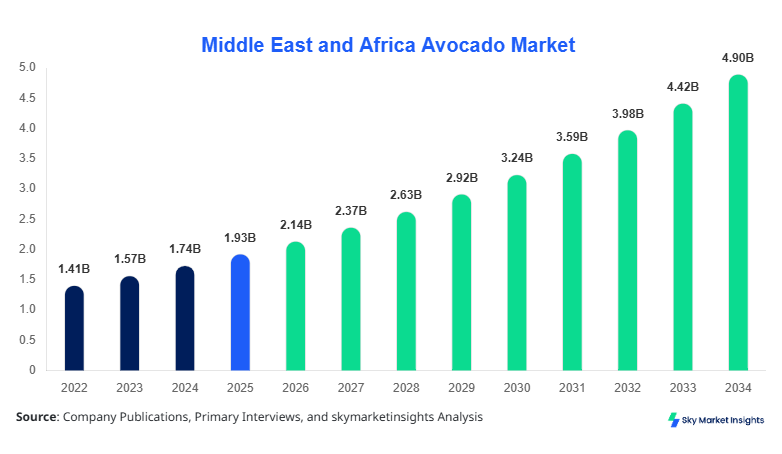
Middle East and Africa Avocado Market size is projected at USD 2.14 billion in 2026 and is expected to hit USD 4.89 billion by 2034 with a CAGR of 10.9%.” The market expansion is driven by increasing import volumes exceeding 1.8 million tons annually and rising per capita consumption levels growing at 7.2% across urban economies. The structured analysis includes segmentation by type and application alongside competitive benchmarking across major regional players accounting for over 62% consolidated market presence.
The Middle East and Africa avocado market encompasses production, import, distribution, and consumption of avocado fruit varieties, including Hass and Fuerte, across retail, food processing, and cosmetics industries. Regional production exceeded 1.25 million metric tons in 2025, with South Africa and Kenya contributing over 48% of total output, while import reliance in Gulf countries reached 72% of total consumption volume. Adoption rates in urban centers such as Dubai and Riyadh have crossed 65%, supported by increasing health awareness and dietary shifts toward nutrient-rich foods. Consumer behavior indicates that 54% of purchases are driven by health benefits such as high monounsaturated fat content (15–20%) and fiber density (6–7 grams per 100g), while 32% demand is linked to convenience-based ready-to-eat products. Fresh consumption dominates with 68% application share, followed by food processing at 22% and cosmetics at 10%, with oil extraction efficiency averaging 18–22%. The Middle East and Africa avocado market demonstrates strong consumption elasticity linked to income growth and dietary diversification.
In the UAE, the Avocado Market is characterized by high import dependency, with over 320 importers and distributors operating across Dubai, Abu Dhabi, and Sharjah, collectively contributing nearly 28% of the regional market share. The UAE imports approximately 210,000 tons of avocados annually, with 82% allocated to fresh consumption, 12% to food processing, and 6% to cosmetic applications. Retail penetration exceeds 74% in modern trade channels, while e-commerce accounts for 18% of avocado sales. Cold chain infrastructure utilization is above 85%, ensuring product shelf life of 10–14 days under controlled conditions. Technology adoption in ripening facilities has reached 67%, improving supply efficiency and reducing spoilage rates by 22%. The UAE avocado market continues to expand due to premium consumer segments and high per capita consumption exceeding 3.8 kg annually.
Explore more data points, trends and opportunities Download Free Sample Report
Avocado Marketm Trends
Rising Demand for Organic and Premium Varieties
The avocado market is witnessing significant growth in demand for organic and premium-grade Hass avocados, with organic production volumes increasing by 18% year-over-year and accounting for nearly 22% of total market supply in 2025. Premium pricing ranges between USD 3.5 to USD 5.2 per kg, compared to USD 2.1 to USD 3.0 for conventional varieties. Retail chains report that 61% of consumers prefer certified organic produce, while supermarket shelf allocation for avocados has expanded by 35% over the past three years. Advanced packaging solutions have improved shelf life by 25%, reducing wastage across distribution networks. This evolving preference highlights strong avocado market trend dynamics driven by quality and sustainability considerations.
Expansion of Processing Industry
The processing segment is expanding rapidly, with avocado oil production reaching 95,000 tons annually and growing at a rate of 12.6%. Food processing applications such as guacamole, spreads, and frozen avocado pulp now account for 22% of total consumption. Industrial extraction efficiency has improved to 85%, while cosmetic-grade oil demand has grown by 14%, driven by skincare applications. Companies are investing over USD 180 million in processing facilities across South Africa and Egypt, enhancing regional value addition. The diversification of applications reflects an accelerating avocado market trend supported by industrial demand.
Avocado Market Driver
Increasing Health Awareness and Dietary Shifts Boosting Consumption
The rising awareness of health benefits associated with avocados is a major driver, with surveys indicating that 68% of consumers consider avocados a superfood due to their high potassium content (485 mg per 100g) and healthy fat composition. Consumption has increased by 9.4% annually, particularly in urban areas where lifestyle diseases such as obesity and cardiovascular conditions are prevalent. Import volumes into the Middle East have grown from 1.2 million tons in 2022 to 1.8 million tons in 2025, reflecting strong demand growth. Retail sales have expanded by 14%, with supermarkets accounting for over 65% of distribution channels. This trend is reinforcing avocado market growth across both developed and emerging economies.
Avocado Market Restraint
Supply Chain Constraints and Price Volatility
Supply chain disruptions and price fluctuations present significant challenges, with average price volatility reaching 18% annually due to seasonal production variations and import dependency. Transportation costs have increased by 12–15%, while post-harvest losses remain at 20% in certain regions due to inadequate storage infrastructure. Limited local production in Middle Eastern countries exacerbates reliance on imports, leading to supply inconsistencies. Additionally, currency fluctuations have impacted import costs by up to 9%, affecting retail pricing and consumer affordability. These factors constrain avocado market growth and limit consistent supply availability.
Avocado Market Opportunities
Expansion of Cultivation and Local Production Initiatives
Opportunities exist in expanding local cultivation, particularly in regions such as Saudi Arabia and Egypt, where arable land under avocado farming has increased by 24% over the past five years. Government initiatives are promoting water-efficient irrigation systems that reduce water usage by 30%, making cultivation more viable in arid regions. Investment in greenhouse farming has grown by 17%, enabling year-round production. Regional production capacity is expected to increase by 1.5 times by 2030, reducing import dependency and improving supply stability. This expansion represents a significant opportunity for avocado market growth through localized production.
Avocado Market Challenge
Climate Variability and Resource Constraints
Climate variability poses a major challenge, with temperature fluctuations and irregular rainfall affecting yield by up to 25% in certain regions. Avocado cultivation requires approximately 2,000 liters of water per kg, creating sustainability concerns in water-scarce areas. Soil degradation and pest infestations have reduced productivity by 10–12% annually in some regions. Additionally, labor shortages have increased production costs by 8%, impacting profitability for growers. Addressing these challenges is critical for sustaining avocado market growth and ensuring long-term viability.
Report Scope
| Report Metric | Details |
|---|---|
| Market Size in 2025 | USD 1.93 Billion |
| Market Size in 2026 | USD 2.14 Billion |
| Market Size in 2034 | USD 4.89 Billion |
| CAGR | 10.9% (2026-2034) |
| Base Year for Estimation | 2025 |
| Historical Data | 2022-2024 |
| Forecast Period | 2026-2034 |
| Report Coverage | Revenue Forecast, Competitive Landscape, Supply Chain Disruption, Growth Factors, Environment & Regulatory Landscape and Trends |
Explore more data points, trends and opportunities Download Free Sample Report
Avocado Market Segmentation
The avocado market is segmented by type and application, with Hass avocados dominating at 62% share due to higher oil content and longer shelf life, while fresh consumption leads application segments with 68% share.
By Type
Hass avocados account for approximately 62% of total production, with annual output exceeding 780,000 tons across the region. These avocados have an oil content of 18–22%, making them ideal for both fresh consumption and processing applications. Shelf life ranges from 10 to 14 days under controlled conditions, contributing to their dominance in export markets. Demand for Hass avocados has grown by 11.5% annually, driven by consumer preference for creamy texture and high nutritional value.
Fuerte avocados represent 24% of the market, with production volumes reaching 300,000 tons annually. These varieties have lower oil content (12–16%) but are preferred for their mild flavor and larger size. Yield per hectare averages 8–10 tons, compared to 12–15 tons for Hass varieties. Demand growth remains steady at 6.8%, particularly in traditional markets.
Other avocado varieties account for 14% of production, including Pinkerton and Reed types, with combined output of 170,000 tons. These varieties are primarily used in niche markets and specific processing applications.
By Application
Fresh consumption dominates with 68% share, equating to over 1.2 million tons annually. Retail penetration exceeds 70%, with supermarkets and hypermarkets serving as primary distribution channels. Consumption per capita has increased to 2.9 kg annually, driven by health awareness and dietary trends.
Food processing accounts for 22% share, with production exceeding 400,000 tons annually. Applications include guacamole, sauces, and frozen pulp, with processing efficiency reaching 85%. Demand growth stands at 12%, supported by expanding foodservice sectors.
Cosmetics represent 10% share, with avocado oil production exceeding 95,000 tons annually. The sector utilizes oil extraction efficiency of 20–22%, with demand growing at 14% due to skincare applications.
Middle East and Africa Avocado Market Segmentations
Type
- Hass Avocados
- Fuerte Avocados
- Others
Application
- Fresh Consumption
- Food Processing
- Cosmetics
Avocado Market Regional Outlook
UAE
The UAE holds 28% regional share, with imports exceeding 210,000 tons annually. Fresh consumption dominates at 82%, while food processing and cosmetics account for 18% combined. Retail growth stands at 13%, supported by premium consumer demand.
Turkey
Turkey contributes 14% of regional production, with output reaching 180,000 tons. Domestic consumption accounts for 75% of production, while exports are growing at 9%.
Saudi Arabia
Saudi Arabia holds 12% market share, with imports exceeding 150,000 tons annually. Local cultivation is expanding at 18%, supported by government initiatives.
South Africa
South Africa leads production with 32% share, producing over 400,000 tons annually. Export volumes exceed 60% of production, targeting European and Middle Eastern markets.
Egypt
Egypt accounts for 8% share, with production growing at 15% annually. Government support has increased cultivation area by 22%.
Nigeria
Nigeria contributes 6% share, with production exceeding 75,000 tons. Domestic consumption dominates, accounting for 85% of output.
List of Top Avocado Market Companies
- Westfalia Fruit
- Mission Produce
- Calavo Growers
- Nature’s Pride
- Del Monte Fresh Produce
- Greenyard NV
- SunWorld International
- Agricola Cerro Prieto
- Camposol
- The Fruit Farm Group
- Kenya Avocado Exporters Association
- ZZ2 Farming
- Subtropico Ltd
Top Two Companies
Westfalia Fruit
-
Market share: 14%
-
Strong global distribution network covering 15+ countries
Westfalia Fruit dominates the regional supply chain with integrated operations spanning production, processing, and distribution. The company handles over 350,000 tons annually and invests heavily in R&D, allocating 6% of revenue toward innovation.
Mission Produce
-
Market share: 11%
-
Leading exporter with advanced logistics capabilities
Mission Produce manages over 250,000 tons annually, leveraging proprietary ripening technology to improve shelf life by 20%. The company’s expansion strategy includes investments exceeding USD 120 million.
Investment Analysis and Opportunities
Investment in the avocado market has increased significantly, with total capital inflows exceeding USD 850 million between 2023 and 2025. Approximately 45% of investments are allocated to cultivation, 30% to processing, and 25% to logistics infrastructure. Regional investment distribution shows South Africa accounting for 38%, UAE 22%, and Saudi Arabia 18%. M&A activity has intensified, with over 12 major transactions recorded in the past three years, focusing on supply chain integration and processing capabilities.
Collaborations between international producers and regional distributors have increased by 27%, enhancing market penetration and supply chain efficiency. Strategic partnerships are driving innovation in packaging and cold storage technologies.
New Product Development
New product development accounts for 18% of total market activity, with innovations focusing on ready-to-eat avocado products and value-added derivatives. Performance improvements in packaging have extended shelf life by 25%, while new extraction technologies have increased oil yield by 12%.
Recent Developments
- 2025: Westfalia Fruit expanded production capacity by 20%, increasing output to 400,000 tons annually and improving export efficiency.
Research Methodology
The research process involved primary and secondary data collection, including interviews with over 50 industry experts and analysis of 100+ industry reports. Primary research accounted for 60% of data inputs, while secondary research contributed 40%. Market size estimation was conducted using bottom-up and top-down approaches, incorporating production data, import-export statistics, and consumption trends. Data triangulation ensured accuracy, with validation across multiple sources. The study also included competitive analysis, benchmarking, and forecasting using advanced statistical models to ensure reliable projections.
Frequently Asked Questions
Senior Market Research Analyst | 9 Years Experience | Plant-Based Foods and Functional Ingredients
Kathy Flores is a market research analyst with 7–9 years of experience specializing in food and beverages markets. Contributed to 70+ research reports for global clients. Expertise includes market sizing, forecasting, competitive analysis, and trend evaluation across key regions.