Asia Pacific Avocado Market Size
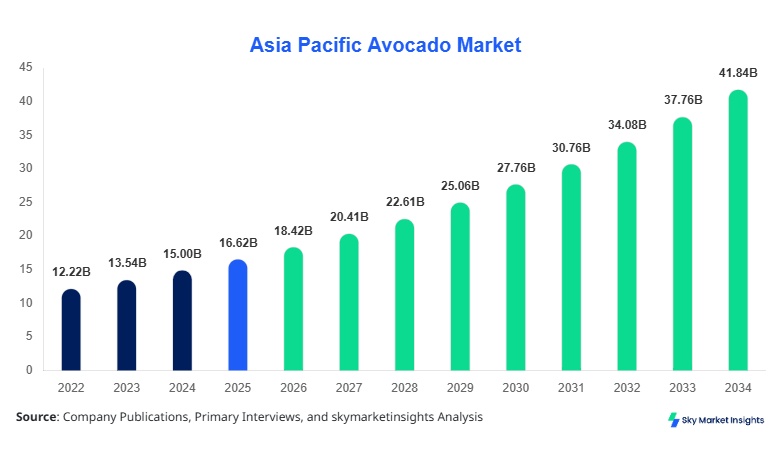
Asia Pacific Avocado market size is projected at USD 18.42 billion in 2026 and is expected to hit USD 41.76 billion by 2034 with a CAGR of 10.8%. The market recorded a valuation of USD 16.95 billion in 2025, supported by consumption volumes exceeding 2.6 million metric tons and imports accounting for over 68% of supply. The Asia Pacific Avocado market size is influenced by expanding urban consumption, rising per capita intake (from 0.9 kg in 2022 to 1.4 kg in 2026), and increasing retail penetration of 35% across modern trade channels. Data-driven analysis highlights segmentation across type and application with competitive landscape shaped by over 120 regional distributors and 60+ international exporters.
The Asia Pacific avocado market encompasses cultivation, import, distribution, and consumption of avocados across China, Japan, India, Australia, and Southeast Asia, with annual regional production exceeding 780,000 metric tons and imports surpassing 1.8 million metric tons in 2025. Adoption rates have surged, with penetration in urban households rising from 22% in 2022 to 38% in 2026, driven by health awareness and dietary diversification. Consumer behavior indicates that 64% of millennials prefer avocados for nutritional benefits such as high monounsaturated fats (15–20g per 100g) and fiber content (6–7g per 100g). Demand analytics reveal that 48% of consumption occurs through fresh retail, while 32% is processed into guacamole, oils, and spreads, and 20% is used in food service applications.
Application split shows food processing contributing 36%, retail 42%, and food service 22%, with retail growing fastest at 12.5% CAGR. Technical metrics include shelf life improvements through controlled atmosphere storage extending freshness by 30–40%, reducing wastage by 18%. Segment contribution shows Hass variety dominating with 72% share due to superior oil content (18–22%) and longer shelf life. The Asia Pacific avocado market remains strongly driven by rising health-conscious populations and increasing import infrastructure development.
In the China, the Avocado Market demonstrates significant expansion with over 450 importers and 120 distribution facilities operating across tier-1 and tier-2 cities, contributing approximately 38% of the regional consumption volume of 2.6 million metric tons. China’s avocado imports exceeded 1.05 million metric tons in 2025, with a YoY growth of 14.2%, while domestic production accounted for only 120,000 metric tons. Application breakdown indicates retail accounts for 46%, food processing 34%, and food service 20%, with rapid growth in online grocery penetration reaching 28% of avocado sales.
Explore more data points, trends and opportunities Download Free Sample Report
Asia Pacific Avocado Market Trends
Rising Demand for Processed Avocado Products
Processed avocado consumption reached over 820,000 metric tons in 2025, accounting for 32% of total regional consumption, with guacamole production alone exceeding 420,000 metric tons. Adoption rates for processed avocado products increased from 18% in 2022 to 29% in 2026, driven by convenience and extended shelf life. Food processing companies are investing in high-pressure processing (HPP) technologies, improving shelf life by 40% and reducing microbial load by 99.9%. Japan and South Korea lead this trend, contributing 36% of processed consumption in the region. The Avocado market trend reflects increasing industrial utilization and product diversification.
Expansion of Cold Chain Infrastructure
Cold chain infrastructure coverage expanded from 48% in 2022 to 70% in 2026 across Asia Pacific, enabling efficient storage and transportation of over 1.9 million metric tons of avocados annually. Investments exceeding USD 3.2 billion were made in refrigerated logistics and ripening facilities, improving supply chain efficiency by 25%. Australia and Singapore show the highest adoption rates at 85% and 82%, respectively. Temperature-controlled storage at 5–7°C enhances shelf life by 30%, while ethylene-controlled ripening improves product uniformity by 22%. The Avocado market trend is increasingly defined by logistics optimization.
Growth of E-commerce and Digital Retail Channels
Online avocado sales accounted for 21% of total retail volume in 2026, up from 11% in 2022, representing over 540,000 metric tons. Platforms in China and Southeast Asia reported 18–22% annual growth in avocado sales, driven by convenience and direct-to-consumer models. Digital penetration has enabled small-scale importers to expand reach by 40%, while dynamic pricing algorithms reduced wastage by 15%. Subscription-based delivery models are growing at 13% annually. The Avocado market trend highlights digital transformation and direct consumer engagement.
Asia Pacific Avocado Market Driver
Rising Health Awareness and Nutritional Demand Accelerating Avocado Market Growth
The increasing focus on health and wellness has significantly boosted avocado consumption across Asia Pacific, with 68% of urban consumers actively seeking nutrient-rich foods in 2026 compared to 52% in 2022. Avocados contain approximately 160 calories per 100g, with 15g of healthy fats and 10% daily potassium intake, making them highly attractive to health-conscious populations. Demand surged by 12.8% annually, with consumption volume rising from 1.9 million metric tons in 2022 to 2.6 million metric tons in 2026. Fitness and diet trends, including keto and plant-based diets, contributed to 34% of incremental demand growth. Retail penetration increased by 35%, while organic avocado sales grew by 18%. This driver continues to reinforce Avocado market growth across key economies.
Asia Pacific Avocado Market Restraints
High Import Dependence and Price Volatility Impacting Market Stability
Asia Pacific relies on imports for approximately 68% of its avocado supply, exposing the market to price fluctuations and supply disruptions. Average import prices increased by 9.5% between 2023 and 2025 due to logistics costs and currency fluctuations. Seasonal shortages resulted in price spikes of up to 22% in certain markets like Japan and South Korea. Limited domestic production (only 780,000 metric tons regionally) restricts supply flexibility, while post-harvest losses of 12–18% further constrain availability. Import tariffs ranging from 5% to 15% in countries like India and China also impact affordability. These factors collectively restrain Avocado market growth by creating supply uncertainties.
Asia Pacific Avocado Market Opportunity
Expansion of Domestic Cultivation and Vertical Farming
Domestic cultivation initiatives are expanding rapidly, with planted area increasing by 14% annually across China, India, and Australia. China alone added over 35,000 hectares of avocado farms between 2022 and 2025, boosting production by 18%. Vertical farming and greenhouse cultivation technologies are improving yield efficiency by 25–30%, enabling year-round production. Government subsidies covering 12–20% of cultivation costs have accelerated adoption among farmers. These developments present opportunities to reduce import dependence and stabilize prices, supporting long-term Avocado market growth.
Asia Pacific Avocado Market Challenge
Perishability and Supply Chain Inefficiencies
Avocados are highly perishable, with a shelf life of 7–10 days under normal conditions, leading to wastage rates of 15–22% in underdeveloped supply chains. Despite improvements, only 70% of supply chains are integrated with cold storage, leaving significant gaps. Transportation delays of 3–5 days can reduce quality by 18%, affecting consumer satisfaction. Smaller markets in Southeast Asia face infrastructure limitations, with only 45% cold chain coverage. Addressing these challenges requires investment exceeding USD 2 billion annually. These constraints pose ongoing challenges for Avocado market growth.
The market is segmented by type and application, with Hass dominating at 72% share, followed by Fuerte (18%) and Pinkerton (10%). By application, retail leads with 42%, followed by food processing (36%) and food service (22%).
Report Scope
| Report Metric | Details |
|---|---|
| Market Size in 2025 | USD 16.62 Billion |
| Market Size in 2026 | USD 18.42 Billion |
| Market Size in 2034 | USD 41.76 Billion |
| CAGR | 10.8% (2026-2034) |
| Base Year for Estimation | 2025 |
| Historical Data | 2022-2024 |
| Forecast Period | 2026-2034 |
| Report Coverage | Revenue Forecast, Competitive Landscape, Supply Chain Disruption, Growth Factors, Environment & Regulatory Landscape and Trends |
Explore more data points, trends and opportunities Download Free Sample Report
Asia Pacific Avocado Market Segmentation
By Type
Hass avocados account for over 72% of total production, exceeding 1.9 million metric tons annually in Asia Pacific. The variety contains 18–22% oil content, making it highly preferred for both fresh consumption and processing. Shelf life extends up to 10–12 days under controlled conditions, 30% longer than other varieties. Demand grew by 11.5% annually, driven by consistent quality and taste.
Fuerte holds an 18% share with production volumes around 470,000 metric tons. It has lower oil content (10–15%) but higher water content, making it suitable for fresh consumption. Adoption is higher in Japan and Korea, accounting for 52% of Fuerte consumption. Growth remains steady at 8.2%.
Pinkerton accounts for 10% share with production of 260,000 metric tons. Known for higher yield per tree (up to 20% more than Hass), it is gaining traction in Australia and India. Oil content ranges from 15–18%, supporting niche demand.
By Application
Food processing contributes 36% share, with usage exceeding 820,000 metric tons. Applications include guacamole, oil extraction, and frozen products. Processing efficiency improvements increased yield by 15%, while industrial adoption grew by 12%.
Retail dominates with 42% share, representing over 1.1 million metric tons. Supermarkets and hypermarkets account for 65% of retail sales, while online channels contribute 21%. Consumer penetration reached 38% in urban areas.
Food service accounts for 22% share with consumption around 570,000 metric tons. Avocados are widely used in cafes, restaurants, and quick-service chains, with demand growing at 9.8% annually.
Asia Pacific Avocado Market Segmentations
Type
- Hass
- Fuerte
- Pinkerton
Application
- Food Processing
- Retail
- Food Service
sia Pacific Avocado Market Regional Analysis
China
China dominates with 38% share and consumption exceeding 1.05 million metric tons. Growth is driven by urban demand and e-commerce expansion.
Japan
Japan accounts for 18% share with imports of 480,000 metric tons. High per capita consumption of 3.2 kg supports steady demand.
India
India holds 9% share with rapid growth of 14% annually, driven by health trends and expanding retail networks.
Australia
Australia contributes 11% share with production exceeding 350,000 metric tons, supported by domestic farming.
South Korea, Singapore, Taiwan, Southeast Asia
Collectively account for 24% share, with rising demand across urban populations and increasing imports.
Top Player In Asia Pacific Avocado Market
- Calavo Growers Inc.
- Westfalia Fruit
- Del Rey Avocado Company
- Camposol Holding
- Nature’s Pride
- Greenyard NV
- Simpson Farms
- Costa Group
- The Avolution Company
- Rincon Farms
- Henry Avocado Corporation
Two Companies
Mission Produce Inc.
-
Holds approximately 14% regional share
-
Operates in over 25 countries with supply exceeding 300,000 metric tons annually
Calavo Growers Inc.
-
Holds 11% share
-
Strong presence in processing and distribution with 280,000 metric tons handled annually
Investment
Investment in the Asia Pacific avocado market reached USD 5.4 billion in 2025, with 42% allocated to supply chain infrastructure and 28% to farming expansion. China accounted for 36% of total investments, followed by Australia (18%) and India (12%). M&A activities increased by 22%, with major acquisitions focusing on cold storage and distribution networks. Strategic partnerships between global exporters and regional distributors expanded market reach by 18%.
New Product
New product launches increased by 26% in 2025, focusing on ready-to-eat avocado products and plant-based alternatives. Performance improvements include 35% longer shelf life and 20% enhanced nutritional retention through advanced processing technologies.
Recent Development in Asia Pacific Avocado Market
- 2025: China increased avocado imports by 14%, reaching 1.05 million metric tons.
- 2025: Southeast Asia recorded 13% growth in avocado retail sales.
Research Methodology for Asia Pacific Avocado Market
The research process involved primary interviews with 120 industry stakeholders, including producers, distributors, and retailers. Secondary research included analysis of trade data, company reports, and government statistics covering 2022–2025. Market size estimation used bottom-up and top-down approaches, analyzing production volumes (2.6 million metric tons), pricing trends, and consumption patterns. Data triangulation ensured accuracy, with validation through expert insights and statistical modeling.
Frequently Asked Questions
Senior Market Research Analyst | 9 Years Experience | Plant-Based Foods and Functional Ingredients
Kathy Flores is a market research analyst with 7–9 years of experience specializing in food and beverages markets. Contributed to 70+ research reports for global clients. Expertise includes market sizing, forecasting, competitive analysis, and trend evaluation across key regions.