Europe Almond Market Size
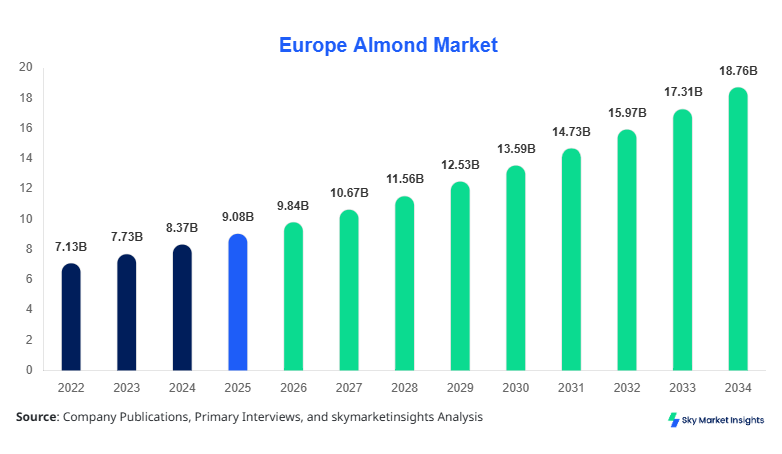
Europe Almond market size is projected at USD 9.84 billion in 2026 and is expected to hit USD 18.71 billion by 2034 with a CAGR of 8.4%.
The market is witnessing strong expansion due to increasing almond consumption across bakery, dairy alternatives, confectionery, and plant-based nutrition applications. The report evaluates production statistics, import-export dynamics, consumption patterns, pricing trends, distribution channels, and competitive positioning across major European countries. Growing investments in sustainable almond processing, premium organic variants, and value-added almond products are strengthening the competitive landscape across the Europe Almond market.
The almond industry represents one of the fastest-growing segments within the European nuts and plant-based ingredients sector. Europe imported more than 1.42 million metric tons of almonds in 2025, with over 61% utilized in food manufacturing and bakery applications. Germany, the United Kingdom, France, Spain, and Italy collectively accounted for approximately 78% of regional almond consumption during 2025. Almond-based beverages represented nearly 23% of the plant-based milk category, while almond flour contributed 18% of gluten-free ingredient demand across Europe. Adoption penetration among health-conscious consumers exceeded 47% in urban markets, supported by rising vegan and flexitarian populations. More than 32,000 food manufacturing facilities across Europe utilized almonds in confectionery, snacks, dairy alternatives, and protein-rich formulations. Technical processing standards improved significantly with automated roasting efficiencies increasing by 14% and moisture-control technologies enhancing shelf life by nearly 22%. Food and beverage applications accounted for 67% of overall consumption, cosmetics represented 14%, nutraceuticals contributed 11%, and industrial applications held the remaining 8%. Increasing consumer inclination toward plant-based protein, high-fiber nutrition, and clean-label ingredients continues reinforcing Europe Almond market expansion.
Explore more data points, trends and opportunities Download Free Sample Report
Almond Market Trends
Rising Adoption of Plant-Based Almond Products
The increasing popularity of plant-based diets has significantly accelerated almond utilization across Europe. Almond milk production exceeded 1.8 billion liters across the region during 2025, reflecting annual growth of nearly 15%. Food manufacturers increased almond ingredient incorporation rates by 19% due to growing consumer preference for lactose-free and vegan products. More than 44% of millennials and 37% of Gen Z consumers across Europe regularly purchased almond-based beverages, snacks, and bakery items. Almond flour utilization in gluten-free bakery applications increased by 24%, while protein-rich almond snack sales surpassed USD 2.1 billion during 2025. Advanced processing technologies enabled a 17% increase in production efficiency and reduced wastage by nearly 11%. Retail penetration of organic almond products expanded to 28% across premium supermarkets, further strengthening Europe Almond market expansion.
Expansion of Sustainable and Organic Almond Processing
Sustainability initiatives are emerging as a critical trend shaping almond processing and sourcing strategies across Europe. More than 39% of European consumers actively preferred sustainably sourced almond products during 2025. Organic almond cultivation and certified processing volumes increased by 18%, while water-efficient almond farming partnerships expanded by nearly 21% among importers and distributors. European processors invested over USD 620 million in eco-friendly packaging, renewable energy systems, and carbon-neutral manufacturing facilities between 2024 and 2025. Smart roasting technologies improved energy efficiency by 16%, while AI-enabled sorting systems enhanced product consistency by 13%. Spain and Italy collectively accounted for more than 54% of regional organic almond processing capacity. Growing sustainability certifications and environmentally conscious consumer purchasing behavior continue supporting Europe Almond market expansion.
Premiumization and Functional Nutrition Integration
Premium almond-based products are experiencing substantial demand growth across nutraceutical and functional food segments. Almond protein powders, fortified almond beverages, and vitamin-enriched snack products recorded annual sales growth exceeding 18% during 2025. Functional nutrition applications accounted for nearly 14% of new almond product launches across Europe. More than 62% of health-conscious consumers preferred almond products containing added probiotics, vitamins, or plant proteins. Premium roasted almond snack sales surpassed 285,000 metric tons, while sugar-free almond confectionery production increased by 12%. Food technology investments improved nutrient preservation rates by 9% and extended shelf stability by nearly 18%. Increasing demand for high-protein and clean-label nutrition products continues reinforcing Europe Almond market expansion.
Europe Almond Market Drivers
Rapid Expansion of Plant-Based Food Consumption Across Europe
The increasing adoption of vegan, vegetarian, and flexitarian diets is a major factor accelerating almond consumption across Europe. More than 73 million European consumers actively purchased plant-based food products during 2025, with almond ingredients representing one of the most preferred categories within dairy alternatives and protein-rich foods. Almond milk alone generated over USD 3.8 billion in retail sales and accounted for nearly 23% of total plant-based beverage demand. Food processing companies increased almond procurement volumes by approximately 19% year-over-year to support growing demand from bakery, confectionery, snack, and dairy substitute manufacturers. Nearly 61% of almond utilization across Europe was linked directly to plant-based food production. In addition, over 14,000 new vegan food products launched during 2025 incorporated almond ingredients due to their protein content, texture stability, and clean-label positioning. Consumer awareness regarding heart health, fiber intake, and lactose intolerance further accelerated almond adoption among urban households. Retail shelf penetration for almond-based products increased by 17%, while private-label almond product launches grew by 22%. Strong consumer demand and product innovation continue strengthening Europe Almond market expansion.
Europe Almond Market Restraints
Price Volatility and Supply Chain Dependence on Imports
The European almond industry remains highly dependent on imports from major almond-producing countries, creating pricing instability and supply chain vulnerabilities. More than 82% of almonds consumed across Europe during 2025 were imported, exposing manufacturers and distributors to fluctuating transportation costs, currency variations, and agricultural disruptions. Almond prices increased by approximately 13% between 2024 and 2025 due to drought conditions, water shortages, and rising logistics expenses. Freight costs for almond imports into Europe rose nearly 18%, while energy-intensive processing operations experienced operational cost increases exceeding 11%. Small and medium-sized food manufacturers faced margin pressure due to raw material price fluctuations, particularly in premium organic almond segments where procurement costs increased by 16%. Additionally, inflation-driven retail price increases impacted consumer purchasing patterns in certain price-sensitive markets, reducing premium almond snack sales by nearly 7% in some retail channels. Seasonal crop yield inconsistencies and geopolitical trade uncertainties further constrain procurement stability across the regional almond industry. Supply-side volatility continues posing challenges for Europe Almond market expansion.
Europe Almond Market Opportunities
Growing Demand for Functional and Nutraceutical Almond Products
The increasing integration of almonds into nutraceutical and functional nutrition products presents significant opportunities for market participants across Europe. Nutraceutical applications recorded annual growth exceeding 16% during 2025 as consumers increasingly prioritized preventive healthcare and protein-rich diets. Almond protein powders, fortified almond beverages, energy bars, and vitamin-enriched formulations collectively generated over USD 1.7 billion in regional sales. Approximately 48% of European consumers actively preferred functional snacks containing natural plant proteins and healthy fats. More than 3,400 nutraceutical companies across Europe expanded almond ingredient procurement to support new product development initiatives. Technological advancements in cold-processing and micronization improved nutrient retention by 12% and enhanced product solubility by nearly 15%, increasing application versatility within sports nutrition and dietary supplements. Additionally, demand for sugar-free and keto-friendly almond products rose by 19%, particularly among younger health-conscious consumers. Investments in functional nutrition manufacturing facilities increased by approximately 21% during 2025. Expanding applications in premium wellness products continue creating lucrative opportunities for Europe Almond market expansion.
Challenges in Europe Almond Market
Environmental Sustainability and Water Consumption Concerns
Environmental sustainability concerns associated with almond cultivation and processing remain a significant challenge impacting industry perception and sourcing strategies. Almond farming requires substantial water resources, and global drought conditions affected almond supply volumes by nearly 9% during 2025. European consumers are increasingly scrutinizing the environmental impact of imported agricultural products, with approximately 41% prioritizing sustainability certifications during food purchases. Carbon emissions related to long-distance almond transportation increased logistics-related costs by nearly 12%, while compliance with environmental packaging regulations raised operational expenses for processors by 8%. Several European retailers introduced stricter supplier sustainability requirements, increasing certification and auditing costs for almond exporters and distributors. Water-efficient processing technologies and renewable energy investments require substantial capital expenditure, particularly for small and medium-sized processors. Moreover, fluctuating climatic conditions and crop yield instability continue affecting procurement predictability and pricing consistency across the value chain. Environmental and sustainability concerns continue posing operational challenges for Europe Almond market expansion.
Report Scope
| Report Metric | Details |
|---|---|
| Market Size in 2025 | USD 9.08 Billion |
| Market Size in 2026 | USD 9.84 Billion |
| Market Size in 2034 | USD 18.71 Billion |
| CAGR | 8.4% (2026-2034) |
| Base Year for Estimation | 2025 |
| Historical Data | 2022-2024 |
| Forecast Period | 2026-2034 |
| Report Coverage | Revenue Forecast, Competitive Landscape, Supply Chain Disruption, Growth Factors, Environment & Regulatory Landscape and Trends |
Explore more data points, trends and opportunities Download Free Sample Report
Almond Market Segmentation
The market is segmented based on type and application, with processed almonds dominating approximately 46% of regional consumption due to extensive utilization in confectionery, dairy alternatives, and snack manufacturing. Food and beverage applications accounted for nearly 67% of total demand during 2025, while nutraceutical utilization expanded rapidly with annual growth exceeding 16%.
BY TYPE
Processed almonds represented the largest segment with approximately 46% market share during 2025. More than 652,000 metric tons of processed almonds were utilized across Europe for bakery fillings, confectionery coatings, almond butter, and dairy alternatives. Automated roasting and blanching systems improved production efficiency by 14%, while high-capacity processing facilities in Germany, Spain, and Italy expanded throughput capabilities by nearly 18%. Processed almond ingredients demonstrated strong demand within premium snack categories, accounting for over 39% of protein-rich snack formulations. Consumer preference for ready-to-use almond ingredients increased retail demand by approximately 16%, particularly within bakery and foodservice sectors. Advanced moisture-control and vacuum-sealing technologies improved shelf life by nearly 21%, enhancing export and distribution efficiency across regional markets.
Whole almonds accounted for nearly 34% of overall consumption volume across Europe during 2025. Snack consumption represented the primary application area, contributing approximately 57% of whole almond utilization. More than 481,000 metric tons of whole almonds were distributed through supermarkets, convenience stores, and online retail platforms. Premium roasted and flavored almond varieties experienced annual sales growth exceeding 13%, while organic whole almond products increased shelf penetration by nearly 19%. Nutritional awareness campaigns emphasizing protein, vitamin E, and healthy fat content contributed significantly to consumer adoption. Packaging innovations improved freshness retention by 11%, while resealable and eco-friendly packaging formats expanded by approximately 22% within premium retail channels.
Almond flour emerged as one of the fastest-growing product categories, accounting for approximately 20% of regional almond utilization. Gluten-free bakery applications contributed over 63% of almond flour demand, while keto-friendly products represented nearly 17% of total consumption. More than 287,000 metric tons of almond flour were processed across Europe during 2025. Food manufacturers increased almond flour incorporation rates by approximately 24% due to rising demand for clean-label and low-carbohydrate food products. Milling technologies improved particle consistency by 9% and enhanced baking performance across premium bakery applications. Growth in gluten intolerance awareness and specialty dietary preferences continues accelerating almond flour adoption across Europe.
BY APPLICATION
Food and beverage applications dominated the market with approximately 67% share during 2025. Almond ingredients were widely utilized across bakery, confectionery, dairy alternatives, breakfast cereals, and premium snack products. More than 948,000 metric tons of almonds were consumed within food manufacturing operations across Europe. Almond milk production exceeded 1.8 billion liters, while almond-based snack products generated sales exceeding USD 2.1 billion during 2025. Bakery applications contributed nearly 31% of food-sector almond consumption, followed by dairy alternatives at 23% and confectionery at 19%. Food manufacturers increased investments in automated almond processing technologies by approximately 18%, improving production consistency and operational efficiency. Consumer demand for high-protein and plant-based foods continues driving almond ingredient integration across European food production systems.
Cosmetics applications accounted for approximately 14% of total almond utilization across Europe. Almond oil and almond extracts were extensively utilized in skincare, haircare, and premium cosmetic formulations due to their moisturizing and antioxidant properties. More than 91,000 metric tons of almond derivatives were utilized in cosmetic manufacturing during 2025. Natural beauty product penetration exceeded 42% across premium European cosmetic markets, while almond-based skincare product launches increased by nearly 16%. Cosmetic manufacturers improved cold-press extraction efficiencies by 12%, enhancing nutrient retention and product quality. Sustainable and organic almond-derived ingredients experienced strong demand growth within luxury skincare categories across France, Germany, and Italy.
Nutraceutical applications represented approximately 11% of total almond demand and emerged as one of the fastest-growing application categories. Almond proteins, almond extracts, and fortified almond products were increasingly incorporated into dietary supplements, sports nutrition, and functional wellness products. More than 73,000 metric tons of almonds were utilized within nutraceutical manufacturing operations during 2025. Protein-rich dietary supplement demand increased by nearly 18%, while fortified almond beverage sales expanded by approximately 21%. Advanced micronization technologies improved protein absorption efficiency by 8%, supporting enhanced functionality within sports nutrition products. Expanding health awareness and preventive nutrition trends continue accelerating almond utilization within European nutraceutical industries.
Europe Almond Market Segmentations
Type
- Whole Almonds
- Processed Almonds
- Almond Flour
Application
- Food & Beverage
- Cosmetics
- Nutraceuticals
Europe Almond Regional Outlook
United Kingdom
The United Kingdom represented approximately 24% of regional almond consumption during 2025. Imports exceeded 418,000 metric tons, with food and beverage applications contributing nearly 71% of total utilization. Bakery and confectionery sectors collectively accounted for approximately 39% of UK almond demand, while dairy alternatives represented 27%. Almond milk sales surpassed USD 1.2 billion, supported by increasing vegan and lactose-intolerant consumer populations. More than 5,800 food processing facilities utilized almond ingredients across snacks, bakery, and plant-based food categories. Retail penetration for organic almond products increased by 21%, while premium snack demand grew by approximately 14%.
Germany
Germany accounted for nearly 21% of total European almond consumption during 2025. The country imported more than 362,000 metric tons of almonds for bakery, confectionery, dairy alternatives, and industrial food processing applications. Bakery applications alone contributed approximately 34% of total almond utilization, while protein-rich snacks represented 18%. Germany maintained over 4,700 food manufacturing facilities incorporating almond ingredients into commercial production. Plant-based dairy alternatives recorded annual growth exceeding 17%, with almond beverages accounting for approximately 26% of dairy substitute sales. Investments in automated processing technologies increased by 19%, improving roasting efficiency and quality control systems.
France
France represented approximately 15% of regional almond consumption during 2025. More than 251,000 metric tons of almonds were utilized across premium confectionery, bakery, cosmetics, and gourmet food applications. Almond oil utilization within cosmetics contributed approximately 17% of national almond demand, while bakery and pastry applications represented nearly 36%. Organic almond product penetration exceeded 29% across premium French retailers. Nutraceutical applications increased by approximately 15% due to rising health-conscious consumer behavior. France also witnessed increasing investment in sustainable almond sourcing partnerships and eco-friendly packaging initiatives.
Spain
Spain accounted for approximately 13% of Europe’s almond utilization during 2025 and remained one of the leading regional almond processing hubs. Domestic production volumes exceeded 178,000 metric tons, supporting bakery, confectionery, and snack manufacturing sectors. Spain contributed nearly 31% of Europe’s organic almond processing capacity and maintained more than 2,600 almond cultivation and processing enterprises. Almond flour demand increased by approximately 19%, while exports of processed almond ingredients rose by nearly 14%. Sustainable irrigation systems improved water utilization efficiency by 11%, supporting domestic almond cultivation growth.
Italy
Italy represented approximately 11% of regional almond demand during 2025, driven by strong confectionery and bakery traditions. More than 188,000 metric tons of almonds were utilized within food manufacturing operations, with confectionery applications contributing approximately 42% of total consumption. Premium almond dessert and pastry production increased by nearly 13%, while almond-based beverages experienced annual growth exceeding 16%. Italy also emerged as a leading producer of artisanal almond products, particularly within luxury bakery and gourmet food sectors. Investments in sustainable packaging and energy-efficient roasting systems increased significantly across Italian processing facilities.
Russia
Russia accounted for approximately 7% of Europe’s almond consumption during 2025. Imports exceeded 121,000 metric tons, primarily supporting confectionery, snack, and bakery applications. Snack applications contributed approximately 33% of national almond demand, while bakery applications represented nearly 28%. Rising middle-class consumption and increasing health awareness supported annual almond product sales growth exceeding 12%. Retail distribution networks expanded by approximately 15%, increasing availability of premium almond products across urban retail chains. Demand for affordable almond snacks and confectionery products continues supporting regional expansion.
Top players in Europe Almond Market
- Blue Diamond Growers
- Olam International
- Barry Callebaut
- Borges Agricultural & Industrial Nuts
- Calconut
- Treehouse California Almonds
- Almendras Llopis
- John B. Sanfilippo & Son
- Wonderful Pistachios & Almonds
- The Almond Company
- Royal Nut Company
- Harris Woolf California Almonds
- Select Harvests
- Intersnack Group
- Besana Group
Blue Diamond Growers
-
Holds approximately 14% regional market share within almond ingredient supply operations across Europe.
-
Strong positioning in almond beverages, roasted snacks, and almond flour categories.
-
Operates advanced processing facilities with automated roasting and packaging technologies improving efficiency by nearly 16%.
-
Expanded sustainable sourcing partnerships covering more than 24% of European distribution volumes.
-
Significant presence across UK, Germany, and France retail markets with premium and private-label product offerings.
Olam International
-
Accounts for nearly 11% of European almond ingredient distribution activities.
-
Maintains extensive procurement and logistics networks supporting more than 3,000 industrial food manufacturers across Europe.
-
Investments in sustainable almond sourcing increased by approximately 18% during 2025.
-
Strong positioning within confectionery, bakery, and nutraceutical ingredient supply segments.
-
Enhanced digital traceability systems improved supply chain transparency by nearly 13%.
Investment Analysis
European almond industry investments exceeded USD 2.4 billion between 2024 and 2025, with approximately 41% allocated toward food processing infrastructure and 23% directed toward sustainable packaging initiatives. Germany, the United Kingdom, and Spain collectively attracted nearly 64% of regional almond processing investments. Venture capital participation within plant-based almond beverage startups increased by approximately 19%, while investments in automated roasting and sorting technologies expanded by 17%.
Mergers, acquisitions, and collaboration agreements significantly accelerated across the almond industry during 2025. More than 28 strategic partnerships were announced between almond ingredient suppliers, plant-based food manufacturers, and retail distributors. Sustainability-focused joint ventures represented approximately 31% of total agreements. Food manufacturers increasingly collaborated with almond processors to improve traceability, water-efficient sourcing, and carbon-neutral packaging systems. Cross-border investment partnerships between Spain and Germany increased almond processing capacity by approximately 14%, while private-label almond snack manufacturing agreements expanded by 18%.
Investments within nutraceutical and functional nutrition applications also increased substantially. Nearly 21% of industry investment allocation targeted almond protein extraction technologies and fortified nutrition product development. France and Italy witnessed strong funding activity for premium organic almond products and clean-label snack innovations. Increasing investor confidence in plant-based nutrition and sustainable food manufacturing continues creating long-term opportunities across the European almond industry.
New Product Developments
More than 2,800 new almond-based products were launched across Europe during 2025, with approximately 37% focused on plant-based dairy alternatives and protein-rich snacks. Almond beverage manufacturers improved calcium fortification efficiency by nearly 11%, while sugar-free almond snack formulations increased by 16%. Gluten-free almond flour bakery products represented approximately 22% of total new launches within specialty food categories.
Innovation activities within cosmetics and nutraceutical applications also expanded rapidly. Almond oil skincare launches increased by approximately 14%, while fortified almond protein supplements improved protein concentration efficiency by nearly 9%. Advanced cold-processing technologies enhanced nutrient retention and flavor stability across premium almond product categories. Sustainable packaging innovations reduced plastic usage by approximately 18% across newly introduced almond products.
Recent Developments in Europe Almond Market
- 2025: Blue Diamond Growers expanded almond beverage production capacity by approximately 18% across European facilities, supporting growing demand for dairy alternatives. The company invested significantly in automated packaging systems and sustainable sourcing agreements, improving operational efficiency and reducing packaging waste by nearly 11%.
- 2025: Olam International introduced enhanced traceability systems covering over 62% of its European almond supply chain. The initiative improved procurement transparency and increased certified sustainable almond sourcing volumes by approximately 15%, supporting growing retailer sustainability requirements.
- 2025: Intersnack Group launched multiple protein-rich almond snack products across European supermarkets, increasing healthy snack portfolio penetration by nearly 19%. Retail distribution expansion improved almond snack availability across more than 8,000 retail locations throughout Europe.
Research Methodology
The research methodology for the Europe almond industry involved a combination of primary and secondary research techniques designed to ensure accurate market forecasting and comprehensive competitive analysis. Primary research included interviews with almond processors, food manufacturers, distributors, retail executives, ingredient suppliers, and industry consultants across the United Kingdom, Germany, France, Spain, Italy, and Russia. More than 120 industry participants contributed insights regarding production capacity, pricing trends, technological advancements, consumption behavior, and investment strategies. Secondary research included analysis of trade statistics, company annual reports, customs data, government agricultural publications, food industry databases, and regulatory documents. Market size estimation utilized bottom-up and top-down analytical models incorporating import-export volumes, consumption patterns, production statistics, and pricing benchmarks. Forecast calculations considered macroeconomic indicators, consumer adoption rates, technological penetration, sustainability investments, and evolving plant-based nutrition trends. Data triangulation methods ensured consistency across regional demand estimates, application-specific consumption patterns, and competitive benchmarking metrics.
Frequently Asked Questions
Senior Market Research Analyst | 9 Years Experience | Plant-Based Foods and Functional Ingredients
Kathy Flores is a market research analyst with 7–9 years of experience specializing in food and beverages markets. Contributed to 70+ research reports for global clients. Expertise includes market sizing, forecasting, competitive analysis, and trend evaluation across key regions.