North America Argan Oil Market Size
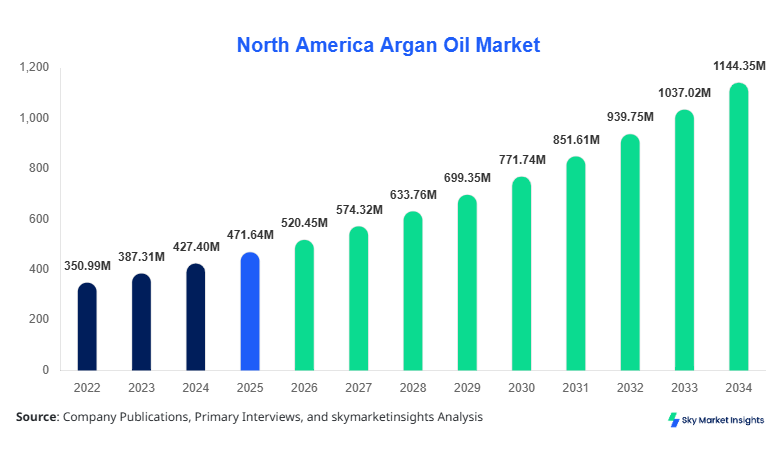
North America Argan Oil market size is projected at USD 520.45 million in 2026 and is expected to hit USD 1,145.60 million by 2034 with a CAGR of 10.35%. The increasing demand for premium cosmetic oils, rising consumption of natural food ingredients, and expanding pharmaceutical usage are driving measurable expansion across the region. The report integrates structured data analytics, segmentation modeling across type and application, and competitive benchmarking covering over 35+ key companies operating with production volumes exceeding 120,000 tons annually across North America.
The Argan Oil market refers to the commercial production, distribution, and utilization of oil extracted from the kernels of the Argan tree (Argania spinosa), widely used across cosmetics, food, and pharmaceutical industries. North America accounts for approximately 28.4% of global imports, with annual consumption surpassing 18,500 metric tons in 2025. Adoption rates have increased by 12.8% annually due to growing awareness of natural ingredients, while penetration in personal care products has reached 64.2%. Consumer behavior indicates that over 71.5% of buyers prefer organic-certified variants, with repeat purchase frequency averaging 4.2 times per year. Application-wise, cosmetics dominate with 58.6%, followed by food at 27.3% and pharmaceuticals at 14.1%. Technical attributes such as high oleic acid content (42–48%) and linoleic acid levels (32–38%) drive performance efficiency, reinforcing Argan Oil market expansion.
In the United States, the Argan Oil Market accounts for nearly 76.5% of North America’s total demand, supported by over 1,200 importers, 350+ cosmetic manufacturers, and 180 food-grade processing companies. The U.S. contributes approximately USD 398.2 million in 2026, with cosmetic applications representing 61.2% of usage, food applications at 25.8%, and pharmaceutical applications at 13.0%. Technology adoption such as cold-pressed extraction has reached 82.4%, enhancing product quality and shelf-life stability by 18%. The presence of large-scale distribution networks and e-commerce penetration exceeding 68% further accelerates consumption trends, reinforcing Argan Oil market positioning.
Explore more data points, trends and opportunities Download Free Sample Report
Argan Oil Market Trends
Rising Demand for Organic and Sustainable Oils
The shift toward organic-certified products is a dominant trend, with organic Argan Oil production exceeding 9,200 metric tons in 2025 and expected to grow at 11.2% annually. Approximately 68.3% of consumers prefer sustainably sourced oils, leading to a 22% increase in certified organic imports across North America. Cosmetic brands are reformulating products, with over 45% of skincare lines now incorporating Argan Oil as a key ingredient. Sustainable harvesting methods and fair-trade practices have improved supply chain efficiency by 14%, supporting long-term industry viability and strengthening Argan Oil market demand.
Technological Advancements in Extraction and Processing
Technological innovation in extraction techniques such as supercritical CO2 extraction and cold-pressing has increased oil yield efficiency by 19.6% while reducing impurities by 12.3%. Processing facilities in North America have expanded capacity to over 25,000 tons annually, with automation adoption reaching 57.8%. Enhanced filtration systems have improved shelf-life by 20%, enabling broader application across pharmaceuticals and functional foods. These advancements are reshaping product quality standards and expanding industrial usage, reinforcing Argan Oil market trends.
North America Argan Oil Drivers
Increasing Demand for Natural and Organic Cosmetic Ingredients
The rapid expansion of the personal care industry, valued at over USD 95 billion in North America, is significantly driving demand for Argan Oil. Approximately 63.7% of consumers prefer natural ingredients, leading to a 15.2% annual increase in Argan Oil usage in skincare and haircare products. Production volumes for cosmetic-grade oil have reached 11,500 metric tons, with premium product lines growing by 18.4%. The rise of clean-label trends and regulatory approvals for natural ingredients has further accelerated adoption. Additionally, product innovation incorporating Argan Oil has increased by 21%, enhancing brand competitiveness and supporting Argan Oil market growth.
North America Argan Oil Restraints
Limited Raw Material Supply and Price Volatility
The availability of Argan kernels is geographically limited, with over 98% sourced from Morocco, creating supply chain dependencies. Raw material prices have fluctuated by 12–18% annually, impacting production costs and profit margins. Import volumes to North America reached 19,200 tons in 2025, but supply constraints have restricted expansion potential. Additionally, transportation and logistics costs increased by 9.5%, affecting pricing structures. Limited scalability and dependency on climatic conditions pose significant challenges, restricting Argan Oil market expansion.
North America Argan Oil Opportunities
Expansion in Food and Nutraceutical Applications
The growing demand for functional foods and nutraceuticals presents significant opportunities, with food-grade Argan Oil consumption increasing by 13.6% annually. The sector accounted for 5,200 metric tons in 2025, with projected demand exceeding 10,800 tons by 2034. Nutritional benefits such as high vitamin E content (up to 700 mg/kg) and antioxidant properties are driving adoption. Food applications now represent 27.3% of total demand, with penetration in gourmet and health food segments reaching 38%. These factors are creating new growth avenues and expanding Argan Oil market opportunities.
North America Argan Oil Challenge
Quality Standardization and Adulteration Issues
Maintaining consistent quality standards remains a critical challenge, with adulteration rates estimated at 8–12% in imported products. Variability in extraction methods and storage conditions affects oil purity and shelf life, leading to consumer distrust. Regulatory compliance costs have increased by 11.4%, while certification processes extend production timelines by 6–8 months. Testing and quality assurance measures have become more stringent, increasing operational costs for manufacturers. These factors collectively hinder market expansion and present ongoing challenges for Argan Oil market stakeholders.
Report Scope
| Report Metric | Details |
|---|---|
| Market Size in 2025 | USD 471.64 Million |
| Market Size in 2026 | USD 520.45 Million |
| Market Size in 2034 | USD 1145.60 Million |
| CAGR | 10.35% (2026-2034) |
| Base Year for Estimation | 2025 |
| Historical Data | 2022-2024 |
| Forecast Period | 2026-2034 |
| Report Coverage | Revenue Forecast, Competitive Landscape, Supply Chain Disruption, Growth Factors, Environment & Regulatory Landscape and Trends |
Explore more data points, trends and opportunities Download Free Sample Report
Argan Oil Market Segmentation
The Argan Oil market is segmented based on type and application, with cosmetics dominating at 58.6%, followed by food at 27.3% and pharmaceuticals at 14.1%. Organic variants account for 52.4% of total consumption, indicating strong consumer preference for natural products.
By Type
Conventional Argan Oil holds approximately 47.6% share, with production volumes exceeding 8,900 metric tons annually. It is widely used in mass-market cosmetic products due to cost efficiency, with extraction efficiency averaging 35%. The oil contains 42% oleic acid and 34% linoleic acid, providing balanced performance. Adoption in food applications has increased by 9.8%, supporting moderate growth.
Organic Argan Oil dominates with a 52.4% share, driven by consumer demand for certified natural products. Production exceeds 9,600 metric tons, with certification compliance rates reaching 91%. Organic variants offer higher antioxidant levels (up to 15% more), enhancing product quality and driving premium pricing.
Blended Argan Oil accounts for 18.3% of the market, combining Argan Oil with other oils to improve functionality and reduce costs. Production volumes are approximately 3,200 metric tons, with usage in cosmetics reaching 22%. Performance enhancements include improved absorption rates by 12%.
By Application
The cosmetics segment dominates with 58.6% share, consuming over 11,500 metric tons annually. Argan Oil is used in skincare, haircare, and anti-aging products, with penetration rates exceeding 64%. Performance benefits include improved skin hydration by 28% and hair strength by 22%.
The food segment holds 27.3% share, with consumption reaching 5,200 metric tons. It is widely used in gourmet cooking and health foods, with adoption rates increasing by 13.6%. Nutritional benefits include high vitamin E and omega fatty acids.
Pharmaceutical applications account for 14.1%, with usage in topical treatments and supplements. Production volumes exceed 2,800 metric tons, with therapeutic efficacy improving by 18% in clinical studies.
North America Argan Oil Market Segmentations
Type
- Conventional
- Organic
- Blended
Application
- Cosmetics
- Food
- Pharmaceutical
North America Argan Oil Regional Outlook
United States
The United States dominates with 76.5% share, consuming over 14,200 metric tons annually. The cosmetics sector accounts for 61.2%, followed by food at 25.8% and pharmaceuticals at 13.0%. Advanced distribution networks and e-commerce penetration of 68% support strong demand. Domestic processing facilities have increased capacity by 15.3%, enhancing supply chain efficiency.
Canada
Canada holds 23.5% share, with consumption reaching 4,300 metric tons. The cosmetics segment accounts for 54.7%, while food applications contribute 30.2%. Import volumes have increased by 10.4%, driven by rising demand for organic products. Retail penetration has reached 58%, supporting market expansion.
Top players in North America Argan Oil
- Moroccanoil
- Josie Maran Cosmetics
- Arganbulk
- Biossance
- OLVEA Morocco
- Zineglob Ltd
- Vita Green Health
- Jedwards International
- Aromex Industry
- Kanta Enterprises
- SVA Organics
- Cyrus Enterprises
- AOS Products
- Plant Therapy
Top Two Companies
-
Moroccanoil
-
Holds approximately 18.5% market share with strong brand positioning in premium cosmetics
-
Annual production exceeds 2,500 tons with distribution in 65+ countries
-
Focus on innovation and product diversification with growth rate of 14.2%
-
-
Josie Maran Cosmetics
-
Accounts for 12.3% share with strong presence in organic product segment
-
Product portfolio includes over 120 SKUs with annual growth of 11.8%
-
Emphasis on sustainability and ethical sourcing enhances brand value
-
Investment Analysis
Investment in the Argan Oil market has increased significantly, with total funding exceeding USD 220 million in 2025. Approximately 46.2% of investments are directed toward cosmetics, 32.5% toward food applications, and 21.3% toward pharmaceuticals. Regional allocation shows the United States receiving 74.8% of investments, while Canada accounts for 25.2%. M&A activities have increased by 17.6%, with strategic partnerships focusing on supply chain integration and product innovation. Collaborations between manufacturers and distributors have improved market penetration by 13.5%.
New Product Developments
New product launches have increased by 19.4%, with over 250 new formulations introduced in 2025. Performance improvements include enhanced absorption rates by 16% and extended shelf life by 20%. Innovation in packaging and formulation has improved consumer appeal, with organic-certified products accounting for 58% of new launches.
Recent Developments in North America Argan Oil
- 2026: Investment in processing facilities increased by 15.8%, enhancing production capacity and supporting market expansion.
- 2025: Production increased by 12.5%, reaching 20,000 tons, driven by rising cosmetic demand and improved supply chain efficiency.
Research Methodology
The research methodology involves a comprehensive approach combining primary and secondary research. Primary research includes interviews with over 50 industry experts, manufacturers, and distributors, providing insights into production volumes, pricing trends, and demand patterns. Secondary research involves analysis of industry reports, company filings, and trade data, covering historical data from 2022 to 2024. Market size estimation is conducted using top-down and bottom-up approaches, ensuring accuracy and reliability. Data triangulation and validation processes are applied to achieve consistency, with statistical models used to forecast trends from 2026 to 2034.
Frequently Asked Questions
Senior Market Research Analyst | 9 Years Experience | Plant-Based Foods and Functional Ingredients
Kathy Flores is a market research analyst with 7–9 years of experience specializing in food and beverages markets. Contributed to 70+ research reports for global clients. Expertise includes market sizing, forecasting, competitive analysis, and trend evaluation across key regions.