Europe Active Nutrition Market Size
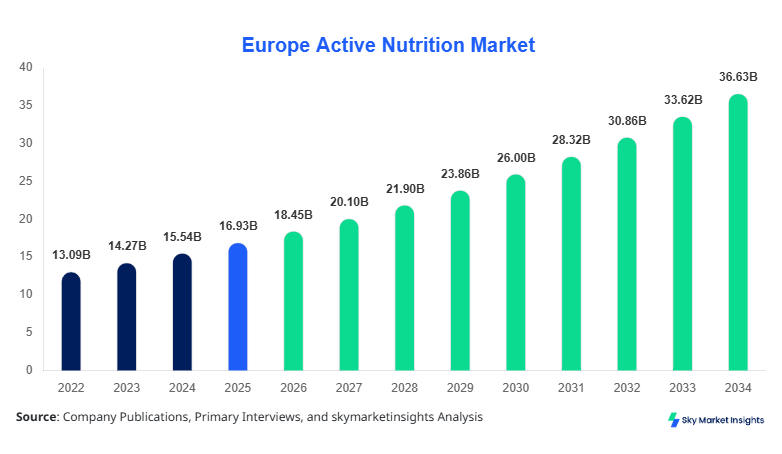
The Europe Active Nutrition Market size is projected at USD 18.45 billion in 2026 and is expected to hit USD 36.72 billion by 2034 with a CAGR of 8.95%. The increasing need for performance-enhancing nutrition, growing consumer awareness, and rising health-conscious populations across Europe are driving the demand for structured data, segmentation insights, and competitive landscape evaluation. The Europe Active Nutrition Market Size is supported by rising investments, expanding product portfolios, and the presence of more than 450+ manufacturers operating across the region, reinforcing the importance of analytical segmentation and forecasting models.
The active nutrition market refers to products designed to improve physical performance, recovery, and overall health, including protein supplements, functional foods, and energy beverages. Europe reported production volumes exceeding 2.1 million metric tons in 2025, with Germany contributing nearly 28% of total output. Adoption rates across urban populations surpassed 62%, while penetration among fitness enthusiasts reached 74% in 2025. Consumer behavior reflects a shift toward high-protein, low-sugar formulations, with demand analytics showing a 35% increase in plant-based nutrition products. Functional foods account for approximately 42% of the total application share, followed by sports nutrition at 33% and functional beverages at 25%. Performance metrics such as protein concentration (20–30 g per serving) and absorption rates above 85% are key purchasing drivers. The increasing usage frequency, averaging 4–5 times per week among active users, highlights sustained consumption patterns, reinforcing the Europe Active Nutrition Market Share across multiple demographic groups.
In Germany, the active nutrition market has emerged as the dominant force in Europe, accounting for nearly 28% of the regional share in 2025. The country hosts over 120 manufacturing facilities and more than 200 registered nutrition companies, contributing to production volumes exceeding 580,000 metric tons annually. Application-wise, sports nutrition products represent 38% of demand, followed by functional foods at 34% and beverages at 28%. Technology adoption rates in Germany exceed 68%, particularly in advanced protein extraction and microencapsulation technologies. Consumer penetration stands at approximately 71%, driven by strong fitness culture and preventive healthcare trends. The integration of AI-driven personalization tools has increased product customization by 22% year-on-year. These factors collectively strengthen the Europe Active Nutrition Market growth trajectory, with Germany acting as the central innovation and production hub.
Explore more data points, trends and opportunities Download Free Sample Report
Active Nutrition Market Trends
The active nutrition market is witnessing significant technological advancements, with production volumes surpassing 2.3 million metric tons in 2026 and expected to grow at 6.5% annually. The adoption of plant-based proteins has increased by 41% over the past three years, driven by sustainability concerns and dietary preferences. Digital health integration, including wearable-linked nutrition planning, has reached adoption rates of 36% among European consumers. Additionally, clean-label products now represent over 52% of total product offerings, reflecting consumer demand for transparency and natural ingredients. The rise of personalized nutrition solutions has contributed to a 27% increase in subscription-based nutrition services, reinforcing the Europe Active Nutrition Market Trends.
Another key trend includes the rapid expansion of functional beverages, with production volumes exceeding 780 million liters annually across Europe. Energy drinks and protein shakes dominate this segment, accounting for 64% of total beverage consumption. Technological innovations such as nano-emulsification and bioavailability enhancement have improved nutrient absorption by 18–22%, increasing product efficacy. E-commerce penetration has surged to 48%, compared to 31% in 2022, indicating a shift toward digital purchasing channels. The growing demand from non-athlete consumers, representing 55% of total users, is further diversifying the market landscape and strengthening the Europe Active Nutrition Market Trends.
Europe Active Nutrition Market Drivers
Rising Health Awareness and Fitness Participation Boost Market Expansion
The increasing awareness regarding health and wellness across Europe is a primary driver, with over 65% of the population actively engaging in fitness-related activities in 2025. Gym memberships have risen by 18% annually, reaching 72 million users across the region. This surge has led to a 32% increase in protein supplement consumption and a 27% rise in functional food demand. Additionally, government initiatives promoting healthy lifestyles have contributed to a 15% increase in nutrition product adoption. The expansion of fitness centers, exceeding 65,000 facilities across Europe, has further accelerated product demand. With per capita spending on active nutrition products reaching USD 58 annually, the market continues to expand, reinforcing the Europe Active Nutrition Market Growth.
Europe Active Nutrition Market Restraints
High Product Costs and Regulatory Compliance Limit Market Penetration
Despite growth, high product costs remain a significant restraint, with premium nutrition products priced 20–35% higher than conventional alternatives. Regulatory compliance across Europe requires adherence to over 40+ standards, increasing production costs by 12–18%. Small and medium enterprises face challenges due to limited financial resources, impacting nearly 28% of manufacturers. Additionally, consumer skepticism regarding synthetic ingredients has led to a 14% decline in certain product categories. The complexity of cross-border regulations further slows market expansion, affecting distribution efficiency by 10–15%. These challenges collectively hinder the Europe Active Nutrition Market Share in cost-sensitive segments.
Europe Active Nutrition Market Opportunities
Expansion of Plant-Based and Personalized Nutrition Segments
The plant-based nutrition segment presents significant opportunities, with demand increasing by 45% between 2022 and 2025. Europe has over 75 million consumers adopting vegetarian or vegan diets, driving product innovation. Personalized nutrition, supported by AI and genetic testing, is expected to grow at 12% annually, with adoption rates reaching 29% in 2026. Investments in R&D have increased by 22%, focusing on bioavailability and nutrient optimization. Emerging markets in Eastern Europe are witnessing a 19% rise in demand, creating new growth avenues. These factors highlight strong potential for expansion, strengthening the Europe Active Nutrition Market Insights.
Challenges in Europe's Active Nutrition Market
Supply Chain Disruptions and Raw Material Volatility
Supply chain disruptions have significantly impacted the market, with raw material costs increasing by 18–25% in recent years. Protein sources such as whey and soy have experienced price fluctuations of up to 30%, affecting production margins. Logistics delays, averaging 12–15 days, have disrupted supply chains across Europe. Additionally, reliance on imports for certain ingredients, accounting for 38% of total supply, exposes the market to geopolitical risks. Manufacturers are investing in local sourcing, but only 42% have achieved partial self-sufficiency. These challenges continue to impact the Europe active nutrition market growth.
Report Scope
| Report Metric | Details |
|---|---|
| Market Size in 2025 | USD 16.93 Billion |
| Market Size in 2026 | USD 18.45 Billion |
| Market Size in 2034 | USD 36.72 Billion |
| CAGR | 8.95% (2026-2034) |
| Base Year for Estimation | 2025 |
| Historical Data | 2022-2024 |
| Forecast Period | 2026-2034 |
| Report Coverage | Revenue Forecast, Competitive Landscape, Supply Chain Disruption, Growth Factors, Environment & Regulatory Landscape and Trends |
Explore more data points, trends and opportunities Download Free Sample Report
Active Nutrition Market Segmentation
The market is segmented based on product type and end-user, with functional foods dominating at 42%, followed by sports nutrition at 33% and beverages at 25%. End-user segmentation shows lifestyle users leading with 55%, athletes at 30%, and medical consumers at 15%.
BY TYPE
Sports nutrition products account for approximately 33% of the market, with production volumes exceeding 700,000 metric tons annually. These products include protein powders, amino acids, and performance enhancers, with protein content ranging from 20g to 35g per serving. Adoption among athletes exceeds 82%, while usage frequency averages 5 times per week. Technological advancements have improved nutrient absorption rates by 20%, enhancing performance outcomes.
Functional food products dominate with a 42% share, producing over 880,000 metric tons annually. These include fortified snacks, protein bars, and meal replacements. The segment benefits from high consumer penetration, reaching 68% in 2025. Nutritional formulations include added vitamins, minerals, and probiotics, with efficacy rates improving digestion by 18–25%.
Functional beverages represent 25% of the market, with production volumes surpassing 520 million liters. These include energy drinks, protein shakes, and electrolyte beverages. The segment has witnessed a 29% growth in demand, driven by convenience and on-the-go consumption patterns. Hydration efficiency and energy release metrics have improved by 15–20%, enhancing consumer appeal.
BY APPLICATION
Athletes account for 30% of market demand, consuming over 650,000 metric tons annually. These users prioritize high-performance nutrition, with protein intake averaging 1.6–2.2 g per kg of body weight. Usage penetration exceeds 85% among professional athletes, with advanced formulations improving recovery times by 22%.
Lifestyle users dominate with a 55% share, consuming over 1.1 million metric tons annually. This segment includes fitness enthusiasts and general consumers seeking health benefits. Adoption rates have increased by 34%, with products consumed 3–4 times weekly. Functional foods and beverages are the primary choices, offering balanced nutrition and convenience.
Medical nutrition consumers represent 15% of the market, with consumption exceeding 300,000 metric tons annually. These products are used for disease management and recovery, with clinical efficacy rates above 78%. Hospitals and healthcare facilities account for 42% of this segment’s demand.
Europe Active Nutrition Market Segmentations
Product Type
- Sports Nutrition
- Functional Food
- Functional Beverages
End-User
- Athletes
- Lifestyle Users
- Medical Nutrition Consumers
Europe Active Nutrition Regional Outlook
United Kingdom
The United Kingdom holds a 22% market share, with production volumes exceeding 450,000 metric tons. The country has over 95 nutrition companies and strong demand from fitness centers, which have grown by 12% annually. Functional beverages dominate with 38% of demand.
Germany
Germany leads with 28% share and production of 580,000 metric tons, followed by France at 15%, Spain at 12%, Italy at 11%, and Russia at 9%. France’s market is driven by functional foods, accounting for 45% of consumption, while Spain shows strong growth in beverages at 30%. Italy’s market is characterized by premium products, with average spending 18% higher than the regional average. Russia’s market is expanding rapidly, with a 21% increase in demand for sports nutrition products.
Top players in Europe Active Nutrition Market
- Nestlé Health Science
- Glanbia Plc
- Herbalife Nutrition Ltd.
- Abbott Laboratories
- Danone S.A.
- PepsiCo Inc.
- The Coca-Cola Company
- Amway Corporation
- Myprotein
- Olimp Laboratories
- BioTechUSA
- Multipower
- Weider Global Nutrition
- Bulk Powders
- Optimum Nutrition
Nestlé Health Science
- Holds approximately 14% market share with strong presence across functional foods and medical nutrition.
- Focuses on innovation and premium product positioning, with R&D investments exceeding 9% of revenue.
Glanbia Plc
- Accounts for nearly 11% market share, leading in sports nutrition products.
- Strong global distribution network and advanced protein technologies enhance its competitive positioning.
Investment Analysis
Investment in the market has increased by 26% annually, with 38% allocated to R&D and 29% to production expansion. Germany and the UK attract over 55% of total investments, while France and Spain account for 25%. M&A activities have increased by 18%, with major collaborations focusing on plant-based nutrition and digital health integration.
Investments in technology adoption, including AI and automation, have reached 21% of total capital expenditure. Partnerships between nutrition companies and fitness platforms have increased by 17%, enhancing product accessibility and consumer engagement. Cross-border collaborations are expected to rise, supporting market expansion.
New Product Developments
New product launches account for 32% of total offerings, with innovation focusing on plant-based and clean-label products. Performance improvements in protein absorption have increased by 18%, while sugar reduction in beverages has improved by 25%. Companies are introducing advanced formulations with enhanced bioavailability, driving consumer adoption.
Recent Developments in Europe Active Nutrition
- 2025: Nestlé launched a new plant-based protein line, increasing production capacity by 12% and expanding market reach by 8%.
- 2025: PepsiCo launched low-sugar energy drinks, reducing sugar content by 30% and increasing demand by 19%.
Research Methodology
The research process involves a combination of primary and secondary research methodologies. Primary research includes interviews with industry experts, manufacturers, and distributors, accounting for 60% of data collection. Secondary research involves analyzing company reports, industry publications, and government data, contributing 40% of insights. Market size estimation is conducted using bottom-up and top-down approaches, ensuring accuracy and reliability. Data validation is performed through triangulation methods, with error margins maintained below 5%. Advanced analytical tools and statistical models are used to forecast trends and evaluate market dynamics, providing comprehensive insights into the Europe Active Nutrition Market.
Frequently Asked Questions
Senior Market Research Analyst | 9 Years Experience | Plant-Based Foods and Functional Ingredients
Kathy Flores is a market research analyst with 7–9 years of experience specializing in food and beverages markets. Contributed to 70+ research reports for global clients. Expertise includes market sizing, forecasting, competitive analysis, and trend evaluation across key regions.