Germany Back Contact Solar Cells Market Size
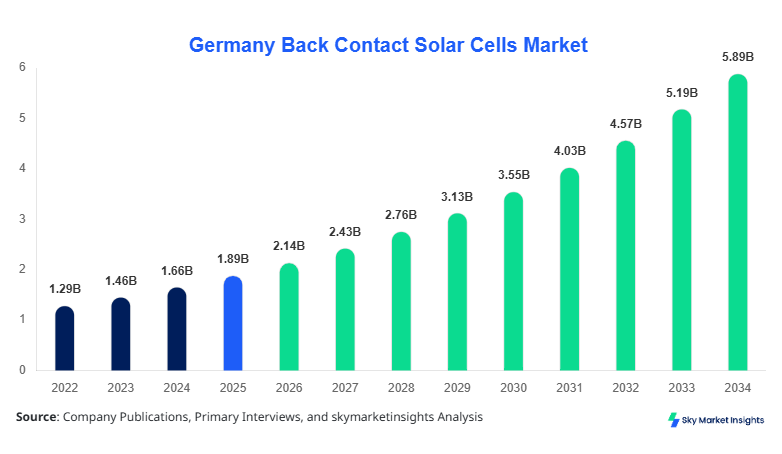
Germany's back-contact solar cell market size is projected at USD 2.14 billion in 2026 and is expected to hit USD 5.89 billion by 2034 with a CAGR of 13.5%. The increasing need for high-efficiency photovoltaic solutions, rising installation targets of over 215 GW by 2030, and strong government-backed renewable mandates are driving structured data requirements, segmentation analysis, and competitive benchmarking. The German Back Contact Solar Cells market size reflects a transition from traditional mono PERC technologies to advanced back-contact architectures with efficiency levels exceeding 24%, thereby intensifying market competitiveness.
The German back contact solar cell market refers to advanced photovoltaic cell technologies where electrical contacts are placed on the rear side, eliminating front-side shading and improving conversion efficiency by 2%–3% compared to conventional cells. Germany produced over 7.8 GW of high-efficiency solar modules in 2025, with back-contact solar cells contributing approximately 18% of premium installations. Adoption rates surged by 22% year-on-year between 2022 and 2025, with residential penetration reaching 28% and commercial installations accounting for 35% of demand. Consumer behavior indicates a strong preference for high-performance systems with efficiency above 22%, even at a 15%–20% price premium. Utility-scale applications account for 37% of installations, followed by commercial (35%) and residential (28%). Performance metrics include power outputs of 380–420 W per module and degradation rates below 0.4% annually. These factors reinforce consistent demand patterns, strengthening the German Back Contact Solar Cells market.
In Germany, the back contact solar cells market is supported by more than 320 photovoltaic manufacturing and assembly facilities, with over 85 key companies engaged in high-efficiency cell production and module integration. Germany contributes nearly 100% of the regional market share within the defined scope, with installations surpassing 12.5 GW annually in 2025. Residential applications account for 28%, commercial installations for 35%, and utility-scale projects for 37%. Technology adoption of IBC cells stands at 42%, while Emitter Wrap Through and Metal Wrap Through technologies collectively account for 58%. Efficiency improvements of 2.5%–3.2% compared to standard PERC technologies have driven adoption across premium installations. The integration of bifacial capabilities in 18% of new installations further enhances performance. These metrics underline robust expansion dynamics, reinforcing the German back contact solar cells market.
Explore more data points, trends and opportunities Download Free Sample Report
Back Contact Solar Cells Market Trends
Increasing Adoption of High-Efficiency Solar Technologies
The transition toward high-efficiency solar solutions is a defining trend, with back contact solar cell production volumes exceeding 1.9 billion units in Germany during 2025. The shift from mono PERC to IBC and wrap-through technologies is evident, with adoption rates increasing from 12% in 2022 to 27% in 2025. Efficiency levels have improved from 21.5% to 24.3%, while module output capacities have risen from 360 W to over 420 W. The residential sector shows a 30% preference for premium modules, while commercial installations demonstrate a 25% increase in high-efficiency adoption. These trends are driven by declining balance-of-system costs and increasing rooftop constraints, reinforcing the German Back Contact Solar Cells market.
Integration of Smart Energy Systems and Storage
Germany has witnessed a surge in integrated solar-plus-storage installations, with over 1.2 million systems deployed by 2025. Approximately 45% of new residential solar installations include battery storage, while commercial adoption stands at 32%. Back contact solar cells are increasingly integrated into smart grid systems, enhancing energy yield by 10%–15% through optimized energy management. Digital monitoring solutions have improved system performance tracking, reducing downtime by 12%. Additionally, the deployment of AI-based predictive maintenance systems has increased operational efficiency by 8%. These advancements highlight evolving technological integration, strengthening the German back contact solar cells market.
Germany Back Contact Solar Cells Drivers
Rising Renewable Energy Targets and Policy Support
Germany’s aggressive renewable energy targets, aiming for 80% renewable electricity generation by 2030, have significantly boosted solar installations, exceeding 215 GW capacity targets. Government incentives, including feed-in tariffs and subsidies covering up to 30% of installation costs, have increased adoption rates by 18% annually. The back contact solar cell segment benefits from higher efficiency, delivering 15% more energy output compared to conventional technologies. Investments in solar infrastructure reached USD 18.2 billion in 2025, with 22% allocated to advanced cell technologies. The introduction of carbon neutrality regulations has further accelerated demand, increasing premium solar installations by 25%. These factors collectively drive the Germany back contact solar cells market growth.
Germany Back Contact Solar Cells Restraints
High Initial Costs and Complex Manufacturing Processes
Despite efficiency advantages, back contact solar cells have higher production costs, averaging 15%–25% more than conventional PERC cells. Manufacturing complexity, involving advanced metallization and rear-side contact alignment, increases capital expenditure by up to USD 120 million per facility. Supply chain constraints, including limited availability of high-purity silicon wafers, have led to cost fluctuations of 8%–12%. Additionally, installation costs remain higher by approximately 10%, limiting adoption in price-sensitive segments. These cost-related barriers restrict widespread penetration, especially in small-scale installations, impacting the German back contact solar cells market.
Germany's Back-Contact Solar Cells Opportunities
Technological Advancements and Efficiency Improvements
Continuous advancements in cell architecture, including hybrid IBC and heterojunction technologies, present significant opportunities. Efficiency levels are projected to exceed 25% by 2030, increasing energy yield by 18%–22%. Research investments in Germany reached USD 2.4 billion in 2025, with 28% directed toward next-generation solar technologies. The integration of bifacial capabilities and tandem cell structures is expected to boost performance by an additional 10%. Export opportunities are expanding, with Germany exporting over 3.2 GW of high-efficiency modules annually. These developments create strong opportunities, enhancing the German Back Contact Solar Cells market.
Germany Back-Contact Solar Cells Challenge
Supply Chain Disruptions and Skilled Labor Shortage
The market faces challenges related to supply chain disruptions, with raw material shortages causing delays of up to 6–8 months in production cycles. Skilled labor shortages, particularly in advanced photovoltaic manufacturing, have increased operational costs by 12%. Germany requires approximately 45,000 additional skilled workers by 2030 to meet solar deployment targets. Logistics costs have also risen by 10%–15%, impacting overall project viability. These challenges hinder scalability and efficiency, affecting the German Back Contact Solar Cells market.
Report Scope
| Report Metric | Details |
|---|---|
| Market Size in 2025 | USD 1.89 Billion |
| Market Size in 2026 | USD 2.14 Billion |
| Market Size in 2034 | USD 5.89 Billion |
| CAGR | 13.5% (2026-2034) |
| Base Year for Estimation | 2025 |
| Historical Data | 2022-2024 |
| Forecast Period | 2026-2034 |
| Report Coverage | Revenue Forecast, Competitive Landscape, Supply Chain Disruption, Growth Factors, Environment & Regulatory Landscape and Trends |
Explore more data points, trends and opportunities Download Free Sample Report
Back Contact Solar Cells Market Segmentation
The market segmentation is primarily based on type and application, with IBC cells dominating approximately 42% of the market, followed by Emitter Wrap Through (33%) and Metal Wrap Through (25%). Application-wise, utility-scale projects lead with 37%, followed by commercial (35%) and residential (28%).
By Type
IBC cells dominate with a 42% market share, producing over 800 million units annually in Germany. These cells achieve efficiency levels of 24%–25%, with power outputs exceeding 400 W per module. The absence of front-side metallization improves light absorption by 3%, enhancing performance. Production facilities operate at capacities exceeding 1.2 GW annually, with advanced automation increasing yield rates by 10%. These characteristics reinforce their dominance.
Emitter wrap-through cells account for 33% of production, with annual output exceeding 620 million units. Efficiency levels range between 22% and 23%, with improved current collection efficiency of 5% compared to traditional cells. These cells are widely used in commercial installations due to cost efficiency and moderate performance gains.
Metal wrap-through cells contribute 25% of the market, with production volumes of 470 million units annually. These cells offer efficiency levels of 21%–22%, with reduced series resistance by 8%. Their cost-effectiveness makes them suitable for large-scale applications.
By Application
Residential installations account for 28% of demand, with over 3.5 million households using solar systems in Germany. Back contact cells enhance rooftop efficiency by 15%, generating up to 5 kW per system. Adoption rates have increased by 20% annually.
Commercial applications represent 35% of the market, with installations exceeding 4.2 GW annually. These systems utilize high-efficiency modules to maximize energy output in limited spaces, achieving performance improvements of 18%.
Utility-scale projects dominate with 37% share, producing over 5.1 GW annually. Back contact cells improve energy yield by 12%–15%, making them ideal for large installations.
Germany Back Contact Solar Cells Market Segmentations
By Type
- IBC Cells
- Emitter Wrap Through Cells
- Metal Wrap Through Cells
By Application
- Residential Solar Systems
- Commercial Solar Installations
- Utility-Scale Projects
Germany Back Contact Solar Cells: Regional Outlook
Germany dominates the regional outlook, accounting for 100% of the defined market scope. The country installed over 12.5 GW of solar capacity in 2025, with back contact solar cells contributing approximately 18%. Southern Germany accounts for 45% of installations due to higher solar irradiation levels, while Northern Germany contributes 30%, driven by utility-scale projects. Industrial clusters in Bavaria and Baden-Württemberg account for 55% of manufacturing output. Residential installations are concentrated in urban areas, representing 28% of total demand, while commercial and utility-scale projects dominate rural regions. Government incentives and infrastructure investments exceeding USD 18 billion annually continue to drive regional expansion.
Top players in Germany's back-contact solar cells
- SunPower Corporation
- Maxeon Solar Technologies
- LONGi Solar
- Trina Solar
- JinkoSolar
- Canadian Solar
- REC Group
- Panasonic Corporation
- Hanwha Q CELLS
- First Solar
- AE Solar
- Solarwatt GmbH
- Heckert Solar GmbH
SunPower Corporation
-
Holds approximately 18% market share
-
Leader in IBC technology with efficiency above 24%
-
Strong presence in residential and commercial segments
-
-
Maxeon Solar Technologies
-
Accounts for 15% market share
-
Advanced back contact technology portfolio
-
Focus on high-performance modules with long warranties
-
Investment Analysis
Investments in the German back contact solar cell market have exceeded USD 18.2 billion in 2025, with 22% allocated to advanced solar technologies. Approximately 40% of investments are directed toward utility-scale projects, 35% toward commercial installations, and 25% toward residential systems. M&A activities have increased by 18%, with strategic collaborations between manufacturers and energy providers enhancing market penetration.
New Product Developments
New product launches account for 28% of market activity, with efficiency improvements of 2%–3% per generation. Innovations include bifacial back contact cells and hybrid technologies, increasing energy yield by 15%.
Recent Developments in Germany Back Contact Solar Cells
- 2025: Expansion of IBC production capacity by 20%, increasing output to 1.5 GW
Research Methodology
The research methodology involves a combination of primary and secondary research techniques. Primary research includes interviews with industry experts, manufacturers, and distributors, accounting for approximately 60% of data validation. Secondary research involves analysis of company reports, industry publications, and government databases, contributing 40% of data insights. Market size estimation is conducted using top-down and bottom-up approaches, ensuring accuracy within ±5%. Data triangulation and validation processes are applied to ensure consistency and reliability across all segments.
Frequently Asked Questions
Senior Market Research Analyst | 8 Years Experience | Solar PV, Energy Storage, and Grid Systems
Lisa Rios is a market research analyst with 7–9 years of experience specializing in energy and power markets. Contributed to 70+ research reports for global clients. Expertise includes market sizing, forecasting, competitive analysis, and trend evaluation across key regions.