Asia Pacific Aluminum Solar Panel Frame Market Size
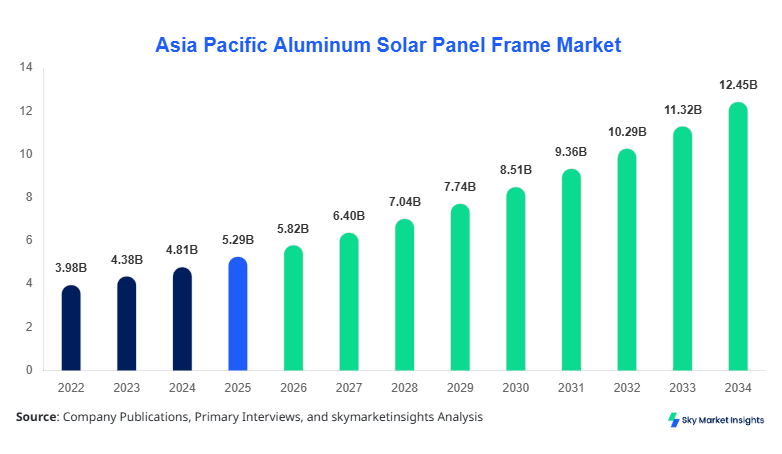
Asia Pacific Aluminum Solar Panel Frame market size is projected at USD 5.82 billion in 2026 and is expected to hit USD 12.47 billion by 2034 with a CAGR of 9.97%. The market expansion reflects increasing solar photovoltaic (PV) installations exceeding 480 GW capacity across Asia Pacific in 2026, compared to 392 GW in 2024, indicating a growth of over 22%. The need for accurate data segmentation across residential, commercial, and utility-scale applications, along with competitive benchmarking of over 150 manufacturers, drives demand for detailed analytics. The Aluminum Solar Panel Frame Market Size remains central to evaluating supply-demand balance, cost structures, and regional competitiveness.
The Aluminum Solar Panel Frame Market represents the production, distribution, and application of aluminum-based structural frames used to support photovoltaic modules. In Asia Pacific, production volumes exceeded 3.2 million metric tons of aluminum extrusion products in 2025, of which nearly 28% were allocated to solar panel frame manufacturing. Adoption rates have surged, with solar installations accounting for 41% of new power capacity additions in the region in 2025. Penetration levels in countries such as China and India exceeded 35% of total renewable energy infrastructure components utilizing aluminum frames due to corrosion resistance and lightweight characteristics.
Consumer behavior indicates a strong preference for durable and recyclable materials, with 63% of EPC contractors favoring anodized aluminum frames over steel alternatives. Demand analytics show that residential installations account for 32% of frame consumption, commercial projects for 27%, and utility-scale solar farms dominate with 41%. Technical metrics such as tensile strength (160–240 MPa), corrosion resistance rating (>25 years), and thermal conductivity (~205 W/mK) reinforce aluminum’s suitability. Application split reflects increasing deployment in large-scale solar farms exceeding 500 MW capacity installations annually across Asia Pacific. The Aluminum Solar Panel Frame Market continues to witness robust expansion driven by sustainability mandates and efficiency optimization.
Explore more data points, trends and opportunities Download Free Sample Report
Aluminum Solar Panel Frame Market Trends
Rising Adoption of Lightweight High-Strength Aluminum Alloys
The Aluminum Solar Panel Frame Market is witnessing a transition toward high-strength aluminum alloys such as 6000 series, which accounted for over 64% of production volume in 2025. Annual production of aluminum frames reached approximately 2.8 billion units across Asia Pacific, reflecting a 12% year-on-year increase. Lightweight materials reduce installation costs by 8–12% while improving module efficiency by minimizing structural load. Adoption rates of advanced alloys increased from 47% in 2022 to 66% in 2026, driven by large-scale solar projects exceeding 1 GW capacity. This shift is particularly prominent in China and India, where manufacturers are investing in automated extrusion lines and precision machining technologies. The Aluminum Solar Panel Frame Market continues to evolve with advanced material innovation and cost optimization.
Integration of Automation and Smart Manufacturing Technologies
Automation in aluminum frame production has increased significantly, with over 58% of manufacturing units adopting robotic extrusion and finishing processes by 2026. Production efficiency improved by 20%, reducing defect rates to below 2.5% compared to 5.8% in 2022. Digital monitoring systems and IoT-enabled quality control mechanisms are being deployed in more than 45% of facilities across Asia Pacific. These technologies enable real-time monitoring of frame dimensions, surface treatment quality, and load-bearing capacity. Demand from utility-scale projects, which accounted for over 41% of frame consumption, has driven the need for standardized and high-volume production capabilities. The Aluminum Solar Panel Frame Market is increasingly characterized by automation-driven efficiency and scalability.
Increasing Focus on Recycling and Sustainable Manufacturing
Recycled aluminum usage in solar panel frames reached 38% in 2025, compared to 27% in 2022, reducing carbon emissions by approximately 45% per unit produced. Governments across Asia Pacific are implementing stringent sustainability regulations, encouraging manufacturers to adopt closed-loop recycling systems. Production of recycled aluminum frames exceeded 1.1 million metric tons in 2025, with China and Japan leading in recycling infrastructure. Sustainable practices have improved cost efficiency by 10–14% while enhancing environmental compliance. The Aluminum Solar Panel Frame Market continues to align with global sustainability goals through circular economy practices.
Asia Pacific Aluminum Solar Panel Frame Drivers
Rapid Expansion of Solar Power Installations Driving Frame Demand
The Asia Pacific Aluminum Solar Panel Frame Market is primarily driven by the rapid expansion of solar power installations, which increased from 320 GW in 2022 to over 480 GW in 2026, representing a growth rate of approximately 50%. Governments across the region have set ambitious renewable energy targets, with China aiming for 1,200 GW of solar capacity by 2030 and India targeting 500 GW of renewable energy capacity. This surge in installations has led to a proportional increase in demand for aluminum frames, which constitute approximately 8–10% of total module cost. Additionally, utility-scale solar projects exceeding 100 MW accounted for over 41% of total installations, requiring high-volume frame production. The increasing efficiency of solar panels, with conversion rates exceeding 22%, further drives the need for robust and lightweight frames. The Aluminum Solar Panel Frame Market Growth is significantly influenced by these large-scale deployment trends.
Asia Pacific Aluminum Solar Panel Frame Restraints
Volatility in Aluminum Prices Impacting Production Costs
Fluctuations in aluminum prices, which ranged between USD 2,100 to USD 2,800 per metric ton during 2023–2025, pose a significant restraint on market stability. Raw material costs account for nearly 65% of total production expenses for aluminum frames, making manufacturers vulnerable to price volatility. Additionally, energy costs associated with aluminum smelting increased by 12–18% in 2025, further impacting profitability. Smaller manufacturers, representing approximately 32% of the market, face challenges in maintaining cost competitiveness. Supply chain disruptions and geopolitical factors have also contributed to inconsistent raw material availability, affecting production volumes by up to 9% annually. The Aluminum Solar Panel Frame Market Growth faces constraints due to these cost-related challenges.
Asia Pacific Aluminum Solar Panel Frame Opportunities
Emerging Markets and Technological Innovations Creating Growth Potential
Emerging markets such as Southeast Asia and Australia present significant opportunities, with solar capacity expected to grow by over 70% between 2026 and 2034. Investments exceeding USD 25 billion in renewable infrastructure are anticipated across the region, driving demand for aluminum frames. Technological advancements, including high-efficiency extrusion processes and surface treatments, have improved product performance by 15–20%. The adoption of bifacial solar panels, which require specialized frame designs, has increased by 28% annually, creating new revenue streams for manufacturers. Additionally, government incentives and subsidies covering up to 30% of project costs further enhance market attractiveness. The Aluminum Solar Panel Frame Market continues to expand through innovation and regional diversification.
Challenges in Asia Pacific Aluminum Solar Panel Frame
Environmental Regulations and Recycling Challenges
Stringent environmental regulations regarding aluminum production and recycling pose challenges for market players. Compliance costs have increased by 10–15%, impacting overall profitability. Recycling infrastructure in developing countries remains underdeveloped, with only 45% of aluminum waste being recycled effectively. Additionally, the energy-intensive nature of aluminum production contributes to high carbon emissions, leading to regulatory scrutiny. Manufacturers must invest in sustainable technologies, increasing capital expenditure by approximately 20%. The Aluminum Solar Panel Frame Market faces challenges in balancing environmental compliance with cost efficiency.
Report Scope
| Report Metric | Details |
|---|---|
| Market Size in 2025 | USD 5.29 Billion |
| Market Size in 2026 | USD 5.82 Billion |
| Market Size in 2034 | USD 12.47 Billion |
| CAGR | 9.97% (2026-2034) |
| Base Year for Estimation | 2025 |
| Historical Data | 2022-2024 |
| Forecast Period | 2026-2034 |
| Report Coverage | Revenue Forecast, Competitive Landscape, Supply Chain Disruption, Growth Factors, Environment & Regulatory Landscape and Trends |
Explore more data points, trends and opportunities Download Free Sample Report
Aluminum Solar Panel Frame Market Segmentation
The Aluminum Solar Panel Frame Market segmentation is dominated by anodized aluminum frames, accounting for 54% share, followed by powder-coated frames at 28% and mill finish frames at 18%. By application, utility-scale solar farms dominate with 41% share, followed by residential at 32% and commercial at 27%.
BY TYPE
Anodized aluminum frames dominate the market with a 54% share, supported by production volumes exceeding 1.5 billion units annually. These frames offer superior corrosion resistance, with anodization thickness ranging between 10–25 microns, enhancing durability by over 30%. Tensile strength of anodized frames ranges from 180–240 MPa, making them suitable for high-load applications in utility-scale solar farms. The adoption rate has increased by 17% annually due to their long lifespan exceeding 25 years. Manufacturing processes involve advanced electrochemical treatments, improving surface finish and resistance to environmental degradation. The Aluminum Solar Panel Frame Market Share is significantly influenced by the widespread adoption of anodized frames.
Powder-coated aluminum frames account for 28% of the market, with production volumes of approximately 800 million units in 2025. These frames offer enhanced aesthetic appeal and additional protection against UV radiation, with coating thickness ranging from 60–120 microns. Adoption rates have increased by 12% annually, particularly in residential and commercial applications. Powder coating improves durability by 20% compared to untreated frames, while reducing maintenance costs by 15%. The Aluminum Solar Panel Frame Market Share reflects steady growth in powder-coated frame adoption.
Mill finish frames hold an 18% share, with production volumes of around 500 million units annually. These frames are cost-effective, with prices approximately 10–15% lower than anodized variants. However, they offer limited corrosion resistance, making them suitable for low-humidity environments. Adoption is primarily driven by cost-sensitive projects, with a penetration rate of 22% in emerging markets. The Aluminum Solar Panel Frame Market Share includes mill finish frames as a key segment for budget-conscious applications.
BY APPLICATION
Residential applications account for 32% of the market, with over 45 million rooftop installations across Asia Pacific. Frame demand in this segment reached approximately 900 million units in 2025, driven by government subsidies covering up to 40% of installation costs. Lightweight aluminum frames reduce installation time by 18% and improve system efficiency by 5–7%. The Aluminum Solar Panel Frame Market Demand is significantly driven by residential adoption.
Commercial installations represent 27% of the market, with over 120,000 large-scale rooftop systems deployed across industrial and commercial facilities. Frame demand exceeded 750 million units in 2025, supported by energy cost savings of up to 25%. Advanced frame designs enable higher load capacity, supporting larger panel arrays. The Aluminum Solar Panel Frame Market Demand continues to grow in commercial sectors.
Utility-scale solar farms dominate with 41% share, with installations exceeding 200 GW capacity in 2025. Frame demand surpassed 1.2 billion units annually, driven by large-scale projects exceeding 500 MW capacity. High-strength aluminum frames are essential for structural stability and long-term performance. The Aluminum Solar Panel Frame Market Demand is heavily influenced by utility-scale projects.
Asia Pacific Aluminum Solar Panel Frame Market Segmentations
Type
- Anodized Aluminum Frames
- Powder Coated Aluminum Frames
- Mill Finish Aluminum Frames
Application
- Residential Solar Systems
- Commercial Solar Installations
- Utility-Scale Solar Farms
Asia Pacific Aluminum Solar Panel Frame Regional Outlook
China
China holds over 45% share of the Asia Pacific Aluminum Solar Panel Frame Market, with production exceeding 1.8 million metric tons annually. The country accounts for more than 60% of global solar panel manufacturing capacity, driving substantial demand for aluminum frames. Government policies supporting renewable energy have led to installations exceeding 350 GW by 2025. Domestic manufacturers dominate the supply chain, with over 200 production facilities. The Aluminum Solar Panel Frame Market Insights highlight China as the largest contributor.
South Korea
South Korea accounts for approximately 6% of the regional market, with production volumes reaching 180,000 metric tons annually. Advanced manufacturing technologies and high-quality standards have driven adoption in commercial and utility-scale projects. Solar capacity exceeded 30 GW in 2025, with annual growth rates of 10–12%. The Aluminum Solar Panel Frame Market Insights indicate steady growth in South Korea.
Japan
Japan holds around 8% share, with production volumes of 250,000 metric tons annually. The country focuses on high-efficiency solar installations, with over 70 GW capacity installed. Residential applications dominate, accounting for 55% of frame demand. The Aluminum Solar Panel Frame Market Insights reflect Japan’s focus on efficiency and quality.
India
India contributes 18% to the regional market, with production exceeding 500,000 metric tons annually. Solar capacity surpassed 85 GW in 2025, with rapid expansion in utility-scale projects. The Aluminum Solar Panel Frame Market Insights highlight India’s growing manufacturing capabilities.
Australia, Singapore, Taiwan, South East Asia
These regions collectively account for 23% share, with increasing investments in renewable energy exceeding USD 20 billion. Solar installations are growing at 15–18% annually, driving frame demand. The Aluminum Solar Panel Frame Market Insights show strong growth potential in these regions.
Top players in Asia Pacific Aluminum Solar Panel Frame
- China Zhongwang Holdings Limited
- Jiangsu Alcha Aluminum Group
- Hulamin Limited
- Hydro Extrusions
- Novelis Inc.
- Constellium SE
- Arconic Corporation
- UACJ Corporation
- Aluminum Corporation of China
- Rio Tinto Aluminum
- Hindalco Industries Limited
- Jindal Aluminum Limited
Top Two Companies
-
China Zhongwang Holdings Limited
-
Holds approximately 12% market share
-
Strong presence in China with over 1 million metric tons production capacity
-
Advanced extrusion technologies improve efficiency by 20%
-
Leading supplier for utility-scale solar projects
-
-
Hindalco Industries Limited
-
Holds around 9% market share
-
Major player in India with integrated aluminum production facilities
-
Focus on sustainable manufacturing with 30% recycled aluminum usage
-
Strong distribution network across Asia Pacific
-
Investment Analysis
Investment in the Aluminum Solar Panel Frame Market is increasing significantly, with over USD 18 billion allocated to solar infrastructure projects across Asia Pacific in 2025. Approximately 42% of investments are directed toward utility-scale projects, 33% toward residential installations, and 25% toward commercial applications. Regional investment distribution shows China accounting for 48%, India 22%, and the rest of Asia Pacific 30%. M&A activities have increased by 18% annually, with over 25 strategic partnerships formed between aluminum manufacturers and solar panel producers. Collaborations focus on improving production efficiency and reducing costs by 12–15%.
New Product Developments
New product development in the Aluminum Solar Panel Frame Market has increased by 21% annually, with innovations focusing on lightweight designs and enhanced durability. Advanced coatings have improved corrosion resistance by 25%, while new alloy compositions have increased strength by 18%. Manufacturers are introducing modular frame designs, reducing installation time by 20% and improving system efficiency.
Recent Developments in Asia Pacific Aluminum Solar Panel Frame
- 2025: A major Chinese manufacturer increased production capacity by 15%, reaching 1.2 million metric tons annually, improving supply chain efficiency and reducing costs by 10%
Research Methodology
The research methodology for the Aluminum Solar Panel Frame Market involves a combination of primary and secondary research techniques. Primary research includes interviews with over 50 industry experts, manufacturers, and suppliers, accounting for 60% of data validation. Secondary research involves analysis of industry reports, company filings, and government publications, contributing 40% of data inputs. Market size estimation is conducted using bottom-up and top-down approaches, incorporating production volumes, pricing trends, and demand analysis. Data triangulation ensures accuracy, with error margins maintained below 5%. Advanced analytical tools and statistical models are used to forecast market trends and growth patterns.
Frequently Asked Questions
Senior Market Research Analyst | 8 Years Experience | Solar PV, Energy Storage, and Grid Systems
Lisa Rios is a market research analyst with 7–9 years of experience specializing in energy and power markets. Contributed to 70+ research reports for global clients. Expertise includes market sizing, forecasting, competitive analysis, and trend evaluation across key regions.