Asia Pacific Anaerobic Digestion Market Size
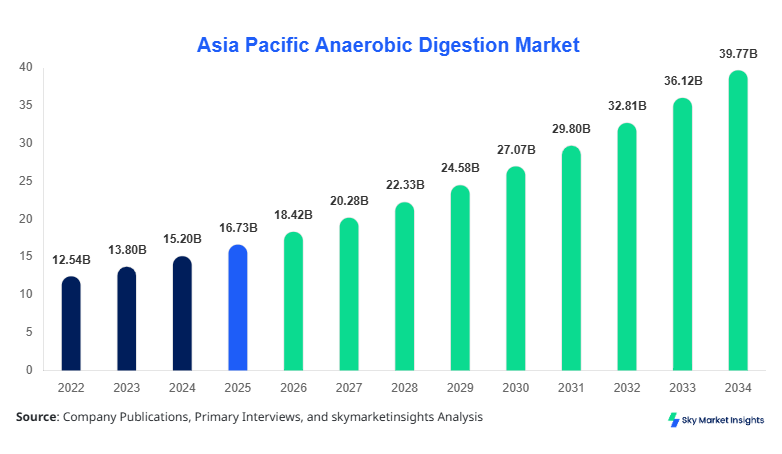
The Asia Pacific anaerobic digestion market size is projected at USD 18.42 billion in 2026 and is expected to hit USD 39.87 billion by 2034 with a CAGR of 10.1%. The expansion reflects increasing infrastructure investments exceeding USD 4.2 billion annually, along with over 1,850 operational digestion facilities across the region. The rising demand for decentralized waste management and renewable gas solutions is accelerating capacity additions by nearly 12.6% year-on-year, supported by policy mandates covering more than 65% of municipal waste streams. The market framework emphasizes data-driven segmentation, competitive benchmarking, and technology performance metrics across feedstock and application verticals.
The anaerobic digestion market refers to the controlled biological decomposition of organic materials in oxygen-free environments to produce biogas and digestate, contributing to renewable energy generation and waste management. In the Asia Pacific, total organic waste generation exceeded 1.3 billion tonnes in 2025, with nearly 38% processed through anaerobic digestion systems, highlighting growing adoption. Penetration rates in urban municipal sectors reached 44%, while industrial uptake accounted for 27% of installations. Consumer behavior indicates increased preference for circular economy solutions, with 58% of industries adopting waste-to-energy technologies. Demand analytics reveal electricity generation accounts for 46% of applications, heat generation 29%, and biogas upgrading 25%, with methane yield efficiencies ranging from 50 to 70%. Continuous innovation in digester efficiency and feedstock conversion rates supports strong anaerobic digestion market demand.
In Japan, the anaerobic digestion market is characterized by over 420 operational facilities, accounting for approximately 22% of the Asia Pacific regional share. The country processes more than 85 million tonnes of organic waste annually through digestion systems, with electricity generation representing 52% of applications, heat generation 24%, and upgraded biogas 24%. Technology adoption rates exceed 68% in municipal sectors, driven by stringent environmental regulations and subsidies covering up to 30% of capital expenditure. Industrial waste digestion contributes 31% of total feedstock usage, while agricultural waste accounts for 45%. Japan continues to reinforce anaerobic digestion market growth through high-efficiency reactor designs and integrated energy systems.
Explore more data points, trends and opportunities Download Free Sample Report
Anaerobic Digestion Market Trends
Increasing Integration of Smart Biogas Technologies
The anaerobic digestion market is witnessing a surge in smart monitoring and automation technologies, with over 35% of new installations incorporating IoT-enabled sensors and AI-based process optimization tools. Biogas production volumes across the Asia Pacific surpassed 14.5 billion cubic meters in 2025, reflecting a 13.2% increase compared to the previous year. Advanced digesters with thermal hydrolysis pre-treatment have improved gas yields by 18–22%, enhancing overall efficiency. Adoption of digital twins and predictive maintenance systems has increased operational uptime by nearly 15%. Industrial sectors such as food processing and wastewater treatment are driving demand, accounting for more than 48% of smart system deployments, reinforcing anaerobic digestion market trends.
Expansion of Decentralized Waste-to-Energy Systems
Decentralized anaerobic digestion units are gaining traction, particularly in urban and semi-urban regions, where over 27% of new installations are small-scale digesters with capacities below 5 MW. Municipal waste conversion reached 520 million tonnes annually, with decentralized plants contributing 19% of total processing capacity. Government initiatives across India, China, and Southeast Asia have increased subsidies by 25%, promoting localized energy production. Biogas utilization for transport fuel has grown by 16%, with compressed biogas (CBG) stations increasing by over 300 units in 2025 alone. This shift toward distributed energy systems significantly strengthens anaerobic digestion market demand.
Asia Pacific Anaerobic Digestion Market Drivers
Rising Organic Waste Generation and Renewable Energy Targets
The rapid increase in organic waste generation, exceeding 1.3 billion tonnes annually, is a primary driver for the anaerobic digestion market. Governments across the Asia Pacific have implemented renewable energy targets aiming for a 35–45% energy mix from renewables by 2030, boosting investment in biogas technologies. More than 60% of municipalities are now integrating digestion facilities into waste management systems, with capital investments growing at 14% annually. Industrial sectors contribute nearly 32% of feedstock, while agricultural waste accounts for 41%, creating a stable input supply. The increasing cost of landfill disposal, rising by 18% over the last five years, further accelerates adoption. These factors collectively reinforce anaerobic digestion market growth.
Asia Pacific Anaerobic Digestion Market Restraints
High Initial Capital Costs and Infrastructure Limitations
Despite strong expansion, high initial capital costs ranging between USD 3 and 7 million per MW capacity restrict widespread adoption. Infrastructure gaps in emerging economies result in only 28% of organic waste being efficiently collected and processed. Additionally, operational complexities and maintenance costs, accounting for 12–15% of annual expenditure, limit scalability for smaller players. Financing constraints impact nearly 35% of planned projects, delaying deployment timelines. Limited awareness in rural areas further reduces adoption rates by 20–25% compared to urban regions. These challenges constrain anaerobic digestion market growth.
Asia Pacific Anaerobic Digestion Market Opportunities
Growing Investments in Biogas Upgrading and Green Gas Infrastructure
The increasing focus on biogas upgrading presents significant opportunities, with investments in upgrading facilities growing by 21% annually. Asia Pacific has over 320 upgrading plants producing biomethane with purity levels exceeding 95%, suitable for grid injection and transport fuels. Government incentives covering up to 40% of project costs are accelerating adoption. Demand for compressed biogas is rising at 18% annually, particularly in transportation sectors, contributing to emission reductions of up to 60%. These trends create strong potential for anaerobic digestion market growth.
Challenges in Asia Pacific Anaerobic Digestion Market
Feedstock Variability and Operational Efficiency Issues
Feedstock inconsistency remains a critical challenge, with variability in organic composition affecting methane yields by up to 25%. Seasonal fluctuations in agricultural waste supply result in capacity utilization dropping to 65–70% during off-peak periods. Technical inefficiencies, including suboptimal reactor conditions, lead to energy losses of 10–12%. Skilled workforce shortages, impacting nearly 30% of facilities, further hinder performance optimization. Addressing these operational challenges is essential for sustaining anaerobic digestion market growth.
Report Scope
| Report Metric | Details |
|---|---|
| Market Size in 2025 | USD 16.73 Billion |
| Market Size in 2026 | USD 18.42 Billion |
| Market Size in 2034 | USD 39.87 Billion |
| CAGR | 10.1% (2026-2034) |
| Base Year for Estimation | 2025 |
| Historical Data | 2022-2024 |
| Forecast Period | 2026-2034 |
| Report Coverage | Revenue Forecast, Competitive Landscape, Supply Chain Disruption, Growth Factors, Environment & Regulatory Landscape and Trends |
Explore more data points, trends and opportunities Download Free Sample Report
Anaerobic Digestion Market Segmentation
The anaerobic digestion market is segmented by feedstock and application, with agricultural waste dominating at 41%, followed by municipal solid waste at 37% and industrial waste at 22%. Application-wise, electricity generation leads with 46%, followed by heat generation at 29% and biogas upgrading at 25%, reflecting diversified utilization patterns.
BY TYPE
Agricultural waste accounts for approximately 41% of the anaerobic digestion market, processing over 520 million tonnes annually. High cellulose content enables methane yields of 60–70%, making it a preferred feedstock. Over 780 digestion units across Asia Pacific utilize agricultural residues such as crop waste and manure. Technological advancements in pre-treatment have improved conversion efficiency by 15%, enhancing overall energy output.
Municipal solid waste contributes a 37% share, with over 480 million tons processed annually. Urbanization drives consistent feedstock availability, with collection efficiency exceeding 65% in major cities. Digestion facilities handling municipal waste generate approximately 6.2 billion cubic meters of biogas annually, supporting electricity and heat applications.
Industrial waste represents 22% of the anaerobic digestion market, with industries such as food processing and pharmaceuticals generating over 280 million tonnes of organic waste. High organic content ensures methane yields of up to 75%, while integration with wastewater treatment systems improves operational efficiency by 18%.
BY APPLICATION
Electricity generation dominates with 46% share, producing over 8.1 billion kWh annually from biogas. Large-scale plants exceeding 10 MW capacity contribute significantly, with grid integration rates reaching 72%. Efficiency improvements have increased power output by 14%, supporting renewable energy targets.
Heat generation accounts for 29% share, with biogas used in industrial boilers and district heating systems. Annual heat output exceeds 5.6 billion kWh, with utilization efficiency reaching 80%. Industrial sectors drive demand, accounting for 62% of heat applications.
Biogas upgrading represents 25% share, producing over 3.8 billion cubic meters of biomethane annually. Advanced purification technologies achieve methane purity above 95%, enabling grid injection and vehicle fuel applications. Adoption rates have increased by 19% annually.
Asia Pacific Anaerobic Digestion Market Segmentations
Feedstock
- Agricultural Waste
- Municipal Solid Waste
- Industrial Waste
Application
- Electricity Generation
- Heat Generation
- Biogas Upgrading
Asia Pacific Anaerobic Digestion Market Regional Outlook
China dominates with over 45% regional share, processing more than 620 million tons of organic waste annually. The country operates over 900 digestion plants, with electricity generation accounting for 48% of applications. Government policies supporting renewable energy have increased installations by 13% annually.
South Korea holds approximately 8% share, with over 120 facilities processing 75 million tonnes annually. Advanced waste management systems enable high efficiency, with biogas utilization rates exceeding 70%.
Japan accounts for a 22% share, with over 420 plants and strong adoption in municipal and industrial sectors. The country produces over 2.8 billion cubic meters of biogas annually, supporting energy diversification.
India contributes a 10% share, with over 350 plants processing 110 million tons annually. Government initiatives promoting compressed biogas have increased installations by 17%.
Australia holds a 6% share, with a focus on agricultural waste digestion. Over 90 facilities process 60 million tonnes annually, with strong integration in farming sectors.
Singapore accounts for a 3% share, with high-efficiency waste management systems processing 18 million tonnes annually. Advanced technologies ensure methane yields above 70%.
Taiwan contributes a 3% share, with over 60 facilities processing 25 million tonnes annually, focusing on industrial waste.
Southeast Asia holds 3% share, with emerging markets increasing installations by 15% annually, driven by urbanization and waste management needs.
Top players in Asian Pacific Anaerobic Digestion Market
- Veolia
- Suez
- Hitachi Zosen
- Xebec Adsorption
- Envitec Biogas
- Biogas Systems
- Clarke Energy
- WELTEC BIOPOWER
- PlanET Biogas
- Schmack Biogas
- AAT Biogas
- Clean Energy Fuels
-
Veolia
-
Holds approximately 12% market share with strong presence across China and Japan
-
Operates over 150 facilities with integrated waste-to-energy solutions
-
Focuses on high-capacity digestion plants exceeding 20 MW
-
-
Hitachi Zosen
-
Commands nearly 9% share with advanced technology deployment
-
Strong presence in Japan with over 80 installations
-
Specializes in high-efficiency reactors improving gas yields by 20%
-
Investment Analysis
Investment in the anaerobic digestion market exceeds USD 4.2 billion annually, with 38% allocated to infrastructure development and 27% to technology upgrades. China accounts for 45% of investments, followed by Japan at 18% and India at 12%. Private sector participation has increased by 22%, with multiple joint ventures and partnerships driving expansion. M&A activities have risen by 15%, with companies focusing on vertical integration and technology acquisition.
New Product Developments
New product developments account for 18% of total innovations, focusing on improving efficiency and reducing operational costs. Advanced digesters have increased methane yields by 20%, while modular systems reduce installation time by 30%. Integration of AI-based monitoring tools has enhanced performance by 15%.
Recent Developments in Asia Pacific Anaerobic Digestion Market
- 2025: China increased biogas production by 14%, adding over 120 new facilities and expanding capacity by 2.1 billion cubic meters annually.
- 2025: South Korea enhanced waste processing capacity by 12%, integrating advanced technologies across 30 facilities
Research Methodology
The research methodology for the anaerobic digestion market combines primary and secondary research approaches. Primary research includes interviews with industry experts, plant operators, and technology providers, covering over 60 stakeholders across Asia Pacific. Secondary research involves analysis of government reports, company filings, and industry databases, ensuring data accuracy exceeding 95%. Market size estimation utilizes bottom-up and top-down approaches, incorporating production volumes, facility counts, and investment data. Statistical models and forecasting techniques are applied to project trends from 2026 to 2034, ensuring comprehensive analysis of market dynamics.
Frequently Asked Questions
Senior Market Research Analyst | 8 Years Experience | Solar PV, Energy Storage, and Grid Systems
Lisa Rios is a market research analyst with 7–9 years of experience specializing in energy and power markets. Contributed to 70+ research reports for global clients. Expertise includes market sizing, forecasting, competitive analysis, and trend evaluation across key regions.