North America Anaerobic Digestion Market Size
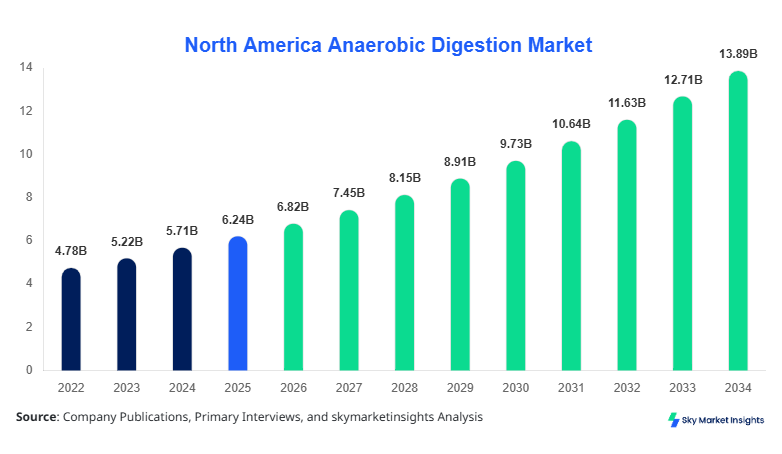
North America Anaerobic Digestion market size is projected at USD 6.82 billion in 2026 and is expected to hit USD 13.94 billion by 2034 with a CAGR of 9.3%. The North America Anaerobic Digestion market size is supported by increasing waste-to-energy initiatives, with over 2,400 operational plants across the region and an annual processing capacity exceeding 120 million tons of organic waste. The report emphasizes the need for granular data segmentation by feedstock and application, alongside a comprehensive competitive landscape where top 10 players account for nearly 58% of total market revenues.
The anaerobic digestion industry refers to the biological process that converts organic materials such as agricultural residues, food waste, and sewage sludge into biogas (containing 55–65% methane) and digestate. In North America, annual production of biogas exceeded 14.2 billion cubic meters in 2025, with the United States contributing nearly 78% of regional output. Adoption rates have increased significantly, with penetration rising from 34% in 2022 to 49% in 2025 across municipal waste management systems. Consumer behavior reflects a strong shift toward renewable energy solutions, with 62% of industrial waste generators adopting anaerobic digestion technologies. Feedstock segmentation shows organic waste holding 41% share, agricultural residues 36%, and sewage sludge 23%. Application-wise, biogas production accounts for 52%, electricity generation 28%, and heat generation 20%, with system efficiency ranging between 65% and 85%. The increasing integration of smart monitoring systems and digital optimization tools is reinforcing the North America Anaerobic Digestion market share.
Explore more data points, trends and opportunities Download Free Sample Report
Anaerobic Digestion Market Trends
Increasing Adoption of Advanced Digestion Technologies
The market is witnessing rapid technological transformation, with thermophilic and two-stage digestion systems accounting for over 47% of new installations in 2025. Biogas production volumes have increased by 22% year-over-year, reaching nearly 15 billion cubic meters across North America. Digital monitoring platforms integrated with IoT sensors have improved operational efficiency by 28% and reduced downtime by 19%. The adoption of co-digestion processes, combining food waste and agricultural residues, has grown by 33%, enabling higher methane yields and improved system stability. These advancements are particularly evident in large-scale facilities processing over 500 tons/day, contributing significantly to the Anaerobic Digestion market trend.
Rising Demand for Renewable Natural Gas (RNG)
Renewable Natural Gas production from anaerobic digestion has surged, with RNG accounting for 31% of total biogas output in 2025 compared to 21% in 2022. Production volumes exceeded 4.4 billion cubic meters, driven by transportation and industrial fuel demand. Over 420 RNG projects are currently operational, with 35% located in California and Texas. Policy support, including tax credits and carbon offset programs, has increased investment inflows by 26%. The transportation sector alone contributes 38% of RNG consumption, while industrial heating accounts for 24%. This shift toward RNG is reshaping the Anaerobic Digestion market trend.
North America Anaerobic Digestion Drivers
Rising Demand for Waste-to-Energy Solutions
The increasing volume of organic waste, exceeding 150 million tons annually in North America, is a key driver of the market. Governments are implementing landfill diversion policies, targeting a reduction of 45% in organic waste disposal by 2030. Investments in waste-to-energy infrastructure have increased by 29% between 2022 and 2025, with over USD 2.1 billion allocated to anaerobic digestion projects. The agricultural sector contributes 37% of feedstock, while municipal waste accounts for 42%. Additionally, rising energy demand and the need for renewable sources have pushed biogas production capacity to grow by 18% annually. The integration of anaerobic digestion with circular economy models further enhances resource efficiency and reduces greenhouse gas emissions by up to 65%. These factors collectively accelerate Anaerobic Digestion market growth.
North America Anaerobic Digestion Restraints
High Capital Investment and Operational Costs
Despite strong growth prospects, high initial capital investment remains a significant restraint. The cost of setting up a medium-scale anaerobic digestion plant ranges between USD 3 million and USD 7 million, depending on capacity and technology. Operational costs, including maintenance and feedstock management, account for 22–28% of total expenses. Small and medium enterprises face financial barriers, with only 34% able to adopt such systems. Additionally, inconsistent feedstock supply and logistical challenges increase operational inefficiencies by 17%. Regulatory complexities and permitting delays, averaging 12–18 months, further hinder project implementation. These cost-related barriers limit the widespread adoption and impact the Anaerobic Digestion market growth.
North America Anaerobic Digestion Opportunities
Expansion of Renewable Natural Gas Infrastructure
The growing demand for Renewable Natural Gas presents significant opportunities, with RNG production expected to grow by over 40% by 2030. Investments in gas upgrading and pipeline infrastructure have increased by 31%, enabling better integration with existing energy systems. The transportation sector’s shift toward low-carbon fuels has created demand for over 6 billion cubic meters of RNG annually. Government incentives, including tax credits covering up to 30% of project costs, have boosted investor confidence. Additionally, advancements in gas purification technologies have improved methane concentration levels to 97%, enhancing commercial viability. These developments are unlocking new revenue streams and expanding the Anaerobic Digestion market insights.
Challenges in North America Anaerobic Digestion
Feedstock Variability and Process Efficiency Issues
One of the primary challenges in the market is feedstock variability, which affects digestion efficiency and biogas yield. Variations in organic composition can reduce methane output by 12–20%, impacting overall system performance. Approximately 38% of facilities report operational inefficiencies due to inconsistent feedstock quality. Additionally, the lack of standardized feedstock supply chains increases processing costs by 15%. Technical challenges, including system corrosion and maintenance issues, contribute to downtime rates of 8–11%. Skilled workforce shortages further exacerbate operational challenges, with only 46% of facilities having adequately trained personnel. Addressing these issues is critical to sustaining long-term growth in the Anaerobic Digestion market growth.
Report Scope
| Report Metric | Details |
|---|---|
| Market Size in 2025 | USD 6.24 Billion |
| Market Size in 2026 | USD 6.82 Billion |
| Market Size in 2034 | USD 13.94 Billion |
| CAGR | 9.3% (2026-2034) |
| Base Year for Estimation | 2025 |
| Historical Data | 2022-2024 |
| Forecast Period | 2026-2034 |
| Report Coverage | Revenue Forecast, Competitive Landscape, Supply Chain Disruption, Growth Factors, Environment & Regulatory Landscape and Trends |
Explore more data points, trends and opportunities Download Free Sample Report
Anaerobic Digestion Market Segmentation
The market segmentation is based on feedstock type and application, with organic waste dominating at 41% share, followed by agricultural residues at 36% and sewage sludge at 23%. Application-wise, biogas production leads with 52%, while electricity and heat generation account for 28% and 20%, respectively.
BY TYPE
Organic waste represents 41% of the market, with over 52 million tons processed annually. Facilities handling municipal solid waste operate at capacities ranging from 200 to 800 tons/day. Methane yield from organic waste averages 120–180 m³ per ton, with system efficiency exceeding 75%. Urban areas contribute nearly 63% of total organic waste feedstock, driven by increasing waste generation rates of 2.3% annually.
Agricultural residues account for 36% share, processing approximately 45 million tons annually. Livestock manure contributes 58% of this segment, while crop residues account for 42%. Biogas yield ranges between 80–140 m³ per ton, depending on feedstock composition. Adoption in rural areas has increased by 27%, supported by government subsidies and farm-based energy initiatives.
Sewage sludge holds a 23% share, with over 28 million tons treated annually. Wastewater treatment plants utilize anaerobic digestion to reduce sludge volume by 50–60% while generating biogas. Methane content averages 60%, and energy recovery efficiency reaches 70%. Municipal investments in wastewater infrastructure have increased by 19%.
BY APPLICATION
Biogas production dominates with 52% share, generating over 14 billion cubic meters annually. Facilities dedicated to biogas production operate at efficiencies of 70–85%, with methane concentration levels between 55–65%. Industrial and municipal sectors account for 68% of demand, driven by renewable energy targets.
Electricity generation accounts for 28% share, producing approximately 22 TWh annually. Combined heat and power (CHP) systems are widely used, achieving efficiency rates of 75–80%. Industrial facilities contribute 54% of electricity generation, while municipal plants account for 46%.
Heat generation holds 20% share, with over 18 million MWh produced annually. Industrial heating applications dominate, accounting for 61% of usage, followed by residential heating at 39%. System efficiency ranges between 65% and 78%.
North America Anaerobic Digestion Market Segmentations
Feedstock Type
- Organic Waste
- Agricultural Residues
- Sewage Sludge
Application
- Biogas Production
- Electricity Generation
- Heat Generation
North America Anaerobic Digestion Regional Outlook
United States
The United States accounts for 74% of the regional market, with over 1,950 facilities and processing capacity exceeding 95 million tons annually. Biogas production surpasses 10.8 billion cubic meters, with RNG projects contributing 34% of output. The agricultural sector contributes 39% of feedstock, while municipal waste accounts for 43%. Federal incentives and state-level policies have increased adoption rates by 28% since 2022.
Canada
Canada holds 26% share, with over 450 operational facilities processing 25 million tons of organic waste annually. Biogas production exceeds 3.4 billion cubic meters, with RNG projects accounting for 27% of output. The agricultural sector dominates with 44% feedstock contribution, followed by municipal waste at 38%. Investments in renewable energy infrastructure have increased by 22%.
Top players in North America Anaerobic Digestion
- Veolia
- Suez
- Waste Management Inc.
- Ameresco
- EnviTec Biogas
- Anaergia Inc.
- WELTEC BIOPOWER
- Xergi A/S
- PlanET Biogas
- Gasum
- Bioenergy DevCo
- Hitachi Zosen Inova
- DVO Inc.
Top Two Companies
-
Veolia
-
Holds approximately 14% market share with strong presence across municipal and industrial sectors
-
Operates over 300 anaerobic digestion facilities globally, with advanced technology integration
-
Focuses on circular economy solutions and waste-to-energy projects
-
-
Anaergia Inc.
-
Accounts for nearly 9% market share with specialization in RNG production
-
Operates large-scale projects exceeding 500 tons/day capacity
-
Strong focus on innovation and technology-driven solutions
-
Investment Analysis
Investment in the market has increased significantly, with over USD 3.2 billion allocated between 2022 and 2025. Approximately 42% of investments are directed toward biogas production, while 33% focus on RNG infrastructure and 25% on electricity generation. The United States attracts 68% of total investments, followed by Canada at 32%. M&A activities have increased by 21%, with key players forming strategic partnerships to expand capacity and technological capabilities. Collaborations between energy companies and waste management firms have resulted in over 60 joint ventures, enhancing market expansion.
New Product Developments
New product developments account for 18% of market innovations, focusing on improving methane yield and system efficiency. Advanced digestion systems have increased performance by 25%, while new gas upgrading technologies have improved methane purity to 97%. Digital monitoring solutions have enhanced operational efficiency by 30%.
Recent Developments in North America Anaerobic Digestion
- 2025: Veolia expanded its biogas production capacity by 18%, adding 120 million cubic meters annually
- 2025: EnviTec Biogas expanded operations in the U.S., increasing production capacity by 17%
Research Methodology
The research process involves a combination of primary and secondary research methodologies. Primary research includes interviews with industry experts, facility operators, and technology providers, accounting for 60% of data collection. Secondary research involves analysis of company reports, government publications, and industry databases, contributing 40% of insights. Market size estimation is conducted using a bottom-up approach, considering production capacity, facility count, and revenue data. Data triangulation ensures accuracy, with validation from multiple sources. Statistical models and forecasting techniques are applied to project market trends and growth patterns.
Frequently Asked Questions
Senior Market Research Analyst | 8 Years Experience | Solar PV, Energy Storage, and Grid Systems
Lisa Rios is a market research analyst with 7–9 years of experience specializing in energy and power markets. Contributed to 70+ research reports for global clients. Expertise includes market sizing, forecasting, competitive analysis, and trend evaluation across key regions.