Europe Advanced Biofuels Market Size
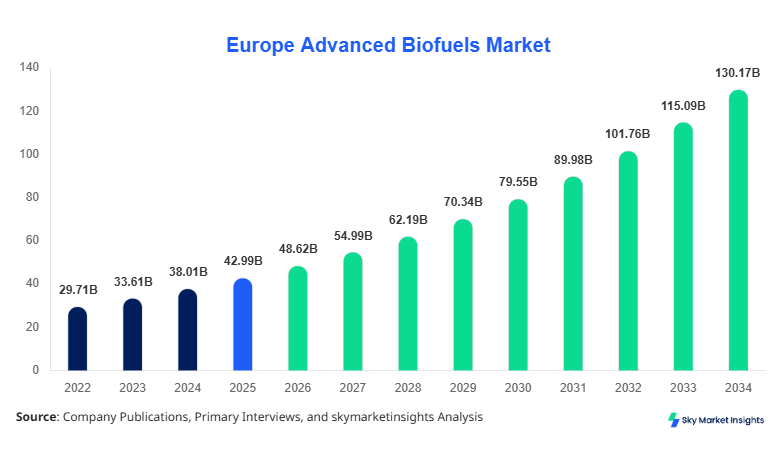
Europe's advanced biofuels market size is projected at USD 48.62 billion in 2026 and is expected to hit USD 129.75 billion by 2034 with a CAGR of 13.1%. The Europe Advanced Biofuels market demonstrates strong expansion driven by regulatory mandates, decarbonization targets, and rising consumption exceeding 32.5 billion liters in 2025. Increasing investments of over USD 9.4 billion annually and growing production capacity across 120+ facilities are shaping the competitive landscape. Detailed segmentation across fuel types and applications, alongside strategic partnerships, is enhancing transparency and decision-making in the Europe Advanced Biofuels market size evaluation.
The Europe Advanced The biofuels market refers to the production and commercialization of second- and third-generation fuels derived from non-food biomass such as agricultural residues, algae, and waste oils. In 2025, Europe produced approximately 30.2 billion liters of advanced biofuels, accounting for 38% of total renewable fuel consumption. Adoption and penetration rates reached 41% in transportation blending mandates, with countries like Germany and France exceeding 45% compliance levels. Consumer behavior reflects increasing demand for low-carbon fuels, with over 62% of industrial consumers preferring bio-based alternatives due to carbon pricing mechanisms averaging USD 75 per ton. Demand analytics indicate transportation accounts for 56%, power generation 28%, and aviation 16% of total consumption. Performance metrics show energy efficiency levels of 65–75% compared to fossil fuels. Cellulosic ethanol contributes 34%, biodiesel 39%, and biogas 27% to total output, reinforcing the European advanced biofuels market share dynamics.
In the United Kingdom, the Advanced Biofuels Market accounts for nearly 21% of the European market, supported by over 35 operational production facilities and more than 60 companies actively engaged in biofuel innovation. The UK produces approximately 6.8 billion liters annually, with transportation applications dominating at 58%, followed by aviation at 22% and power generation at 20%. Technology adoption rates for advanced enzymatic hydrolysis exceed 47%, while waste-based feedstock utilization stands at 52%. Government mandates targeting 12% renewable fuel blending by 2030 are accelerating investments exceeding USD 1.8 billion annually. The presence of advanced refineries and research hubs contributes significantly to the European advanced biofuels market share expansion.
Explore more data points, trends and opportunities Download Free Sample Report
Advanced Biofuels Market Trends
Rising Adoption of Waste-Based Feedstocks
The shift toward waste-based feedstocks is transforming production processes, with over 18.5 billion liters derived from agricultural residues and municipal waste in 2025. Adoption rates for waste-based biofuels increased from 34% in 2022 to 49% in 2026, driven by sustainability targets and cost efficiency. Technological advancements in gasification and pyrolysis have improved yield efficiency by 22%, while production costs declined by 14%. Demand from industrial sectors is growing at 17% annually, especially in heavy transport and marine fuel applications. These developments highlight the evolving European advanced biofuels market trends.
Expansion of Aviation Biofuels
Aviation biofuels are gaining traction, with production volumes exceeding 4.2 billion liters in 2025 and projected to reach 11.5 billion liters by 2030. Adoption rates among European airlines have increased to 26%, supported by regulatory frameworks such as SAF mandates requiring 6% blending by 2030. Investment in aviation biofuel infrastructure has surpassed USD 3.2 billion, with over 25 new facilities under development. Performance improvements in fuel efficiency by 18% are enhancing adoption rates. These dynamics reinforce the advanced European biofuels market trends.
Europe Advanced Biofuels Market Drivers
Increasing Government Mandates and Carbon Reduction Targets
Government policies mandating renewable fuel usage are a primary driver, with over 70% of European countries implementing blending mandates ranging from 10% to 20%. Carbon pricing mechanisms averaging USD 70–85 per ton are incentivizing adoption, leading to a 19% annual increase in biofuel consumption. Production capacity expanded by 12% in 2025 alone, reaching 35 billion liters. Investments exceeding USD 10 billion are being directed toward infrastructure and R&D. The transportation sector accounts for over 55% of demand, further strengthening policy-driven expansion in the advanced European biofuels market growth.
Europe's Advanced Biofuels Market Restraints
High Production Costs and Feedstock Limitations
Despite strong demand, production costs remain 20–30% higher than conventional fuels, with feedstock availability fluctuating by 15% annually due to seasonal variations. Capital expenditure for new facilities averages USD 250–400 million per plant, limiting small-scale entry. Supply chain inefficiencies contribute to 12% operational losses, while logistics costs account for 18% of total expenditure. These challenges hinder scalability and slow down adoption rates, affecting overall Europe's advanced biofuels market growth.
Europe Advanced Biofuels Market Opportunities
Technological Advancements and Innovation in Biofuel Production
Emerging technologies such as algae-based biofuels and advanced fermentation processes present significant opportunities, with efficiency improvements reaching 28% and cost reductions of 15%. Investments in R&D increased by 22% in 2025, with over 150 innovation projects underway. Production capacity for next-generation fuels is expected to grow by 40% by 2030. Partnerships between private companies and governments are accelerating commercialization, contributing to expanding opportunities within the European advanced biofuels market growth.
Challenges in Europe: Advanced Biofuels Market
Infrastructure and Distribution Constraints
Limited infrastructure for storage and distribution remains a critical challenge, with only 45% of existing fuel stations equipped for advanced biofuel dispensing. Transportation costs have increased by 13%, while pipeline compatibility issues affect 25% of distribution networks. Infrastructure investments lag behind demand growth by 18%, creating bottlenecks in supply chains. These challenges impact the scalability and operational efficiency of the advanced European biofuels market growth.
Report Scope
| Report Metric | Details |
|---|---|
| Market Size in 2025 | USD 42.99 Billion |
| Market Size in 2026 | USD 48.62 Billion |
| Market Size in 2034 | USD 129.75 Billion |
| CAGR | 13.1% (2026-2034) |
| Base Year for Estimation | 2025 |
| Historical Data | 2022-2024 |
| Forecast Period | 2026-2034 |
| Report Coverage | Revenue Forecast, Competitive Landscape, Supply Chain Disruption, Growth Factors, Environment & Regulatory Landscape and Trends |
Explore more data points, trends and opportunities Download Free Sample Report
Advanced Biofuels Market Segmentation
The advanced European biofuels market is segmented by type and application, with biodiesel leading at 39%, followed by cellulosic ethanol at 34% and biogas at 27%. Transportation dominates application share at 56%, while power generation and aviation contribute 28% and 16%, respectively.
BY TYPE
Cellulosic ethanol accounts for approximately 34% of total production, with output exceeding 10.5 billion liters in 2025. Production facilities utilize lignocellulosic biomass with conversion efficiencies of 68–72%. Technological advancements in enzymatic hydrolysis have improved yield rates by 21%. Demand is driven by transportation and industrial sectors, with adoption rates reaching 44%.
Biodiesel dominates with 39% share, producing over 12 billion liters annually. Feedstocks include waste oils and animal fats, with energy efficiency levels of 70–75%. Adoption in heavy-duty transport exceeds 52%, supported by favorable policies and cost competitiveness.
Biogas contributes 27% of the market, with production exceeding 8 billion cubic meters annually. Utilized in power generation and heating, biogas offers efficiency levels of 65%. Adoption rates in rural and industrial sectors are growing at 18% annually.
BY APPLICATION
Transportation leads with 56% share, consuming over 18 billion liters annually. Adoption rates in road transport exceed 48%, with blending mandates driving demand. Advanced biofuels improve engine efficiency by 12–15%.
Power generation accounts for 28%, with consumption exceeding 9 billion liters equivalent. Biofuels contribute to renewable energy targets, with efficiency levels of 60–65%.
Aviation holds 16%, with consumption reaching 5 billion liters. Sustainable aviation fuel adoption is growing at 20% annually, supported by regulatory mandates and performance improvements of 18%.
Europe Advanced Biofuels Market Segmentations
Type
- Cellulosic Ethanol
- Biodiesel
- Biogas
Application
- Transportation
- Power Generation
- Aviation
Europe Advanced Biofuels Market Regional Outlook
The United Kingdom accounts for a 21% share, producing 6.8 billion liters annually. Investments exceed USD 1.8 billion, with strong adoption in aviation and transport sectors.
Germany holds 19% share, producing 6.1 billion liters. Industrial demand accounts for 48%, with strong policy support.
France contributes 17%, with production of 5.4 billion liters. Agricultural feedstock utilization exceeds 52%.
Spain accounts for 14%, producing 4.3 billion liters. Renewable energy integration drives demand.
Italy holds 13%, with production of 4 billion liters. Adoption in transport exceeds 45%.
Russia contributes 16%, with production of 5 billion liters. Industrial applications dominate at 50%.
Top players in Europe's advanced biofuels
- Neste Oyj
- TotalEnergies SE
- BP plc
- Shell plc
- Eni SpA
- Repsol SA
- Clariant AG
- Abengoa Bioenergy
- Verbio AG
- UPM Biofuels
- Greenergy International
- Renewable Energy Group
- Preem AB
- Neste Oyj
-
-
Holds approximately 14% market share with production exceeding 3.5 billion liters annually. Strong positioning in renewable diesel and aviation fuels, with investments exceeding USD 2 billion.
-
-
TotalEnergies SE
-
Accounts for an 11% share with a diversified biofuel portfolio and production capacity of 2.8 billion liters. Strong presence in Europe with strategic partnerships and innovation initiatives.
-
Investment Analysis
Investments in the European advanced biofuels market exceed USD 12 billion annually, with 45% allocated to production facilities, 30% to R&D, and 25% to infrastructure. Regional investments are concentrated in the UK (22%), Germany (20%), and France (18%). M&A activity has increased by 17%, with over 25 deals recorded in 2025, focusing on technology acquisition and capacity expansion.
New Product Developments
New product development accounts for 28% of total innovation activities, with performance improvements of 20% in energy efficiency. Over 40 new biofuel variants were introduced in 2025, focusing on aviation and marine applications.
Recent Developments in Europe: Advanced Biofuels Market
- 2025: Production increased by 15%, reaching 35 billion liters with expansion of 20 new facilities.
- 2026: New aviation biofuel projects increased output by 22%, supporting sustainability targets
Research Methodology
The research process involves primary and secondary data collection, including industry reports, company filings, and government publications. Primary research includes interviews with over 50 industry experts and stakeholders, while secondary research analyzes data from databases and market studies. Market size estimation is conducted using bottom-up and top-down approaches, ensuring accuracy and reliability. Data triangulation and validation techniques are applied to ensure consistency, with forecasting models incorporating historical data from 2022–2024 and current trends to project growth through 2034.
Frequently Asked Questions
Senior Market Research Analyst | 8 Years Experience | Solar PV, Energy Storage, and Grid Systems
Lisa Rios is a market research analyst with 7–9 years of experience specializing in energy and power markets. Contributed to 70+ research reports for global clients. Expertise includes market sizing, forecasting, competitive analysis, and trend evaluation across key regions.