Europe Anaerobic Digestion Market Size
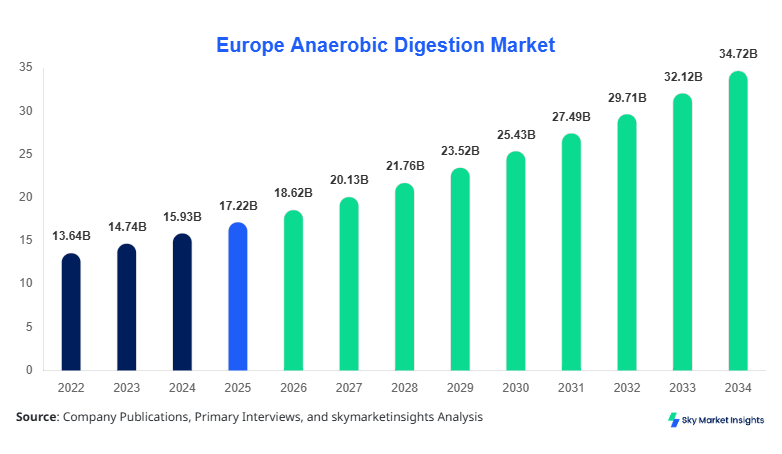
Europe Anaerobic Digestion market size is projected at USD 18.62 billion in 2026 and is expected to hit USD 34.71 billion by 2034 with a CAGR of 8.1%. The expanding deployment of biogas infrastructure, rising investments in waste-to-energy projects, and increasing renewable gas consumption across Europe are contributing significantly to industry expansion. More than 19,500 anaerobic digestion facilities are currently operational across Europe, processing over 1.4 billion tons of organic waste annually. The industry landscape is increasingly characterized by advanced digestion technologies, public-private partnerships, and integration of biomethane into national gas grids. Detailed segmentation based on feedstock, application, and country-level performance highlights evolving competitive intensity and long-term infrastructure investments across the Europe Anaerobic Digestion market.
The anaerobic digestion industry refers to the biological conversion of organic matter into biogas and digestate under oxygen-free conditions. The process is widely used for treating agricultural residues, food waste, sewage sludge, industrial organic waste, and municipal solid waste. Europe produced more than 22 billion cubic meters of biogas in 2025, with approximately 68% generated through anaerobic digestion systems. Germany, Italy, France, and the United Kingdom collectively accounted for nearly 71% of total regional production capacity. Adoption rates across industrial and municipal sectors increased by 14.8% between 2023 and 2025 due to stricter landfill diversion targets and carbon neutrality policies. Consumer demand for renewable natural gas rose sharply, with biomethane injection into European gas grids crossing 6.4 billion cubic meters in 2025. Agricultural feedstock contributed around 44% of total processed volume, while municipal organic waste represented 31% and industrial residues accounted for 25%. Operational efficiency levels improved significantly, with modern digesters achieving methane yields above 62% and energy conversion efficiencies reaching 85%. Demand analytics indicate strong growth from transport fuel applications, district heating systems, and decentralized power generation facilities, reinforcing long-term expansion across the Europe Anaerobic Digestion market.
Explore more data points, trends and opportunities Download Free Sample Report
Anaerobic Digestion Market Trends
Expansion of Biomethane Upgrading Infrastructure
The increasing adoption of biomethane upgrading technologies is one of the most influential developments across the industry. Europe added over 420 new biomethane upgrading facilities between 2023 and 2025, increasing total regional upgrading capacity by approximately 19.6%. Pressure swing adsorption and membrane separation technologies accounted for nearly 63% of newly commissioned systems because of higher methane purity rates exceeding 97%. Countries including Germany, France, and Italy significantly expanded renewable gas grid connectivity, with biomethane injection volumes crossing 6.4 billion cubic meters in 2025 compared to 4.8 billion cubic meters in 2022. The transport sector also witnessed rising demand for compressed biomethane fuels, particularly in commercial fleets and public transportation networks. Nearly 22% of European renewable transport fuel consumption originated from anaerobic digestion-derived biomethane in 2025. The integration of digital monitoring systems and AI-based process optimization further improved operational uptime by 13.4%, reinforcing technological advancement across the Anaerobic Digestion market.
Rising Industrial Waste Processing Capacity
Industrial waste treatment through anaerobic digestion systems has accelerated significantly due to stricter waste disposal regulations and sustainability targets. Food processing industries, breweries, pulp and paper facilities, and pharmaceutical manufacturers collectively generated more than 240 million tons of organic industrial waste in Europe during 2025. Around 46% of these residues were treated through anaerobic digestion facilities compared to 37% in 2022. High-solid digestion systems gained considerable traction because of their ability to process concentrated organic waste with methane yields exceeding 550 cubic meters per ton. The chemical and food industries increased renewable energy procurement from biogas by nearly 18.2% between 2023 and 2025. Industrial co-digestion facilities processing multiple waste streams also expanded by 15.9%, improving energy efficiency and digestate quality. Growing industrial decarbonization initiatives continue to generate significant opportunities across the Anaerobic Digestion market.
Integration of Circular Economy Models
The incorporation of circular economy principles into waste management strategies has accelerated regional deployment of anaerobic digestion infrastructure. More than 61% of municipalities across Western Europe implemented separate organic waste collection systems by 2025, compared to 49% in 2021. Digestate utilization as organic fertilizer increased by 17.3%, reducing dependency on synthetic fertilizers and lowering agricultural carbon emissions. Several countries established nutrient recovery targets, driving investment in phosphorus and nitrogen extraction technologies integrated with digestion systems. Europe processed approximately 520 million tons of biodegradable municipal waste through circular waste recovery models during 2025. Public awareness regarding renewable energy and sustainable waste management also improved significantly, with household organic waste segregation rates reaching 72% in Germany and 64% in France. These developments continue to support long-term adoption across the Anaerobic Digestion market.
Europe Anaerobic Digestion Drivers
Strong Renewable Energy Policies and Waste Diversion Regulations
Government-led renewable energy mandates and landfill diversion regulations are major growth stimulators for the industry. The European Union targeted a 55% reduction in greenhouse gas emissions by 2030, encouraging rapid deployment of renewable gas technologies. More than EUR 18 billion was allocated toward renewable energy and circular economy projects between 2023 and 2025. Organic landfill bans implemented across Germany, France, and the Netherlands significantly increased feedstock availability for digestion facilities. Europe generated approximately 1.4 billion tons of biodegradable waste annually, with only 58% currently processed through sustainable recovery systems, creating strong infrastructure expansion potential. Subsidy schemes and renewable gas purchase agreements improved investment confidence, resulting in a 16.1% rise in new anaerobic digestion facility approvals during 2025. Additionally, electricity generation from biogas reached nearly 74 TWh in Europe, representing a substantial share of renewable baseload energy production. Favorable policy support and carbon reduction commitments continue to strengthen the Europe Anaerobic Digestion market.
Europe Anaerobic Digestion Restraints
High Capital Costs and Operational Complexity
Despite increasing adoption, the industry faces considerable challenges related to high capital investment requirements and operational complexities. Construction costs for medium-scale anaerobic digestion plants range between EUR 3 million and EUR 15 million depending on capacity and upgrading technologies. Advanced biomethane upgrading systems increase project expenditures by nearly 25% to 40%. Smaller municipalities and agricultural operators often struggle to secure financing due to long payback periods averaging 7 to 12 years. Operational inefficiencies such as feedstock contamination, methane leakage, and digestate management can reduce plant performance by 8% to 14%. Maintenance costs for combined heat and power units also increased by 11.6% during 2025 because of rising component prices and stricter emission compliance standards. Inconsistencies in subsidy structures across different European countries further create uncertainty for investors. These economic and operational barriers continue to limit rapid expansion across certain segments of the Europe Anaerobic Digestion market.
Europe Anaerobic Digestion Opportunities
Expansion of Renewable Transport Fuel Applications
The growing use of biomethane as a renewable transport fuel presents significant expansion opportunities across Europe. Renewable fuel consumption in heavy-duty transportation increased by 21.4% during 2025, with biomethane accounting for nearly 18% of alternative fuel usage in commercial fleets. More than 7,200 biomethane-powered buses and 14,000 heavy trucks were operational across Europe by the end of 2025. Governments introduced tax incentives and low-carbon fuel standards supporting fleet conversion toward renewable gas technologies. The maritime sector is also exploring liquefied biomethane applications, with pilot projects expanding across Scandinavian countries and Germany. Investment in refueling infrastructure increased by approximately 26.7% between 2023 and 2025, creating additional demand for upgraded biogas production. The integration of carbon capture technologies with anaerobic digestion systems is expected to improve carbon intensity reduction performance by more than 35%. These trends are expected to create long-term opportunities within the Europe Anaerobic Digestion market.
Challenges in Europe Anaerobic Digestion
Feedstock Supply Variability and Infrastructure Limitations
Feedstock availability and logistics remain significant concerns for industry participants. Seasonal agricultural residue fluctuations can reduce digestion plant utilization rates by 10% to 18% during certain periods. Transportation costs for organic waste increased by nearly 13.9% in 2025 due to rising fuel prices and collection inefficiencies. Many rural regions lack integrated waste collection infrastructure, limiting feedstock aggregation capabilities. Municipal contamination rates in segregated organic waste streams still exceed 12% in several Southern and Eastern European countries, reducing digestion efficiency and increasing processing costs. Infrastructure bottlenecks associated with gas grid connectivity and biomethane injection approvals also delay project commissioning timelines by an average of 8 to 14 months. In addition, public opposition toward waste processing facilities in densely populated regions creates permitting challenges. Addressing these infrastructure and feedstock management issues remains critical for sustained expansion across the Europe Anaerobic Digestion market.
Report Scope
| Report Metric | Details |
|---|---|
| Market Size in 2025 | USD 17.22 Billion |
| Market Size in 2026 | USD 18.62 Billion |
| Market Size in 2034 | USD 34.71 Billion |
| CAGR | 8.1% (2026-2034) |
| Base Year for Estimation | 2025 |
| Historical Data | 2022-2024 |
| Forecast Period | 2026-2034 |
| Report Coverage | Revenue Forecast, Competitive Landscape, Supply Chain Disruption, Growth Factors, Environment & Regulatory Landscape and Trends |
Explore more data points, trends and opportunities Download Free Sample Report
Anaerobic Digestion Market Segmentation
The market is segmented by feedstock and application, with agricultural waste accounting for approximately 44% of total processed volume during 2025. Municipal waste represented 31%, while industrial organic waste contributed 25%. On the application side, power generation remained dominant with 41% share, followed by biomethane production at 34% and heat generation at 25%.
By Type
Agricultural waste remains the dominant feedstock segment due to the abundance of livestock manure, crop residues, and energy crops across Europe. The segment processed more than 610 million tons of organic material in 2025, accounting for approximately 44% of regional feedstock consumption. Germany, France, and Italy collectively represented over 67% of agricultural digestion capacity. Methane yields from maize silage and livestock slurry reached between 280 and 520 cubic meters per ton depending on feedstock composition. Farm-scale digesters operating below 500 kW capacity accounted for 46% of agricultural installations. Government subsidies for manure management and nutrient recycling continue to encourage adoption. Advanced co-digestion systems integrating food waste with manure improved gas output by nearly 19%, strengthening operational efficiency across the segment.
Municipal solid waste digestion has expanded significantly due to landfill diversion targets and urban sustainability initiatives. Around 430 million tons of municipal organic waste were generated across Europe in 2025, with nearly 39% processed through anaerobic digestion facilities. Source-separated food waste collection increased substantially in urban centers, particularly in France, Spain, and the United Kingdom. Municipal digestion facilities commonly operate under wet digestion systems with retention periods ranging from 15 to 28 days. Biogas yields from municipal waste average between 110 and 220 cubic meters per ton depending on contamination levels. Public-private partnerships and smart waste collection systems improved feedstock recovery rates by 14.2%, enhancing municipal digestion efficiency across the region.
Industrial waste digestion facilities are witnessing rapid deployment among food processing, beverage, dairy, and pharmaceutical industries. Industrial feedstock processing exceeded 350 million tons in 2025, accounting for nearly 25% of regional digestion input volumes. High-strength wastewater digestion systems demonstrated methane yields above 600 cubic meters per ton of volatile solids. Breweries and dairy facilities represented around 37% of industrial digestion installations. Rising wastewater treatment costs and corporate carbon reduction goals accelerated industrial adoption. Advanced thermophilic digestion technologies improved pathogen reduction efficiency by 98%, supporting broader industrial integration.
By Application
Power generation continues to dominate application demand due to widespread deployment of combined heat and power systems. Europe generated approximately 74 TWh of electricity from anaerobic digestion facilities in 2025, with Germany alone contributing nearly 32% of output. Combined heat and power units typically operate at electrical efficiencies between 35% and 42%, while total energy efficiency exceeds 80%. Agricultural plants represented more than half of installed electricity generation capacity. Renewable electricity incentives and feed-in tariff programs supported long-term investments. Grid stabilization benefits associated with baseload renewable power generation further reinforced deployment across industrial and municipal sectors.
Heat generation applications remain essential for district heating systems, industrial steam generation, and agricultural operations. Nearly 28 million households across Europe benefited from renewable heat generated through biogas systems during 2025. Industrial cogeneration applications accounted for approximately 38% of total heat utilization. Waste heat recovery systems integrated with anaerobic digesters improved thermal efficiency by 17%. Scandinavian countries and Germany witnessed strong growth in district heating integration projects utilizing upgraded biogas. Heat-focused digestion plants processing agricultural residues increased by 12.4% between 2023 and 2025.
Biomethane production represents the fastest expanding application segment due to renewable gas demand from transport and industrial sectors. Europe operated more than 1,500 biomethane upgrading facilities by 2025 with total production exceeding 6.4 billion cubic meters annually. Membrane upgrading technologies accounted for nearly 39% of installations, followed by pressure swing adsorption systems at 34%. Transport fuel applications represented approximately 42% of biomethane consumption. Gas grid injection projects expanded rapidly across France, Germany, and Italy due to decarbonization mandates. Biomethane purity levels commonly exceed 97%, supporting compatibility with existing natural gas infrastructure.
Europe Anaerobic Digestion Market Segmentations
Feedstock
- Agricultural Waste
- Municipal Solid Waste
- Industrial Waste
Application
- Power Generation
- Heat Generation
- Biomethane Production
Europe Anaerobic Digestion Regional Outlook
United Kingdom
The United Kingdom accounted for approximately 14% of the regional industry value in 2025 with more than 730 operational anaerobic digestion facilities. Agricultural digestion represented nearly 49% of total installations, while municipal waste treatment contributed 34%. The country processed approximately 38 million tons of organic waste annually through anaerobic systems. Renewable transport fuel demand increased substantially, with biomethane-powered buses and trucks growing by 18.6% during 2025. Government-backed renewable heat incentives and landfill reduction policies continue supporting infrastructure expansion.
Germany
Germany remained the largest regional contributor with around 34% industry share and more than 9,700 anaerobic digestion plants. Total installed electrical generation capacity exceeded 5.8 GW in 2025. Agricultural feedstocks dominated national production volumes, while biomethane grid injection expanded rapidly through more than 250 upgrading facilities. Germany also led Europe in digestate nutrient recycling, with over 82 million tons of digestate applied in agricultural applications annually.
France
France represented nearly 16% of the regional market value due to rapid growth in municipal waste digestion and biomethane projects. More than 1,850 anaerobic digestion facilities were operational by 2025, processing around 92 million tons of organic waste annually. Biomethane injection capacity increased by 22% during 2025, supported by favorable feed-in tariffs and renewable gas targets. Agricultural waste accounted for approximately 47% of total feedstock consumption.
Spain
Spain experienced strong deployment of industrial and municipal digestion systems, accounting for approximately 8% of regional revenue in 2025. Food processing and agricultural sectors generated substantial feedstock volumes exceeding 48 million tons annually. Municipal organic waste collection initiatives improved feedstock segregation rates by 15.4% between 2023 and 2025. The country also invested heavily in biomethane infrastructure to support transport fuel decarbonization goals.
Italy
Italy accounted for nearly 12% of the regional industry value, supported by extensive agricultural biogas infrastructure. More than 2,200 anaerobic digestion facilities operated across the country in 2025. Biomethane production capacity crossed 1.1 billion cubic meters annually due to government incentives promoting renewable transport fuels. Agricultural residues and livestock manure represented around 58% of total feedstock utilization across Italian digestion systems.
Russia
Russia maintained emerging development potential within the regional landscape despite lower deployment levels compared to Western Europe. The country processed approximately 14 million tons of organic waste through digestion systems in 2025. Industrial wastewater treatment projects represented more than 41% of operational capacity. Renewable energy diversification initiatives and agricultural modernization programs are expected to support future expansion across the sector.
Top players in Europe Anaerobic Digestion
- Veolia
- Engie
- EnviTec Biogas AG
- WELTEC BIOPOWER
- PlanET Biogas
- Hitachi Zosen Inova
- TotalEnergies
- Biogen
- Nature Energy
- Gasum
- Future Biogas
- AB Holding
- Agraferm Technologies AG
- Xergi
- BioConstruct GmbH
Veolia
-
Veolia accounted for approximately 8.4% of the regional industry share in 2025 through extensive municipal waste treatment and renewable energy operations.
-
The company operates large-scale digestion and biomethane projects across France, Germany, and the United Kingdom.
-
Veolia processed more than 32 million tons of organic waste annually through integrated waste recovery systems.
-
Strong positioning in municipal contracts and circular economy projects supports long-term competitive advantage.
EnviTec Biogas AG
-
EnviTec Biogas AG represented nearly 6.9% of regional project deployment activity during 2025.
-
The company specializes in agricultural digestion systems, biomethane upgrading, and renewable transport fuel infrastructure.
-
EnviTec commissioned more than 150 new upgrading facilities across Europe between 2022 and 2025.
-
Strong expertise in membrane upgrading and decentralized farm-scale projects strengthens its technological positioning.
Investment Analysis
Investment activity across Europe accelerated significantly due to renewable energy transition targets and circular economy initiatives. More than EUR 18 billion was invested in anaerobic digestion and biomethane infrastructure between 2023 and 2025. Germany accounted for approximately 29% of total regional investment, followed by France at 21% and Italy at 14%. Biomethane upgrading infrastructure attracted nearly 38% of total funding allocations, while municipal waste digestion projects represented 27%. Agricultural digestion systems accounted for approximately 24% of investment activity.
Institutional investors and energy utilities increasingly pursued acquisitions and strategic collaborations to expand renewable gas portfolios. More than 75 M&A agreements and partnership deals were recorded across Europe during 2025. Energy companies focused heavily on integrating carbon capture systems with digestion plants to improve low-carbon fuel production. Public-private collaboration projects increased by 16.4%, particularly in municipal waste management infrastructure. Green bonds and sustainability-linked financing instruments represented nearly 31% of total project financing during 2025.
Cross-border partnerships also intensified as European countries sought regional renewable gas integration. France and Germany announced multiple joint biomethane infrastructure initiatives supporting transnational energy security objectives. Venture capital investment in advanced digestion technologies and digital process optimization platforms increased by 18.9% during 2025, demonstrating growing investor confidence in long-term sector profitability.
New Product Developments
Technology providers introduced advanced digestion systems with significantly improved methane recovery rates and reduced operating costs during 2025. New membrane upgrading technologies improved methane purity efficiency from 96% to over 99%, while reducing energy consumption by approximately 14%. High-solid thermophilic digesters capable of processing mixed organic waste streams witnessed strong commercialization across industrial applications.
Manufacturers also introduced AI-driven monitoring systems capable of reducing plant downtime by 17% and improving feedstock conversion efficiency by nearly 12%. Modular biomethane upgrading units gained popularity among small and medium-scale agricultural operators because of lower installation costs and flexible scalability. Advanced nutrient recovery technologies integrated with digestate processing systems further improved fertilizer output quality and nutrient extraction efficiency.
Recent Developments in Europe Anaerobic Digestion
- 2025: Veolia expanded its biomethane operations across France and Germany by commissioning multiple upgrading facilities capable of processing over 1.8 million tons of organic waste annually. The expansion improved renewable gas production capacity by approximately 16% while reducing landfill dependency across municipal waste streams.
- 2025: EnviTec Biogas AG introduced a next-generation membrane upgrading platform delivering methane purity levels exceeding 99%. The company reported a 13% improvement in operational efficiency and expanded biomethane injection projects across agricultural facilities in Germany and Italy.
Research Methodology
The research process involved comprehensive collection and evaluation of quantitative and qualitative data related to the European anaerobic digestion industry. Primary research included interviews with biogas technology providers, renewable energy utilities, waste management companies, government agencies, and industrial stakeholders across Germany, France, Italy, Spain, and the United Kingdom. More than 120 industry participants contributed operational insights regarding production capacities, feedstock availability, investment trends, and technology adoption rates.
Secondary research involved analysis of renewable energy databases, corporate annual reports, government publications, trade journals, environmental agency statistics, and industry association reports. Data triangulation techniques were used to validate market estimates and regional production figures. Market size estimation was conducted using bottom-up and top-down methodologies, incorporating facility capacities, biomethane output volumes, renewable energy investments, and feedstock processing statistics. Forecast projections were developed using historical deployment patterns, policy frameworks, infrastructure investments, and renewable gas demand trends across Europe between 2026 and 2034.
Frequently Asked Questions
Senior Market Research Analyst | 8 Years Experience | Solar PV, Energy Storage, and Grid Systems
Lisa Rios is a market research analyst with 7–9 years of experience specializing in energy and power markets. Contributed to 70+ research reports for global clients. Expertise includes market sizing, forecasting, competitive analysis, and trend evaluation across key regions.