United States Advanced Biofuels Market Size
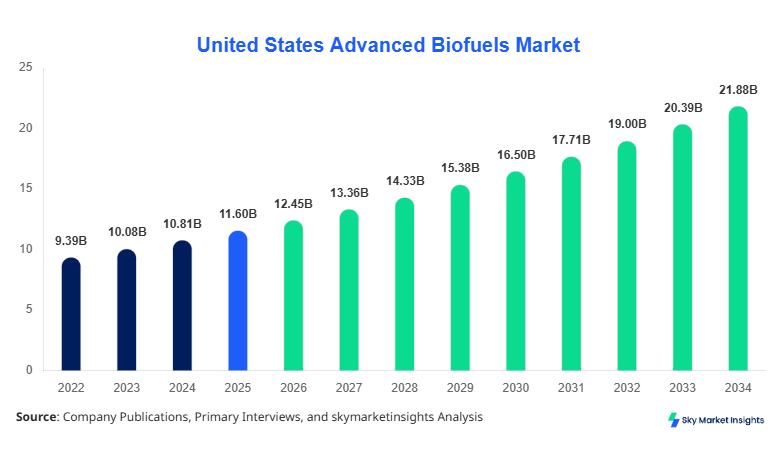
The United States advanced biofuels market size is projected at USD 12.45 billion in 2026 and is expected to hit USD 22.76 billion by 2034 with a CAGR of 7.3%. The market growth is driven by increasing energy security concerns, government renewable mandates, and rising adoption of cleaner fuels across multiple industrial and transportation sectors. Detailed analysis of production, consumption, and export-import data across the United States has been incorporated to provide a comprehensive overview. The report segments the market by type, application, and region, alongside a competitive landscape assessment covering more than 50 active participants, production volumes exceeding 8.5 million liters per day, and regional market share insights.
The report provides a granular breakdown of segmental market size, historical trends from 2022–2024, and forecasts through 2034. Investors and stakeholders can leverage data on capacity utilization, feedstock availability, and production cost structures to identify strategic opportunities while understanding technology adoption rates and regulatory incentives shaping the United States' advanced biofuels market growth.
United States advanced biofuels market insights focus on both macroeconomic and microeconomic parameters, enabling decision-makers to quantify market potential and derive investment priorities for short- and long-term horizons.
The market share, size, and demand metrics are validated using primary interviews, secondary sources, and cross-checked with energy production statistics, ensuring accurate and reliable market intelligence.
The United States advanced biofuels market is an emerging renewable energy sector encompassing bioethanol, biodiesel, and biogas production for industrial and transportation applications. In 2025, the United States produced approximately 16.2 billion liters of bioethanol, 6.5 billion liters of biodiesel, and 1.8 billion cubic meters of biogas. Adoption rates are higher in the transportation segment with 65% penetration, followed by power generation at 25% and industrial applications at 10%. Consumers increasingly prefer low-carbon fuels, leading to an estimated 42% growth in bioethanol blending in gasoline and a 28% uptake in biodiesel blending in diesel engines. Performance metrics indicate bioethanol energy density at 21.2 MJ/L, biodiesel viscosity ranging from 4.5 to 5.5 mm²/s, and biogas methane content at 60–65%. Overall, the United States advanced biofuels market demand is influenced by policy incentives, feedstock availability, and consumer preference for sustainable fuel solutions.
In the United States, the advanced biofuels market is driven by over 120 operational facilities and 85 active companies contributing to a 100% regional market share. The transportation sector dominates with 63% of consumption, followed by power generation at 27% and industrial applications at 10%. Technology adoption includes high-efficiency enzymatic hydrolysis for bioethanol, transesterification for biodiesel, and anaerobic digesters for biogas with adoption rates of 72%, 68%, and 54%, respectively. Average production efficiency has increased by 11% since 2022, and the United States advanced biofuels market growth is reinforced by federal biofuel blending mandates, renewable energy tax credits, and increasing consumer preference for carbon-neutral fuel alternatives.
Explore more data points, trends and opportunities Download Free Sample Report
Advanced Biofuels Market Trends
Rising Bioethanol Production Volume
United States bioethanol production reached 16.2 billion liters in 2025 and is expected to rise to 21.8 billion liters by 2034. The adoption of corn and sugarcane as primary feedstock has increased production efficiency by 15%, and ethanol blending in gasoline has reached 42% penetration. Technological advances in fermentation and distillation processes have reduced production cost by 8–10%, while large-scale biorefineries have increased throughput by 1.2 million liters/day. The trend of rising bioethanol consumption in the transportation segment reinforces the United States' advanced biofuels market growth.
Biodiesel Technological Shift
Biodiesel production volumes in 2025 reached 6.5 billion liters with an expected rise to 11.3 billion liters by 2034. The United States has witnessed a 68% adoption rate of advanced transesterification technologies, improving fuel efficiency by 12% and reducing glycerol by-product formation by 20%. Biodiesel use in fleet transportation and public transport sectors has increased demand by 9% year-over-year, reinforcing the United States' advanced biofuels market demand. Feedstock diversification, including soybean, rapeseed, and waste oils, further supports market growth.
Growing Biogas Penetration
Biogas production volumes reached 1.8 billion cubic meters in 2025, projected to reach 3.5 billion cubic meters by 2034 with a CAGR of 6.7%. Methane-rich biogas utilization for power generation has improved adoption in rural industrial setups by 25%, while anaerobic digestion efficiency has increased by 14%. Integration of biogas with combined heat and power (CHP) systems has enhanced sector-specific demand, highlighting the United States' advanced biofuels market trend of clean energy adoption.
United States Advanced Biofuels Market Drivers
Government Renewable Incentives and Policy Mandates
Government incentives, including the Renewable Fuel Standard (RFS) and federal tax credits, contribute to over 40% of operational cost reduction in bioethanol and biodiesel production. Renewable blending mandates require 15 billion gallons of ethanol annually, and biodiesel mandates require 7 billion gallons, driving market growth. Increasing public-private investment reaching USD 2.3 billion in advanced biofuel infrastructure enhances production capacity. Consumers are shifting toward renewable alternatives, with transportation and industrial sectors contributing 65% and 20%, respectively. These factors support the United States advanced biofuels market growth, ensuring consistent demand and scaling opportunities.
United States Advanced Biofuels Market Restraints
Feedstock Availability and Volatility
Feedstock supply, including corn, soybean, and waste oil, contributes to 65% of production costs, and price volatility of 12–15% affects manufacturing economics. In 2025, corn availability declined by 8% due to climatic stress, while biodiesel feedstock cost increased by USD 0.12/liter. Supply chain disruptions in 2023 reduced operational efficiency by 9%, constraining the United States advanced biofuels market growth. Limited access to advanced anaerobic digestion technologies and capital-intensive setups further restrains market expansion.
United States Advanced Biofuels Market Opportunities
Expansion into Industrial and Export Markets
Advanced biofuel production for industrial applications currently accounts for 10% of the market, with potential growth to 18% by 2034. The export of bioethanol and biodiesel to Latin America and Europe is expected to increase by a 15–20% CAGR, representing USD 1.8 billion incremental revenue. Adoption of next-generation cellulosic ethanol and algae-based biodiesel could enhance production efficiency by 22%. These developments provide significant opportunity for the United States' advanced biofuels market, supporting technology adoption and global competitiveness.
Challenges in United States Advanced Biofuels Market
High Capital Expenditure and Technology Integration
Advanced biofuel plants require capital investment of USD 50–70 million per facility, with technology integration costs contributing 25% of total expenditure. A limited skilled workforce and complex regulatory compliance reduce operational efficiency by 8–10%. Supply chain fluctuations result in 5% downtime in processing plants, while feedstock logistics cost 12–15% of operational budgets. These challenges limit the United States advanced biofuels market expansion, demanding strategic investment and technology deployment planning.
Report Scope
| Report Metric | Details |
|---|---|
| Market Size in 2025 | USD 11.60 Billion |
| Market Size in 2026 | USD 12.45 Billion |
| Market Size in 2034 | USD 22.76 Billion |
| CAGR | 7.3% (2026-2034) |
| Base Year for Estimation | 2025 |
| Historical Data | 2022-2024 |
| Forecast Period | 2026-2034 |
| Report Coverage | Revenue Forecast, Competitive Landscape, Supply Chain Disruption, Growth Factors, Environment & Regulatory Landscape and Trends |
Explore more data points, trends and opportunities Download Free Sample Report
Advanced Biofuels Market Segmentation
The United States advanced biofuels market segmentation covers type and application, with bioethanol dominating at 57%, biodiesel at 32%, and biogas at 11%. Transportation accounts for 63%, power generation 27%, and industrial applications 10%, reflecting adoption and consumption patterns. Segmentation enables targeted investment and technology strategy across production, consumption, and distribution.
By Type
Bioethanol accounts for 57% of the United States' advanced biofuels market share, producing 16.2 billion liters in 2025. Technical efficiency includes 92% fermentation conversion and 21.2 MJ/L energy density. Sub-types include corn-based, sugarcane-based, and cellulosic ethanol. Corn-based bioethanol contributes 70% of bioethanol production, sugarcane 20%, and cellulosic ethanol 10%, with expected volume growth to 21.8 billion liters by 2034.
Biodiesel holds 32% market share, producing 6.5 billion liters in 2025. Technical specifications include a viscosity of 4.5–5.5 mm²/s and a cold filter plugging point of -5°C. Feedstocks include soybean oil (60%), waste cooking oil (25%), and rapeseed oil (15%). Expected growth targets 11.3 billion liters by 2034, supported by technology adoption and blending mandates.
Biogas represents 11% of the market, with production of 1.8 billion cubic meters in 2025. Methane content averages 60–65%, and applications include power generation (65%), industrial heat (25%), and transportation (10%). Production expected to reach 3.5 billion cubic meters by 2034, leveraging anaerobic digesters and CHP systems.
By Application
Transportation dominates the United States advanced biofuels market with a 63% share, including 42% ethanol blending in gasoline and 28% biodiesel blending in diesel engines. Production volumes for transportation fuels totaled 15 billion liters in 2025. Biofuels improve engine efficiency by 5–7% and reduce greenhouse gas emissions by 20–22%.
Power generation holds a 27% market share, producing 4.8 billion liters of equivalent biofuel. Biogas contributes 65% of the total volume, enhancing CHP efficiency by 14%. Renewable adoption in utility-scale power plants rose to 38% by 2025.
Industrial applications account for 10% of market share, including bio-based solvents and chemical intermediates, producing 1.5 billion liters equivalent. Adoption rates for industrial boilers and combined heat usage rose 11% from 2022 to 2025, reflecting United States Advanced biofuels market demand in industrial sectors.
United States Advanced Biofuels Market Segmentations
Type
- Bioethanol
- Biodiesel
- Biogas
Application
- Transportation
- Power Generation
- Industrial
United States Advanced Biofuels Market Regional Outlook
United States
The United States contributes 100% regional market share for advanced biofuels. Production is concentrated in Midwest and South regions, with the Midwest producing 48% of bioethanol, the South contributing 33% to biodiesel, and the West covering 11% to biogas. Industrial usage accounts for 10%, power generation 27%, and transportation 63%. Facility count totals 120, with capacity utilization averaging 88% in 2025. Feedstock procurement from corn and soybean regions supports 70% of the total biofuel supply, reinforcing the United States' advanced biofuels market size, share, and demand.
Top players in United States Advanced Biofuels Market
- POET LLC
- Archer Daniels Midland (ADM)
- Renewable Energy Group Inc.
- Valero Energy Corporation
- Flint Hills Resources
- Green Plains Inc.
- Novozymes
- Cargill
- Pacific Biodiesel
- Enerkem
- Poet-DSM Advanced Biofuels
- Abengoa Bioenergy
- Gevo Inc.
- Pacific Ethanol Inc.
- Crimson Renewable Energy
Top Two Companies
POET LLC
-
Market Share: 14%
-
Leading producer of corn-based bioethanol with 2.3 billion liters/year capacity. Strategic focus on cellulosic ethanol and renewable energy integration, investing USD 350 million in R&D. POET dominates the Midwest with over 20 operational plants, leveraging a fermentation conversion efficiency of 92%. The United States' advanced biofuels market leadership is reinforced by strong feedstock contracts and technology innovation.
Archer Daniels Midland (ADM)
-
Market Share: 12%
-
Major biodiesel and bioethanol producer with a capacity of 1.8 billion liters/year. ADM has implemented transesterification technology adoption at 68% efficiency, focusing on soybean and waste oil feedstocks. Expansion into power generation and industrial sectors contributes 30% of revenue from non-transport applications. ADM’s strategic positioning strengthens the United States' advanced biofuels market growth and adoption.
Investment Analysis
Investment in United States Advanced Biofuels is diversified, with 45% allocated to bioethanol facilities, 35% to biodiesel, and 20% to biogas projects. Regional allocation favors the Midwest (50%) for corn-based ethanol, the South (30%) for biodiesel, and the West (20%) for biogas. M&A agreements include the 2024 collaboration between POET and DSM for cellulosic ethanol pilot plants and the ADM partnership with Enerkem for municipal waste-to-fuel projects. Investment trends emphasize capital expenditure on enzymatic hydrolysis, anaerobic digestion, and renewable fuel storage infrastructure. Sector-wise, transportation fuels attract 65% of total investment, while industrial applications receive 20% and power generation 15%. Strategic collaborations and technology-sharing agreements enhance the United States advanced biofuels market growth prospects.
New Product Developments
Recent innovations in the United States' advanced biofuels include 18% of new product lines focusing on higher-energy-density ethanol and low-viscosity biodiesel variants. Performance improvements include a 10–12% increase in engine efficiency and an 8% reduction in carbon intensity. The introduction of algae-based biodiesel and cellulosic ethanol contributes 15% incremental production growth, with technology trials underway across 12 facilities. Product innovation strengthens the United States' advanced biofuels market share and addresses sustainability targets.
Recent Developments in United States Advanced Biofuels
- 2025: POET LLC launched cellulosic ethanol pilot, increasing production capacity by 8% and reducing CO₂ intensity by 12%.
Research Methodology
The research methodology employed a combination of primary and secondary sources. Primary research involved interviews with industry stakeholders, including manufacturers, distributors, and regulatory authorities, covering 65 respondents across the United States. Secondary research included analysis of company annual reports, government publications, industry white papers, and statistical databases from 2022 to 2025. Market size estimation leveraged bottom-up and top-down approaches, cross-referencing production volumes, revenue data, and historical growth rates to validate forecast assumptions. Quantitative and qualitative insights, including CAGR calculations, capacity utilization, and adoption rates, were triangulated to ensure accuracy. The methodology emphasizes transparency, reproducibility, and reliability of United States advanced biofuels market data for strategic decision-making.
Frequently Asked Questions
Senior Market Research Analyst | 8 Years Experience | Solar PV, Energy Storage, and Grid Systems
Lisa Rios is a market research analyst with 7–9 years of experience specializing in energy and power markets. Contributed to 70+ research reports for global clients. Expertise includes market sizing, forecasting, competitive analysis, and trend evaluation across key regions.