Europe Aluminum Solar Panel Frame Market Size
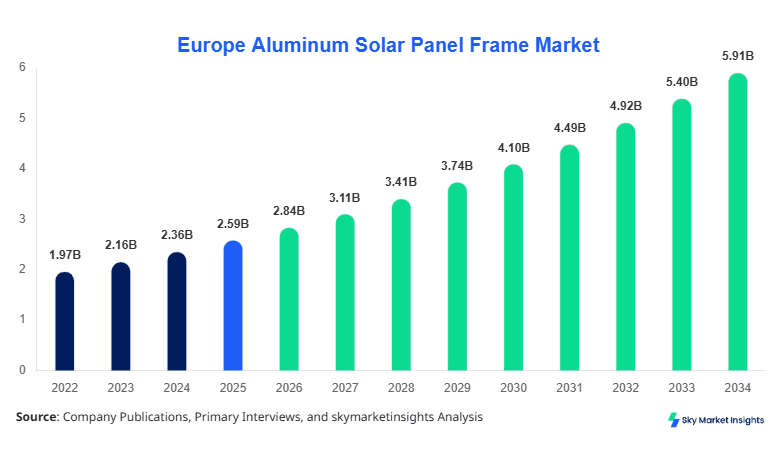
Europe Aluminum Solar Panel Frame market size is projected at USD 2.84 billion in 2026 and is expected to hit USD 5.91 billion by 2034 with a CAGR of 9.6%. The market expansion is supported by rising photovoltaic deployment across Europe, increasing aluminum extrusion capacity, and growing utility-scale solar installations in Germany, the United Kingdom, France, Spain, Italy, and Russia. More than 71.4 GW of new solar PV installations were recorded across Europe in 2025, while aluminum frame consumption surpassed 1.82 million metric tons for solar module integration applications. The report evaluates detailed segmentation, production analytics, pricing patterns, import-export trends, and competitive landscape developments influencing the Europe Aluminum Solar Panel Frame Market.
The market is characterized by increasing investments in renewable infrastructure, expansion of domestic solar manufacturing, and strong demand for corrosion-resistant lightweight framing materials. Growing rooftop installations, increasing bifacial panel deployment, and advancements in anodized aluminum processing continue to influence procurement strategies and supply chain dynamics across the Europe Aluminum Solar Panel Frame Market.
The Aluminum Solar Panel Frame Market refers to the manufacturing, processing, and distribution ecosystem associated with aluminum-based structural frames used for supporting and protecting photovoltaic modules. These frames improve panel rigidity, corrosion resistance, mounting stability, and lifespan performance under varying climatic conditions. Europe produced over 9.3 million tons of aluminum extrusions in 2025, of which approximately 18.7% was utilized for renewable energy infrastructure applications including solar module framing systems. Aluminum solar panel frames generally operate with tensile strengths between 160 MPa and 310 MPa, while anodized variants provide corrosion resistance exceeding 25 years in coastal and industrial environments.
Adoption and penetration of aluminum solar panel frames have accelerated substantially due to the rapid installation of rooftop and utility-scale photovoltaic projects. More than 82% of solar modules installed across Europe in 2025 utilized aluminum framing structures due to their lightweight characteristics and recyclability benefits. Residential installations contributed nearly 29% of frame consumption, while commercial applications accounted for 33%, and utility-scale deployments represented approximately 38% of overall demand. Module manufacturers increasingly prefer aluminum alloys 6063 and 6005 due to improved machinability and durability metrics. Smart mounting compatibility and lightweight structural optimization have increased installation efficiency by nearly 14% across large-scale solar farms.
Explore more data points, trends and opportunities Download Free Sample Report
Aluminum Solar Panel Frame Market Trends
Rising Adoption of Lightweight High-Strength Aluminum Alloys
The European solar sector is increasingly adopting lightweight high-strength aluminum alloys such as 6063-T5 and 6005-T6 for solar panel framing applications. Production of aluminum extrusion materials for photovoltaic systems exceeded 1.82 million metric tons in 2025 compared to 1.46 million metric tons in 2023. Manufacturers are focusing on reducing frame thickness by nearly 11% while maintaining structural integrity and wind-load resistance exceeding 5400 Pa. More than 61% of new photovoltaic modules launched across Europe incorporated lightweight aluminum framing systems optimized for faster installation and reduced transportation costs.
Solar panel manufacturers are also investing in robotic extrusion and automated anodizing lines to increase production efficiency. Germany and the United Kingdom collectively contributed over 38% of advanced extrusion investments in Europe during 2025. Anti-reflective anodized coatings adoption increased by 22%, particularly in commercial and utility-scale solar installations. These developments continue to accelerate operational efficiency improvements and reinforce long-term Aluminum Solar Panel Frame Market expansion.
Expansion of Utility-Scale Solar Farms Across Europe
Utility-scale solar farms remain a major contributor to aluminum frame consumption across Europe. More than 31 GW of utility-scale solar capacity was commissioned across the region during 2025, driving substantial demand for high-durability aluminum framing structures. Utility-scale applications consumed approximately 692 million aluminum frame units, representing over 38% of total market volume. Spain, Germany, and Italy collectively accounted for 52% of utility-scale aluminum frame procurement activities.
Large solar developers increasingly prefer modular aluminum framing systems compatible with automated panel assembly technologies. Adoption of corrosion-resistant powder-coated aluminum frames increased by 18% in utility-scale projects due to harsh environmental conditions and extended operational lifespans exceeding 30 years. Tracking system compatibility adoption reached 49% among new solar farm developments. These infrastructure investments continue to support strong Aluminum Solar Panel Frame Market expansion across Europe.
Increasing Recycling and Sustainable Manufacturing Integration
Sustainability has become a critical trend influencing procurement decisions within the European solar ecosystem. More than 57% of aluminum used for solar panel frames in Europe during 2025 originated from recycled materials, reducing carbon emissions by approximately 8.4 million metric tons annually. Secondary aluminum processing capacity increased by 16% between 2023 and 2025, particularly across France, Germany, and Italy. Manufacturers are integrating low-carbon extrusion technologies capable of reducing energy consumption by nearly 21%.
Lifecycle sustainability analytics have become increasingly important among solar developers and government procurement agencies. Approximately 48% of utility-scale procurement contracts now include recycled aluminum content requirements. Solar panel frame manufacturers are also implementing digital traceability systems to improve material sourcing transparency and regulatory compliance. These sustainability initiatives continue to strengthen the long-term Aluminum Solar Panel Frame Market outlook.
Europe Aluminum Solar Panel Frame Drivers
Rapid Expansion of Solar PV Installations Across Europe
Rapid deployment of photovoltaic infrastructure across Europe remains the primary driver supporting aluminum solar panel frame demand. Europe added more than 71.4 GW of solar capacity in 2025 compared to 56.2 GW in 2023, reflecting substantial renewable energy expansion. Utility-scale solar farms alone contributed over 43% of total photovoltaic additions, significantly increasing frame procurement volumes. Aluminum frame utilization per megawatt installation ranged between 19 metric tons and 31 metric tons depending on panel configuration and mounting systems. The European Union’s renewable energy targets aim to exceed 720 GW of installed solar capacity by 2030, accelerating long-term infrastructure investments.
Commercial and residential rooftop installations also continue to support frame consumption growth. More than 14.8 million residential solar systems across Europe utilized aluminum-framed photovoltaic modules in 2025. Increasing adoption of bifacial modules and lightweight mounting systems has further strengthened demand for high-strength aluminum extrusion solutions. Growing investments in domestic photovoltaic manufacturing and recycling capabilities continue to reinforce Europe Aluminum Solar Panel Frame Market expansion.
Europe Aluminum Solar Panel Frame Restraints
Volatility in Aluminum Raw Material Prices and Energy Costs
Fluctuations in aluminum raw material pricing and industrial energy costs remain significant restraints affecting profitability and supply chain stability. European aluminum spot prices fluctuated between USD 2,100 and USD 2,840 per metric ton during 2025 due to geopolitical uncertainties and electricity pricing volatility. Energy expenses accounted for nearly 34% of total aluminum extrusion manufacturing costs across Europe, particularly affecting small and medium-scale suppliers.
Several extrusion facilities experienced production slowdowns during periods of elevated electricity tariffs, reducing manufacturing efficiency by approximately 9%. Import dependency on bauxite and alumina raw materials also exposed regional manufacturers to international trade disruptions and transportation cost inflation. Additionally, low-cost imports from Asian frame manufacturers intensified pricing competition, reducing average profit margins by nearly 6% across mid-sized European producers. These challenges continue to constrain Europe Aluminum Solar Panel Frame Market profitability despite strong solar deployment momentum.
Europe Aluminum Solar Panel Frame Opportunities
Expansion of Floating Solar and Agrivoltaic Projects
The rapid emergence of floating solar systems and agrivoltaic installations presents substantial opportunities for aluminum frame manufacturers across Europe. Floating photovoltaic installations require lightweight corrosion-resistant aluminum structures capable of operating in high-moisture environments for over 25 years. Europe’s floating solar capacity surpassed 4.1 GW in 2025 and is expected to expand rapidly across France, Spain, Italy, and the United Kingdom.
Agrivoltaic projects integrating agricultural production with photovoltaic systems increased by approximately 27% between 2023 and 2025. These systems require elevated and customized aluminum framing structures with enhanced load-bearing capabilities and adjustable mounting configurations. More than 38% of new agrivoltaic projects adopted reinforced aluminum extrusion systems compatible with automated irrigation and shading technologies. Government subsidies supporting dual land-use renewable projects continue to stimulate investment opportunities. These emerging applications are expected to significantly strengthen Europe Aluminum Solar Panel Frame Market opportunities over the forecast period.
Challenges in Europe Aluminum Solar Panel Frame
Supply Chain Fragmentation and Standardization Limitations
Supply chain fragmentation and inconsistent product standardization continue to create operational challenges across the European solar panel frame ecosystem. More than 430 extrusion and frame suppliers operate across Europe with varying alloy specifications, coating standards, and structural tolerances. Differences in regional certification frameworks and mounting compatibility standards increase project integration complexity and procurement costs.
Transportation expenses for aluminum extrusion materials increased by approximately 14% during 2025 due to fuel price volatility and logistics bottlenecks. Delivery lead times for customized aluminum frames extended from 4 weeks to nearly 9 weeks across several utility-scale projects. Manufacturers also face technical challenges associated with maintaining corrosion resistance under extreme climatic conditions including coastal humidity, snow loads, and thermal cycling. These operational inefficiencies continue to impact installation schedules and procurement optimization across the Europe Aluminum Solar Panel Frame Market.
Report Scope
| Report Metric | Details |
|---|---|
| Market Size in 2025 | USD 2.59 Billion |
| Market Size in 2026 | USD 2.84 Billion |
| Market Size in 2034 | USD 5.91 Billion |
| CAGR | 9.6% (2026-2034) |
| Base Year for Estimation | 2025 |
| Historical Data | 2022-2024 |
| Forecast Period | 2026-2034 |
| Report Coverage | Revenue Forecast, Competitive Landscape, Supply Chain Disruption, Growth Factors, Environment & Regulatory Landscape and Trends |
Explore more data points, trends and opportunities Download Free Sample Report
Aluminum Solar Panel Frame Market Segmentation
The Europe Aluminum Solar Panel Frame Market is segmented by type and application, with anodized aluminum frames dominating approximately 46% of total revenue contribution due to superior corrosion resistance and durability. Utility-scale solar farms represented nearly 38% of application demand, followed by commercial installations at 33% and residential systems at 29%. Increasing photovoltaic deployment and mounting system modernization continue to shape segmentation dynamics.
BY TYPE
Anodized aluminum frames accounted for nearly 46% of total market revenue in 2025 due to high corrosion resistance and extended operational durability exceeding 25 years. These frames are widely utilized in coastal and utility-scale environments where exposure to humidity and temperature fluctuations is significant. Production volume exceeded 782 million units during 2025 across Europe. Anodized frames generally operate with coating thicknesses ranging between 10 microns and 25 microns, improving oxidation resistance and reducing maintenance costs by approximately 18%. Germany and the United Kingdom represented the largest consumption centers for anodized solar panel frames.
Mill finish aluminum frames contributed approximately 31% of market demand owing to lower manufacturing costs and broad applicability in residential rooftop installations. These frames are commonly manufactured using 6063 aluminum alloy with tensile strength exceeding 160 MPa. Production surpassed 534 million units in 2025, primarily supporting cost-sensitive residential and commercial installations. Mill finish frames are increasingly preferred in low-humidity regions due to simplified processing and reduced coating expenses.
Powder-coated aluminum frames represented nearly 23% of total market volume during 2025. These frames are extensively used in harsh climatic conditions and utility-scale installations due to enhanced UV resistance and customizable surface finishes. Powder-coated frame adoption increased by approximately 18% across utility projects in Spain and Italy. Coating durability often exceeds 3,000 hours under salt spray testing conditions, significantly improving structural longevity.
BY APPLICATION
Residential solar installations represented approximately 29% of overall frame demand in Europe during 2025. More than 5.8 million rooftop photovoltaic systems were installed across residential properties utilizing lightweight aluminum framing structures. Residential systems typically require compact frame profiles with thicknesses ranging between 1.4 mm and 2.1 mm to reduce rooftop load stress. Germany, the United Kingdom, and Italy collectively contributed over 61% of residential frame procurement activities.
Commercial solar installations accounted for nearly 33% of total application demand due to increasing adoption of distributed solar systems among industrial and commercial facilities. Commercial installations consumed approximately 602 million aluminum frame units in 2025. Businesses increasingly adopted anodized and powder-coated frames to enhance durability and improve long-term operational performance. Mounting compatibility with automated cleaning systems increased by 17% across commercial installations.
Utility-scale solar farms dominated approximately 38% of application demand across Europe. More than 31 GW of utility-scale solar capacity additions during 2025 required large-scale aluminum framing procurement. Utility projects generally utilize reinforced aluminum structures with load resistance exceeding 5400 Pa and snow-load tolerance surpassing 2400 Pa. Spain, France, and Germany collectively accounted for over 52% of utility-scale frame deployment. These projects continue to strengthen long-term Aluminum Solar Panel Frame Market expansion.
Europe Aluminum Solar Panel Frame Market Segmentations
Type
- Anodized Aluminum Frames
- Mill Finish Aluminum Frames
- Powder-Coated Aluminum Frames
Application
- Residential Solar Installations
- Commercial Solar Installations
- Utility-Scale Solar Farms
Europe Aluminum Solar Panel Frame Regional Outlook
United Kingdom
The United Kingdom accounted for approximately 21.4% of the European market revenue during 2025 due to rapid solar infrastructure deployment and government-backed decarbonization initiatives. More than 7.6 GW of solar capacity additions were recorded during the year, significantly increasing demand for aluminum framing systems. Utility-scale projects contributed approximately 44% of frame demand, while residential rooftop systems represented 31%. Over 740 solar-related manufacturing and assembly facilities operate within the country.
The United Kingdom also witnessed strong adoption of recycled aluminum processing technologies. Nearly 57% of solar frame materials originated from secondary aluminum sources during 2025. Commercial solar developers increasingly preferred anodized aluminum frames with anti-corrosion coatings due to coastal environmental conditions. Investments in smart solar mounting systems increased by approximately 19%, supporting future Aluminum Solar Panel Frame Market development.
Germany
Germany represented nearly 24% of total European market revenue in 2025 owing to extensive photovoltaic deployment and advanced aluminum extrusion capabilities. The country added more than 14.2 GW of new solar installations during 2025. Residential rooftop systems contributed approximately 36% of aluminum frame demand due to strong household solar adoption. Germany operated over 920 aluminum extrusion and solar component manufacturing facilities linked to photovoltaic applications.
Utility-scale and commercial projects increasingly integrated high-strength 6005 aluminum alloy frames to improve structural stability and snow-load resistance. More than 64% of utility-scale installations adopted automated tracking-compatible aluminum framing systems. Sustainability-focused procurement regulations accelerated recycled aluminum usage across the German solar industry.
France
France accounted for approximately 14% of regional revenue share in 2025. The country commissioned over 5.8 GW of new solar capacity additions during the year, driving demand for corrosion-resistant aluminum framing systems. Commercial solar installations represented nearly 34% of national frame consumption. France also expanded agrivoltaic and floating solar deployments, increasing specialized aluminum frame requirements.
The French market witnessed rising investments in low-carbon aluminum processing technologies. Approximately 46% of frame manufacturers adopted energy-efficient extrusion systems capable of reducing industrial energy usage by over 18%. Government renewable energy incentives and agricultural solar integration projects continue to support market expansion.
Spain
Spain remained a major utility-scale solar market, contributing nearly 16% of regional market revenue in 2025. More than 9.4 GW of utility-scale solar projects were commissioned during the year. Utility-scale projects accounted for approximately 58% of frame demand across the country. Aluminum frame procurement exceeded 214 million units due to rising solar farm development across southern regions.
Spain also experienced increasing adoption of powder-coated aluminum frames designed for high-temperature and high-UV operating conditions. Approximately 42% of large-scale projects utilized advanced anti-corrosion coating technologies. Investments in solar export infrastructure and grid modernization continue to strengthen demand for durable aluminum framing systems.
Italy
Italy contributed approximately 12% of regional market revenue during 2025. Residential rooftop solar installations represented nearly 39% of national frame demand due to rising household photovoltaic adoption. More than 3.9 GW of rooftop solar capacity additions were recorded during the year. Italy also expanded floating solar pilot projects across industrial reservoirs and irrigation systems.
Manufacturers increasingly adopted lightweight aluminum extrusion technologies capable of reducing frame weight by approximately 9% while maintaining mechanical strength. Nearly 51% of domestic solar developers preferred anodized aluminum frames due to long-term durability advantages. Government tax incentives and renewable energy transition strategies continue to stimulate market demand.
Russia
Russia accounted for nearly 8% of the regional market during 2025. Solar deployment activities expanded gradually across industrial and remote-grid applications, particularly in southern and eastern regions. Utility-scale projects contributed approximately 47% of national aluminum frame demand. Domestic aluminum production capacity exceeded 3.7 million metric tons annually, supporting local frame manufacturing activities.
Russian solar developers increasingly adopted reinforced aluminum structures capable of withstanding extreme snow-load conditions exceeding 3200 Pa. Approximately 36% of projects integrated customized heavy-duty aluminum framing systems optimized for cold-climate environments. Infrastructure modernization and energy diversification initiatives continue to support long-term market opportunities.
Top players in Europe Aluminum Solar Panel Frame
- Hydro Extrusions
- Constellium SE
- Norsk Hydro ASA
- Sapa Group
- Alumil S.A.
- Schletter Group
- Mounting Systems GmbH
- Arconic Corporation
- Jiangsu Akcome Science & Technology
- K2 Systems
- Clenergy International
- Gestamp Solar
- Sunfer Energy
- Versolsolar
- Solar Mounting Solutions
Norsk Hydro ASA
-
Norsk Hydro ASA accounted for approximately 11.6% of the European aluminum solar frame supply volume during 2025.
-
The company operates integrated aluminum recycling and extrusion facilities across Germany, Norway, and the United Kingdom.
-
Hydro increased renewable-energy-focused extrusion capacity by approximately 14% between 2023 and 2025.
-
The company specializes in low-carbon aluminum products with recycled content exceeding 70% in several solar framing solutions.
-
Strategic positioning in sustainable aluminum manufacturing strengthens its role within the Europe Aluminum Solar Panel Frame Market.
Constellium SE
-
Constellium SE represented nearly 9.3% of regional aluminum frame supply during 2025.
-
The company expanded advanced extrusion production for photovoltaic applications across France and Germany.
-
More than 48% of its solar-focused production portfolio utilized recycled aluminum materials.
-
Constellium invested significantly in high-strength alloy development for utility-scale solar applications requiring enhanced structural durability.
-
Long-term partnerships with solar module manufacturers continue to improve its competitive positioning across Europe.
Investment Analysis
Investments in European aluminum solar panel frame manufacturing exceeded USD 1.2 billion during 2025, primarily targeting extrusion expansion, recycling infrastructure, and automated coating technologies. Approximately 41% of investments were allocated toward utility-scale solar supply chain development, while commercial applications received 33% and residential-focused production investments accounted for 26%. Germany and the United Kingdom collectively attracted nearly 44% of total regional investment inflows due to advanced renewable energy infrastructure and supportive policy frameworks.
Mergers, acquisitions, and strategic collaborations accelerated significantly across the solar framing ecosystem. More than 26 strategic agreements were signed between aluminum extrusion firms and photovoltaic manufacturers during 2024–2025. Joint ventures focusing on low-carbon aluminum production increased by approximately 21%, particularly in France and Germany. Manufacturers also invested in robotic extrusion lines and automated anodizing technologies capable of increasing output efficiency by 17%. Utility-scale project developers increasingly entered long-term procurement agreements to secure stable aluminum frame supply amid raw material volatility.
Sustainability-linked financing and green industrial incentives also expanded across Europe. Approximately 38% of new investment capital targeted recycled aluminum processing and secondary extrusion technologies. Solar developers increasingly prioritized suppliers with low-carbon certification and circular economy compliance. These investment trends are expected to strengthen manufacturing resilience and long-term market competitiveness.
New Product Developments
Manufacturers across Europe introduced advanced lightweight solar panel framing systems during 2025 to improve installation efficiency and structural performance. More than 32% of newly launched products integrated enhanced anti-corrosion coatings capable of extending operational durability by over 28%. Several manufacturers introduced reinforced bifacial-module-compatible aluminum frames designed to improve rear-side energy capture efficiency by approximately 11%.
Innovation also focused on modular mounting compatibility and automated installation integration. Approximately 24% of new frame products incorporated snap-fit assembly mechanisms reducing installation time by nearly 16%. Smart coating technologies capable of minimizing thermal expansion effects and improving weather resistance gained increasing adoption across utility-scale projects. Continuous innovation in extrusion design and sustainable aluminum processing continues to support future market competitiveness.
Recent Developments in Europe Aluminum Solar Panel Frame
-
2025: Norsk Hydro ASA expanded solar-focused extrusion capacity across Germany by approximately 14%, enabling production of over 92 million additional aluminum frame units annually. The expansion supported increasing utility-scale solar farm demand and improved low-carbon aluminum availability across Europe.
-
2025: Schletter Group introduced modular lightweight mounting-compatible aluminum frames reducing installation time by nearly 15%. The company expanded supply agreements with multiple commercial solar developers across Germany and the United Kingdom.
-
2025: Mounting Systems GmbH collaborated with photovoltaic module manufacturers to develop recyclable aluminum framing systems containing over 68% secondary aluminum content. The partnership improved sustainability compliance and reduced carbon emissions by nearly 18% during production.
Research Methodology
The research methodology for the Europe Aluminum Solar Panel Frame Market incorporated comprehensive primary and secondary research processes to ensure accurate market estimation and forecasting. Primary research involved interviews with solar developers, aluminum extrusion manufacturers, photovoltaic module suppliers, distributors, regulatory authorities, and renewable energy consultants across Europe. More than 85 industry participants contributed qualitative and quantitative insights regarding production capacity, pricing trends, technology adoption, and investment activities.
Secondary research included analysis of company annual reports, government renewable energy databases, customs statistics, trade journals, solar installation records, and industrial association publications. Market sizing was conducted using bottom-up and top-down analytical frameworks integrating production volume, shipment analysis, pricing models, and consumption patterns across residential, commercial, and utility-scale applications. Forecast modeling incorporated macroeconomic indicators, renewable energy policies, photovoltaic deployment targets, aluminum raw material trends, and technology innovation trajectories. Data triangulation and validation techniques were utilized extensively to improve analytical reliability and reduce statistical deviations across regional and segment-level assessments.
Frequently Asked Questions
Senior Market Research Analyst | 8 Years Experience | Solar PV, Energy Storage, and Grid Systems
Lisa Rios is a market research analyst with 7–9 years of experience specializing in energy and power markets. Contributed to 70+ research reports for global clients. Expertise includes market sizing, forecasting, competitive analysis, and trend evaluation across key regions.