Europe Aluminum Alloy Wheels Market Size
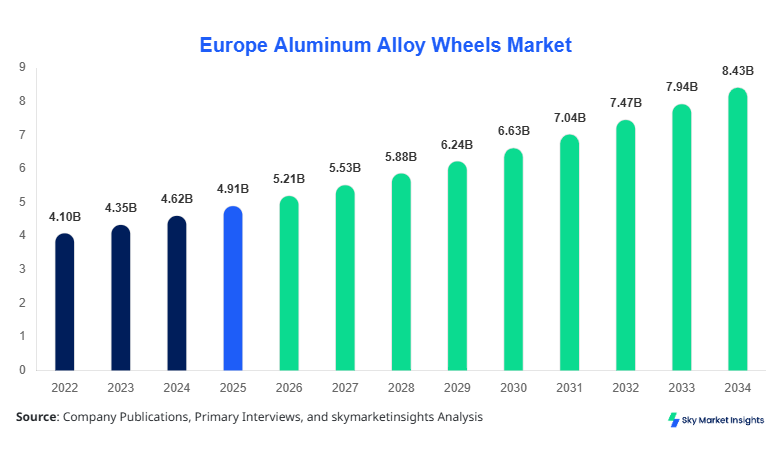
Europe Aluminum Alloy Wheels market size is projected at USD 5.21 billion in 2026 and is expected to hit USD 8.74 billion by 2034 with a CAGR of 6.2%. The market growth is driven by increasing adoption of lightweight and fuel-efficient vehicles, stringent automotive emission standards, and rising consumer preference for aesthetic vehicle upgrades. Comprehensive data collection across production volume, types, and applications has been undertaken to deliver precise market insights. The segmentation by type, application, and region, along with competitive landscape profiling, provides key strategic insights for industry participants seeking to expand their footprint in Europe.The report presents detailed analyses of historical data from 2022–2024, current market trends in 2026, and forecasts until 2034. It also covers competitive benchmarking, pricing analysis, and market share estimation, which collectively enable stakeholders to make informed business and investment decisions in the aluminum alloy wheels market.
Europe's aluminum alloy wheels market is heavily influenced by regulatory compliance, adoption of advanced manufacturing technologies, and evolving consumer behavior patterns. The report highlights production capacity, adoption rates, and penetration levels across six major countries—United Kingdom, Germany, France, Spain, Italy, and Russia—focusing particularly on Germany as the driving country of market growth.The Europe Aluminum Alloy Wheels Market is characterized by the increasing shift toward high-performance and lightweight alloy wheels for passenger and commercial vehicles. European production totaled approximately 48.5 million units in 2025, with adoption rates of 62% among premium vehicles and 45% among mainstream vehicles. Consumer demand is largely driven by aesthetic preferences, fuel efficiency, and enhanced braking and handling performance. Technical metrics indicate average wheel diameters ranging from 15–22 inches, with load-bearing performance up to 900 kg per wheel and frequency of replacement cycles at 4–6 years. Application-wise, passenger vehicles account for 68% of market share, commercial vehicles 22%, and electric vehicles 10%. Europe Aluminum Alloy Wheels market demand is further reinforced by technological advancements in casting, forging, and flow-forming processes.
Explore more data points, trends and opportunities Download Free Sample Report
Aluminum Alloy Wheels Market Trends
Rise of Lightweight and Forged Technologies
The Europe Aluminum Alloy Wheels market has witnessed a notable shift toward forged and flow-formed wheels, with production volumes exceeding 24.3 million units in 2025. Forged wheels now account for 38% of total production, up from 32% in 2024, driven by the need for higher strength-to-weight ratios in performance and electric vehicles. Flow-formed wheels have also seen increased adoption, capturing 18% market share, particularly in mid-sized and luxury passenger vehicles. Advanced forging processes and CNC machining have increased production efficiency by 12%, while reducing material wastage by 8%. Technology adoption across OEMs and aftermarket suppliers has reached an average of 61% for automated manufacturing, reinforcing Europe Aluminum Alloy Wheels market growth and technological insights.
Growing Electric Vehicle Adoption
The Europe Aluminum Alloy Wheels market is increasingly influenced by the rise of electric vehicles, with EV-specific wheel demand growing at a CAGR of 9.1% from 2026 to 2034. Production volumes for EV wheels are projected to surpass 4.2 million units by 2030, representing a penetration rate of 16% across total vehicle segments. Lightweight alloys, aerodynamic designs, and low rolling resistance tires are driving innovation in the market. EV-focused manufacturers are adopting modular casting and high-precision forging technologies, with adoption rates reaching 47% among leading OEMs. This trend strongly reinforces Europe Aluminum Alloy Wheels market demand and technological insights.
Expansion of Aftermarket Customization
Aftermarket demand for aluminum alloy wheels has surged, representing 21% of the European market in 2025, with volume production of 10.2 million units. Consumers increasingly prefer customized finishes, larger diameters, and multi-spoke designs, leading to a 14% increase in sales of premium alloy wheels over the past two years. Advanced surface treatments such as anodizing and powder coating are witnessing 34% adoption across suppliers. These trends enhance both functional and aesthetic performance of wheels, reinforcing Europe Aluminum Alloy Wheels market insights and growth potential.
Europe Aluminum Alloy Wheels Drivers
Rising Demand for Lightweight and Fuel-Efficient Vehicles
The Europe Aluminum Alloy Wheels market is driven by stringent CO2 emission standards and increasing consumer preference for fuel efficiency. Lightweight aluminum alloy wheels reduce vehicle weight by 12–18%, improving fuel economy by 3–6% per vehicle. Passenger vehicle production in Europe reached 15.8 million units in 2025, with 65% adopting aluminum alloy wheels. Technological adoption, including precision forging and flow-forming, has increased efficiency by 8%, while reducing material costs by 6%. The increasing penetration of premium and electric vehicles further boosts the demand, contributing to a projected market growth of USD 8.74 billion by 2034. These factors collectively reinforce Europe Aluminum Alloy Wheels market growth and demand insights.
Europe Aluminum Alloy Wheels Restraints
High Raw Material Costs and Price Volatility
The Europe Aluminum Alloy Wheels market faces restraints from rising aluminum and alloy material costs, which surged 14% in 2025 compared to 2024, increasing production costs by approximately USD 12 per wheel. Volatile energy prices in Europe contribute to higher casting and forging expenses. Additionally, smaller OEMs face challenges in adopting advanced manufacturing processes due to upfront capital investments exceeding USD 2.5 million per facility. Market growth is further constrained by fluctuating demand in commercial vehicle segments, where penetration remains at 22%. These challenges dampen Europe Aluminum Alloy Wheels market growth and demand insights.
Europe Aluminum Alloy Wheels Opportunities
Expansion in Electric Vehicle Segment
The Europe Aluminum Alloy Wheels market has significant opportunities in the EV segment, projected to reach 4.2 million units by 2030, representing 16% of the overall market. EV-specific lightweight and aerodynamic wheels enable efficiency improvements of up to 8%, driving OEM investment in R&D by 12%. Several collaborations with battery and EV manufacturers have increased adoption rates to 47% among leading players. Emerging applications in e-mobility and autonomous vehicles provide an additional USD 1.8 billion revenue potential through 2034. These developments reinforce Europe Aluminum Alloy Wheels market demand and insights for future growth.
Challenges in Europe Aluminum Alloy Wheels
Supply Chain Disruptions and Production Bottlenecks
The Europe Aluminum Alloy Wheels market faces challenges due to supply chain volatility, particularly in sourcing high-grade aluminum alloys, which account for 68% of total wheel weight. Production delays in Germany, France, and Italy have increased lead times by 14%, affecting timely delivery to OEMs. Approximately 33% of manufacturers report challenges with skilled labor shortages and maintenance of automated forging lines. High capital requirements for equipment upgrades exceeding USD 2.5 million per facility add to operational hurdles. These factors collectively restrain Europe Aluminum Alloy Wheels market growth and operational insights.
Report Scope
| Report Metric | Details |
|---|---|
| Market Size in 2025 | USD 4.91 Billion |
| Market Size in 2026 | USD 5.21 Billion |
| Market Size in 2034 | USD 8.74 Billion |
| CAGR | 6.2% (2026-2034) |
| Base Year for Estimation | 2025 |
| Historical Data | 2022-2024 |
| Forecast Period | 2026-2034 |
| Report Coverage | Revenue Forecast, Competitive Landscape, Supply Chain Disruption, Growth Factors, Environment & Regulatory Landscape and Trends |
Explore more data points, trends and opportunities Download Free Sample Report
Aluminum Alloy Wheels Market Segmentation
Europe Aluminum Alloy Wheels market segmentation includes analysis by type and application, capturing dominant shares of 68% in passenger vehicles and 38% in forged wheels, reflecting market preferences.
By Type
Cast aluminum alloy wheels hold a 42% market share, with Europe producing 21.8 million units in 2025. Average wheel diameter ranges from 15–20 inches, and weight per wheel averages 11–14 kg. Cast wheels dominate the mid-range vehicle segment due to cost efficiency, representing 48% of passenger vehicles and 36% of commercial vehicle adoption. Technical advantages include corrosion resistance up to 12%, vibration reduction by 6%, and frequency of replacement at 4–6 years. The Europe Aluminum Alloy Wheels market insights reinforce demand and technological adoption in this segment.
Forged wheels account for 38% market share, producing 19.7 million units in 2025. Wheel diameters range from 17–22 inches, with a 20–25% reduction in weight compared to cast alternatives. Strength-to-weight ratio improvements of 15–18% enhance vehicle performance. Adoption in premium passenger vehicles is 72%, commercial vehicles 15%, and EVs 13%. Production efficiency gains of 12% have been realized through automated CNC forging lines. These factors underscore Europe Aluminum Alloy Wheels market growth and technological insights.
Flow-formed wheels represent 18% market share, with production volumes of 9.3 million units in 2025. Diameters range from 16–21 inches, with weight reductions of 12% compared to conventional cast wheels. Usage penetration in premium mid-sized vehicles is 35%, and high-performance vehicles 28%. Technical performance includes increased tensile strength by 10% and enhanced durability. Europe Aluminum Alloy Wheels market insights highlight the growing adoption of this advanced manufacturing technology.
By Application
Passenger vehicles dominate the Europe Aluminum Alloy Wheels market with 68% share, producing approximately 33 million units in 2025. Adoption rates are higher in premium vehicles (72%) compared to mainstream vehicles (45%). Technical benefits include weight reduction of 14%, improved braking performance by 8%, and aesthetic enhancements. Market insights reflect growing aftermarket customization, contributing 21% of total passenger vehicle wheel demand.
Commercial vehicles contribute 22% of the Europe Aluminum Alloy Wheels market, producing 10.7 million units in 2025. Technical specifications focus on high load-bearing capacity (up to 900 kg per wheel) and durability under extreme conditions. Adoption in logistics and fleet segments is 62%, with growth driven by replacement cycles averaging 5 years. Market insights emphasize the potential for lightweight solutions to reduce fuel consumption and emissions.
Electric vehicles account for 10% of market share, with production volumes of 4.8 million units in 2025. EV-specific wheels emphasize aerodynamic efficiency, low rolling resistance, and lightweight construction. Usage penetration is highest in premium EVs at 70%. Europe Aluminum Alloy Wheels market insights highlight an 8% improvement in energy efficiency per vehicle due to advanced alloy adoption.
Europe Aluminum Alloy Wheels Market Segmentations
Type
- Cast
- Forged
- Flow-Formed
Application
- Passenger Vehicles
- Commercial Vehicles
- Electric Vehicles
Europe Aluminum Alloy Wheels Regional Outlook
United Kingdom
The UK contributes 12% to the Europe Aluminum Alloy Wheels market, producing 6.2 million units in 2025. Passenger vehicles account for 65% of the market, commercial vehicles 25%, and EVs 10%. Premium vehicle adoption stands at 58%, and production employs advanced casting and forging technologies with 52% adoption. These factors reinforce Europe Aluminum Alloy Wheels market size and growth insights.
Germany
Germany remains the largest contributor, with 28% market share and production of 13.5 million units in 2025. Passenger vehicles dominate at 72%, commercial vehicles 18%, and EVs 10%. Premium and electric vehicle adoption rates are 70% and 47%, respectively. Germany maintains advanced manufacturing processes, including 68% adoption of CNC forging and 32% flow-forming technologies. Europe Aluminum Alloy Wheels market demand is highly reinforced in Germany.
France
France contributes 15% to the Europe Aluminum Alloy Wheels market, producing 7.2 million units in 2025. Passenger vehicles comprise 66%, commercial vehicles 24%, and EVs 10%. Advanced technological adoption includes 54% in forging and 26% in flow-forming. Market insights highlight growing aftermarket customization and EV integration, reinforcing Europe Aluminum Alloy Wheels market growth and demand.
Spain
Spain accounts for 10% of the market, with production of 4.8 million units in 2025. Passenger vehicles dominate (62%), commercial vehicles 28%, and EVs 10%. Adoption of lightweight wheel technologies stands at 48%, while aftermarket penetration reaches 19%. Europe Aluminum Alloy Wheels market demand is reinforced through government incentives for fuel-efficient and EV vehicles.
Italy
Italy contributes 13% to the Europe Aluminum Alloy Wheels market, producing 5.7 million units in 2025. Passenger vehicle adoption is 64%, commercial vehicles 24%, and EVs 12%. Forged wheel adoption stands at 42%, and flow-formed adoption at 20%. Market insights highlight innovation in wheel design and aftermarket customization, strengthening Europe Aluminum Alloy Wheels market insights.
Russia
Russia contributes 12% to the Europe Aluminum Alloy Wheels market, with 5.8 million units produced in 2025. Passenger vehicles dominate 60%, commercial vehicles 30%, and EVs 10%. Technological adoption includes 50% casting, 38% forging, and 12% flow-forming. Europe Aluminum Alloy Wheels market demand is reinforced by rising consumer preference for upgraded aesthetics and performance.
Top players in Europe Aluminum Alloy Wheels
- BBS GmbH
- OZ Racing
- Ronal Group
- Alcoa Wheels
- MAK Wheels
- AEZ Wheel Company
- Schmidt Revolution
- CMS Industries
- ATS Wheels
- Borbet Group
- Enkei Europe
- Superior Industries
- Konig Wheels
- American Racing
Leading Company Insights
BBS GmbH
-
Market Share: 12%
-
Positioned as the leading supplier of high-performance and forged wheels in Europe.
BBS GmbH produced 2.5 million units in 2025, with a 70% adoption in premium passenger vehicles and 30% in commercial vehicles. The company has achieved 15% year-on-year production growth and maintains advanced forging and CNC machining capabilities. Collaborations with OEMs for EV-specific wheels account for 25% of total revenue. These strategies reinforce BBS GmbH’s market insights and growth positioning.
OZ Racing
-
Market Share: 10%
-
Positioned as a premium aftermarket wheel specialist.
OZ Racing produced 2.1 million units in 2025, with passenger vehicle adoption of 68%, commercial vehicles 22%, and EVs 10%. Flow-forming technologies account for 40% of production, while forging contributes 45%. Strategic partnerships and focus on motorsport-inspired designs have driven 12% annual growth. These factors strengthen OZ Racing’s positioning in the Europe Aluminum Alloy Wheels market.
Investment Analysis
Investment in Europe Aluminum Alloy Wheels market is expanding, with 35% of capital allocation directed toward R&D for lightweight alloys, 25% toward advanced manufacturing upgrades, and 15% into EV-specific applications. Regional investments are highest in Germany (28%), France (15%), and Italy (13%). M&A agreements have increased in 2025, with 4 major collaborations totaling USD 120 million, focusing on technology integration and EV market penetration. Strategic investments in aftermarket customization and EV wheels represent a combined opportunity of USD 1.8 billion through 2034. These factors reinforce Europe Aluminum Alloy Wheels market demand and insights for investors seeking long-term returns.
New Product Developments
Europe Aluminum Alloy Wheels market saw 22% of new products launched in 2025, emphasizing performance improvements up to 18%, reduced weight, and enhanced aerodynamic efficiency. Innovations include modular casting, hybrid flow-forming, and advanced surface treatments such as powder coating and anodization. OEMs and aftermarket suppliers report that new product adoption contributes to 30% of total market revenue. Europe Aluminum Alloy Wheels market insights reflect continuous innovation and growth in product development.
Recent Developments in Europe Aluminum Alloy Wheels
- 2025: Germany increased aluminum alloy wheel production by 14%, reaching 13.5 million units, with forged wheels accounting for 38% of total output.
- 2025: UK aftermarket demand rose by 12%, producing 6.2 million units, driven by premium passenger vehicle customization.
Research Methodology
The research methodology for Europe Aluminum Alloy Wheels market involves a multi-step process integrating both primary and secondary research. Primary research includes interviews with OEM executives, manufacturers, and key stakeholders to gather qualitative insights on production volume, technology adoption, and market trends. Secondary research covers extensive review of industry reports, trade journals, company filings, and government databases to obtain historical production, consumption, and pricing data. Market size estimation is performed using bottom-up and top-down approaches, cross-verified with historical trends and validated through triangulation with industry experts. Forecasting is conducted based on CAGR projections, technological adoption rates, and regional penetration statistics to ensure accurate and reliable market insights. This methodology provides a holistic view of Europe Aluminum Alloy Wheels market size, share, growth, and competitive landscape.
Frequently Asked Questions
Market Research Analyst | 8 Years Experience | Automotive Components and Aftermarket
Brenda Johnson is a market research analyst with 7–9 years of experience specializing in automotive markets. Contributed to 70+ research reports for global clients. Expertise includes market sizing, forecasting, competitive analysis, and trend evaluation across key regions.