Europe Alpha Olefin Market Size
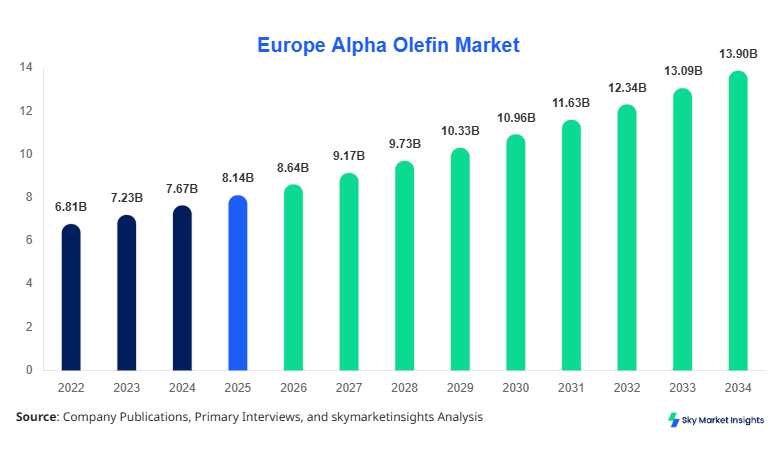
Europe Alpha Olefin market size is projected at USD 8.64 billion in 2026 and is expected to hit USD 13.91 billion by 2034 with a CAGR of 6.12%. The market recorded an estimated valuation of USD 8.11 billion in 2025, while total regional production exceeded 11.8 million metric tons across Europe during the base year. Increasing demand for polyethylene resins, detergent alcohol formulations, and synthetic lubricants continues to strengthen downstream consumption across industrial and consumer applications. Rising investments in petrochemical capacity expansion, coupled with technological modernization in cracking and oligomerization processes, are supporting competitive positioning among European manufacturers. The report evaluates production capacity, supply-demand analytics, pricing patterns, import-export dynamics, segmentation analysis, and competitive landscape across the Europe Alpha Olefin market size ecosystem.
The alpha olefin industry represents a critical segment of the petrochemical value chain, primarily consisting of linear alpha olefins derived from ethylene oligomerization processes. Europe accounted for nearly 21.4% of global alpha olefin consumption in 2025, with Germany contributing approximately 28.7% of the regional demand volume. Total Europe production capacity surpassed 13.2 million metric tons annually, while operational utilization rates averaged 84.3%. Polyethylene applications represented nearly 46.2% of total consumption, followed by detergent alcohols at 22.8%, synthetic lubricants at 14.6%, and plasticizer intermediates at 9.3%. Adoption rates for high-performance alpha olefin derivatives in automotive lubricants increased by 17.5% between 2022 and 2025. Consumer demand for lightweight packaging materials expanded by 8.9%, driving strong linear low-density polyethylene production volumes across Western Europe. Technical efficiency improvements in catalytic oligomerization systems enhanced output yields by 11.2%, while energy consumption per ton declined by 7.4% during the historical period. Increased usage in surfactants, drilling fluids, adhesives, and co-monomer production continues to reinforce Europe Alpha Olefin market share across industrial manufacturing sectors.
In the Germany, the Alpha Olefin Market accounted for nearly 28.7% of total European consumption in 2025, supported by over 42 operational petrochemical and downstream chemical facilities concentrated across North Rhine-Westphalia, Bavaria, and Lower Saxony. Germany produced approximately 3.4 million metric tons of alpha olefins during the base year, with ethylene-derived alpha olefins representing 61.5% of national output. Polyethylene applications contributed 48.9% of domestic demand, while detergent alcohols accounted for 20.6% and synthetic lubricants contributed 15.4%. More than 71% of German petrochemical plants adopted advanced catalytic cracking and low-emission production technologies by 2025, significantly improving process efficiency and reducing energy consumption by 9.8%. Automotive lubricant consumption increased by 12.3%, while packaging-grade polyethylene production expanded by 10.1% between 2023 and 2025. Germany also accounted for approximately 31.4% of regional exports of specialty alpha olefin derivatives, supported by strong industrial integration and export-oriented chemical manufacturing. Continuous investment in sustainable petrochemical feedstocks and circular polymer infrastructure is accelerating Europe Alpha Olefin market growth.
Explore more data points, trends and opportunities Download Free Sample Report
Alpha Olefin Market Trends
Expansion of Sustainable Olefin Production Technologies
The increasing integration of sustainable and low-carbon petrochemical production technologies represents a major transformation within the alpha olefin industry. European manufacturers invested more than USD 1.4 billion in decarbonization and catalytic efficiency enhancement projects between 2023 and 2025. Bio-based and renewable feedstock integration increased by 14.7%, particularly in Germany, France, and the United Kingdom. Production of sustainable alpha olefins exceeded 1.2 million metric tons in 2025, representing approximately 10.1% of total regional output. Advanced catalyst technologies improved alpha olefin selectivity rates by 13.8% while reducing by-product formation by nearly 9.4%. Demand from eco-friendly packaging manufacturers increased by 11.6%, while industrial lubricant applications using synthetic alpha olefins expanded by 8.3%. Manufacturers are increasingly prioritizing energy-efficient cracking systems and digitalized process optimization platforms to improve profitability and reduce emissions intensity. The transition toward circular chemical production ecosystems continues to strengthen alpha olefin market trend patterns across Europe.
Rising Demand from Packaging and Automotive Sectors
The packaging and automotive industries remain key demand generators for alpha olefins across Europe. Flexible packaging production exceeded 8.7 million metric tons in 2025, with linear low-density polyethylene consumption increasing by 9.2% year-over-year. Automotive synthetic lubricant demand rose by 12.8%, driven by electric vehicle thermal management requirements and high-performance engine applications. Alpha olefin utilization in specialty lubricant manufacturing accounted for nearly 1.1 million metric tons in 2025. The adoption rate of lightweight polyethylene materials in food packaging applications reached 67.5% across Western Europe. Industrial production automation and high-performance polymer engineering are also driving increased demand for specialty co-monomers derived from alpha olefins. Additionally, investment in high-density polyethylene capacity expansions increased by 16.4% during 2024–2025, supporting regional manufacturing competitiveness. Technological innovation and rising industrial applications continue to reinforce Alpha Olefin market trend developments throughout Europe.
Europe Alpha Olefin Drivers
Increasing Demand for Polyethylene and Specialty Lubricants Across Europe
The rising consumption of polyethylene resins and specialty lubricants is significantly driving alpha olefin demand across Europe. Polyethylene production in the region exceeded 18.4 million metric tons in 2025, with nearly 42% utilizing alpha olefin co-monomers such as 1-butene and 1-hexene. Flexible packaging applications increased by 8.9%, while demand for high-strength industrial films grew by 10.4%. Synthetic lubricants manufactured using alpha olefin feedstocks accounted for over 1.3 million metric tons of output during the base year. Automotive and industrial machinery sectors collectively represented 38.6% of specialty lubricant consumption. Additionally, the growing penetration of electric vehicles increased demand for thermal stability lubricants by 13.1% between 2023 and 2025. Germany, France, and the United Kingdom collectively accounted for 61.8% of regional downstream alpha olefin demand. Improvements in catalytic efficiency and process automation have also reduced production costs by nearly 6.7%, encouraging higher operating utilization rates across petrochemical complexes. The expansion of downstream polymer manufacturing continues to accelerate Europe's alpha olefin market growth.
Europe Alpha Olefin Restraints
Volatility in Crude Oil and Petrochemical Feedstock Prices
Price volatility in crude oil and petrochemical feedstocks remains a major restraint impacting alpha olefin manufacturers across Europe. Ethylene feedstock prices fluctuated by nearly 18.6% during 2024–2025 due to geopolitical disruptions, energy inflation, and supply chain instability. Production costs for alpha olefins increased by approximately 11.3% during periods of elevated natural gas pricing, particularly affecting facilities in Germany and Italy. Feedstock procurement represented nearly 58% of total operational expenditure for regional producers in 2025. Additionally, environmental compliance costs increased by 7.8% as European Union emission reduction regulations became stricter. Smaller manufacturers operating below 300,000 metric tons annual capacity experienced reduced profitability margins, with average operating margins declining by 4.9%. Logistics costs for petrochemical imports also increased by 6.2%, particularly for maritime shipments through major European ports. Supply disruptions and cost inflation continue to create operational challenges that may hinder Europe's alpha olefin market growth during the forecast period.
Europe Alpha Olefin Opportunities
Expansion of Bio-Based and Circular Chemical Manufacturing
The increasing emphasis on sustainable chemical production presents substantial opportunities for alpha olefin manufacturers across Europe. Investments in renewable feedstocks and circular polymer infrastructure exceeded USD 2.1 billion between 2024 and 2026. More than 24 petrochemical companies initiated projects involving recycled or bio-based olefin feedstocks during the current year. Demand for sustainable polyethylene grades increased by 15.7%, while industrial procurement contracts for low-carbon chemical intermediates expanded by 18.2%. Europe’s recycled polymer processing capacity surpassed 7.9 million metric tons annually in 2025, supporting integration opportunities for specialty alpha olefin derivatives. Germany and France collectively represented 49.3% of regional green chemical investment activity. Advanced catalytic conversion technologies improved renewable alpha olefin yield efficiency by 10.5%, enhancing commercial viability for sustainable manufacturing operations. Increasing consumer preference for eco-friendly packaging and industrial materials is creating long-term expansion potential for Europe's alpha-olefin market share.
Challenges in Europe: Alpha Olefin
Stringent Environmental Regulations and Energy Cost Pressures
European alpha olefin manufacturers face significant challenges associated with stringent environmental regulations and rising industrial energy costs. Industrial electricity prices across Europe increased by nearly 14.1% between 2023 and 2025, while natural gas costs remained 22.4% above pre-2022 averages. Compliance with European Union carbon emission reduction frameworks required petrochemical operators to allocate approximately 6.8% of annual operating expenditure toward environmental upgrades and carbon management initiatives. Production facilities operating older steam cracking systems experienced efficiency disadvantages of nearly 12.5% compared to newly modernized plants. Carbon taxation policies also increased overall production costs by approximately USD 42 per metric ton for selected petrochemical facilities. In addition, delays in infrastructure modernization projects affected nearly 17% of planned regional capacity expansion activities during 2025. Supply chain disruptions impacting catalyst procurement and specialty chemical transportation further constrained operational flexibility. These structural and regulatory challenges continue to influence Europe's alpha-olefin market growth dynamics.
Report Scope
| Report Metric | Details |
|---|---|
| Market Size in 2025 | USD 8.14 Billion |
| Market Size in 2026 | USD 8.64 Billion |
| Market Size in 2034 | USD 13.91 Billion |
| CAGR | 6.12% (2026-2034) |
| Base Year for Estimation | 2025 |
| Historical Data | 2022-2024 |
| Forecast Period | 2026-2034 |
| Report Coverage | Revenue Forecast, Competitive Landscape, Supply Chain Disruption, Growth Factors, Environment & Regulatory Landscape and Trends |
Explore more data points, trends and opportunities Download Free Sample Report
Alpha Olefin Market Segmentation
The Europe alpha olefin industry is segmented by type and application, with ethylene-based derivatives dominating approximately 61.5% of total production volume in 2025. Polyethylene applications represented the leading consumption category with nearly 46.2% market contribution, followed by detergent alcohols and synthetic lubricants. Rising industrialization, polymer manufacturing expansion, and sustainable chemical innovation continue to support diversified market penetration across multiple end-use sectors.
BY TYPE
Ethylene-derived alpha olefins dominated the regional industry with approximately 61.5% share in 2025 and production volumes exceeding 7.2 million metric tons annually. These alpha olefins are extensively utilized in polyethylene co-monomer manufacturing, surfactants, and industrial chemical intermediates. Germany, France, and the United Kingdom collectively accounted for nearly 65% of ethylene alpha olefin consumption across Europe. Advanced catalytic oligomerization technologies improved conversion efficiency by 12.4%, enabling higher production throughput and lower operating costs. Ethylene alpha olefins also demonstrated strong adoption within packaging and flexible film manufacturing applications, where demand increased by 9.1% between 2023 and 2025. Polyethylene resin producers increasingly preferred 1-hexene and 1-octene due to enhanced tensile strength and improved polymer flexibility characteristics. Operational capacity utilization rates for ethylene alpha olefin plants averaged 86.3% during the base year. Continuous investments in sustainable feedstock integration and digitalized manufacturing systems continue supporting production scalability and Europe's alpha olefin market size expansion.
Propylene-based alpha olefins represented approximately 24.7% of regional production volume in 2025, supported by increasing demand from automotive, adhesives, and industrial coating sectors. Total production surpassed 2.9 million metric tons, with utilization rates exceeding 81.2%. Propylene derivatives demonstrated strong demand within lubricant additives and specialty polymer formulations due to improved oxidation resistance and thermal performance. Automotive manufacturing activity across Germany and Italy increased consumption of propylene-derived lubricants by nearly 10.8%. Technological advancements in propylene cracking and downstream catalytic synthesis improved production selectivity by 8.6%. The growing penetration of lightweight automotive materials and engineered plastics further accelerated demand across industrial manufacturing ecosystems.
Butene alpha olefins accounted for approximately 13.8% of regional production volume during 2025, exceeding 1.6 million metric tons annually. These derivatives are widely used in linear low-density polyethylene production and specialty synthetic lubricants. Western Europe represented nearly 72% of total butene demand due to concentrated packaging and industrial manufacturing activity. Butene-based co-monomers improved polymer flexibility and impact resistance by approximately 15.3% compared to conventional formulations. Growing food packaging demand and rising e-commerce logistics activities significantly increased consumption of butene-enhanced polyethylene materials across Europe.
BY APPLICATION
Polyethylene applications dominated the European alpha-olefin industry, with approximately 46.2% of total consumption in 2025. Total alpha olefin utilization within polyethylene manufacturing exceeded 5.4 million metric tons, driven by strong demand for flexible packaging, industrial films, and consumer goods applications. Linear low-density polyethylene represented nearly 58% of polyethylene-related alpha olefin usage due to superior durability, flexibility, and tensile strength characteristics. Germany, France, and Spain collectively accounted for more than 60% of regional polyethylene demand. Packaging sector expansion increased polyethylene resin production by 8.7% during the historical period. Advanced polymer engineering technologies also enhanced material recyclability rates by 11.4%, supporting sustainable packaging initiatives across Europe. Continuous growth in food packaging, pharmaceutical packaging, and industrial logistics sectors continues strengthening Europe's alpha olefin market share.
Detergent alcohol applications accounted for approximately 22.8% of regional alpha olefin consumption in 2025, supported by increasing demand for industrial cleaners, household detergents, and surfactant formulations. Total production volumes exceeded 2.6 million metric tons during the base year. Consumer demand for high-performance and biodegradable cleaning products increased by 13.6%, particularly across Western Europe. Alpha olefin-based detergent alcohols demonstrated enhanced emulsification efficiency and reduced environmental impact compared to conventional surfactants. Germany and the United Kingdom represented nearly 47% of detergent alcohol consumption due to advanced consumer goods manufacturing sectors. Rising hygiene awareness and industrial sanitation requirements continue driving substantial downstream consumption growth.
Synthetic lubricants represented approximately 14.6% of regional alpha olefin demand during 2025, with total production exceeding 1.7 million metric tons. Automotive, aerospace, and industrial machinery sectors collectively accounted for over 69% of lubricant-related alpha olefin utilization. Polyalphaolefin lubricants improved thermal stability by 18.4% and oxidation resistance by 16.1% compared to mineral-based alternatives. Electric vehicle manufacturing growth increased demand for specialty lubricants by nearly 12.9% between 2023 and 2025. Advanced industrial machinery and high-performance automotive systems continue to require premium lubricant formulations, strengthening long-term application potential.
Europe Alpha Olefin Market Segmentations
By Type
- Ethylene
- Propylene
- Butene
By Application
- Polyethylene
- Detergent Alcohols
- Synthetic Lubricants
Europe Alpha Olefin Regional Outlook
United Kingdom
The United Kingdom accounted for approximately 14.2% of regional alpha olefin consumption in 2025, supported by advanced packaging, industrial chemical, and lubricant manufacturing sectors. National production volumes exceeded 1.5 million metric tons annually, while import dependency for specialty derivatives remained near 22.4%. Polyethylene applications represented nearly 44.8% of domestic demand, followed by detergent alcohols at 23.7%. Investments in low-carbon petrochemical infrastructure increased by 11.3% during 2024–2025. More than 64% of petrochemical facilities adopted energy-efficient process automation technologies to reduce operating costs and carbon emissions. The country’s industrial lubricant sector also expanded significantly, supported by increasing electric vehicle production and advanced manufacturing activities.
Germany
Germany remained the largest regional contributor with nearly 28.7% Europe market share in 2025. National alpha olefin production surpassed 3.4 million metric tons, supported by over 42 integrated petrochemical and downstream processing facilities. Polyethylene manufacturing represented 48.9% of total domestic demand, while automotive lubricant applications contributed approximately 16.5%. Germany also led regional investments in sustainable chemical manufacturing, accounting for nearly 31% of total European decarbonization expenditure within petrochemicals. Advanced catalyst deployment improved process efficiency by 10.6%, while industrial digitalization reduced energy consumption by 8.9%.
France
France represented approximately 16.1% of Europe alpha olefin demand during 2025, with total production exceeding 1.9 million metric tons annually. The country maintained strong growth in detergent alcohol manufacturing and sustainable packaging applications. Polyethylene demand increased by 9.3%, while biodegradable surfactant production expanded by 12.8%. Government incentives supporting low-carbon industrial production accelerated investments in renewable feedstock integration across major chemical clusters. France also accounted for nearly 18% of Europe’s recycled polymer capacity expansion projects during the current year.
Spain
Spain accounted for nearly 11.4% of regional alpha olefin consumption in 2025, supported by rising packaging production and industrial manufacturing growth. National production exceeded 1.2 million metric tons, with polyethylene applications contributing approximately 45.6% of total demand. Flexible packaging manufacturing activity increased by 10.2%, while detergent alcohol production expanded by 7.8%. The country also witnessed rising investments in circular polymer infrastructure and specialty lubricant blending facilities, particularly across Catalonia and Valencia industrial regions.
Italy
Italy represented approximately 12.3% of total Europe alpha olefin demand in 2025, supported by strong automotive, industrial lubricant, and packaging industries. Production volumes surpassed 1.4 million metric tons annually. Automotive lubricant applications contributed nearly 18.7% of domestic alpha olefin consumption due to the country’s advanced automotive engineering ecosystem. Industrial energy cost inflation increased operational expenditures by 9.6%, prompting greater investment in energy-efficient petrochemical systems. Italy also strengthened exports of specialty lubricant additives and polymer intermediates across Southern Europe.
Russia
Russia accounted for approximately 17.3% of regional alpha olefin production during 2025, exceeding 2.1 million metric tons annually. Large hydrocarbon feedstock availability supported competitive manufacturing economics and export capacity expansion. Polyethylene manufacturing represented 51.2% of domestic alpha olefin utilization, while industrial chemical applications contributed nearly 21.4%. Investments in pipeline infrastructure and petrochemical modernization projects increased by 13.7% between 2023 and 2025. Russia also strengthened exports of basic alpha olefin intermediates toward Eastern Europe and Asian markets.
Top players in Europe: Alpha Olefin
- Shell plc
- INEOS Group
- BASF SE
- SABIC
- ExxonMobil Chemical
- Chevron Phillips Chemical Company
- LyondellBasell Industries
- TotalEnergies
- Evonik Industries
- Clariant AG
- Borealis AG
- Repsol S.A.
- Dow Inc.
- Nouryon
- Sasol Limited
Shell plc
-
Estimated regional market positioning exceeded 14.8% share in 2025 through integrated petrochemical manufacturing operations.
-
Operated multiple advanced olefin and polymer production facilities across Germany, the Netherlands, and the United Kingdom.
-
Invested more than USD 420 million in sustainable feedstock integration and low-emission petrochemical modernization projects between 2023 and 2025.
-
Expanded specialty polyalphaolefin lubricant production capacity by approximately 11.6%.
-
Strengthened downstream packaging and industrial polymer supply agreements across Western Europe.
INEOS Group
-
Accounted for approximately 12.9% regional share in Europe during 2025 through extensive petrochemical production infrastructure.
-
Operated more than 20 integrated chemical and polymer facilities across Europe with annual olefin production exceeding 4 million metric tons.
-
Increased polyethylene-related alpha olefin output by nearly 9.8% during the historical period.
-
Invested heavily in catalyst optimization, process automation, and recycling infrastructure modernization.
-
Expanded industrial lubricant and specialty surfactant production capabilities to support downstream manufacturing demand.
Investment Analysis
Investment activity within the Europe alpha olefin industry accelerated substantially between 2024 and 2026, with total regional petrochemical and downstream infrastructure investment exceeding USD 5.8 billion. Approximately 38.4% of total investment allocation targeted sustainable feedstock integration and decarbonization initiatives, while 27.6% focused on polymer manufacturing capacity expansion. Germany accounted for nearly 31.2% of total regional investments, followed by France at 18.7% and the United Kingdom at 15.9%. Investment in digital manufacturing systems and process automation increased by 14.5% year-over-year, improving operational efficiency and reducing maintenance costs across petrochemical complexes.
Mergers, acquisitions, and strategic collaborations continued to reshape competitive positioning across the industry. More than 22 major partnership agreements were announced between 2023 and 2025 involving catalyst technology providers, sustainable chemical manufacturers, and polymer processing companies. Joint ventures focused on circular polyethylene production and renewable feedstock integration represented approximately 29% of all announced agreements. Several European manufacturers expanded partnerships with automotive lubricant suppliers to support electric vehicle thermal management applications. Cross-border collaborations between Germany, France, and the Netherlands strengthened regional supply chain integration and feedstock security. Investment in recycled polymer processing facilities increased by 17.3%, supporting long-term sustainability goals and industrial competitiveness.
New Product Developments
European manufacturers significantly accelerated new product innovation activities within the alpha olefin industry during 2025. Approximately 18.6% of newly introduced chemical formulations involved sustainable or low-carbon alpha olefin derivatives. Advanced polyalphaolefin lubricants demonstrated thermal efficiency improvements of nearly 16.2% and oxidation resistance enhancements of 14.8% compared to conventional products. New catalyst technologies improved alpha olefin yield selectivity by approximately 10.4%, enabling higher production throughput and lower operational waste generation.
Several companies introduced high-performance polyethylene co-monomers specifically designed for recyclable packaging applications. These materials improved film durability by 13.1% while reducing packaging weight by 8.7%. Innovation within detergent alcohol formulations also increased biodegradability performance by 11.5%, supporting stricter environmental compliance requirements across Europe. Rising research and development expenditure continues accelerating product differentiation and commercial competitiveness within the regional market.
Recent Developments in Europe Alpha Olefin
- 2025: Shell plc expanded its Germany-based alpha olefin production facility by approximately 280,000 metric tons annually, increasing operational capacity utilization to nearly 88%. The expansion supported rising demand from polyethylene and specialty lubricant manufacturers across Western Europe. The company also implemented advanced catalyst systems that improved process efficiency by 9.6% while reducing carbon emissions intensity by 7.4%.
- 2025: BASF SE introduced a new generation of high-performance polyalphaolefin lubricants for electric vehicle thermal management systems. The products demonstrated approximately 17.1% higher thermal stability and 12.8% improved oxidation resistance compared to previous formulations. Production capacity for specialty lubricants increased by nearly 110,000 metric tons annually to address growing automotive sector demand.
- 2025: Borealis AG expanded its specialty polymer manufacturing operations in Austria and Germany, increasing alpha olefin consumption capacity by approximately 9.4%. The project supported rising demand for high-performance industrial films and lightweight packaging materials. Advanced process automation systems also reduced operational energy consumption by 6.9% across the upgraded production facilities.
Research Methodology
The Europe alpha olefin market assessment was developed through a comprehensive multi-stage research methodology combining primary research, secondary research, market validation, and quantitative forecasting techniques. The research process involved detailed analysis of petrochemical production data, trade statistics, industrial manufacturing indicators, company annual reports, investor presentations, regulatory publications, and chemical industry databases from 2022 through 2025. Primary research included interviews with petrochemical manufacturers, polymer producers, distributors, industry consultants, and technology providers across Germany, France, the United Kingdom, Spain, Italy, and Russia. Secondary research incorporated evaluation of government industrial statistics, customs data, sustainability reports, technical journals, and production capacity databases. Market size estimation utilized both top-down and bottom-up analytical approaches, incorporating production volume analysis, demand-side consumption modeling, pricing trend assessment, and end-use application forecasting. Forecast models integrated macroeconomic indicators, downstream polymer demand patterns, industrial investment trends, and technological adoption rates to ensure accurate long-term market projections across the Europe alpha olefin industry.
Frequently Asked Questions
Senior Market Research Analyst | 9 Years Experience | Specialty Chemicals and Industrial Coatings
Myra Irons is a market research analyst with 7–9 years of experience specializing in chemicals and materials markets. Contributed to 70+ research reports for global clients. Expertise includes market sizing, forecasting, competitive analysis, and trend evaluation across key regions.