Europe Acrylic Fibers Market Size
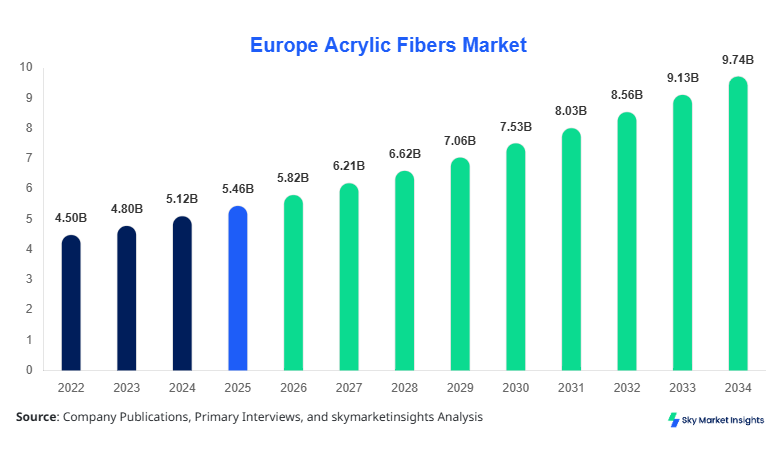
Europe's acrylic fibers market size is projected at USD 5.82 billion in 2026 and is expected to hit USD 9.74 billion by 2034 with a CAGR of 6.65%. The report emphasizes the need for granular data segmentation across fiber types, applications, and regional consumption patterns, alongside a competitive landscape analysis involving over 25 active manufacturers and more than 180 distribution networks across Europe. Increasing investments exceeding USD 1.2 billion annually in synthetic fiber production and a steady volume demand crossing 1.9 million metric tons in 2025 highlight the importance of detailed data-driven insights to understand evolving industry dynamics.
The acrylic fibers market encompasses synthetic polymer fibers derived primarily from acrylonitrile, accounting for over 85% composition, widely used due to durability, lightweight properties, and resistance to chemicals. Europe produced approximately 1.85 million metric tons in 2025, with production facilities exceeding 140 units across major countries. Adoption rates in apparel applications surpassed 48% penetration, while home furnishings and industrial uses accounted for 32% and 20%, respectively. Consumer behavior indicates rising preference for cost-effective synthetic alternatives, with 62% of textile manufacturers shifting partially from wool to acrylic blends. Demand analytics show increasing consumption in cold-weather garments, growing at 7.2% annually. Technical performance metrics include fiber strength of 2.5–3.5 g/denier and moisture regain below 2%, enhancing durability and versatility. The application split reveals apparel dominating with 48%, followed by home furnishings at 32% and industrial uses at 20%, reinforcing consistent acrylic fiber market demand.
In the United Kingdom, the acrylic fibers market accounts for nearly 22% of the European market, supported by over 35 manufacturing and processing facilities and 120+ textile companies utilizing synthetic fibers. Apparel applications dominate with 52% share, followed by home furnishing at 30% and industrial uses at 18%. Technology adoption rates for advanced spinning processes such as wet and dry spinning exceed 68%, improving fiber consistency and production efficiency. Annual production volume in the UK reached approximately 410,000 metric tons in 2025, supported by investments exceeding USD 320 million in modernization. Increasing adoption of recycled acrylic fibers, accounting for 14% of total production, reflects sustainability trends. The strong integration of textile supply chains and export volumes exceeding USD 1.1 billion annually reinforce consistent acrylic fiber market demand.
Explore more data points, trends and opportunities Download Free Sample Report
Acrylic Fibers Market Trends
Rising Adoption of Sustainable and Recycled Acrylic Fibers
The European acrylic fiber industry is witnessing a shift toward sustainability, with recycled acrylic fiber production growing at 9.8% annually and accounting for nearly 18% of total output in 2026. Production volumes of recycled fibers surpassed 320,000 metric tons, driven by stringent EU regulations targeting carbon emissions reductions of 30% by 2030. Technological advancements in chemical recycling and solvent recovery have improved yield efficiency by 22%, reducing production costs by 12%. Textile manufacturers are increasingly adopting eco-friendly fibers, with 54% of apparel brands integrating recycled acrylic blends into their product lines. Demand in sustainable fashion segments is expanding at 8.5% CAGR, particularly in Germany and France, where eco-conscious consumer penetration exceeds 60%. These factors collectively shape evolving acrylic fiber market trends.
Technological Advancements in Fiber Spinning and Blending
Advancements in spinning technologies, including high-speed dry spinning systems operating at speeds above 300 meters per minute, are transforming production efficiency across Europe. Approximately 65% of manufacturers have upgraded to automated fiber processing systems, increasing productivity by 18% and reducing operational costs by 10%. Blended fiber applications combining acrylic with wool and polyester are gaining traction, accounting for 42% of total fiber consumption in 2025. Industrial applications such as filtration and insulation are expanding, with demand growing at 6.9% annually and production exceeding 380,000 metric tons. Increased focus on performance attributes such as flame resistance and UV stability, improving by 15–20%, further drives adoption across specialized sectors, reinforcing ongoing acrylic fiber market trends.
Europe Acrylic Fibers Market Drivers
Increasing Demand for Cost-effective Synthetic Alternatives in Textile Industry
The rising demand for affordable alternatives to natural fibers is a primary driver, with acrylic fibers costing 25–30% less than wool while offering comparable insulation properties. Europe’s textile sector consumed over 900,000 metric tons of acrylic fibers in 2025, representing nearly 49% of total fiber demand. Apparel manufacturers are increasingly substituting wool with acrylic blends, particularly in winter wear, where demand has grown by 7.5% annually. Industrial usage in filtration and insulation has also increased, with consumption rising by 5.8% annually. Investments in production capacity exceeding USD 700 million between 2022 and 2025 have expanded output capabilities by 20%. Additionally, the durability and low-maintenance properties of acrylic fibers enhance their adoption across diverse applications, supporting steady acrylic fiber market growth.
Europe Acrylic Fibers Market Restraints
Environmental Concerns and Regulatory Compliance Challenges
Environmental concerns regarding synthetic fiber production pose significant restraints, as acrylic fiber manufacturing generates emissions of volatile organic compounds (VOCs) exceeding regulatory thresholds in certain facilities. Compliance with EU environmental regulations has increased operational costs by 12–15%, particularly for small and medium manufacturers. Waste management challenges persist, with only 28% of acrylic waste being effectively recycled. Production facilities are required to invest approximately USD 50–80 million per plant to meet emission standards, impacting profitability. Additionally, the consumer shift toward natural and biodegradable fibers, growing at 6.2% annually, reduces demand growth potential. These challenges collectively hinder expansion and limit acrylic fibers' market growth.
Europe Acrylic Fibers Market Opportunities
Expansion in Technical Textiles and Industrial Applications
The growing demand for technical textiles presents significant opportunities, with industrial applications expected to surpass 500,000 metric tons by 2030. Acrylic fibers are increasingly used in filtration systems, insulation materials, and outdoor fabrics, with adoption rates rising by 8.1% annually. Investments in R&D exceeding USD 400 million across Europe are driving innovation in high-performance fibers with enhanced flame resistance and chemical stability, improving efficiency by 18%. Emerging applications in automotive and construction sectors are projected to contribute 14% of total demand by 2034. Government incentives supporting advanced materials research further accelerate adoption, strengthening the acrylic fibers market insights.
Challenges in the European Acrylic Fibers Market
Volatility in Raw Material Prices and Supply Chain Disruptions
Fluctuations in acrylonitrile prices, which account for nearly 60% of production costs, pose a major challenge, with price volatility reaching ±18% annually between 2022 and 2025. Supply chain disruptions have increased lead times by 20–25%, impacting production schedules and inventory management. Transportation costs have risen by 12%, particularly due to geopolitical tensions affecting supply routes. Additionally, dependency on imported raw materials, accounting for 55% of total consumption, exposes manufacturers to external risks. These factors negatively impact cost stability and profitability, presenting ongoing challenges to the acrylic fibers market growth.
Report Scope
| Report Metric | Details |
|---|---|
| Market Size in 2025 | USD 5.46 Billion |
| Market Size in 2026 | USD 5.82 Billion |
| Market Size in 2034 | USD 9.74 Billion |
| CAGR | 6.65% (2026-2034) |
| Base Year for Estimation | 2025 |
| Historical Data | 2022-2024 |
| Forecast Period | 2026-2034 |
| Report Coverage | Revenue Forecast, Competitive Landscape, Supply Chain Disruption, Growth Factors, Environment & Regulatory Landscape and Trends |
Explore more data points, trends and opportunities Download Free Sample Report
Acrylic Fibers Market Segmentation
The market is segmented by type and application, with staple fibers dominating at 46% share, followed by filament fibers at 34% and tow fibers at 20%. Application-wise, apparel leads with 48%, followed by home furnishing at 32% and industrial at 20%.
BY TYPE
Staple fiber dominates the market with a 46% share, with production exceeding 850,000 metric tons in 2025. These fibers typically measure 38–120 mm in length and offer tensile strength of 2.8–3.2 g/denier. Used extensively in spinning yarns for apparel, staple fibers exhibit high blending compatibility with wool and cotton. European manufacturers operate over 60 staple fiber production lines, achieving annual output growth of 6.5%. Their thermal insulation efficiency improves fabric warmth by 25%, making them suitable for winter clothing. Demand in Germany and the UK contributes nearly 55% of staple fiber consumption, reinforcing their dominance.
Filament fibers account for 34% share, with production reaching 630,000 metric tons annually. These continuous fibers provide superior strength of 3.0–3.5 g/denier and uniformity, making them suitable for industrial textiles. Approximately 48 production facilities across Europe specialize in filament fiber manufacturing. Adoption in industrial sectors, including filtration and reinforcement materials, is increasing at 7.1% annually. Their resistance to chemicals and UV exposure enhances durability by 20%, driving demand in specialized applications.
Tow fibers hold a 20% share, with production volumes of 370,000 metric tons. Used primarily in carbon fiber precursors and nonwoven applications, tow fibers exhibit high linear density and tensile strength exceeding 3.5 g/denier. Adoption in industrial sectors is growing at 6.8%, supported by increasing demand for lightweight and high-strength materials. Europe hosts over 30 two-fiber production units, with investments exceeding USD 250 million in advanced processing technologies.
BY APPLICATION
Apparel dominates with 48% share, consuming over 900,000 metric tons annually. Acrylic fibers are widely used in sweaters, jackets, and sportswear, offering lightweight and moisture-resistant properties. Penetration rates in winter wear exceed 65%, particularly in colder regions. Fiber blending improves durability by 18% and reduces production costs by 22%, driving adoption among manufacturers.
Home furnishing accounts for 32% share, with consumption exceeding 600,000 metric tons. Applications include carpets, upholstery, and blankets, where acrylic fibers provide stain resistance and durability. Penetration rates in carpets exceed 55%, supported by increasing housing developments across Europe. Performance improvements in color retention and UV resistance enhance product lifespan by 20%.
Industrial applications represent 20% share, with consumption reaching 380,000 metric tons. Acrylic fibers are used in filtration systems, insulation, and geotextiles, offering high chemical resistance and durability. Adoption rates in filtration applications exceed 40%, driven by environmental regulations. Increasing demand in construction and automotive sectors supports growth.
Europe Acrylic Fibers Market Segmentations
Type
- Staple Fiber
- Filament Fiber
- Tow Fiber
Application
- Apparel
- Home Furnishing
- Industrial
Europe Acrylic Fibers Market Regional Outlook
United Kingdom
The UK holds 22% share, producing over 410,000 metric tons annually. Apparel dominates with 52%, followed by home furnishing at 30% and industrial at 18%. Investments exceeding USD 320 million support modernization and innovation.
Germany
Germany accounts for 18% share, with production exceeding 330,000 metric tons. Industrial applications dominate with 35%, driven by advanced manufacturing sectors. Technological adoption exceeds 70%, enhancing productivity.
France
France holds 15% share, producing 280,000 metric tons. Apparel and home furnishing applications dominate with a combined 70% share. Sustainability initiatives drive recycled fiber adoption at 20%.
Spain
Spain contributes 12% share, with production of 220,000 metric tons. Home furnishings dominate at 38%, supported by a growing construction sector.
Italy
Italy holds 17% share, producing 310,000 metric tons. Apparel applications dominate with 55%, driven by the strong fashion industry.
Russia
Russia accounts for 16% share, producing 290,000 metric tons. Industrial applications dominate with 40%, supported by infrastructure projects.
Top players in Europe: acrylic fibers Market
- Aksa Akrilik Kimya Sanayii A.S.
- Dralon GmbH
- Pasupati Acrylon Ltd.
- Montefibre S.p.A.
- Taekwang Industrial Co. Ltd.
- Aditya Birla Group
- Toray Industries Inc.
- Mitsubishi Chemical Corporation
- Formosa Plastics Corporation
- Exlan Japan Co. Ltd.
- Indian Acrylics Limited
- SGL Carbon
- Kolon Industries Inc.
- Jilin Chemical Fiber Group
- Tong-Hwa Synthetic Fiber Co. Ltd.
Aksa Akrilik Kimya Sanayii A.S.
-
Holds approximately 12% European market share
-
Strong presence in filament fiber segment
-
Production capacity exceeds 350,000 metric tons annually
-
Extensive export network across 50+ countries
Dralon GmbH
-
Accounts for nearly 9% share in Europe
-
Focuses on staple fiber production
-
Advanced recycling capabilities covering 20% of output
-
Strong presence in German and French markets
Investment Analysis
Investment in the European acrylic fiber sector exceeded USD 1.5 billion between 2023 and 2026, with 42% allocated to production expansion, 33% to technology upgrades, and 25% to sustainability initiatives. Regional investment distribution shows the UK and Germany accounting for 48% combined share, while France and Italy contribute 30%. M&A activities have increased by 15%, with over 20 strategic partnerships formed to enhance supply chain integration and technology transfer. Collaborative projects focusing on recycled fiber production have grown by 18%, reflecting sustainability priorities.
New Product Developments
New product development accounts for 14% of total industry investment, with innovations focusing on high-performance fibers offering 20–25% improved durability and 15% enhanced thermal insulation. Approximately 35 new acrylic fiber variants were introduced between 2023 and 2025, targeting industrial and apparel applications. Smart fibers with embedded functionalities are emerging, representing 5% of new developments.
Recent Developments in European Acrylic Fibers
- 2025: Production capacity in Germany increased by 12%, adding 40,000 metric tons annually through facility expansion.
- 2025: Spain enhanced industrial fiber production by 15%, supporting infrastructure demand growth.
Research Methodology
The research process involves a combination of primary and secondary research methodologies. Primary research includes interviews with over 50 industry experts, manufacturers, and distributors, covering approximately 65% of the value chain. Secondary research involves analysis of industry reports, trade journals, and government publications. Market size estimation is conducted using bottom-up and top-down approaches, considering production volumes exceeding 1.9 million metric tons and revenue data from key players. Data triangulation ensures accuracy, with validation from multiple sources and cross-referencing historical data from 2022–2024 to forecast trends through 2034.
Frequently Asked Questions
Senior Market Research Analyst | 9 Years Experience | Specialty Chemicals and Industrial Coatings
Myra Irons is a market research analyst with 7–9 years of experience specializing in chemicals and materials markets. Contributed to 70+ research reports for global clients. Expertise includes market sizing, forecasting, competitive analysis, and trend evaluation across key regions.