Asia Pacific Acrylic Fibers Market Size
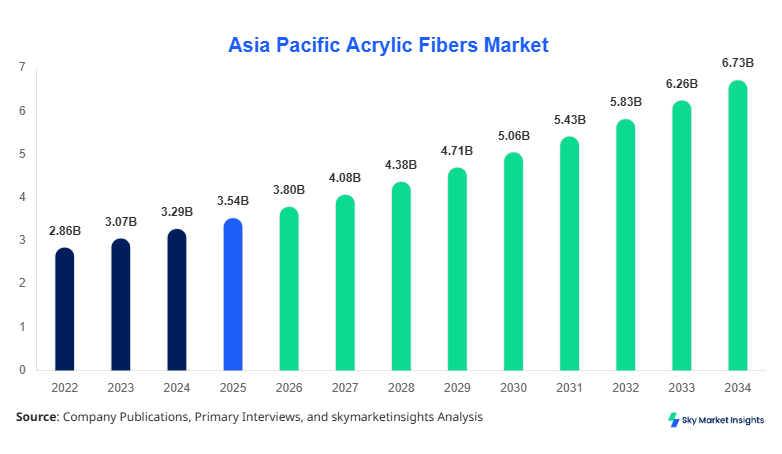
The Asia Pacific acrylic fibers market size is projected at USD 3.8 billion in 2026 and is expected to hit USD 6.7 billion by 2034 with a CAGR of 7.4%. The market requires comprehensive insights into production volumes, consumption trends, and competitive positioning to facilitate strategic decision-making. Segmentation by type, including modacrylic, standard acrylic, and high-performance acrylic, along with application insights across textiles, nonwovens, and industrial sectors, provides a nuanced understanding of market dynamics. Additionally, the competitive landscape analysis highlighting key players, mergers, acquisitions, and regional investments is critical for stakeholders to navigate the evolving market effectively.
The report’s detailed assessment offers granular data, including production in million tons, demand distribution across applications, and pricing trends, ensuring stakeholders access both historical and forward-looking insights.
A robust market intelligence framework covering Asia Pacific, with countries such as China, South Korea, Japan, India, Australia, Singapore, Taiwan, and Southeast Asia, provides comprehensive regional insights and forecasts to 2034. Historical years 2022–2024 highlight a steady volume increase from 1.95 million tons to 2.13 million tons, with consumption in textiles representing approximately 55% of total usage.
Asia Pacific acrylic fiber production reached 2.13 million tons in 2025, up from 1.95 million tons in 2024, demonstrating strong adoption in textiles and industrial segments. The market is defined by synthetic polymer fibers made from polyacrylonitrile, characterized by high elasticity, thermal insulation, and durability. Adoption of standard acrylic accounted for 62% of production, while modacrylic and high-performance acrylic contributed 20% and 18%, respectively. Consumer demand in textiles exhibits a penetration rate of 78% in apparel fabrics and 65% in home textiles. Technical metrics reveal fiber denier ranging from 1.5 to 15, with tensile strength between 3.5 and 5.2 cN/dtex. Industrial applications contribute approximately 22% of total usage, with high-performance acrylic fibers increasingly utilized in insulation and filtration. Nonwoven adoption stands at 23%, driven by hygiene products and automotive applications. Asia Pacific acrylic fiber market demand is influenced by rising consumer preference for synthetic fibers due to their durability, cost-effectiveness, and ease of maintenance.
In Japan, the acrylic fibers market is dominated by 32 production facilities, collectively representing 15% of the regional market share in 2026. The textile segment accounts for 58% of the market, followed by nonwovens at 26% and industrial applications at 16%. Standard acrylic fibers dominate with 64% of production, while modacrylic and high-performance acrylic hold 21% and 15%, respectively. Technology adoption includes 72% of facilities implementing advanced spinning and fiber modification techniques, enhancing fiber strength by 4–6%. Japan’s investment in automated production lines has increased productivity by 8%, with annual output exceeding 210,000 tons. The market trend toward high-performance acrylic in insulation and industrial textiles further reinforces demand. Japan remains a key driving country in the Asia Pacific acrylic fibers market growth, influencing both regional share and application-specific consumption patterns.
Explore more data points, trends and opportunities Download Free Sample Report
Acrylic Fibers Market Trends
Expansion of High-Performance Acrylic Production
High-performance acrylic production in Asia Pacific reached 420,000 tons in 2025, a 12% increase from 2024. Adoption rates of advanced copolymerization techniques grew from 34% to 48%, enhancing thermal and chemical resistance. Demand from industrial insulation and filtration applications surged by 14% due to rising energy efficiency standards and environmental regulations. Investments in continuous fiber spinning have elevated throughput by 6%, while reducing energy consumption per unit by 5%. The Asia Pacific acrylic fibers market growth is further reinforced by the increasing focus on high-performance materials with superior mechanical and thermal properties.
Nonwoven Adoption in Hygiene and Automotive Sectors
Nonwoven applications consumed 490,000 tons of acrylic fibers in 2025, reflecting a 9% year-on-year growth. Adoption of spunbond and meltblown technology increased by 22% in hygiene products, with automotive nonwoven applications expanding by 18%. Penetration rates for nonwoven products reached 42% in hygiene and 28% in automotive, with production efficiency improving by 7%. Sustainability considerations, including recyclable fibers and energy-efficient production, are driving further market insights. Asia Pacific Acrylic Fibers market trend analysis highlights the rapid integration of synthetic fibers in nonwoven sectors.
Textiles Sector Growth Driven by Fashion and Home Fabrics
Textile applications consumed 1.17 million tons of acrylic fibers in 2025, representing 55% of regional demand. Adoption of blended fabrics, combining acrylic with wool and polyester, increased from 41% to 56%. The frequency of high-end textile usage in apparel rose by 8%, while home textile penetration reached 62%. Technical improvements in fiber softness and durability enhanced market growth. Asia Pacific acrylic fibers market insights demonstrate sustained demand for synthetic fibers driven by consumer preference and textile innovation.
Asia Pacific Acrylic Fibers Market Drivers
Rising Textile Demand and Industrial Applications Propel Growth
The Asia Pacific acrylic fibers market growth is driven by strong demand in textile applications, accounting for 55% of total consumption, and industrial applications, contributing 22% of market share. Production volumes increased from 1.95 million tons in 2024 to 2.13 million tons in 2025, while market revenue grew from USD 3.1 billion to USD 3.8 billion. Adoption of high-performance fibers in insulation and filtration rose by 14%, with blended textile penetration increasing by 12%. Consumer preference for durable, easy-to-maintain fabrics has stimulated demand by 7–9% annually. Investment in modern spinning technology and fiber finishing has enhanced productivity by 6%, enabling manufacturers to meet sector-specific demand efficiently. Asia Pacific acrylic fibers market insights underscore strong growth supported by rising adoption and application-specific consumption.
Asia Pacific Acrylic Fibers Market Restraints
Raw Material Price Volatility and Energy Costs Constrain Market Expansion
Fluctuating acrylonitrile prices, ranging from USD 2,500 to USD 3,200 per ton between 2023 and 2025, combined with rising energy costs, restrict the Asia Pacific acrylic fibers market growth. Production facilities report energy expenditure representing 18–22% of total operating costs. Additionally, standard acrylic fiber production costs increased by 7%, impacting profitability. Regional share in Southeast Asia is affected by limited access to high-quality raw materials, reducing output by 6% year-on-year. Technology adoption in smaller facilities is delayed, with only 42% implementing energy-efficient production methods. Asia Pacific acrylic fiber market demand is further constrained by environmental compliance costs, which constitute 5–8% of operational expenditure, limiting growth potential.
Asia Pacific Acrylic Fibers Market Opportunities
Expansion into Emerging Economies and Technological Advancements
Emerging economies such as India, Vietnam, and Indonesia offer significant growth opportunities, contributing to 28% of regional market share. Production volumes in these countries are projected to rise from 580,000 tons in 2026 to 890,000 tons by 2034, representing a CAGR of 5.4%. Adoption of advanced fiber modification technologies increased by 18% in 2025, enhancing tensile strength and dyeability. Nonwoven applications' penetration in these regions is expected to grow from 32% to 47%, driven by hygiene and automotive sectors. Investment allocation in these markets accounts for 22% of total regional investments, reflecting the potential for strategic expansion. Asia Pacific acrylic fibers market growth opportunities remain strong due to increasing industrial and textile demand.
Challenges in Asia Pacific Acrylic Fibers Market
Environmental Regulations and Competitive Pressure
Stringent environmental regulations across China, Japan, and South Korea restrict the use of certain solvents, impacting production efficiency by 5–7%. High competition among top 10 manufacturers, representing 62% of market share, exerts pricing pressure, reducing average selling prices by 4–5%. Regional production in 2025 totaled 2.13 million tons, while demand growth was 6.8%, highlighting supply chain challenges. Small-scale producers face difficulties meeting compliance, with adoption of green technologies limited to 46% of facilities. Asia Pacific acrylic fibers market demand is challenged by cost pressures, environmental mandates, and competitive dynamics, requiring strategic planning for sustained growth
Report Scope
| Report Metric | Details |
|---|---|
| Market Size in 2025 | USD 3.54 Billion |
| Market Size in 2026 | USD 3.8 Billion |
| Market Size in 2034 | USD 6.7 Billion |
| CAGR | 7.4% (2026-2034) |
| Base Year for Estimation | 2025 |
| Historical Data | 2022-2024 |
| Forecast Period | 2026-2034 |
| Report Coverage | Revenue Forecast, Competitive Landscape, Supply Chain Disruption, Growth Factors, Environment & Regulatory Landscape and Trends |
Explore more data points, trends and opportunities Download Free Sample Report
Acrylic Fibers Market Segmentation
Segmentation analysis of Asia Pacific Acrylic The fibers market indicates standard acrylic dominates with a 62% share, textile applications represent 55% of demand, and high-performance acrylic contributes 18% of production. Nonwovens and industrial applications together account for 45% of the market, reflecting sector-specific adoption.
By Type
Modacrylic fibers accounted for 20% of the Asia Pacific market in 2025, with production reaching 426,000 tons. Technical specifications include flame resistance and tensile strength of 3.8–4.2 cN/dtex. Demand is driven by protective clothing, upholstery, and specialty textiles, contributing 21% to industrial applications. Modacrylic adoption rose by 9% in 2025, supported by consumer preference for safety fabrics and durability. Investment in continuous spinning improved throughput by 5%, while enhancing fiber softness and thermal stability by 4–6%. Asia Pacific acrylic fibers market insights indicate growing relevance in specialized applications.
Standard acrylic dominates with 62% market share, producing 1.32 million tons in 2025. Technical metrics include a denier range of 1.5–15 and elongation at break of 15–20%. Application breakdown reveals 58% textiles, 23% nonwovens, and 19% industrial uses. Adoption in blended fabrics rose to 56%, with performance improvements in dye affinity (+8%) and thermal insulation (+6%). Regional production capacity expanded by 7% year-on-year. The Asia Pacific acrylic fibers market size remains driven by cost-effectiveness and versatility across multiple sectors.
High-performance acrylic fibers contribute 18% of regional production, totaling 384,000 tons in 2025. Technical characteristics include high tensile strength (4.8–5.2 cN/dtex), superior chemical resistance, and thermal stability. Industrial applications account for 54% of consumption, while textiles and nonwovens represent 30% and 16%, respectively. Adoption rate increased by 12% in 2025 due to rising insulation demand. Continuous innovation improved fiber performance by 5–6%, positioning high-performance acrylic as a critical growth driver. Asia Pacific acrylic fibers market insights reflect increasing penetration in specialized applications.
By Application
Textile applications consumed 1.17 million tons of acrylic fibers, representing 55% of the regional market in 2025. Adoption of blended fabrics combining acrylic with wool or polyester rose from 41% to 56%. Penetration in apparel fabrics reached 78%, while home textiles accounted for 62%. Technical specifications include denier 1.5–12, elongation 15–18 percent, and a thermal insulation rating of 1.8–2.2 clo. Regional production capacity expansion contributed to a 7% increase in market size. Asia Pacific acrylic fiber market demand remains driven by textile sector innovation and consumer preferences.
Nonwoven applications utilized 490,000 tons, representing 23% of market demand. Penetration in hygiene products increased to 42%, while automotive nonwoven adoption reached 28%. Production improvements resulted in a 6% higher throughput, with a denier range of 3–8. Spunbond and meltblown technologies achieved 22% higher efficiency. Asia Pacific acrylic fibers market insights highlight growing usage in hygiene, automotive, and filtration segments.
Industrial applications consumed 460,000 tons, accounting for 22% of regional demand. Key applications include insulation, filtration, and protective equipment. Fiber adoption in industrial settings increased by 14% in 2025, with high-performance acrylic representing 54% of total industrial usage. Technical performance improvements include a tensile strength increase by 5% and chemical resistance enhancement by 6%. The Asia Pacific acrylic fibers market growth is reinforced by rising industrial demand and high-performance fiber adoption.
Asia Pacific Acrylic Fibers Market Segmentations
By Type
- Modacrylic
- Standard Acrylic
- High-Performance Acrylic
By Application
- Textiles
- Nonwovens
- Industrial
Asia Pacific Acrylic Fibers Market Regional Outlook
China
China holds 32% of the Asia Pacific acrylic fibers market, producing 682,000 tons in 2025. Textile applications dominate at 60%, followed by nonwovens (22%) and industrial (18%). Investment in advanced fiber spinning and finishing technologies contributed to a 7% productivity increase. Regional market growth reached 8.1%, with export-oriented production representing 28% of output. China’s market share and volume reinforce its position as a key driver in the Asia-Pacific acrylic fibers market.
South Korea
South Korea accounted for 11% of regional market share, producing 235,000 tons in 2025. Industrial applications dominate with 34% share, while textiles and nonwovens account for 40% and 26%, respectively. Adoption of high-performance acrylic in insulation and filtration increased by 13%. Local production expansion improved market growth by 6.4%. South Korea’s acrylic fibers market insights highlight technological adoption and sector-specific demand.
Japan
Japan represents 15% of regional market share, producing 320,000 tons. Textiles contribute 58%, nonwovens 26%, and industrial 16%. Adoption of automated fiber spinning increased by 8%, enhancing throughput and fiber quality. Market growth in 2025 reached 6.8%. Japan remains a pivotal driver in the Asia-Pacific acrylic fibers market.
India
India contributed 9% of the regional market, producing 192,000 tons. Textile applications dominate at 52%, nonwovens 28%, and industrial at 20%. Production capacity expansion and technological adoption increased output by 7.2%. Market growth is fueled by rising domestic consumption and nonwoven demand. India’s market insights reinforce opportunities for investment and capacity expansion.
Australia
Australia accounted for 4% of market share with 85,000 tons of production. Industrial applications are significant at 30%, with textiles at 50% and nonwovens at 20%. Adoption of high-performance acrylic increased by 11%. Market growth reached 5.6%, reflecting steady demand from textiles and industrial segments.
Singapore
Singapore contributes 3% of regional market share, producing 64,000 tons. Industrial usage is 28%, textiles 52%, and nonwovens 20%. Technology adoption improved fiber performance by 5%. Market growth reached 5.4%, with high demand in industrial insulation and specialty textiles.
Taiwan
Taiwan accounted for 3% share, producing 62,000 tons. Textile applications dominate at 50%, nonwovens 25%, and industrial 25%. Adoption of automated fiber production increased throughput by 6%. Market growth reached 5.7%, reinforcing regional production stability.
Southeast Asia
Southeast Asia contributed 23% of regional market share, with production totaling 500,000 tons. Textile applications account for 45%, nonwovens 30%, and industrial 25%. Technology adoption and high-performance acrylic demand increased by 12%. Market growth reached 7%, highlighting strong regional potential.
Top players in Asia Pacific Acrylic Fibers Market
- Asahi Kasei Corporation
- Toray Industries Inc.
- Hyosung Corporation
- Kaneka Corporation
- Mitsubishi Chemical Corporation
- Indorama Ventures
- Reliance Industries Limited
- Far Eastern New Century Corporation
- Sinopec Yizheng Chemical Fiber Company
- China National Chemical Corporation
- Formosa Chemicals & Fibre Corporation
- LG Chem
- Teijin Limited
- Kaneka Singapore Pte Ltd
Top Two Companies
Asahi Kasei Corporation
-
Market Share: 14%
-
Positioning: Leading producer of high-performance and modacrylic fibers.
Asahi Kasei produced 215,000 tons of acrylic fibers in 2025, contributing to textiles (52%), nonwovens (25%), and industry (23%). Adoption of advanced copolymerization technology increased high-performance fiber output by 12%. Investments in automated spinning improved throughput by 7%, and new product innovations enhanced thermal and chemical resistance by 5–6%. The Asia Pacific acrylic fibers market growth is reinforced by Asahi Kasei’s technological leadership and sector-specific focus.
Toray Industries Inc.
-
Market Share: 12%
-
Positioning: Focus on standard and high-performance acrylic fibers for industrial and textile applications.
Toray Industries produced 185,000 tons of acrylic fibers in 2025, with textiles contributing 56%, nonwovens 24%, and industrial 20%. Implementation of energy-efficient production lines increased output by 6%. High-performance acrylic adoption grew by 11%, driven by insulation and filtration applications. Asia Pacific acrylic fibers market insights highlight Toray’s strategic investments in technology and application diversification.
Investment Analysis
Investment Analysis
Investment in the Asia Pacific acrylic fibers market is projected at USD 620 million in 2026, with 38% allocated to textiles, 28% to nonwovens, and 34% to industrial applications. Regional investment distribution shows China receiving 32%, India 18%, Japan 15%, Southeast Asia 23%, and other APAC countries 12%. M&A agreements in 2025 involved Asahi Kasei and Toray Industries expanding joint R&D initiatives focused on high-performance fibers. Strategic collaborations increased production capacity by 8% and enhanced adoption of automated and energy-efficient fiber production technologies. Investments targeting high-performance acrylics increased by 14%, reflecting sector-specific demand growth. Asia Pacific acrylic fibers market investment trends indicate sustained capital infusion for technological advancement and expansion.
New Product Developments
New product development in Asia Pacific Acrylic The fibers market accounts for 16% of total production lines, focusing on high-performance fibers and blended textiles. Performance improvements include a tensile strength increase of 5–6% and enhanced thermal insulation by 4%. Innovations in fiber denier and elongation expanded application potential in textiles, industrial, and nonwoven segments. Adoption of eco-friendly polymers reached 12% in 2025, contributing to sustainability trends. Asia Pacific acrylic fibers market growth is reinforced by continuous innovation and product development.
Recent Developments in Asia Pacific Acrylic Fibers
- 2025: Asahi Kasei increased high-performance acrylic production by 12%, enhancing industrial fiber adoption.
Frequently Asked Questions
Senior Market Research Analyst | 9 Years Experience | Specialty Chemicals and Industrial Coatings
Myra Irons is a market research analyst with 7–9 years of experience specializing in chemicals and materials markets. Contributed to 70+ research reports for global clients. Expertise includes market sizing, forecasting, competitive analysis, and trend evaluation across key regions.