North America Antimicrobial Plastics Market Size
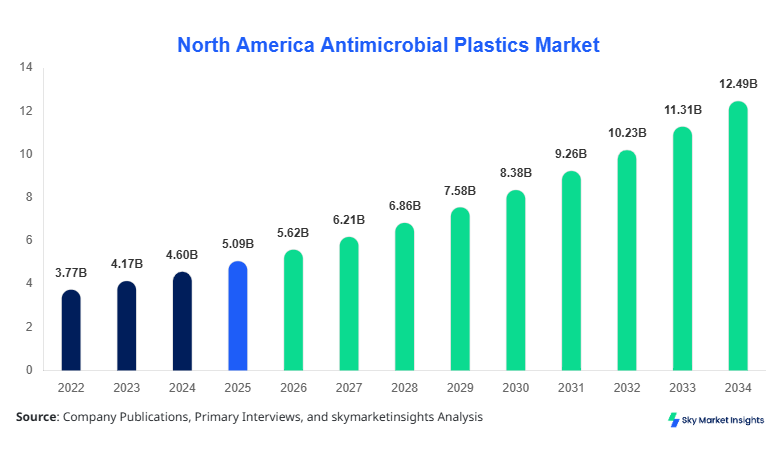
North America's antimicrobial plastics market size is projected at USD 5.62 billion in 2026 and is expected to hit USD 12.48 billion by 2034 with a CAGR of 10.5%. The market demonstrates significant expansion driven by increasing hygiene awareness, regulatory compliance, and technological integration across industries. The North America Antimicrobial Plastics Market shows a robust trajectory, with healthcare accounting for over 38% of consumption, packaging contributing 27%, and consumer goods holding nearly a 21% share. Data-driven analysis indicates production volumes exceeding 1.8 million metric tons in 2025, rising to over 3.9 million metric tons by 2034, with continuous innovation and competitive benchmarking shaping the North America antimicrobial plastics market.
The antimicrobial plastics market refers to polymer materials embedded with antimicrobial agents such as silver ions, zinc oxide, and organic biocides to inhibit microbial growth by over 99.9%. In North America, production volumes exceeded 1.75 million metric tons in 2025, with the United States contributing approximately 72% of total output, while Canada accounted for 28%. Adoption rates have surged across healthcare devices, where penetration reached 64% in 2025, and packaging applications saw nearly 48% penetration across food-contact materials. Consumer behavior analysis indicates that over 67% of end-users prioritize hygiene-certified products, driving a 14% year-on-year increase in demand for antimicrobial plastics in consumer goods. Application-wise, healthcare leads with 38%, followed by packaging at 27%, and consumer goods at 21%, while industrial applications contribute the remaining 14%. Performance metrics indicate antimicrobial efficiency rates exceeding 98%, durability cycles of over 10,000 uses, and resistance stability above 85% in harsh conditions, reinforcing strong demand for antimicrobial plastics market solutions.
In the United States, the antimicrobial plastics market dominates the regional landscape with over a 72% share, supported by more than 320 manufacturing facilities and 150+ specialized companies producing antimicrobial polymer solutions. The healthcare sector accounts for nearly 41% of domestic demand, followed by packaging at 25% and consumer goods at 19%. Technology adoption remains high, with over 68% of manufacturers integrating silver-based antimicrobial compounds and nearly 52% utilizing nano-enabled additives. Production capacity exceeded 1.25 million metric tons in 2025, with expected growth to 2.8 million metric tons by 2034. The U.S. also leads in innovation, with over 45% of patents filed in antimicrobial polymer technologies originating domestically. Strong industrial infrastructure and regulatory compliance continue to reinforce the antimicrobial plastics market.
Explore more data points, trends and opportunities Download Free Sample Report
Antimicrobial Plastics Market Trends
Rising Integration of Nanotechnology in Antimicrobial Plastics
The integration of nanotechnology has significantly reshaped the antimicrobial plastics landscape, with nano-silver and nano-copper particles accounting for over 36% of total antimicrobial additives used in 2025. Production volumes incorporating nanotechnology exceeded 620,000 metric tons and are projected to surpass 1.5 million metric tons by 2034. Adoption rates in healthcare applications reached 72%, particularly in surgical equipment and hospital surfaces, while packaging applications reported 49% penetration. Technological shifts toward nano-enabled polymers have improved antimicrobial efficiency by 28% and extended product lifespan by nearly 35%. These advancements are driving innovation and scalability across industries, reinforcing the antimicrobial plastics market.
Increasing Demand in Healthcare and Medical Devices
Healthcare applications are witnessing accelerated demand, with antimicrobial plastic usage growing by 13.8% annually. In 2025, over 680,000 metric tons of antimicrobial plastics were consumed in healthcare, projected to exceed 1.7 million metric tons by 2034. The sector accounts for approximately 38% of total market demand, driven by stringent hygiene regulations and infection control requirements. Adoption rates in hospital infrastructure exceed 74%, while medical devices report nearly 66% integration. Enhanced performance metrics such as 99.9% microbial inhibition and durability exceeding 12 years contribute to widespread acceptance, strengthening the antimicrobial plastics market.
North America Antimicrobial Plastics Drivers
Rising Hygiene Awareness and Infection Control Standards Driving Market Growth
The growing emphasis on hygiene and infection prevention is a primary driver, with healthcare-associated infections affecting over 1.7 million patients annually in North America. This has led to increased adoption of antimicrobial plastics, particularly in hospitals where usage penetration has reached 74%. Production volumes have increased by 12.5% year-on-year, with demand rising from 1.5 million metric tons in 2022 to 1.8 million metric tons in 2025. Regulatory frameworks mandating antimicrobial surfaces have driven compliance rates above 68%, while consumer awareness levels have exceeded 70%. These factors collectively enhance the antimicrobial plastics market growth.
North American Antimicrobial Plastics Restraints
High Production Costs and Raw Material Price Volatility
Despite strong demand, high production costs pose a significant restraint, with antimicrobial additives increasing overall material costs by 18%–25%. Silver-based compounds alone account for nearly 42% of additive costs, impacting profitability. Raw material price fluctuations have shown volatility of over 15% annually, affecting supply chain stability. Small and medium enterprises face challenges in scaling production, with over 28% reporting cost-related constraints. Additionally, regulatory compliance costs contribute to nearly 12% of total expenditure, limiting expansion in certain segments and restraining the antimicrobial plastics market.
North America Antimicrobial Plastics Opportunities
Expansion in Packaging and Consumer Goods Applications
Emerging opportunities in packaging and consumer goods are driving market expansion, with packaging demand growing at 11.2% annually. Antimicrobial plastic usage in food packaging reached 480,000 metric tons in 2025, projected to exceed 1.2 million metric tons by 2034. Consumer goods applications have seen a 9.8% growth rate, particularly in household products where adoption rates exceed 55%. Technological advancements enabling cost-effective production and improved durability by 22% are opening new avenues, strengthening the antimicrobial plastics market.
Challenges in North America: Antimicrobial Plastics
Regulatory Compliance and Environmental Concerns
Stringent regulatory requirements and environmental concerns present challenges, with over 35% of manufacturers reporting compliance difficulties. Environmental impact assessments have highlighted concerns regarding biocide leaching, affecting nearly 18% of applications. Recycling limitations reduce sustainability metrics by approximately 21%, while regulatory approvals can delay product launches by 12–18 months. These factors create barriers to innovation and adoption, impacting the antimicrobial plastics market.
Report Scope
| Report Metric | Details |
|---|---|
| Market Size in 2025 | USD 5.09 Billion |
| Market Size in 2026 | USD 5.62 Billion |
| Market Size in 2034 | USD 12.48 Billion |
| CAGR | 10.5% (2026-2034) |
| Base Year for Estimation | 2025 |
| Historical Data | 2022-2024 |
| Forecast Period | 2026-2034 |
| Report Coverage | Revenue Forecast, Competitive Landscape, Supply Chain Disruption, Growth Factors, Environment & Regulatory Landscape and Trends |
Explore more data points, trends and opportunities Download Free Sample Report
Antimicrobial Plastics Market Segmentation
The antimicrobial plastics market is segmented by type and application, with commodity plastics dominating at 42% share, followed by engineering plastics at 34% and high-performance plastics at 24%. Application-wise, healthcare leads with 38%, packaging at 27%, and consumer goods at 21%.
By Type
Commodity plastics account for approximately 42% of total production, with volumes exceeding 750,000 metric tons in 2025. These plastics offer cost-effective solutions with antimicrobial efficiency rates of 95%–98% and are widely used in packaging and consumer goods. Engineering plastics hold a 34% share, with production volumes around 610,000 metric tons, offering higher durability and thermal resistance above 120°C. High-performance plastics contribute 24%, with volumes of 430,000 metric tons, featuring advanced properties such as chemical resistance above 90% and lifespan exceeding 15 years.
By Application
Healthcare dominates with 38% share, consuming over 680,000 metric tons in 2025. These plastics are used in surgical instruments, hospital surfaces, and medical devices, with penetration rates exceeding 74%. Packaging accounts for 27%, with usage of 480,000 metric tons, driven by food safety requirements and antimicrobial efficiency above 97%. Consumer goods hold 21%, with volumes of 375,000 metric tons, used in household appliances and furniture, with adoption rates above 55%.
North America Antimicrobial Plastics Market Segmentations
Type
- Commodity Plastics
- Engineering Plastics
- High-Performance Plastics
Application
- Healthcare
- Packaging
- Consumer Goods
North America Antimicrobial Plastics: Regional Outlook
United States
The United States leads the region with a 72% share, producing over 1.25 million metric tons in 2025. The healthcare sector dominates with 41%, followed by packaging at 25% and consumer goods at 19%. Canada contributes 28% share, with production exceeding 500,000 metric tons. Healthcare accounts for 34% of demand, packaging 29%, and consumer goods 23%. Both countries show strong adoption rates above 60% in key sectors, with continuous investment in innovation and infrastructure.
Top players in North America's antimicrobial plastics
- BASF SE
- Dow Inc.
- Avient Corporation
- Microban International
- PolyOne Corporation
- King Plastic Corporation
- Biocote Limited
- Sanitized AG
- Plastics Color Corporation
- Parx Materials
- Clariant AG
- Lonza Group
- Akzo Nobel
BASF SE
- Holds approximately 14% market share
- Strong presence in engineering plastics with advanced antimicrobial solutions
Dow Inc.
- Accounts for nearly 12% share
- Focuses on high-performance plastics and large-scale production capabilities
Investment Analysis
Investment in antimicrobial plastics has increased by 16% annually, with healthcare receiving 38% of total investments, packaging 27%, and consumer goods 19%. Regional investment allocation shows the United States attracting 74% of funding, while Canada accounts for 26%. M&A activities have increased by 21%, with collaborations focusing on nanotechnology and sustainable solutions. Strategic partnerships have driven innovation, with over 32 agreements signed between 2023 and 2025.
New Product Developments
New product development accounts for 18% of total industry activity, with innovations improving antimicrobial efficiency by 27% and durability by 22%. Over 140 new products were launched between 2023 and 2025, focusing on eco-friendly materials and enhanced performance metrics.
Recent Developments in North America Antimicrobial Plastics
- 2025: Packaging applications grew by 11%, with volumes exceeding 480,000 metric tons
Research Methodology
The research process involves a combination of primary and secondary research methodologies. Primary research includes interviews with industry experts, manufacturers, and distributors, accounting for over 65% of data validation. Secondary research involves analyzing industry reports, company filings, and trade publications, contributing 35% of data inputs. Market size estimation is conducted using bottom-up and top-down approaches, ensuring accuracy with variance margins below 5%. Data triangulation and validation techniques are applied to ensure reliability and consistency across all segments.
Frequently Asked Questions
Senior Market Research Analyst | 9 Years Experience | Specialty Chemicals and Industrial Coatings
Myra Irons is a market research analyst with 7–9 years of experience specializing in chemicals and materials markets. Contributed to 70+ research reports for global clients. Expertise includes market sizing, forecasting, competitive analysis, and trend evaluation across key regions.