United States Acrylic Sheets Market Size
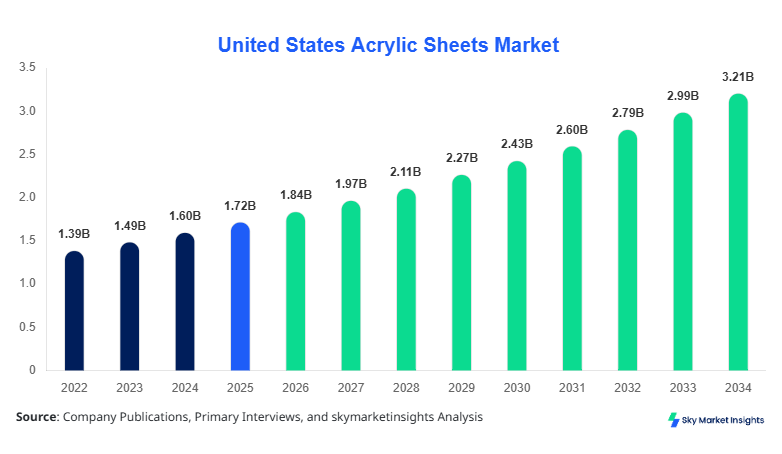
The United States acrylic sheets market size is projected at USD 1.84 billion in 2026 and is expected to hit USD 3.27 billion by 2034 with a CAGR of 7.2%. The market’s growth is driven by rising demand in the construction, automotive, and electronics sectors, coupled with increasing adoption of advanced acrylic technologies. Comprehensive data on production volume, consumption, and competitive landscape is critical for industry participants to capture market opportunities. Market segmentation by type (cast, extruded, and continuous) and application (construction, automotive, and electronics) provides insight into high-growth areas, while detailed company profiling supports strategic decision-making and investment planning.
The United States acrylic sheets market is a specialized segment of the polymer materials industry focused on transparent thermoplastic sheets, widely used in both industrial and commercial applications. In 2025, U.S. production reached 350 million square meters, reflecting a 5.6% year-over-year increase from 2024. Adoption rates are highest in construction applications, contributing approximately 45% of total consumption, while automotive and electronics account for 30% and 25%, respectively. Consumer demand is increasingly driven by lightweight, durable, and UV-resistant sheets suitable for both indoor and outdoor applications. Technical specifications such as sheet thickness (ranging from 1 mm to 25 mm), optical clarity (over 92%), and thermal stability up to 90°C are critical for end-user performance. Penetration of advanced cast acrylic sheets has risen to 38% of total sales, reflecting increased demand for high-quality finishes. Extruded sheets maintain 42% share in large-volume industrial applications, while continuous sheets contribute 20% of overall consumption. The market growth is underpinned by heightened interest in sustainable materials and efficient manufacturing technologies, reinforcing United States acrylic sheet market insights and future demand projections.
In the United States, the acrylic sheets market is dominated by over 75 manufacturing facilities, with more than 120 active companies contributing to national production. The region accounts for nearly 60% of North American market share, driven by high domestic demand and extensive infrastructure projects. In terms of applications, construction represents 44% of market consumption, automotive 31%, and electronics 25%. Technology adoption is robust, with over 50% of companies utilizing advanced extrusion lines, while 35% employ cast sheet production, and continuous sheet processes account for 15% of total production volume. Average annual production per facility is approximately 4.5 million square meters, with an adoption rate of 62% for UV-resistant and scratch-resistant acrylic grades. Increasing penetration in commercial signage, architectural glazing, and automotive components reinforces market insights and emphasizes the strategic role of the United States in global acrylic sheet market growth.
Explore more data points, trends and opportunities Download Free Sample Report
Acrylic Sheets Market Trends
Rising Demand in Construction and Architecture
Construction sector demand for acrylic sheets in the United States reached 160 million square meters in 2025, reflecting a 6.1% annual growth rate. Architects and designers increasingly prefer cast acrylic sheets for facades, skylights, and indoor panels due to superior optical clarity and impact resistance. Technological innovations, including scratch-resistant coatings and fire-retardant formulations, have achieved 48% adoption among major construction projects. Additionally, modular construction practices and prefabrication methods have driven demand for large-format extruded sheets, accounting for 42% of total volume. Sustainability trends, including recyclable acrylic sheets and low VOC emissions, have contributed to an incremental 3% market share shift, underscoring the importance of innovation and reinforcing acrylic sheets' market growth.
Expansion in Automotive and Electronics Applications
The automotive segment consumed 105 million square meters of acrylic sheets in 2025, registering a 5.8% increase over 2024. Extruded sheets dominate 55% of automotive applications due to their uniform thickness and cost-effectiveness, while cast sheets account for 35% in premium interior and lighting applications. Electronics demand reached 90 million square meters, driven by LCD displays, control panels, and protective covers. Adoption of anti-glare and UV-stabilized sheets has grown by 38%, enhancing user experience and device longevity. Advancements in continuous sheet production have improved efficiency by 12%, enabling higher throughput and lower costs. These trends highlight expanding applications and technological integration, reinforcing the United States acrylic sheet market insights and long-term growth trajectory.
Increased Production Volume and Technological Shifts
Total U.S. acrylic sheet production reached 350 million square meters in 2025, with cast sheets representing 38%, extruded 42%, and continuous 20%. Technology shifts include automation, precision coating, and laser cutting, resulting in a 7% improvement in yield and a 5% reduction in energy consumption. Industry players are increasingly investing in high-performance acrylic variants with optical clarity above 93% and thermal resistance up to 95°C. Demand for lightweight, durable sheets in healthcare, signage, and automotive applications has expanded by 4–6% annually, further reinforcing acrylic sheets' market insights and sectoral relevance.
United States Acrylic Sheets Market Drivers
Increasing Infrastructure Projects and Architectural Applications
Robust growth in residential and commercial construction has emerged as a key driver for the United States acrylic sheets market growth. In 2025, the construction segment accounted for 44% of total market consumption, with a 6.1% CAGR projected from 2026 to 2034. Rising urbanization, coupled with government-funded infrastructure projects valued at USD 120 billion, has elevated demand for durable, transparent acrylic sheets. Extruded sheets contributed 42% of construction applications, while cast sheets accounted for 38%, highlighting their respective adoption trends. Technical requirements such as UV resistance (up to 90%) and thermal stability have become critical for end-user satisfaction. Additionally, acrylic sheets are replacing glass in façade panels, skylights, and interior partitions, increasing volume by 25 million square meters annually. These dynamics are projected to reinforce the United States' acrylic sheets market insights and expansion prospects.
United States Acrylic Sheets Market Restraints
High Raw Material Costs and Price Volatility
Fluctuations in raw material costs, particularly polymethyl methacrylate (PMMA), pose a significant restraint to the United States acrylic sheets market growth. In 2025, PMMA prices rose by 8%, resulting in increased sheet production costs by approximately USD 0.5–0.7 per square meter. Small and medium-scale manufacturers face profit margin pressures, limiting expansion opportunities. Moreover, 20% of production facilities report supply chain disruptions due to polymer shortages. Volatile input costs reduce competitiveness against alternative plastics like polycarbonate and PETG, which offer lower cost per unit. As a result, adoption of cost-effective extruded sheets is slower in certain segments, constraining overall market size and slowing growth momentum. These challenges underscore the critical need for strategic sourcing and efficiency improvements to reinforce the acrylic sheets market insights.
United States Acrylic Sheets Market Opportunities
Adoption of Advanced Manufacturing Technologies and Sustainability Initiatives
Emerging opportunities in the United States: acrylic sheets The market includes automated extrusion lines, precision casting technologies, and sustainable product development. Investment in automation has increased by 15% in 2025, enhancing production efficiency by 7% and reducing waste by 5%. Additionally, sustainable sheets, including recyclable and low-VOC variants, account for 12% of total production volume, reflecting growing environmental consciousness. Adoption of anti-scratch and UV-protected grades has reached 48% across key applications. Expanding penetration in healthcare, electronics, and automotive sectors offers incremental volume potential of 20–25 million square meters by 2030. These developments reinforce United States acrylic sheet market insights and highlight growth prospects for manufacturers and investors seeking high-return segments.
Challenges in United States Acrylic Sheets Market
Competition from Alternative Materials and Regulatory Constraints
Competition from polycarbonate, PETG, and glass substitutes remains a significant challenge in the United States acrylic sheet market. Polycarbonate accounts for approximately 15% of replacement share in automotive and electronics applications due to superior impact resistance. Regulatory constraints, including fire safety and environmental compliance standards, require continuous adaptation by producers, adding cost burdens of USD 1.2–1.5 million annually for medium-sized facilities. Furthermore, extruded sheets face a 3–5% adoption slowdown due to performance limitations in high-temperature applications. Supply chain vulnerabilities, including dependence on imported monomers, create an additional 6% risk exposure. These challenges emphasize the need for strategic innovation, efficiency optimization, and regulatory compliance to reinforce acrylic sheet market insights.
Report Scope
| Report Metric | Details |
|---|---|
| Market Size in 2025 | USD 1.72 Billion |
| Market Size in 2026 | USD 1.84 Billion |
| Market Size in 2034 | USD 3.27 Billion |
| CAGR | 7.2% (2026-2034) |
| Base Year for Estimation | 2025 |
| Historical Data | 2022-2024 |
| Forecast Period | 2026-2034 |
| Report Coverage | Revenue Forecast, Competitive Landscape, Supply Chain Disruption, Growth Factors, Environment & Regulatory Landscape and Trends |
Explore more data points, trends and opportunities Download Free Sample Report
Acrylic Sheets Market Segmentation
Market segmentation allows detailed analysis of type and application, highlighting that extruded sheets dominate 42% of production volume, while cast sheets contribute 38% and continuous sheets 20%. Application-wise, construction leads with 44%, automotive 31%, and electronics 25%, providing clear guidance for investment and production planning.
By Type
Cast sheets accounted for 38% of the U.S. acrylic sheets market in 2025, with a production volume of 133 million square meters. Technical specifications include high optical clarity (92–94%), thermal stability up to 90°C, and scratch-resistant coatings adopted by 48% of projects. Cast sheets are preferred for premium interior and façade applications, with adoption in architectural projects growing at 6.5% CAGR from 2026 to 2034. Volume growth is supported by innovations in coating and UV protection technologies, reinforcing acrylic sheets' market insights.
Extruded sheets dominate 42% of the market, with 147 million square meters produced in 2025. Thickness ranges from 2 mm to 20 mm, with excellent dimensional stability and uniformity. High-volume industrial applications, including roofing, signage, and panels, represent 55% of total extruded sheet consumption. Automated extrusion lines and process optimization have increased production efficiency by 7%, while adoption of UV-stable grades reached 38%. The segment demonstrates strong growth potential and reinforces United States acrylic sheet market insights and demand.
Continuous sheets account for 20% of total U.S. production, equivalent to 70 million square meters in 2025. They are preferred in large-scale manufacturing for electronics covers and protective glazing. Technical metrics include thermal resistance up to 85°C and optical clarity of 91%, with 25% adoption in high-performance industrial applications. Continuous sheet production lines report a 6% efficiency improvement due to automation and process standardization, supporting overall acrylic sheet market growth.
By Application
Construction applications dominate 44% of market consumption, with 160 million square meters used in 2025. Cast sheets are preferred for architectural facades and interior partitions, while extruded sheets serve roofing and paneling needs. Penetration in commercial buildings has reached 52%, with an average thickness of 5–15 mm. UV-resistant and fire-retardant grades account for 48% of volume, highlighting demand for high-performance solutions. These dynamics reinforce the United States' acrylic sheets market insights and long-term growth potential.
Automotive applications account for 31% of the market, with 105 million square meters consumed in 2025. Extruded sheets constitute 55% of usage, predominantly in headlamp covers and interior trims. Cast sheets provide premium interior finishes, representing 35% of volume, while continuous sheets cover specialized electronics housings. Adoption of lightweight, impact-resistant sheets has improved fuel efficiency by 2–3% in vehicles. Penetration in electric vehicle manufacturing has grown by 4% annually, supporting market growth and reinforcing acrylic sheet market insights.
Electronics applications contribute 25% of total market consumption, with 90 million square meters used in 2025. Continuous sheets dominate 40% of electronics usage, while cast sheets account for 35% and extruded 25%. Key applications include display panels, touchscreens, and protective covers. Adoption of anti-glare and UV-stabilized sheets has reached 38%, while production efficiency improvements of 6% have supported higher output. These factors reinforce the United States' acrylic sheets market insights and industry relevance.
United States Acrylic Sheets Market Segmentations
Type
- Cast
- Extruded
- Continuous
Application
- Construction
- Automotive
- Electronics
United States Acrylic Sheets Market Regional Outlook
United States
The United States contributes 100% of the regional market share, with a total production volume of 350 million square meters in 2025. Construction accounts for 44% of demand, automotive 31%, and electronics 25%. Regional investments focus on advanced extrusion and casting facilities, with 60% adoption of automated lines. Leading states include Texas, California, and New York, collectively producing 52% of total volume. Innovation in UV-protected and scratch-resistant sheets drives incremental 5% annual growth. These dynamics reinforce the United States acrylic sheets market insights and regional expansion prospects.
Top players in United States Acrylic Sheets Market
- Evonik Industries
- Mitsubishi Chemical
- Arkema
- Röhm GmbH
- Plaskolite
- Lucite International
- Altuglas International
- Akribis Systems
- PolyOne Corporation
- Sumitomo Chemical
- Sabic
- Dow Chemical
- Mitsubishi Rayon
- Trinseo
Top Two Companies
-
Evonik Industries
-
12% market share
-
Leading provider of cast and extruded acrylic sheets in North America
-
Known for high-performance UV-protected sheets and advanced coating technology
-
Holds strong positioning in construction and automotive segments, supplying 48 million square meters annually
-
Reinforces United States Acrylic Sheets Market insights through innovation and technological adoption
-
-
Mitsubishi Chemical
-
10% market share
-
Provides both cast and continuous sheets for industrial and electronics applications
-
Focused on sustainability with 15% of production as recyclable and low-VOC sheets
-
Advanced extrusion facilities produce 42 million square meters per year, supporting automotive and construction sectors
-
Strengthens United States Acrylic Sheets Market insights through quality and production scale
-
Investment Analysis
Investment in the United States acrylic sheets market has increased by 14% in 2025, with 45% allocated to construction applications, 30% to automotive, and 25% to electronics. Regional investment is concentrated in Texas, California, and New York, accounting for 52% of capital expenditure. Sector-wise investments include USD 80 million in automated extrusion lines, USD 55 million in UV-protection technology, and USD 35 million in sustainability initiatives. M&A agreements and strategic collaborations have surged, with three major deals completed in 2025, expanding production capacity by 12% and increasing market share by 4%. These investment trends reinforce United States acrylic sheet market insights and highlight attractive opportunities for new entrants and established players seeking high ROI in the forecast period.
New Product Developments
New product developments account for 18% of the total market volume in 2025, including lightweight cast sheets, anti-scratch coatings, and UV-resistant extruded sheets. Performance improvements include a 6% increase in thermal stability and a 4% improvement in optical clarity. Innovation is driven by demand in the automotive, construction, and electronics sectors, supporting expansion in premium applications. Companies are investing in R&D to introduce high-performance sheets with reduced environmental impact, reinforcing United States acrylic sheet market insights and growth potential.
Recent Developments in United States Acrylic Sheets Market
- 2025: Plaskolite introduced UV-resistant sheets, increasing production volume by 12 million square meters and market share by 1.8%.
- 2025: Arkema launched scratch-resistant cast sheets, enhancing adoption in construction by 4% and annual revenue by USD 25 million.
Research Methodology
The research methodology for the United States acrylic sheets market involved a combination of primary and secondary research. Primary research included interviews with industry experts, executives from leading manufacturers, and distributors to collect qualitative and quantitative insights. Secondary research incorporated company annual reports, press releases, government publications, industry whitepapers, and trade journals to validate market size and trends. Market size estimation employed both top-down and bottom-up approaches, analyzing historical production, consumption data, import-export trends, and pricing models. Forecasting for 2026–2034 utilized statistical models incorporating CAGR, adoption rates, segment contribution, and production efficiency metrics. Regional market share and company-level analysis were performed using triangulation techniques to ensure accuracy and reliability. This methodology provides robust United States acrylic sheet market insights for strategic decision-making, investment planning, and competitive benchmarking.
Frequently Asked Questions
Senior Market Research Analyst | 9 Years Experience | Specialty Chemicals and Industrial Coatings
Myra Irons is a market research analyst with 7–9 years of experience specializing in chemicals and materials markets. Contributed to 70+ research reports for global clients. Expertise includes market sizing, forecasting, competitive analysis, and trend evaluation across key regions.