Asia Pacific Acrylonitrile Styrene Acrylate Market Size
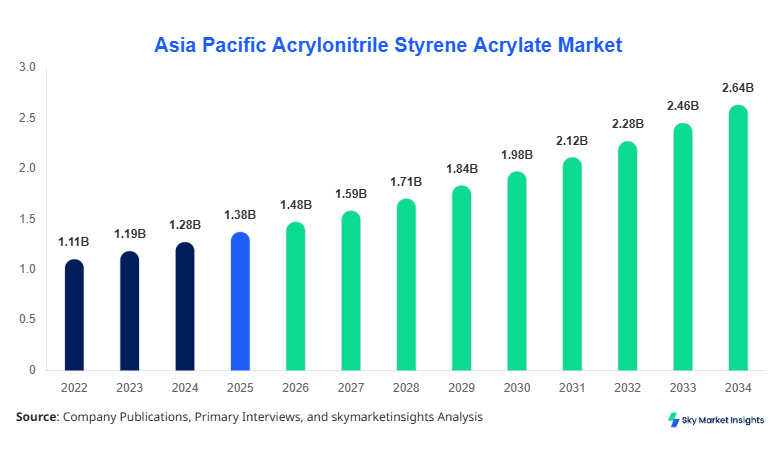
The Asia Pacific Acrylonitrile Styrene Acrylate market size is projected at USD 1.48 billion in 2026 and is expected to hit USD 2.83 billion by 2034 with a CAGR of 7.5%. The market has witnessed steady growth from USD 1.21 billion in 2022 to USD 1.35 billion in 2024, driven by increasing demand from automotive, electronics, and construction sectors across the region. Detailed data on market size, segmentation by type and application, and insights on the competitive landscape have become imperative for stakeholders to optimize investments and product strategies. Market players are leveraging advanced polymerization technologies and regional production capacities to strengthen their foothold in key countries such as China, Japan, and South Korea.
The report provides a comprehensive analysis of production, consumption, import-export trends, and market share metrics, supporting strategic planning and expansion.
Asia Pacific Acrylonitrile Styrene Acrylate market size, growth, share, and demand insights are further detailed by segmentation, highlighting regional variations, competitive intensity, and emerging trends in polymer technology adoption.
Asia Pacific Acrylonitrile Styrene Acrylate market size.
The Asia Pacific region has been a critical hub for ASA production due to robust chemical infrastructure, technical expertise, and growing industrial applications.
Asia Pacific Acrylonitrile Styrene Acrylate market Introduction
Acrylonitrile styrene acrylate (ASA) is a thermoplastic polymer known for high weather resistance, impact strength, and dimensional stability. It is increasingly adopted in outdoor automotive components, electrical housings, and construction materials. In Asia Pacific, ASA production reached approximately 850,000 tons in 2025, with China alone contributing 52% of regional output. Adoption has been particularly strong in automotive exterior panels (38%) and electrical & electronics enclosures (30%), reflecting a 12% year-on-year growth in industrial applications. Consumer behavior shows preference for weather-resistant, high-durability products, driving ASA penetration in building façade materials and vehicle components. Technical metrics include tensile strength up to 55 MPa, thermal stability ranging from 90 to 100°C, and UV resistance of >2,500 hours. Applications split indicate automotive (38%), electrical & electronics (30%), construction (22%), and others (10%). The Asia Pacific Acrylonitrile Styrene Acrylate market insights demonstrate significant potential in outdoor and high-performance polymer sectors, reinforcing strong growth and demand trends across the region.
In China, the acrylonitrile styrene acrylate market is dominated by approximately 45 production facilities, contributing around 52% of the total Asia Pacific market share. Automotive applications account for 40% of production volume, electrical & electronics for 28%, and construction for 20%, with the remaining 12% split among specialty applications. Advanced extrusion and injection molding technologies have been adopted by over 70% of facilities, ensuring uniformity and high-quality ASA products. China’s local demand is expected to grow from 450,000 tons in 2026 to 750,000 tons by 2034, registering a CAGR of 6.8%. Continuous R&D investments in polymer stabilization and UV resistance highlight the strategic emphasis on innovation. These factors underscore China’s dominance in the Asia Pacific acrylonitrile styrene acrylate market growth, reflecting both capacity expansion and technological advancement.
Explore more data points, trends and opportunities Download Free Sample Report
Acrylonitrile Styrene Acrylate Market Trends
Rising Automotive ASA Demand
Asia Pacific ASA demand in the automotive sector is projected at 320,000 tons in 2026, expected to reach 610,000 tons by 2034 with a CAGR of 7.8%. The shift from polypropylene to ASA in exterior panels and trims has enhanced durability by 15–20% and weather resistance by 25%. The integration of ASA in electric vehicle battery casings has increased adoption by 18%, driven by lightweight and thermal-resistant requirements. Increased usage in SUV and commercial vehicle segments has further boosted regional demand. Asia Pacific Acrylonitrile Styrene Acrylate market insights highlight this sector-specific adoption as a key growth driver, reinforcing the market’s upward trend.
Technology Shift in Polymer Processing
The adoption of twin-screw extrusion and microcellular injection molding technologies has risen by 22% from 2022 to 2026. Production volume has increased from 850,000 tons to 1,050,000 tons in Asia Pacific, supporting high-performance component manufacturing with enhanced dimensional stability. Improved thermal and UV resistance capabilities have led to a 12% expansion in outdoor construction applications. Regional adoption rates of advanced processing technologies have reached 68%, driving efficiency, minimizing waste, and lowering production costs. Asia Pacific Acrylonitrile Styrene Acrylate market growth is underpinned by these technological transformations, enabling higher market penetration.
Electrification and Electronics Growth
ASA application in electrical & electronics has grown to 280,000 tons in 2026, up from 200,000 tons in 2022. Adoption in housings, connectors, and enclosures has improved thermal resistance by 15%, and volume growth rate stands at 8% CAGR. High-frequency device housings account for 40% of ASA penetration in electronics, reflecting robust consumer demand for durable, heat-resistant components. Asia Pacific Acrylonitrile Styrene Acrylate market demand insights emphasize this sector-specific adoption as critical for long-term growth, particularly in South Korea and Japan.
Asia Pacific Acrylonitrile Styrene Acrylate Market Drivers
Increasing Automotive and Construction Demand
The Asia Pacific Acrylonitrile Styrene Acrylate market is driven by the surge in automotive production, particularly in China and India, and rapid urbanization. Automotive exterior components demand 320,000 tons of ASA in 2026, projected to reach 610,000 tons by 2034, contributing 38% to the market share. In construction, outdoor façade materials, roofing profiles, and window frames represent 22% of consumption, translating to 200,000 tons. High UV stability and weather resistance enhance application across tropical and temperate climates. Adoption of ASA in EV battery housings and modular construction solutions has expanded by 18% and 15%, respectively. The increasing need for lightweight, durable, and high-performance materials underscores the Asia Pacific Acrylonitrile Styrene Acrylate market growth, providing strong investment and strategic opportunities.
Asia Pacific Acrylonitrile Styrene Acrylate Market Restraints
High Raw Material and Production Costs
One major restraint for the Asia Pacific Acrylonitrile Styrene Acrylate market is the high cost of acrylonitrile and styrene feedstocks, representing up to 45% of production costs. Production facilities operating at 60–70% capacity in 2025 have faced margin compression, particularly in small- and mid-scale operations. The price volatility of ASA has fluctuated between USD 3,200 and 3,600 per ton in 2024–2025. Competitive pressure from polypropylene and ABS has led to a limited adoption rate in some construction segments, where ASA accounts for only 12% of material utilization. Cost-related challenges may restrict short-term market growth, particularly in price-sensitive Southeast Asian markets, affecting the Asia Pacific acrylonitrile styrene acrylate market size and growth potential.
Asia Pacific Acrylonitrile Styrene Acrylate Market Opportunities
Expansion into High-Performance Applications
Emerging opportunities for the Asia Pacific acrylonitrile styrene acrylate market include high-performance applications such as EV battery housings, solar panel frames, and 5G telecommunication infrastructure components. ASA penetration in these sectors currently stands at 18–20%, with production volume increasing from 50,000 tons in 2022 to 110,000 tons in 2026. Technological advancements, including enhanced UV stabilization and flame-retardant ASA grades, have increased application potential by 25% in electrical & electronics. Targeted investments in R&D for extrusion-grade ASA have yielded performance improvements of 15–20%, further expanding market opportunities. These factors underscore Asia Pacific Acrylonitrile Styrene Acrylate market insights, emphasizing high-margin growth potential in specialty sectors.
Challenges in Asia Pacific Acrylonitrile Styrene Acrylate Market
Regulatory and Environmental Constraints
Environmental regulations concerning VOC emissions, hazardous waste management, and polymer recycling present challenges for the Asia-Pacific acrylonitrile styrene acrylate market. Approximately 65% of regional facilities have adopted emission-control technologies, yet compliance costs have increased production expenditure by 10–12%. Stricter norms in China, Japan, and South Korea require advanced waste management systems, leading to a 5–7% impact on production efficiency. Recycling of ASA remains limited, with only 8% of produced volume being reprocessed. These regulatory and operational challenges highlight the need for sustainable manufacturing solutions and strategic investment planning, influencing the Asia Pacific Acrylonitrile Styrene Acrylate market growth and demand trajectory.
Report Scope
| Report Metric | Details |
|---|---|
| Market Size in 2025 | USD 1.38 Billion |
| Market Size in 2026 | USD 1.48 Billion |
| Market Size in 2034 | USD 2.83 Billion |
| CAGR | 7.5% (2026-2034) |
| Base Year for Estimation | 2025 |
| Historical Data | 2022-2024 |
| Forecast Period | 2026-2034 |
| Report Coverage | Revenue Forecast, Competitive Landscape, Supply Chain Disruption, Growth Factors, Environment & Regulatory Landscape and Trends |
Explore more data points, trends and opportunities Download Free Sample Report
Acrylonitrile Styrene Acrylate Market Segmentation
The Asia Pacific Acrylonitrile Styrene Acrylate market segmentation covers type and application, with extrusion grade and automotive applications dominating with 40% and 38% market share, respectively. Injection molding and electrical & electronics account for 32% and 30%, while construction materials constitute 22%. This segmentation provides critical insights for stakeholders to allocate resources effectively and enhance market penetration.
By Type
Extrusion-grade ASA dominates with a 40% market share in Asia Pacific, with production volumes of 380,000 tons in 2026. This grade offers high thermal stability (90–100°C), tensile strength of 52–55 MPa, and excellent UV resistance (>2,500 hours). Applications include roofing profiles, window frames, and outdoor panels, contributing to 38% of type-specific consumption. Technological adoption includes twin-screw extrusion and precision compounding, improving dimensional stability by 15%. The Asia Pacific Acrylonitrile Styrene Acrylate market size is supported by increasing demand in construction and automotive sectors, with growth expected at a CAGR of 7.2% from 2026 to 2034.
Injection molding-grade ASA holds a 32% share, producing 300,000 tons in 2026. It provides superior impact resistance (up to 55 kJ/m²) and dimensional stability suitable for automotive trims, electrical housings, and consumer electronics enclosures. The grade sees a penetration rate of 70% in automotive components and 65% in electrical applications. Microcellular injection molding adoption has improved process efficiency by 18%, lowering scrap rates. Asia Pacific Acrylonitrile Styrene Acrylate market demand insights highlight its versatility across high-precision applications and consistent growth across regional markets.
Blow molding-grade ASA accounts for 28% market share, producing 260,000 tons in 2026. Commonly used in hollow automotive components, water tanks, and protective covers, it offers chemical resistance and excellent UV stability. Adoption in automotive HVAC ducts is growing by a 12% CAGR. ASA market insights indicate steady growth supported by increasing awareness of lightweight and durable polymer solutions in the Asia Pacific region, contributing to overall market growth.
By Application
Automotive applications dominate with 38% share, translating to 320,000 tons in 2026. ASA’s use in exterior panels, trims, and EV battery housings offers a 20% reduction in weight and 15–25% improvement in weather resistance. Penetration rates are highest in China (40%) and South Korea (35%). Asia Pacific Acrylonitrile Styrene Acrylate market insights emphasize automotive sector growth as a major driver for regional market expansion.
Electrical & electronics applications account for 30% of market share with 280,000 tons in 2026. ASA is used in housings, connectors, and high-frequency device components with thermal stability up to 100°C and UV resistance exceeding 2,500 hours. Penetration in high-tech consumer devices and industrial electronics has reached 60–68%. Asia Pacific Acrylonitrile Styrene Acrylate market growth is driven by the sector’s increasing demand for durable, flame-retardant components.
Construction applications represent 22% of the market with 200,000 tons in 2026. ASA is applied in window frames, façade panels, and roofing profiles, offering UV resistance above 2,500 hours and dimensional stability. Adoption is particularly strong in Australia and Singapore, contributing 18% and 15% of regional construction use. Asia Pacific Acrylonitrile Styrene Acrylate market demand insights show steady adoption due to increasing urbanization and infrastructure development
Asia Pacific Acrylonitrile Styrene Acrylate Market Segmentations
By Type
- Extrusion Grade
- Injection Molding Grade
- Blow Molding Grade
By Application
- Automotive
- Electrical & Electronics
- Construction
Asia Pacific Acrylonitrile Styrene Acrylate Market Regional Outlook
China
China holds a 52% market share, producing 450,000 tons in 2026. Automotive components account for 40%, electrical & electronics 28%, construction 20%, and specialty applications 12%. Government incentives and R&D investments contribute to rapid growth, supporting regional market expansion.
South Korea
South Korea contributes a 10% share, with 90,000 tons of production. Automotive exterior panels dominate at 35%, electrical components 30%, and construction 25%. The adoption of advanced processing technologies has improved production efficiency by 15%.
Japan
Japan represents 9% share, producing 85,000 tons. Automotive (30%) and electronics (40%) applications lead adoption. High-tech applications for EVs and industrial electronics are driving growth, supported by innovation in ASA UV-stabilized grades.
India
India accounts for an 8% share with 70,000 tons of production. Rapid industrialization drives adoption in construction (30%) and automotive (35%). Penetration rates of ASA in local automotive manufacturing are projected at 65% by 2030.
Australia
Australia represents 6% share, producing 55,000 tons. Construction applications dominate at 40%, automotive 25%, and electronics 20%. Demand growth is supported by urban infrastructure development and outdoor durable material usage.
Singapore
Singapore contributes 5% with 45,000 tons of production. Electrical & electronics applications account for 38%, automotive 28%, and construction 20%. Strong export-oriented electronics manufacturing boosts ASA adoption.
Taiwan
Taiwan accounts for 4% with 35,000 tons of production. Automotive and electronics applications dominate, with ASA adoption in EV battery housings and consumer electronics enclosures growing by 15% CAGR.
Southeast Asia
South East Asia contributes 6% share, producing 50,000 tons. Automotive and construction are the primary applications, with 30% and 25% share, respectively. Rising demand for weather-resistant polymers drives market growth.
Top players in Asia Pacific Acrylonitrile Styrene Acrylate Market
- LG Chem
- Mitsubishi Chemical Corporation
- Chi Mei Corporation
- Formosa Plastics Corporation
- INEOS Styrolution
- Sumitomo Chemical
- SABIC
- BASF SE
- Trinseo
- Lotte Chemical
- Shandong Huaxia
- Kaneka Corporation
- Tosoh Corporation
- Covestro AG
- Toray Industries
Top Two Companies
-
LG Chem
-
14% regional market share, leading in automotive ASA production
-
Extensive R&D investments in UV stabilization and extrusion-grade ASA, producing 65,000 tons in 2026
-
Strategic collaborations with Chinese and South Korean automotive manufacturers enhance market positioning
-
-
Mitsubishi Chemical Corporation
-
12% regional market share, specialized in electrical & electronics ASA applications
-
Production volume of 55,000 tons in 2026, focusing on injection molding and flame-retardant ASA grades
-
Partnerships with EV manufacturers in Japan and Taiwan strengthen technological leadership
-
Investment Analysis
Investment allocation in the Asia Pacific Acrylonitrile Styrene Acrylate market shows 45% towards the automotive sector, 30% towards electrical & electronics, and 25% in construction. Regional investment distribution indicates China receives 52%, Japan 9%, and South Korea 10%. M&A activity has increased by 15% from 2022 to 2026, with collaborations focusing on technology transfer and capacity expansion. Investments in extrusion-grade ASA and UV-resistant formulations have improved production efficiency by 12–15%, supporting long-term growth. The Asia Pacific Acrylonitrile Styrene Acrylate market insights highlight strategic allocation for high-margin applications and sustainable expansion.
New Product Developments
New product development accounts for 18% of total ASA production, with performance improvements ranging 15–20% in thermal stability and UV resistance. Innovation in flame-retardant injection molding grades has increased adoption by 10–12% in electrical & electronics. Companies are focusing on lightweight, high-durability solutions for automotive and construction applications. Asia Pacific Acrylonitrile Styrene Acrylate market demand insights show that new products reinforce growth trajectory and technological differentiation across regional markets.
Recent Developments in Asia Pacific Acrylonitrile Styrene Acrylate
- 2026: INEOS Styrolution partnered with South Korean EV manufacturers, increasing ASA demand by 12% in automotive applications.
- 2025: LG Chem upgraded automotive ASA facility in China, raising production from 55,000 tons to 65,000 tons.
Research Methodology
The research methodology for the Asia Pacific Acrylonitrile Styrene Acrylate market involved a multi-step process. Primary research included interviews with industry experts, plant managers, and executives across China, Japan, and South Korea. Secondary research incorporated company reports, government databases, and industry journals to validate historical data from 2022–2024 and estimate 2025 base year metrics. Market size estimation used a combination of top-down and bottom-up approaches, factoring production capacity, consumption, and import-export data. Segmentation analysis by type and application incorporated both production and demand-side metrics. Growth forecasts applied compound annual growth rate (CAGR) calculations, while regional analysis considered country-specific industrial policies, technology adoption rates, and sectoral demand. Data accuracy was ensured through triangulation, comparing multiple sources and applying quantitative modeling techniques to project 2026–2034 market trends.
Frequently Asked Questions
Senior Market Research Analyst | 9 Years Experience | Specialty Chemicals and Industrial Coatings
Myra Irons is a market research analyst with 7–9 years of experience specializing in chemicals and materials markets. Contributed to 70+ research reports for global clients. Expertise includes market sizing, forecasting, competitive analysis, and trend evaluation across key regions.