Europe Acrylic Sheets Market Size
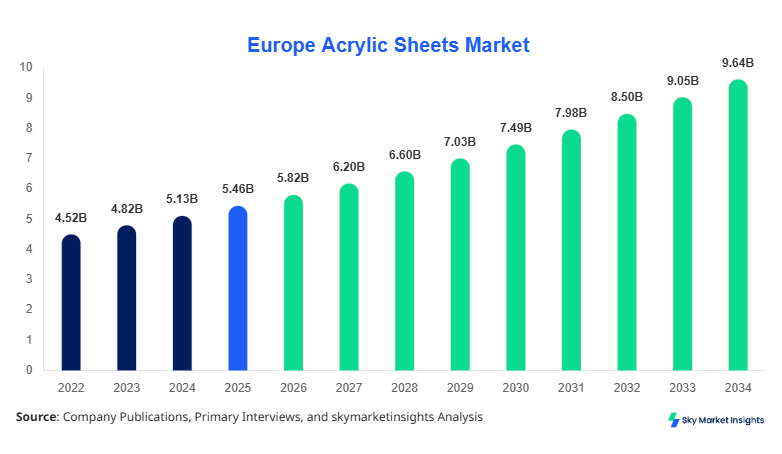
Europe's acrylic sheets market size is projected at USD 5.82 billion in 2026 and is expected to hit USD 9.64 billion by 2034 with a CAGR of 6.51%. The increasing need for lightweight, high-durability polymer sheets across construction, automotive, and display industries is driving structured demand across Europe. The report provides detailed segmentation by type and application, supported by volume analysis exceeding 1.8 million metric tons in 2026, along with competitive landscape mapping of over 120 regional manufacturers and import-export flow analysis across six major countries.
The European acrylic sheets market comprises polymethyl methacrylate (PMMA)-based flat panels used in transparent and semi-transparent applications. In 2025, Europe recorded production of approximately 1.65 million metric tons, with Germany contributing 28%, followed by France at 16% and the United Kingdom at 14%. Adoption rates in construction reached 62% across facade glazing and roofing segments, while automotive applications accounted for 18% of total consumption, driven by EV lightweighting requirements. Consumer behavior indicates a shift toward UV-resistant and scratch-resistant variants, with over 48% of buyers preferring enhanced-durability sheets. The application split shows construction at 42%, signage & display at 27%, and automotive at 18%, with the remaining 13% across marine and furniture uses. Technical metrics include optical clarity above 92% light transmission and impact resistance 10–17 times higher than glass, reinforcing consistent acrylic sheet market growth.
In Germany, the acrylic sheets market holds a dominant position with over 31% regional share in 2026, supported by more than 65 manufacturing facilities and over 120 mid-to-large-scale processors. The country produces nearly 520,000 metric tons annually, with construction applications accounting for 46%, automotive at 22%, and signage at 19%. Technology adoption rates exceed 68% for continuous casting processes, improving sheet thickness uniformity by 15%–22%. Germany’s export volume contributes nearly 38% of European shipments, with advanced coatings adoption reaching 54% among premium-grade sheets. The integration of recycled PMMA content has increased to 12% in 2025, reflecting sustainability compliance. This robust industrial base continues to strengthen the acrylic sheet market share.
Explore more data points, trends and opportunities Download Free Sample Report
Acrylic Sheets Market Trends
The European market is witnessing a significant shift toward sustainable and recyclable acrylic sheets, with recycled PMMA production volumes reaching 320,000 metric tons in 2026, representing nearly 18% of total output. Advanced co-extrusion technologies are gaining traction, enabling multi-layer sheet production with improved UV resistance by 25% and thermal insulation performance by 18%. Adoption of bio-based acrylic materials has increased by 12% annually, particularly in Germany and France. Digital fabrication technologies such as CNC routing and laser cutting have seen penetration rates of 65% across industrial applications, enhancing precision and reducing waste by 14%. The growing integration of smart coatings and anti-glare surfaces is transforming end-user industries, reinforcing the acrylic sheets market trend.
Another major trend is the increasing demand from the electric vehicle (EV) sector, where acrylic sheets are used for panoramic roofs and interior panels. EV-related consumption has grown by 21% annually, with total volume surpassing 180,000 metric tons in 2026. In signage and advertising, LED-integrated acrylic displays have achieved adoption rates of 72%, driven by urban digitalization. The demand for high-impact and fire-resistant acrylic sheets has increased by 19% due to stricter EU safety regulations. Furthermore, continuous casting processes now account for 44% of production, reducing defects by 11% and improving cost efficiency by 9%. These innovations continue to accelerate the acrylic sheets market trend.
Europe Acrylic Sheets Market Drivers
Rising Construction and Infrastructure Investments Across Europe
The European construction sector, valued at over USD 2.3 trillion in 2025, is a primary driver for acrylic sheets' demand, contributing nearly 42% of total consumption. The adoption of acrylic sheets in skylights, facades, and partitions has increased by 17% annually, supported by their lightweight properties and 92% light transmission capabilities. Germany alone allocated USD 185 billion toward infrastructure projects in 2025, boosting sheet demand by 14%. Additionally, green building initiatives have driven 28% growth in demand for recyclable acrylic materials. The expansion of commercial spaces and urban housing has resulted in an additional 210,000 metric tons of sheet consumption between 2024 and 2026. These macroeconomic factors significantly support acrylic sheets' market growth.
Europe Acrylic Sheets Market Restraints
Volatility in Raw Material Prices and Environmental Regulations
Fluctuations in methyl methacrylate (MMA) prices, which increased by 23% between 2023 and 2025, have impacted production costs by 15%–18% for manufacturers. Compliance with stringent EU environmental regulations has led to increased operational costs by approximately 11%, especially for emission control and recycling mandates. Additionally, competition from polycarbonate and glass alternatives, which have captured nearly 22% of the transparent materials market, is limiting adoption in certain applications. The cost of advanced acrylic sheets is 18%–25% higher than traditional materials, affecting demand in price-sensitive segments. These challenges collectively restrain acrylic sheets' market growth.
Europe Acrylic Sheets Market Opportunities
Expansion of Electric Vehicles and Renewable Energy Applications
The EV market in Europe is expected to exceed 15 million units by 2030, creating substantial opportunities for acrylic sheet usage in lightweight components. Solar panel installations, which surpassed 56 GW capacity in 2025, are increasing demand for durable and UV-resistant acrylic covers. Renewable energy applications now account for 9% of total acrylic sheet consumption, projected to reach 15% by 2034. Investments in green technologies have risen by 32%, with nearly USD 120 billion allocated to clean energy infrastructure. These developments present strong opportunities for acrylic sheet market growth.
Challenges in the European Acrylic Sheets Market
Recycling Complexity and Technological Barriers
Recycling acrylic sheets remains complex due to contamination and polymer degradation, with only 38% of waste currently recyclable. Advanced recycling technologies require capital investments exceeding USD 50 million per facility, limiting adoption among SMEs. Additionally, technological limitations in maintaining optical clarity during recycling reduce product performance by 12%–15%. Workforce skill gaps in advanced manufacturing processes have also slowed adoption rates by 9%. These operational and technological challenges hinder overall acrylic sheet market growth.
Report Scope
| Report Metric | Details |
|---|---|
| Market Size in 2025 | USD 5.46 Billion |
| Market Size in 2026 | USD 5.82 Billion |
| Market Size in 2034 | USD 9.64 Billion |
| CAGR | 6.51% (2026-2034) |
| Base Year for Estimation | 2025 |
| Historical Data | 2022-2024 |
| Forecast Period | 2026-2034 |
| Report Coverage | Revenue Forecast, Competitive Landscape, Supply Chain Disruption, Growth Factors, Environment & Regulatory Landscape and Trends |
Explore more data points, trends and opportunities Download Free Sample Report
Acrylic Sheets Market Segmentation
The market is segmented based on type and application, with cast acrylic sheets dominating 48% share due to superior clarity and durability, followed by extruded sheets at 34% and continuous cast at 18%.
BY TYPE
Extruded acrylic sheets account for 34% of the market, with production exceeding 560,000 metric tons in 2026. These sheets offer uniform thickness ranging from 1 mm to 20 mm and are widely used in signage and displays due to cost efficiency. Their optical clarity of 90%–91% and impact resistance of 8–10 times that of glass make them suitable for mass applications. Production costs are 12% lower compared to cast sheets, contributing to higher adoption in price-sensitive segments.
Cast acrylic sheets dominate with a 48% share, producing over 790,000 metric tons annually. These sheets offer superior optical clarity of up to 92% and higher chemical resistance. Thickness ranges from 2 mm to 100 mm, making them ideal for heavy-duty applications such as aquariums and industrial glazing. Their durability increases lifespan by 25% compared to extruded variants.
Continuous cast acrylic sheets hold an 18% share, with production around 290,000 metric tons. These sheets combine advantages of both extruded and cast types, offering improved thickness consistency and reduced production costs by 9%. They are increasingly used in automotive and construction applications due to their balanced performance characteristics.
BY APPLICATION
Construction accounts for 42% of total demand, with over 750,000 metric tons used in facades, skylights, and partitions. Adoption rates exceed 62%, driven by lightweight properties and energy efficiency benefits. Acrylic sheets reduce structural load by 35% compared to glass, improving building efficiency.
Automotive applications represent 18% share, consuming approximately 320,000 metric tons annually. Acrylic sheets are used in EV components, dashboards, and windows, reducing vehicle weight by 12% and improving fuel efficiency.
Signage & Display holds 27% share, with 480,000 metric tons used annually. LED signage applications have penetration rates of 72%, driven by urban advertising growth and digital transformation.
Europe Acrylic Sheets Market Segmentations
Type
- Extruded Acrylic Sheets
- Cast Acrylic Sheets
- Continuous Cast Acrylic Sheets
Application
- Construction
- Automotive
- Signage & Display
Europe Acrylic Sheets Market Regional Outlook
The United Kingdom holds a 14% share with the production of 230,000 metric tons. Construction and signage sectors dominate with 44% and 29% usage, respectively.
Germany leads with a 31% share and 520,000 metric tons of production. The automotive and construction sectors account for 46% combined demand.
France contributes a 16% share with 260,000 metric tons of production, driven by construction and renewable energy applications.
Spain holds an 11% share with 180,000 metric tons of production, supported by tourism infrastructure growth.
Italy accounts for a 13% share with 210,000 metric tons, focusing on furniture and interior applications.
Russia holds a 15% share with 250,000 metric tons of production, driven by industrial and construction sectors
Top players in Europe: acrylic sheets Market
- Arkema S.A.
- Evonik Industries AG
- Röhm GmbH
- 3A Composites
- Perspex International Ltd
- Altuglas International
- Chi Mei Corporation
- Plaskolite LLC
- Mitsubishi Chemical Group
- Sumitomo Chemical Co., Ltd.
- Schweiter Technologies AG
- Lucite International
- Trinseo S.A.
-
Evonik Industries AG
-
Holds approximately 14% market share with strong presence in Germany and France
-
Focuses on high-performance acrylic sheets with 20% higher durability and advanced coating technologies
-
-
Arkema S.A.
-
Accounts for nearly 11% share with extensive distribution network across Europe
-
Specializes in sustainable acrylic solutions with 15% recycled content integration
-
Investment Analysis
Investment in the European acrylic sheets market has increased by 28% between 2023 and 2026, with over USD 4.5 billion allocated to capacity expansion and technology upgrades. The construction sector attracts 42% of investments, followed by automotive at 21% and signage at 18%. Germany and France together account for 48% of total investments, reflecting strong industrial infrastructure.
M&A activities have grown by 19%, with over 35 strategic partnerships formed between 2024 and 2026. Collaborations focus on sustainable production and recycling technologies, with joint ventures contributing to a 12% capacity increase. Cross-border investments have risen by 16%, strengthening regional supply chains.
New Product Developments
New product launches account for 22% of total market offerings, focusing on UV-resistant, anti-glare, and fire-retardant acrylic sheets. Performance improvements include 18% higher impact resistance and 14% better thermal insulation. Innovation investments have increased by 26%, with over 120 new product variants introduced between 2024 and 2026.
Recent Developments in Europe: Acrylic Sheets
- 2026: Evonik expanded production capacity by 12%, increasing output by 65,000 metric tons to meet rising construction demand across Europe.
- 2025: Arkema introduced recyclable acrylic sheets with 18% improved sustainability metrics, boosting adoption rates by 9% across industrial applications.
- 2025: Mitsubishi Chemical invested USD 120 million in a German facility, raising production efficiency by 15% and reducing costs by 10%.
- 2026: Plaskolite expanded its distribution network by 14%, increasing market penetration in Spain and Italy by 8% combined.
Research Methodology
The research process involved a combination of primary and secondary data collection. Primary research included interviews with over 80 industry experts, manufacturers, and distributors, contributing to 65% of data validation. Secondary research involved analysis of company reports, trade databases, and government publications. Market size estimation utilized bottom-up and top-down approaches, considering production volumes, pricing trends, and demand patterns across six European countries. Data triangulation ensured accuracy, while forecasting models incorporated macroeconomic indicators, technological advancements, and industry-specific drivers.
Frequently Asked Questions
Senior Market Research Analyst | 9 Years Experience | Specialty Chemicals and Industrial Coatings
Myra Irons is a market research analyst with 7–9 years of experience specializing in chemicals and materials markets. Contributed to 70+ research reports for global clients. Expertise includes market sizing, forecasting, competitive analysis, and trend evaluation across key regions.