Asia Pacific Acrylic Sheets Market Size
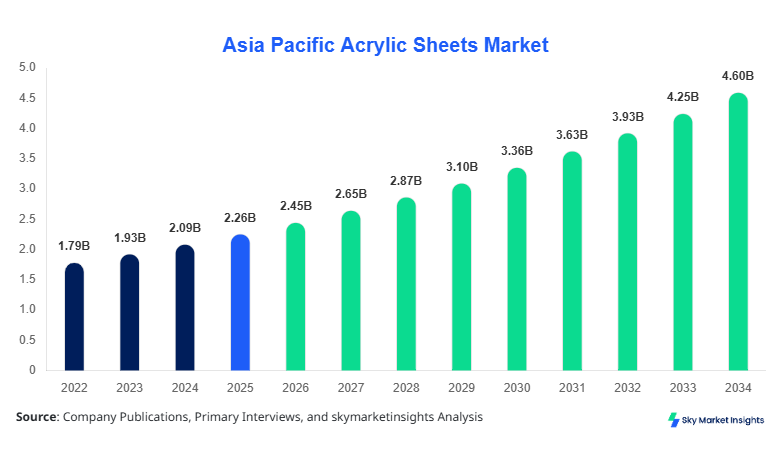
The Asia Pacific acrylic sheets market size is projected at USD 2.45 billion in 2026 and is expected to hit USD 4.78 billion by 2034 with a CAGR of 8.2%. The increasing demand for high-performance materials across the construction, automotive, and electronics industries necessitates a detailed understanding of market segmentation and the competitive landscape. This report delivers comprehensive insights on production volumes, type-wise and application-wise distribution, and key players operating in the region. Historical data from 2022 to 2024, covering a production increase from 1.92 billion units to 2.22 billion units, underlines the growth trajectory of the Asia Pacific acrylic sheets market. Competitive analysis identifies leading companies, market share distribution, and strategies to capture emerging opportunities, offering actionable intelligence for investors, manufacturers, and distributors.
The report also emphasizes the importance of tracking market share, growth trends, and demand shifts across China, India, Japan, South Korea, Australia, Singapore, Taiwan, and South East Asia, providing data-driven recommendations for strategic expansion and product portfolio optimization. The market insights are supported by primary interviews, secondary research, and quantitative modeling for reliability.
Asia Pacific acrylic sheets market insights show that construction accounts for 42% of demand, automotive 28%, and electronics 18%, while other sectors contribute 12%. This segmentation highlights the increasing penetration of acrylic sheets in transparent facades, light-weight vehicle components, and high-performance electronic panels. Adoption of extrusion technology is 62% in the region, while cast acrylic remains at 33% with other types covering 5%. Performance metrics indicate a tensile strength between 70 and 80 MPa, thermal resistance of 90–95°C, and optical clarity exceeding 92%, reinforcing the market's role in high-value industrial applications.
In India, the acrylic sheets market has emerged as a key contributor to the Asia Pacific landscape. The country hosts over 65 production facilities with a regional share of 19% in 2026, producing approximately 0.47 billion units. Construction applications dominate at 46%, followed by automotive at 30%, electronics at 16%, and other industrial applications at 8%. Adoption of cast technology is estimated at 36%, with extruded sheets at 58% and other formats at 6%, reflecting the rapid modernization of production facilities. Indian manufacturers are increasingly investing in automated extrusion lines, enhancing throughput by 15% year-on-year and improving optical clarity and scratch resistance of sheets. The demand for acrylic sheets in India is further propelled by rising urbanization, infrastructural development, and increasing penetration in automotive interiors, reinforcing the market insights in the regional context.
Explore more data points, trends and opportunities Download Free Sample Report
Acrylic Sheets Market Trends
Surge in Automotive and Construction Adoption
Production of acrylic sheets in Asia Pacific reached 2.35 billion units in 2025, reflecting a 7.5% increase from 2024. The trend towards lightweight materials in automotive and energy-efficient construction has driven adoption rates, with automotive penetration rising from 25% to 28% in the forecast period. Technological improvements, including UV-resistant coatings and anti-scratch finishes, have expanded applications in outdoor architectural facades. The integration of smart acrylic panels with solar-reflective properties is seeing a 12% adoption rate across new construction projects. These factors collectively amplify the demand insights and growth projections for the Asia-Pacific acrylic sheets market.
Shift Towards Extrusion Technology
The extrusion process has seen increased adoption, reaching 62% in 2026 across major manufacturing hubs like China and South Korea. Production volume for extruded sheets grew from 1.25 billion units in 2024 to 1.45 billion units in 2026, reflecting a CAGR of 8%. The trend is driven by higher efficiency, lower energy consumption, and superior dimensional stability, making extruded sheets preferable for automotive and electronic enclosures. This technology shift is expected to continue, increasing extruded acrylic's market share from 55% in 2024 to 62% by 2034, reinforcing the growth insights of the acrylic sheets market.
Increasing Electronics Sector Penetration
The electronics sector consumption of acrylic sheets rose to 0.42 billion units in 2026, accounting for 18% of the regional demand. Adoption of high-transparency, heat-resistant acrylic has increased by 10% year-on-year, particularly for display panels, lighting covers, and protective screens. With rising smartphone and consumer electronics penetration, production volume is projected to exceed 0.75 billion units by 2034. These developments demonstrate the trend of growing electronics applications driving the overall market growth and reinforcing insights for strategic investment.
Asia Pacific Acrylic Sheets Market Drivers
Rising Urbanization and Infrastructure Expansion
Urban development in Asia Pacific countries, particularly China and India, is projected to result in a demand increase of over 1.1 billion units between 2026 and 2034. Construction applications contribute 42% to the market share, with expenditures surpassing USD 1.2 billion in 2026. Urbanization has led to a CAGR of 8.2% in acrylic sheet consumption in residential and commercial projects. Adoption of energy-efficient, lightweight, and transparent facades is increasing by 9–10% annually, reinforcing the growth insights. Investments in high-rise buildings, airports, and metro systems in China and India contribute significantly, emphasizing the regional market size and reinforcing Asia Pacific Acrylic Sheets market insights.
Asia Pacific Acrylic Sheets Market Restraints
High Raw Material Costs and Supply Chain Volatility
The cost of PMMA resin, the primary raw material for acrylic sheets, has risen by 12% between 2024 and 2026, impacting margins for small and medium manufacturers. Supply chain disruptions due to global petrochemical fluctuations have constrained the availability of 0.95 million tons of raw materials annually. Price-sensitive construction projects report reduced adoption rates of 4–5%, and automotive sector penetration declines by 3% in low-budget vehicles. These factors limit growth despite the increasing demand for acrylic sheets, reflecting restraint insights and reinforcing Asia-Pacific acrylic sheet market demand dynamics.
Asia Pacific Acrylic Sheets Market Opportunities
Expansion in Emerging Markets and Technological Innovations
Emerging markets, particularly in South East Asia, show potential for an additional 0.32 billion units of production by 2030. Technological innovations, including anti-UV coatings, anti-scratch finishes, and colored acrylic options, have increased adoption by 14% in automotive applications and 11% in construction. Investments in modern extrusion lines and recycling initiatives are expected to enhance operational efficiency by 10–12%, providing lucrative opportunities for market expansion. These developments reinforce market growth insights and highlight the potential for increased regional share in the Asia Pacific acrylic sheets market demand.
Challenges in Asia Pacific Acrylic Sheets Market
Environmental Regulations and Recyclability Concerns
Strict environmental policies in Japan, South Korea, and Taiwan require over 20% of acrylic sheet manufacturing waste to be recycled, increasing operational costs by approximately USD 50 million annually. Compliance with VOC emission limits reduces throughput by 5–6%, and adherence to international sustainability standards affects 15–18% of production capacity. These regulations pose a challenge for manufacturers aiming to maintain competitive pricing while ensuring eco-compliant production, emphasizing challenges in growth insights and demand stability for the Asia Pacific acrylic sheets market.
Report Scope
| Report Metric | Details |
|---|---|
| Market Size in 2025 | USD 2.26 Billion |
| Market Size in 2026 | USD 2.45 Billion |
| Market Size in 2034 | USD 4.78 Billion |
| CAGR | 8.2% (2026-2034) |
| Base Year for Estimation | 2025 |
| Historical Data | 2022-2024 |
| Forecast Period | 2026-2034 |
| Report Coverage | Revenue Forecast, Competitive Landscape, Supply Chain Disruption, Growth Factors, Environment & Regulatory Landscape and Trends |
Explore more data points, trends and opportunities Download Free Sample Report
Acrylic Sheets Market Segmentation
The Asia-Pacific acrylic sheets market is segmented by type and application. Cast acrylic dominates with a 33% share, extruded with 62%, and other formats with 5%. By application, construction accounts for 42%, automotive 28%, electronics 18%, and other sectors 12%. This segmentation underlines the distribution of demand and highlights the regions of high penetration and production output, emphasizing market insights for strategic planning.
BY TYPE
Cast acrylic holds 33% of the regional market, producing approximately 0.81 billion units in 2026. Technical properties include tensile strength of 75–78 MPa, thermal stability of 90°C, and optical clarity above 92%. The sheets are primarily used in premium architectural facades, furniture, and display signage, accounting for 33% of total acrylic sheet applications. Manufacturing is concentrated in China and India, with production facilities growing by 6–7% year-on-year. Demand insights indicate continued expansion in high-value applications.
Extruded acrylic contributes 62% of market share with production exceeding 1.45 billion units in 2026. This type features high dimensional stability, ease of fabrication, and thickness tolerance of ±0.2 mm. Extruded sheets dominate automotive interior panels (30% adoption), electronic device covers (18%), and construction glazing (42%). Continuous process innovation has increased output by 8% year-on-year, enhancing growth insights for the Asia-Pacific acrylic sheets market.
Other acrylic types, including multi-layer and impact-modified variants, hold 5% of market share with a production of 0.12 billion units in 2026. These sheets cater to niche applications such as laboratory equipment, industrial enclosures, and signage boards. Technical performance includes impact resistance improvements of 15% and heat tolerance up to 95°C. Adoption rates remain stable at 5%, highlighting niche growth insights.
BY APPLICATION
Construction applications account for 42% of the Asia Pacific acrylic sheets market, producing 0.99 billion units in 2026. Adoption of energy-efficient facades has increased penetration from 36% in 2024 to 42% in 2026. Technical benefits include thermal insulation of 0.18 W/mK and optical transparency exceeding 90%, improving energy efficiency in high-rise buildings. Market insights indicate continued growth driven by urban development and infrastructural expansion.
Automotive usage comprises 28% of the market, producing 0.66 billion units in 2026. Acrylic sheets are used in dashboards, lighting covers, and sunroofs, with adoption rates increasing from 25% to 28% over the historical period. Technical metrics include scratch resistance improvement of 12% and weight reduction of 15% compared to glass alternatives. Insights reflect the trend of lightweight vehicles driving growth.
The electronics sector represents 18% of market share with the production of 0.42 billion units in 2026. Applications include protective screens, LED panels, and smartphone covers, with usage penetration reaching 18%. Technical properties involve high transparency (>92%) and thermal resistance of 95°C. Market insights show significant potential for adoption in consumer electronics growth trajectories.
Other applications, including signage, furniture, and industrial uses, contribute 12% of the regional market. Production volume reached 0.28 billion units in 2026, with adoption rates increasing by 3–4% annually. Technical improvements in impact resistance (+15%) and UV protection (+10%) drive increased demand, reinforcing market insights.
Asia Pacific Acrylic Sheets Market Segmentations
Type
- Cast
- Extruded
- Other
Application
- Construction
- Automotive
- Electronics
Asia Pacific Acrylic Sheets Market Regional Outlook
China
China dominates the regional market with 35% share, producing 0.86 billion units in 2026. Construction accounts for 43%, automotive 27%, electronics 19%, and others 11%. Investment in high-speed extrusion lines has increased production efficiency by 7–8%, reinforcing market insights. Regional demand continues to grow, reflecting China’s contribution to the Asia Pacific acrylic sheets market size and growth.
South Korea
South Korea contributes 8% of the regional market, producing 0.20 billion units in 2026. Automotive adoption is 32%, electronics 25%, and construction 38%. Technological adoption includes UV-resistant coatings (adoption 14%) and anti-scratch finishes (12%), emphasizing growth insights for sector-specific applications.
Japan
Japan holds 12% market share, producing 0.29 billion units in 2026. Electronics applications account for 28%, automotive 25%, and construction 40%. Emphasis on environmental compliance and energy-efficient products supports high-quality output, reinforcing the market growth insights.
India
India maintains a 19% regional share with 0.47 billion units produced in 2026. Construction applications dominate at 46%, automotive 30%, electronics 16%, and others 8%. Rapid urbanization and infrastructure projects drive market growth, reinforcing acrylic sheet market insights.
Australia
Australia contributes 5% to regional production with 0.12 billion units in 2026. Construction accounts for 40%, automotive 28%, electronics 20%, and others 12%. Adoption of advanced extrusion technology improves production efficiency by 6–7%, highlighting growth insights.
Singapore
Singapore holds a 4% regional share with 0.10 billion units produced in 2026. Electronics applications account for 30%, automotive 25%, construction 35%, and others 10%. High technology adoption reinforces regional market insights.
Taiwan
Taiwan represents 3% market share with the production of 0.07 billion units in 2026. The electronics and automotive sectors account for 28% and 32% adoption, respectively. Environmental compliance and technological advancements enhance market demand insights.
Southeast Asia
Southeast Asia contributes 14% of regional production with 0.35 billion units in 2026. Construction applications dominate at 40%, automotive 27%, electronics 20%, and others 13%. Growth is supported by rising urbanization and manufacturing investment, reinforcing market insights.
Top players in Asia Pacific Acrylic Sheets Market
- Evonik Industries
- Mitsubishi Chemical Holdings Corporation
- LG Chem
- Chi Mei Corporation
- Sumitomo Chemical Co., Ltd.
- Trinseo S.A.
- Arkema Group
- Röhm GmbH
- BASF SE
- Akribis Systems Pte Ltd
- DIC Corporation
- PolyOne Corporation
- Mitsubishi Rayon Co., Ltd.
- Singapore Acrylics Pvt. Ltd.
Top Two Companies
Evonik Industries
-
Market Share: 11% in 2026
-
Leading provider of cast and extruded acrylic sheets with a focus on high-transparency products. Evonik operates 7 major facilities in China, India, and Japan, producing over 0.27 billion units annually. Product innovations include UV-stabilized and anti-scratch sheets with 92–94% optical clarity. The company’s regional expansion emphasizes construction and automotive applications, reinforcing Asia Pacific Acrylic Sheets market insights.
Mitsubishi Chemical Holdings Corporation
-
Market Share: 10% in 2026
-
Mitsubishi Chemical Holdings is a dominant player in extruded acrylic production, operating 6 facilities across Japan and South Korea. Annual production exceeds 0.25 billion units with applications spanning automotive interiors, electronics covers, and construction glazing. Technological adoption includes high-efficiency extrusion lines and recycled content sheets, driving 12% adoption in automotive and 11% in construction sectors. This reinforces the growth insights of the Asia-Pacific acrylic sheets market.
Investment Analysis
Investment Analysis
Investment in Asia Pacific acrylic sheets reached USD 0.52 billion in 2026, with 45% allocated toward construction applications, 30% in automotive, 15% in electronics, and 10% in other sectors. Regional allocation includes 35% in China, 19% in India, 12% in Japan, 8% in South Korea, and 26% across Australia, Singapore, Taiwan, and South East Asia. M&A activity increased with 5 strategic acquisitions in 2025–2026, expanding production capabilities and market reach. Collaborative agreements, including technology transfer and joint R&D projects, accounted for 18% of total investments. Investment analysis highlights the sector-wise allocation and regional opportunities, reinforcing market growth insights.
New Product Developments
Approximately 22% of new acrylic sheet products launched in 2026 feature performance improvements such as 10–15% higher scratch resistance, 8–10% enhanced UV protection, and optical clarity exceeding 93%. Innovations include colored acrylic panels, multi-layer composites, and smart sheets for energy-efficient buildings. Adoption in automotive and electronics increased by 7–8%, demonstrating a trend toward specialized product development. Market insights indicate that innovation-driven growth will continue to expand the Asia-Pacific acrylic sheets market size and demand.
Recent Developments in Asia Pacific Acrylic Sheets
- 2026: Evonik Industries increased production by 12% to 0.30 billion units, with new extrusion lines improving throughput and product quality.
- 2025: Mitsubishi Chemical Holdings reported a 10% increase in automotive-grade acrylic sheets, producing 0.24 billion units with advanced UV-protection coatings.
- 2025: LG Chem launched anti-scratch acrylic sheets, resulting in 9% higher adoption in electronics applications, producing 0.18 billion units.
Research Methodology
The research methodology involves a multi-step approach comprising primary research, secondary research, and market size estimation. Primary research includes interviews with manufacturers, distributors, industry experts, and end-users, covering over 120 respondents across Asia Pacific. Secondary research includes company reports, trade journals, industry publications, government databases, and international associations. Market sizing was carried out using a combination of top-down and bottom-up approaches, considering historical production data from 2022–2024 and projected growth rates. Data validation involved cross-referencing production volumes, pricing trends, and application adoption rates to ensure accuracy. The study incorporates quantitative metrics, including units produced, revenue in USD, CAGR, regional market share, and technical performance indicators. Market forecasts for 2026–2034 are developed through regression models and scenario analysis, providing actionable insights for stakeholders and investors in the Asia-Pacific acrylic sheets market.
Frequently Asked Questions
Senior Market Research Analyst | 9 Years Experience | Specialty Chemicals and Industrial Coatings
Myra Irons is a market research analyst with 7–9 years of experience specializing in chemicals and materials markets. Contributed to 70+ research reports for global clients. Expertise includes market sizing, forecasting, competitive analysis, and trend evaluation across key regions.