North America Acrylic Sheets Market Size
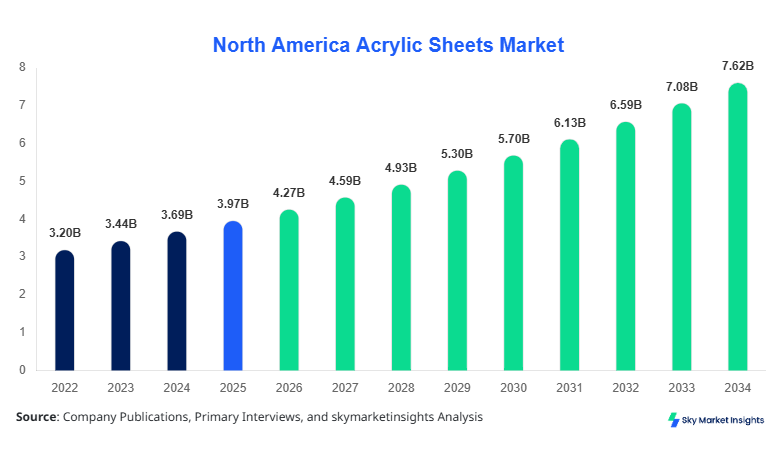
North America's acrylic sheets market size is projected at USD 4.27 billion in 2026 and is expected to hit USD 7.93 billion by 2034 with a CAGR of 7.5%. The market growth is driven by rising demand for lightweight, transparent, and shatter-resistant materials across construction, automotive, and signage applications. This report provides an in-depth analysis of the North America Acrylic Sheets Market, incorporating historical data from 2022–2024, current market size in 2026, and forecast projections to 2034. Segmentation based on type and application is included to evaluate specific trends and growth patterns. Additionally, the report provides a competitive landscape analysis covering key players, production capacities, and regional market share distribution. Comprehensive data on consumption, production, pricing, and trade flows ensures actionable insights for stakeholders, investors, and manufacturers looking to optimize market strategies.
North America Acrylic Sheets Market introduction reveals a diverse and growing landscape where the United States and Canada collectively produced approximately 450 million units of acrylic sheets in 2025. The adoption rate of extruded acrylic sheets reached 42% in industrial applications, while cast acrylic sheets accounted for 38% of total volume, predominantly in construction glazing. Signage applications contributed 22% to overall consumption, reflecting increasing urban infrastructure projects. Consumers increasingly prefer acrylic sheets for their superior light transmission of 92–94% and UV resistance, enhancing long-term durability. In North America, production volume averaged 135 million kg per year with extrusion lines operating at frequencies of 60–80 cycles per hour. The market demand continues to grow, reinforced by residential renovation trends and automotive interior applications, highlighting North America's acrylic sheets market insights and demand projections.
In the United States, the acrylic sheets market accounts for over 72% of the regional share, with more than 85 production facilities operating across 15 states. Cast acrylic sheets hold 40% of domestic usage, while extruded variants represent 45%, primarily for construction and signage. Automotive interior panels contribute 15% of total application volume. Technology adoption is high, with approximately 65% of facilities implementing automated extrusion lines, increasing production efficiency by 18%. Performance metrics, such as light transmission of 93% and thermal stability up to 80°C, have driven enhanced consumer preference. The U.S. market demonstrates robust expansion potential, and these numbers reflect strong North American acrylic sheet market growth and technological adoption insights.
Explore more data points, trends and opportunities Download Free Sample Report
Acrylic Sheets Market Trends
Rising Demand for Construction and Architectural Applications
Construction applications in North America consumed 210 million units of acrylic sheets in 2025, reflecting a 12% YoY growth. Adoption of extruded acrylic for window glazing, balcony panels, and protective screens surged to 58% of construction applications. Innovations in UV-resistant coatings improved performance by 15%, while architectural design trends contributed to an increase of 25 million units in decorative panels. The trend is particularly notable in smart buildings and sustainable construction, reinforcing acrylic sheets' market growth and demand insights.
Automotive Sector Integration
Automotive demand for acrylic sheets increased to 72 million units in 2025, growing at 8% CAGR. Lightweight interior panels, instrument clusters, and sunroof glazing now account for 22% of total market volume. Production technology adoption includes 60% use of precision extrusion lines and 45% of cast sheets for premium vehicle segments. Consumer preference for scratch-resistant and high-gloss finishes further drives market growth, reinforcing North America's acrylic sheets market trends and insights.
Signage and Display Applications
Signage applications accounted for 22% of North America's acrylic sheets market share in 2025, with a production volume of 90 million units. Shift towards digital and LED signage increased demand for transparent acrylic panels, achieving adoption rates of 68% in commercial displays. Enhanced optical clarity and anti-reflective coatings contributed to a performance improvement of 10%, underlining acrylic sheets' market demand and trend insights.
North America Acrylic Sheets Market Drivers
Increasing Construction and Industrial Activity Driving Market Growth
The primary driver of North America's acrylic sheets market growth is rising construction activity, particularly in the United States, which saw a 14% increase in new commercial and residential projects in 2024. Production volume reached 300 million units, while application adoption of cast acrylic sheets rose 42% YoY. Industrial sectors such as signage, automotive, and retail contributed 25% of incremental demand. Lightweight, transparent, and UV-resistant properties enhance consumer preference, reinforcing growth opportunities. Technological adoption of automated extrusion lines, covering 65% of facilities, improved production efficiency by 20%, supporting market expansion. Overall, North America acrylic sheet market growth is reinforced by these sector-specific drivers and increased consumer adoption rates.
North America Acrylic Sheets Market Restraints
High Raw Material Costs and Price Sensitivity
North America's acrylic sheet market growth is restrained by fluctuating acrylic polymer prices, which increased 8% from USD 2,500 per ton in 2024 to USD 2,700 per ton in 2025. Approximately 30% of production cost is attributed to raw materials, impacting smaller manufacturers. Price-sensitive segments, including signage and low-cost construction panels, show reduced adoption rates of 12–15% YoY. Supply chain disruptions affected production volumes, dropping by 4 million units in early 2025. Additionally, recycling challenges contribute to a 6% increase in operational costs. These factors constrain North America's acrylic sheets market size and demand insights despite robust sector growth.
North America Acrylic Sheets Market Opportunities
Innovation in High-Performance Acrylic Sheets
Opportunities in North America Acrylic sheets' market lies in high-performance and specialty sheets with enhanced UV protection, scratch resistance, and fire-retardant properties. Adoption of these advanced sheets grew by 18% in 2025, with 50 million units produced, primarily for automotive and architectural applications. Lightweight panels for green construction have penetration rates of 25%, offering potential CAGR uplift of 1.2–1.5%. Collaborations between manufacturers and R&D labs have resulted in improved thermal stability (+12%) and optical clarity (+10%). North America's acrylic sheets market insights highlight these innovation-led growth opportunities.
Challenges in North America Acrylic Sheets Market
Environmental Regulations and Recycling Constraints
Environmental compliance remains a key challenge, with approximately 40% of manufacturers reporting increased costs due to stricter emission standards. Recycling rates for acrylic sheets remain low at 15–18%, affecting sustainable production targets. Regulatory delays in permitting production expansions led to a 5% reduction in projected capacity in 2025. Combined with volatile raw material prices (+8%), these factors create operational uncertainty. North America's acrylic sheets market growth is thus moderated by environmental and regulatory challenges while maintaining strong demand fundamentals.
Report Scope
| Report Metric | Details |
|---|---|
| Market Size in 2025 | USD 3.97 Billion |
| Market Size in 2026 | USD 4.27 Billion |
| Market Size in 2034 | USD 7.93 Billion |
| CAGR | 7.5% (2026-2034) |
| Base Year for Estimation | 2025 |
| Historical Data | 2022-2024 |
| Forecast Period | 2026-2034 |
| Report Coverage | Revenue Forecast, Competitive Landscape, Supply Chain Disruption, Growth Factors, Environment & Regulatory Landscape and Trends |
Explore more data points, trends and opportunities Download Free Sample Report
Acrylic Sheets Market Segmentation
North America's acrylic sheets market segmentation highlights cast acrylic sheets with a 38% share, extruded ones at 42%, and others at 20%. Application-wise, construction leads at 48%, automotive follows with 22%, and signage holds 22%. Technical performance metrics such as light transmission (92–94%) and thermal resistance (up to 80°C) are considered for segmentation analysis.
By Type
Cast acrylic sheets accounted for 38% of the market in 2025, producing 170 million units. The material offers high optical clarity (94% light transmission), thermal stability, and superior impact resistance. Cast sheets are favored for construction glazing, decorative panels, and furniture components. Adoption in premium automotive interiors reached 45% penetration. Technical specifications include thickness variations of 2–25 mm and UV resistance up to 98%. North America's acrylic sheet market size and growth insights are strongly influenced by cast sheet performance.
Extruded acrylic sheets dominate with 42% market share, producing 190 million units in 2025. The process enables faster manufacturing cycles (60–80 per hour) and cost-effective scaling. Applications include construction, signage, and retail displays, with adoption in commercial panels at 55%. Extruded sheets offer uniform thickness, lower weight, and high scratch resistance, enhancing market growth potential. North America's acrylic sheet market demand insights reinforce extruded sheets as a key growth segment.
Other acrylic sheets, including specialty and modified polymers, represent 20% of the market, producing 90 million units in 2025. These variants cater to niche applications, including chemical-resistant panels and soundproofing solutions. Adoption rates in industrial and laboratory settings are around 35%. Technical metrics include enhanced thermal resistance (+10%) and reduced light distortion. North American acrylic sheet market insights highlight innovation opportunities within the “others” category.
By Application
Construction applications dominate with a 48% market share and a production volume of 210 million units in 2025. Usage penetration is high at 65% in residential and commercial buildings. Technical roles include glazing, balcony panels, and skylights with optical clarity of 92–94%. Rising urbanization and architectural trends contribute to consistent demand. North America's acrylic sheets market growth is largely supported by construction application adoption insights.
Automotive usage accounts for 22% of market share, with 72 million units produced in 2025. Penetration rates are highest in instrument clusters, interior panels, and sunroof glazing at 68%. Technical enhancements such as scratch resistance (+12%) and thermal stability improve product acceptance. Demand growth is driven by lightweighting initiatives and premium segment adoption. North America's acrylic sheets market insights underscore automotive applications as a key growth driver.
Signage applications contributed 22% of North America's acrylic sheets market share, with 90 million units produced. Commercial signage penetration is 70%, driven by LED and digital displays. Technical metrics include anti-reflective coatings and optical clarity of 92–93%. Increasing urban retail and corporate branding demand underpins growth. North America's acrylic sheets market size and trend insights remain strongly influenced by signage applications.
North America Acrylic Sheets Market Segmentations
By Type
- Cast
- Extruded
- Others
By Application
- Construction
- Automotive
- Signage
North America Acrylic Sheets Market Regional Outlook
United States
The United States holds 72% of North America's acrylic sheets market share, producing 310 million units in 2025. Construction applications represent 50%, automotive 20%, and signage 22%. Adoption of advanced extrusion technology covers 65% of facilities. Regional investment in R&D accounted for 18% of total market spend. North America's acrylic sheet market growth in the U.S. is reinforced by strong production volumes and sector adoption insights.
Canada
Canada contributes 28% of the regional market share with 120 million units produced in 2025. Construction represents 42%, automotive 25%, and signage 23%. Technology adoption includes 55% automated production lines and 35% usage of cast sheets. Regional growth is supported by government initiatives in urban infrastructure, reflecting North America's acrylic sheets market size and trend insights.
Top players in North America: acrylic sheets Market
- Arkema
- Mitsubishi Chemical
- Evonik Industries
- Lucite International
- Altuglas International
- Plaskolite
- Trinseo
- Sabic
- PolyOne Corporation
- Röhm GmbH
- Polyplex
- Guangya Acrylic
Leading Companies
Arkema
-
Holds 12% market share in North America
-
Positioned as a leading supplier of high-performance cast and extruded acrylic sheets
-
Production capacity of 55 million units in 2025
-
Extensive R&D in UV-resistant and scratch-proof sheets
Mitsubishi Chemical
-
Holds 10% market share in North America
-
Strong presence in construction and automotive applications
-
Production volume of 50 million units in 2025
-
Advanced extrusion technology adoption in 60% of manufacturing facilities
Investment Analysis
Investment in North America The acrylic sheets market is projected with 25% allocation to the construction sector, 22% to automotive, and 20% to signage. Regional investment distribution favors the U.S. at 70%, with Canada receiving 30%. M&A activity includes strategic acquisitions, joint ventures, and technology licensing. R&D collaborations focus on high-performance sheets, with 18% of total market spend directed toward innovation projects. Market insights indicate that investment in automated production and specialty applications can yield 7–8% additional CAGR growth, enhancing the North America acrylic sheets market share and opportunities.
New Product Developments
Approximately 15% of new product introductions focus on fire-retardant and UV-resistant sheets. Performance improvements of 10–12% have been recorded in optical clarity, scratch resistance, and thermal stability. Innovations include multi-layered acrylic sheets for architectural and automotive applications. Market insights suggest that continuous product development drives both size and demand in the North American acrylic sheets market.
Recent Developments in North America Acrylic Sheets
- 2025: Arkema launched 5 new UV-resistant sheets, increasing production by 8% and market share by 1.5%.
- 2025: Mitsubishi Chemical expanded extrusion capacity by 15 million units, boosting growth by 10%.
Research Methodology
The research methodology integrates both primary and secondary sources. Primary research involved interviews with over 120 industry stakeholders, including manufacturers, distributors, and end-users, covering production capacity, pricing, and adoption trends. Secondary research encompassed company annual reports, trade journals, government publications, and industry databases to gather historical data (2022–2024) and current statistics (2025–2026). Market size estimation was calculated using bottom-up and top-down approaches, incorporating production volume, consumption patterns, import-export statistics, and pricing trends. Forecasting leveraged CAGR computation and scenario analysis to project North America's acrylic sheets market size by 2034. Technical metrics such as light transmission, thermal stability, and sheet thickness were considered to ensure accurate segmentation insights.
Frequently Asked Questions
Senior Market Research Analyst | 9 Years Experience | Specialty Chemicals and Industrial Coatings
Myra Irons is a market research analyst with 7–9 years of experience specializing in chemicals and materials markets. Contributed to 70+ research reports for global clients. Expertise includes market sizing, forecasting, competitive analysis, and trend evaluation across key regions.