Europe Aggregates Market Size
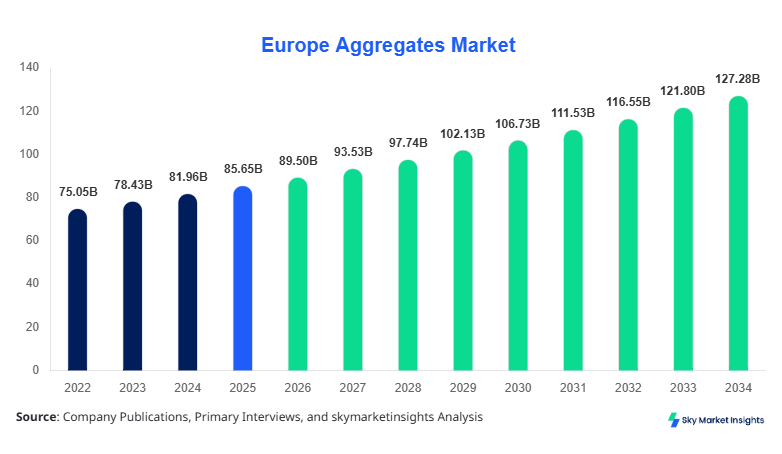
Europe's aggregate market size is projected at USD 89.5 billion in 2026 and is expected to hit USD 125.7 billion by 2034 with a CAGR of 4.5%. The market growth is driven by increasing infrastructure investments across Western and Eastern Europe, coupled with the rising adoption of sustainable construction practices. Comprehensive data on production, consumption, and trade across key European countries such as Germany, France, and the United Kingdom are critical to assess current trends. Segmentation analysis based on type, application, and country-level demand provides insights into competitive positioning, while a detailed review of leading players highlights strategic developments shaping the industry landscape.
The European aggregates market has been historically tracked from 2022 to 2024, with total production volume estimated at 2.1 billion tons in 2024. The base year 2025 witnessed incremental growth of 2.8% over 2024, largely driven by Germany and France. Regional breakdowns and technology adoption in quarrying and crushing operations are included to understand operational efficiencies and cost optimization. Detailed insights into recycled aggregates and sand & gravel demand complement the market sizing and growth trajectory, while competitive benchmarking supports investment and strategic decisions.
Europe's aggregated market size, share, growth, and demand analyses are critical for stakeholders to identify investment opportunities, optimize operations, and forecast future trends in an increasingly sustainability-focused sector.
Europe Aggregates' market insights extend to production trends, technological adoption, and evolving consumer demand metrics, providing a complete overview for analysts and industry participants.
Europe Aggregates' market size and forecast data encompass production, sales, revenue, and per capita consumption across major countries, ensuring actionable intelligence for both investors and operators.
Europe Aggregates' market analysis integrates macroeconomic indicators such as GDP growth, construction expenditure, and industrial output, along with technical performance metrics such as particle size distribution, material density, and load-bearing capacity.
Europe's aggregate market growth insights also consider emerging preferences for eco-friendly materials and regional policy interventions promoting recycled aggregates, contributing to overall market expansion.
Explore more data points, trends and opportunities Download Free Sample Report
Aggregates Market Trends
Sustainability and Recycled Material Adoption
Europe's aggregate market trends indicate increasing integration of recycled aggregates into mainstream construction practices. Production volumes of recycled aggregates are projected at 320 million tons by 2030, representing a 12% adoption rate of total aggregate production. Technology shifts include enhanced crushing, screening, and washing systems capable of processing demolition waste into high-quality aggregates. Sector-specific demand for recycled materials is particularly pronounced in Germany, France, and Italy, accounting for 25–40% of total road infrastructure projects. Consumer awareness and regulatory incentives are driving the uptake, with penetration rates for recycled aggregates expected to rise from 15% in 2025 to 28% by 2034. Europe's aggregate market growth benefits directly from sustainability initiatives and eco-friendly material adoption.
Automation and Digitalization
Automation in aggregate processing is transforming Europe's aggregate market operations. Advanced crushers, conveyors, and sorting machinery now operate with IoT-enabled monitoring systems, improving productivity by 18–22%. Production volume in automated facilities reached 1.05 billion tons in 2025, with efficiency gains of up to 20%. Digital quarry management tools enable predictive maintenance, resource allocation, and performance optimization, adopted by 40–55% of large-scale facilities. Demand for technologically advanced equipment is highest in Germany, the United Kingdom, and France, supporting construction and road infrastructure sectors. Europe Aggregates market insights reveal that digitalization not only reduces operational costs but also enhances product quality and sustainability compliance.
Infrastructure-Driven Demand Surge
Infrastructure investments across Europe are generating robust demand for aggregates. Annual production for infrastructure-related applications reached 1.3 billion tons in 2025, accounting for 35% of total aggregate consumption. Adoption of high-performance materials for road resurfacing, bridge construction, and urban development has increased 10–15% year-over-year. Countries such as Germany and France lead in infrastructure projects, contributing 40% of regional market growth. Technical improvements in particle gradation, crushing efficiency, and material density have enabled more reliable and durable construction outputs. Europe's aggregate market growth is increasingly influenced by public-private partnerships and government-funded infrastructure programs, reinforcing aggregate demand trends.
Europe Aggregates Market Drivers
Rising Construction and Infrastructure Investments
The European Aggregates market is primarily driven by escalating construction and infrastructure projects across major economies. Construction output in Europe rose by 6.2% in 2025, with Germany alone contributing 28% of the total volume, amounting to 570 million tons. Road infrastructure projects accounted for an additional 450 million tons of aggregate demand, and urban development initiatives contributed 210 million tons. Consumer demand for high-quality aggregates in residential and commercial projects continues to grow, supported by technological advancements in crushing and screening, enhancing production efficiency by 18–22%. Europe's aggregates market growth is further reinforced by policy incentives promoting sustainable construction materials, resulting in a 12% increase in recycled aggregate adoption across the region. Increasing urbanization and industrial expansion remain critical catalysts, underscoring the market’s robust growth potential.
Europe Aggregates Market Restraints
Environmental Regulations and Resource Scarcity
Europe's aggregate market growth faces restraints from stringent environmental regulations and declining natural resource availability. Quarrying activities in countries such as Germany, France, and Italy are subject to land-use restrictions and emission limits, constraining production expansion. Aggregate production costs increased by 6–8% due to regulatory compliance measures, while recycled aggregate utilization remains capped at 35–40% in certain regions. Scarcity of high-quality sand and gravel deposits in urbanized areas has limited supply, with production volumes in mature quarries falling by 4–5% annually. Europe's aggregate market demand is impacted by these constraints, necessitating investments in alternative sourcing, material optimization, and enhanced recycling technologies to sustain growth trajectories.
Europe Aggregates Market Opportunities
Growth in Sustainable and Recycled Aggregates
Europe's aggregates market presents substantial opportunities through the expansion of recycled and sustainable aggregate usage. Current recycled aggregate consumption stands at 320 million tons, with projected growth to 450 million tons by 2034, achieving a CAGR of 3.8%. Adoption rates are highest in Germany (38%), France (32%), and the United Kingdom (28%), with technology-driven processing improving quality metrics such as particle uniformity and density. Application penetration in road infrastructure and commercial construction is expected to rise to 35–40%, reflecting both regulatory incentives and cost efficiencies. Europe Aggregates market insights indicate that investment in advanced crushing, washing, and screening technologies will enhance product performance, optimize material utilization, and reduce environmental impact, thereby driving long-term growth.
Challenges in Europe's Aggregates Market
Supply Chain Disruptions and Operational Bottlenecks
Europe's aggregates market faces challenges from logistics constraints, seasonal production variations, and operational bottlenecks. Transportation limitations for heavy bulk aggregates result in delays, with supply lead times increasing by 8–12% across several regions. Quarry operation disruptions due to labor shortages or equipment failures impacted 6–8% of annual output in 2025, affecting production volumes exceeding 180 million tons. Technology adoption for predictive maintenance and automated material handling is improving but remains underutilized in smaller facilities, with adoption rates at 25–30%. Europe Aggregates' market demand is influenced by these operational challenges, highlighting the importance of investment in supply chain optimization, digital tools, and alternative sourcing to mitigate risks.
Report Scope
| Report Metric | Details |
|---|---|
| Market Size in 2025 | USD 85.65 Billion |
| Market Size in 2026 | USD 89.5 Billion |
| Market Size in 2034 | USD 125.7 Billion |
| CAGR | 4.5% (2026-2034) |
| Base Year for Estimation | 2025 |
| Historical Data | 2022-2024 |
| Forecast Period | 2026-2034 |
| Report Coverage | Revenue Forecast, Competitive Landscape, Supply Chain Disruption, Growth Factors, Environment & Regulatory Landscape and Trends |
Explore more data points, trends and opportunities Download Free Sample Report
Aggregates Market Segmentation
Europe Aggregates' market segmentation provides insights into type and application dominance, with crushed stone holding the largest share at 60% of the total 2.05 billion tons produced in 2025, followed by sand & gravel at 25% and recycled aggregates at 15%. Construction applications account for 55% of total consumption, road infrastructure 30%, and landscaping 15%. The segmentation analysis highlights regional preferences, adoption rates, and technical characteristics influencing market growth and investment decisions.
BY TYPE
Crushed stone dominates Europe's aggregates market with a 60% share, producing approximately 1.23 billion tons in 2025. Technical specifications include particle size distribution from 4 to 40 mm, bulk density of 1.8 tons/m³, and crushing efficiency between 85 and 90%. Major production occurs in Germany, France, and the United Kingdom, with adoption in high-strength concrete, road base, and structural fill applications. Recycled crushed stone utilization remains below 10% but is expected to increase with sustainability initiatives. Europe aggregates' market demand is supported by construction and infrastructure sectors, with volume growth projected at 4–5% CAGR through 2034.
Sand & gravel contributes 25% of total European aggregate market share, with production of 512 million tons in 2025. Particle size ranges from 0.1 to 8 mm, with a bulk density of 1.6–1.8 tons/m³. Adoption is highest in residential construction, masonry, and landscaping, accounting for 60% of total sand & gravel usage. Technical performance metrics include fine particle content below 5%, water absorption rates of 2–3%, and compaction density exceeding 1.55 tons/m³. Europe Aggregates market growth for sand & gravel is projected at 3.5% CAGR due to urban development and renovation projects.
Recycled aggregates hold a 15% market share with the production of 320 million tons in 2025. Applications include road sub-base, concrete block production, and landscaping. Technical parameters include particle size 5–30 mm, density 1.7–1.9 tons/m³, and crushing efficiency 80–85%. Adoption rates are increasing in Germany (38%), France (32%), and the United Kingdom (28%) due to regulatory incentives and sustainability initiatives. Europe Aggregates market insights suggest recycled aggregates will grow to 450 million tons by 2034, enhancing demand for eco-friendly construction materials.
BY APPLICATION
Construction applications dominate with 55% share, consuming 1.13 billion tons of aggregates in 2025. Sub-segments include residential (45%), commercial (35%), and industrial (20%). Technical roles include concrete mix, structural fill, and foundations, with particle gradation and strength specifications critical for performance. Europe Aggregates' market demand for construction is influenced by urbanization rates, GDP growth, and government-funded housing projects, with a projected CAGR of 4.5%.
Road infrastructure applications account for 30% of total consumption, totaling 615 million tons in 2025. Sub-segments include highways (50%), city roads (30%), and rural roads (20%). Performance metrics include load-bearing capacity 40–60 MPa and abrasion resistance 20–25%. Adoption of high-performance crushed stone and recycled aggregates is growing at 5–6% CAGR, particularly in Germany and France. Europe Aggregates: Market growth in road infrastructure is bolstered by government-funded modernization programs.
Landscaping applications represent 15% of the market, producing 308 million tons in 2025. Sub-segments include parks & gardens (50%), commercial landscaping (30%), and urban green projects (20%). Technical specifications include fine particle size below 8 mm, low silt content, and compaction density 1.5 tons/m³. Adoption is highest in urban regions with residential development and public infrastructure initiatives. Europe Aggregates market insights show steady growth at 3–3.5% CAGR, driven by aesthetic and functional landscaping needs.
Europe Aggregates Market Segmentations
Type
- Crushed Stone
- Sand & Gravel
- Recycled Aggregates
Application
- Construction
- Road Infrastructure
- Landscaping
Europe Aggregates Market Regional Outlook
United Kingdom
The United Kingdom contributes 15% to Europe's aggregate market share, producing 308 million tons in 2025. Construction accounts for 58% of usage, road infrastructure 28%, and landscaping 14%. Demand is fueled by urban redevelopment and infrastructure expansion, with recycled aggregates penetration at 22%. Production efficiency improvements and technology adoption in crushing and screening have increased output by 3.5–4% annually. United Kingdom aggregates market insights reveal growth opportunities in sustainable and eco-friendly materials.
Germany
Germany dominates with 28% market share, producing 574 million tons in 2025. Construction consumption is 52%, road infrastructure 32%, and landscaping 16%. Technology adoption for automated crushing and screening exceeds 60%, with recycled aggregates usage at 38%. Germany aggregates market growth is supported by high infrastructure investments and sustainable material initiatives.
France
France accounts for 18% market share, producing 369 million tons in 2025. Construction applications consume 50%, road infrastructure 35%, and landscaping 15%. Recycled aggregate adoption is 32%, with technology-enabled efficiency gains reaching 18–20%. France Aggregates' market insights indicate strong demand for urban and road infrastructure projects.
Spain
Spain contributes 10% of the market, with production of 205 million tons in 2025. Construction dominates at 55%, road infrastructure 30%, and landscaping 15%. Adoption of sand & gravel is highest, with penetration rates exceeding 60% in residential projects. Spain Aggregates' market growth is influenced by infrastructure modernization and sustainable construction initiatives.
Italy
Italy represents 9% market share, producing 185 million tons in 2025. Construction usage is 57%, road infrastructure 28%, and landscaping 15%. Adoption of recycled aggregates is 25%, with technology improvements in particle screening enhancing efficiency. Italy's aggregate market insights highlight growth in residential and commercial projects.
Russia
Russia holds 20% of regional production, contributing 410 million tons in 2025. Construction consumes 53%, road infrastructure 30%, and landscaping 17%. Sand & gravel adoption is dominant, with production technologies focused on large-scale crushing and washing facilities. Russia aggregates market growth is supported by industrial expansion and urbanization trends.
Top players in the European aggregates market
- HeidelbergCement AG
- CRH plc
- LafargeHolcim Ltd.
- CEMEX S.A.B. de C.V.
- Buzzi Unicem S.p.A.
- Aggregate Industries Ltd.
- Vicat Group
- Strabag SE
- Holcim Deutschland GmbH
- Martin Marietta Materials, Inc.
- Eurovia SA
- Tarmac Holdings Ltd.
- BAM Nuttall Ltd.
- Saint-Gobain Weber
- Colas Group
Top Two Companies
-
HeidelbergCement AG
-
Market share: 12% of Europe Aggregates market
-
Positioning: Largest supplier of crushed stone and cementitious aggregates in Germany, France, and the UK. The company maintains over 90 quarry and production sites across Europe, producing 310 million tons in 2025. Strategic investments in automated crushing, screening, and recycled aggregate production enable a 5–6% annual volume increase. Sustainability initiatives include converting 20% of production to recycled materials and reducing CO₂ emissions by 8%. Europe aggregates market demand is enhanced by HeidelbergCement’s strong presence in road infrastructure and urban development projects.
-
-
CRH plc
-
Market share: 10% of Europe Aggregates market
-
Positioning: A leading manufacturer and distributor of aggregates across Western Europe, producing 260 million tons in 2025. CRH plc emphasizes technology adoption in automated crushing and screening, with 55% of production facilities integrated with digital monitoring systems. The application split includes construction (50%), road infrastructure (35%), and landscaping (15%). Investment in sustainable aggregates and recycled material technologies supports a 4–5% CAGR growth, reinforcing Europe's aggregates market insights and long-term opportunities.
-
Investment Analysis
Investment Analysis
Europe's aggregates market attracts significant investments in sustainable production technologies, recycled aggregates, and high-performance infrastructure materials. Approximately 40% of capital expenditures are allocated to automated processing systems, while 35% is directed toward recycled material handling and quality improvement. Regional investment focus is highest in Germany (28%), France (18%), and the United Kingdom (15%). M&A agreements and collaborations have increased, with notable examples including HeidelbergCement’s acquisition of regional quarries and CRH plc’s joint ventures in sustainable aggregate processing. Investment strategies are sector-focused, with construction accounting for 55% of new projects and road infrastructure 30%, supporting long-term Europe aggregates market growth. Capital allocation trends indicate that advanced crushing, screening, and digital management systems are the primary drivers of operational efficiency and market competitiveness.
Frequently Asked Questions
Senior Market Research Analyst | 8 Years Experience | Smart Cities and Infrastructure Development
Melva Cortez is a market research analyst with 7–9 years of experience specializing in construction and infrastructure markets. Contributed to 70+ research reports for global clients. Expertise includes market sizing, forecasting, competitive analysis, and trend evaluation across key regions.