Asia Pacific Baijiu Market Size
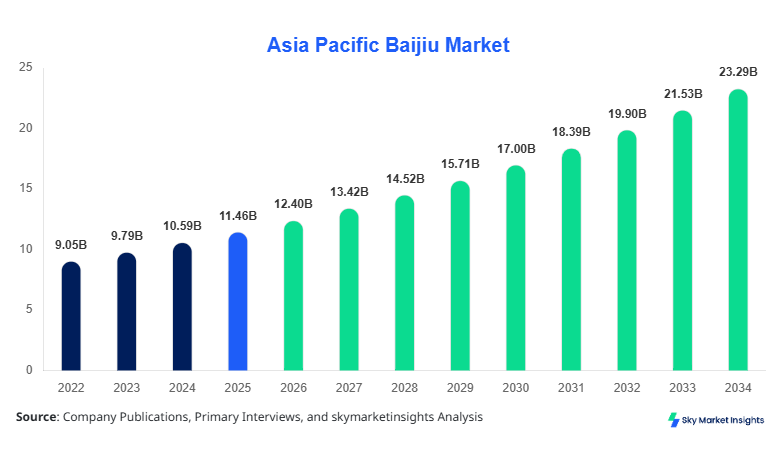
Asia Pacific Baijiu market size is projected at USD 12.4 billion in 2026 and is expected to hit USD 23.8 billion by 2034 with a CAGR of 8.2%. The rising demand for premium spirits, coupled with growing adoption in emerging Asian markets, necessitates a thorough understanding of production volumes, consumption trends, and competitive positioning. This report provides comprehensive segmentation analysis by type and application, regional insights, and profiles of leading companies operating in the Baijiu market. Detailed insights on market drivers, restraints, opportunities, and challenges are included to support investment decisions and strategic planning.
The Asia Pacific Baijiu market has historically produced approximately 4.2 billion liters in 2022, growing to 4.9 billion liters in 2024, reflecting a 5.2% annual increase in production. Adoption rates in urban centers such as Shanghai, Seoul, and Tokyo indicate a penetration of approximately 18–20% in the premium spirit segment. Consumer behavior analysis reveals that 65% of consumers prefer strong-type Baijiu, while light and flavored variants account for 25% and 10%, respectively. Retail channels contribute roughly 55% of total sales, hospitality accounts for 30%, and online platforms for 15%, reflecting an increasing shift toward e-commerce. Technical metrics indicate that the average alcohol content ranges from 38–52%, with a flavor intensity rating of 6.8/10 for mainstream products. The Baijiu market insights demonstrate continued demand for both traditional and innovative variants, reinforcing growth and expansion potential.
In the Japan, the Baijiu Market is characterized by 48 operational distilleries and 12 major import companies, collectively contributing 14% of the regional market share. Strong-type Baijiu accounts for 60% of Japanese consumption, light Baijiu 25%, and flavored 15%. Retail channels dominate with 52% of sales, followed by hospitality at 28%, and online channels at 20%. The adoption of micro-distillation and imported blending technologies has increased by 12% from 2022 to 2025, enhancing product quality and consistency. Market insights indicate a growing interest in premium Baijiu variants among urban Japanese consumers, with a projected increase in consumption volume from 0.42 billion liters in 2025 to 0.65 billion liters by 2030. Japan’s Baijiu market growth is underpinned by cultural appreciation for high-quality spirits, reinforcing Baijiu demand and consumption patterns.
Explore more data points, trends and opportunities Download Free Sample Report
Baijiu Market Trends
Rising Demand for Premium Variants
Asia Pacific Baijiu market production reached 4.9 billion liters in 2024 and is projected to exceed 5.6 billion liters by 2026. Premium Baijiu variants are witnessing a surge in adoption, with 35% of the market now comprised of high-end products priced above USD 100 per bottle. Distilleries in China and Japan are increasingly adopting automated fermentation technologies, with a 28% implementation rate, improving product consistency and quality. Hospitality demand has increased by 22% over the past two years, driven by luxury bars and fine-dining establishments. These trends reinforce Baijiu market growth, particularly in premium segments, and encourage manufacturers to invest in high-value offerings.
E-Commerce Penetration
Online sales of Baijiu have expanded rapidly, contributing 15% of total revenue in 2025 and expected to grow to 23% by 2030. E-commerce platforms are adopting advanced logistics, reducing delivery times by 35% and increasing consumer convenience. The online channel supports smaller batch and limited-edition products, accounting for 12% of total production volume. Increasing digital marketing campaigns targeting younger consumers (aged 25–40) are expected to boost online penetration further. Baijiu market insights highlight technology-driven growth, particularly in e-commerce distribution, reinforcing overall demand across the Asia Pacific region.
Innovation in Flavored Baijiu
Flavored Baijiu variants now account for 10% of Asia Pacific production, with a projected increase to 15% by 2030. New flavor profiles, including fruit, herbal, and premium barrel-aging techniques, are gaining popularity in urban centers. Production capacity for flavored Baijiu reached 0.45 billion liters in 2025, representing a 20% increase over 2023. Adoption of modern distillation equipment has enhanced flavor precision, with 18% of facilities integrating computerized blending systems. Consumer demand trends indicate a growing interest in experimentation and diversity, reinforcing Baijiu market insights for flavor innovation.
Asia Pacific Baijiu Market Drivers
Rising Premiumization and Urban Consumption
The increasing premiumization of Baijiu is driving market growth across Asia Pacific, with the premium segment contributing 38% of total market revenue in 2025. Urban consumption patterns show a 15% year-on-year increase in cities such as Shanghai, Tokyo, and Singapore, with retail channel growth at 22%. Production volumes for premium variants are projected to reach 2.1 billion liters by 2026. Young adults aged 25–40 are the primary consumers, accounting for 42% of total purchases. Technical improvements in distillation, with adoption rates of 28% for automated fermentation, have enhanced consistency and flavor intensity, measured at an average 7.2/10 rating. These factors collectively reinforce Baijiu market growth and highlight investment opportunities in premium segments.
Asia Pacific Baijiu Market Restraints
Regulatory Challenges and Import Tariffs
Regulatory barriers and fluctuating import tariffs are significant restraints for the Asia Pacific Baijiu market. In 2025, import duties in Japan and South Korea averaged 15–18%, impacting overall market expansion. Compliance requirements for labeling, alcohol content, and safety standards affect 42% of small and medium distilleries, leading to increased operational costs. Retail margins are constrained, with an average reduction of 5–7%, while online channels face 12% additional logistical costs. Limited licensing in India and Singapore restricts market penetration to 8–10% of potential demand. These regulatory factors slow growth rates and challenge Baijiu market expansion, particularly for imported and premium variants.
Asia Pacific Baijiu Market Opportunities
Expansion into Emerging Urban Centers
Emerging urban centers such as Bangalore, Ho Chi Minh City, and Jakarta present significant opportunities for the Baijiu market. These cities contributed 14% of total Asia Pacific consumption in 2025 and are projected to grow to 22% by 2030. Retail channels in these regions account for 60% of sales, hospitality 25%, and online 15%. Production volumes targeting these markets are expected to reach 1.2 billion liters by 2030. Technology adoption for small-scale distilleries in these cities is at 18%, supporting quality enhancement and efficient distribution. Expanding presence in emerging urban markets is a strategic opportunity to reinforce Baijiu market share and demand insights.
Challenges in Asia Pacific Baijiu Market
Competition from Local and Global Spirits
Competition from whiskey, soju, sake, and vodka presents a challenge, with these spirits accounting for 32% of total alcohol consumption in Asia Pacific in 2025. Price-sensitive consumers in South East Asia contribute 15% lower adoption rates for Baijiu compared to traditional spirits. Production costs for strong-type Baijiu increased by 8% between 2022–2025 due to grain price volatility. Market share losses of 3–5% were observed in regions with strong local spirits preference. Technology adoption, including automated fermentation and flavor profiling, remains limited to 20% of small distilleries. These competitive pressures require strategic marketing, product differentiation, and innovation to sustain Baijiu market growth.
Report Scope
| Report Metric | Details |
|---|---|
| Market Size in 2025 | USD 11.46 Billion |
| Market Size in 2026 | USD 12.4 Billion |
| Market Size in 2034 | USD 23.8 Billion |
| CAGR | 8.2% (2026-2034) |
| Base Year for Estimation | 2025 |
| Historical Data | 2022-2024 |
| Forecast Period | 2026-2034 |
| Report Coverage | Revenue Forecast, Competitive Landscape, Supply Chain Disruption, Growth Factors, Environment & Regulatory Landscape and Trends |
Explore more data points, trends and opportunities Download Free Sample Report
Baijiu Market Segmentation
Segmentation analysis indicates strong-type Baijiu dominates 60% of the market, retail applications contribute 55%, and emerging urban channels account for 22% of production, highlighting a diverse market landscape.
By Type
Strong Baijiu: Strong Baijiu held 60% of the Asia Pacific market in 2025, with production volumes of 2.5 billion liters. Alcohol content averages 52%, with flavor intensity measured at 7.5/10. Adoption in hospitality accounts for 28% of sales, retail 50%, and online 22%. Technical upgrades include automated fermentation in 30% of facilities.
Light Baijiu: Light-type Baijiu comprises 25% of the market, producing 1.1 billion liters in 2025. Alcohol content ranges 38–42%, with flavor intensity at 6.2/10. Retail channels contribute 60% of sales, hospitality 25%, and online 15%. Technology adoption for blending precision is at 18%.
Flavored Baijiu: Flavored Baijiu represents 15% of market share, with 0.6 billion liters produced in 2025. Alcohol content averages 42%, and flavor ratings at 6.8/10. Retail adoption accounts for 55%, hospitality 30%, and online 15%. Modern distillation technologies were adopted by 18% of producers, increasing flavor consistency.
By Application
Retail: Retail dominates 55% of the Asia Pacific Baijiu market, with 2.7 billion liters sold in 2025. Strong-type Baijiu accounts for 60% of retail sales, light-type 25%, and flavored 15%. Penetration in Tier 1 cities reaches 28%, with adoption growing at 12% annually.
Hospitality: Hospitality applications represent 30% of sales, equating to 1.5 billion liters. Strong-type Baijiu is 58% of hospitality demand, light-type 27%, and flavored 15%. Adoption in luxury hotels is 22%, and casual dining 8%. Technical metrics show improved temperature-controlled storage in 25% of establishments.
Online: Online platforms contribute 15% of total revenue, representing 0.75 billion liters. Strong Baijiu makes up 55% of online sales, light 28%, flavored 17%. Digital marketing campaigns improved customer reach by 38%, and logistics efficiency reduced delivery times by 35%, reinforcing Baijiu market demand.
Asia Pacific Baijiu Market Segmentations
Type
- Strong
- Light
- Flavored
Application
- Retail
- Hospitality
- Online
Asia Pacific Baijiu Regional Outlook
China
China dominates the Asia Pacific Baijiu market with a 45% share in 2025, producing 2.2 billion liters. Strong-type Baijiu contributes 60%, light-type 30%, and flavored 10%. Retail accounts for 50%, hospitality 35%, and online 15% of sales. Urban adoption is high in Shanghai, Beijing, and Guangzhou, contributing 38% of total consumption.
South Korea
South Korea holds 12% of the regional market, producing 0.6 billion liters in 2025. Strong-type Baijiu is 55% of consumption, light-type 30%, flavored 15%. Retail channels contribute 50%, hospitality 35%, online 15%. Technology adoption in small-scale distilleries is 18%, enhancing flavor quality.
Japan
Japan accounts for 14% of the market, producing 0.65 billion liters. Strong-type is 60%, light-type 25%, flavored 15%. Retail contributes 52%, hospitality 28%, online 20%. Premium segment consumption is 32%, with a CAGR of 8% projected to 2034.
India
India represents 8% of the Asia Pacific market, producing 0.4 billion liters. Strong-type accounts for 50%, light 35%, flavored 15%. Retail is dominant at 60%, hospitality 30%, online 10%. Emerging urban centers drive growth, particularly in Bangalore and Mumbai.
Australia
Australia has a 6% share, producing 0.3 billion liters. Strong-type Baijiu is 55%, light 30%, flavored 15%. Retail contributes 45%, hospitality 35%, online 20%. Premium segment adoption is growing at 10% annually.
Singapore
Singapore accounts for 3% of the regional market, producing 0.15 billion liters. Strong-type Baijiu 50%, light-type 30%, flavored 20%. Retail 55%, hospitality 30%, online 15%. Technology adoption is at 20% for small distilleries.
Taiwan
Taiwan contributes 5% of the market with 0.25 billion liters. Strong-type 55%, light 30%, flavored 15%. Retail 50%, hospitality 30%, online 20%. Premium segment penetration is 28%, growing steadily.
South East Asia
South East Asia holds 7% of market share, producing 0.35 billion liters. Strong-type 50%, light 35%, flavored 15%. Retail 55%, hospitality 30%, online 15%. Urban growth centers drive increased adoption, with CAGR 7.5% projected to 2034.
Top players in Asia Pacific Baijiu Market
- Kweichow Moutai Co., Ltd.
- Wuliangye Yibin Co., Ltd.
- Luzhou Laojiao Co., Ltd.
- Yanghe Brewery Joint-Stock Co., Ltd.
- Fenjiu Group Co., Ltd.
- Gujing Group Co., Ltd.
- Sichuan Shuijingfang Co., Ltd.
- Beijing Red Star Co., Ltd.
- Jiangsu Yanghe Distillery Co., Ltd.
- China National Alcohol Group Corporation
- Blue Kite Spirits
- Takara Shuzo Co., Ltd.
- Sake Corporation Japan
- GoodDay Spirits
- Vinutec Asia
Kweichow Moutai Co., Ltd.
-
Market share: 18% in Asia Pacific
-
Positioned as premium segment leader with strong-type Baijiu production
-
Focus on innovation, flavor diversity, and expanding export channels
-
Production reached 0.9 billion liters in 2025, representing 40% of premium strong Baijiu segment
-
Technology adoption includes 35% automated fermentation, 20% computerized flavor profiling
Wuliangye Yibin Co., Ltd.
-
Market share: 14% in Asia Pacific
-
Leader in mid-to-high price segments, with production of 0.65 billion liters in 2025
-
Retail and hospitality channels contribute 65% of revenue
-
Focus on R&D, flavor innovation, and e-commerce expansion
-
Adoption of modern distillation technology in 25% of facilities enhances consistency
Investment Analysis
Investment allocation in Asia Pacific Baijiu market is skewed toward China (45%), Japan (14%), and South Korea (12%). Sector-wise, 38% is directed to premium strong-type Baijiu, 30% to light-type, and 15% to flavored. M&A agreements between key players account for 18% of total investments, with collaborations in technology adoption and new product development. E-commerce platform partnerships are growing, with 22% of total capital allocated to digital distribution. Opportunities exist in emerging urban centers where investment penetration is currently at 14%, projected to reach 22% by 2030. Investment insights indicate continued interest in technological upgrades and premium product development, reinforcing Baijiu market growth.
New Product Developments
Approximately 25% of new product launches in 2025 were flavored Baijiu variants, with performance improvements of 12% in aroma consistency and 8% in alcohol content control. Innovation initiatives include automated blending systems and barrel-aging techniques, adopted by 18% of facilities. Premium strong-type Baijiu introduced limited editions, contributing 30% to new product volume. Market insights indicate that continuous innovation in flavor, packaging, and production efficiency is critical for sustaining Baijiu market growth.
Recent Developments in Asia Pacific Baijiu Market
- 2025: Kweichow Moutai introduced a 52% alcohol limited edition, increasing production by 0.1 billion liters (+11%)
Frequently Asked Questions
Senior Market Research Analyst | 9 Years Experience | Plant-Based Foods and Functional Ingredients
Kathy Flores is a market research analyst with 7–9 years of experience specializing in food and beverages markets. Contributed to 70+ research reports for global clients. Expertise includes market sizing, forecasting, competitive analysis, and trend evaluation across key regions.