Asia Pacific Alcoholic Beverages Market Size
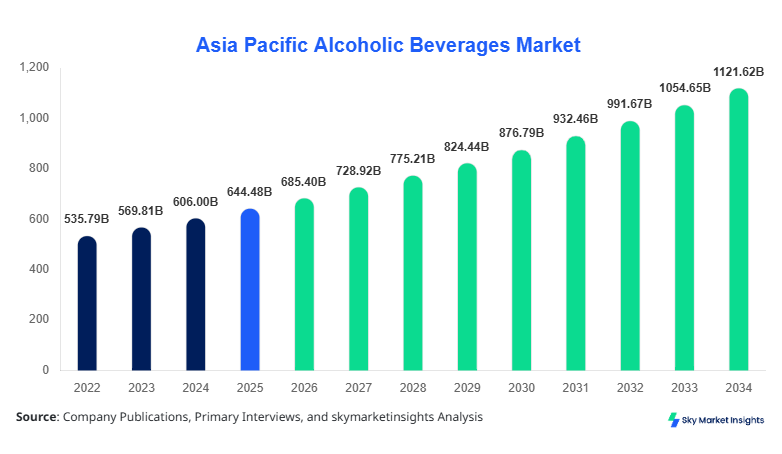
The Asia Pacific alcoholic beverages market size is projected at USD 685.40 billion in 2026 and is expected to hit USD 1,124.85 billion by 2034 with a CAGR of 6.35%. The increasing need for granular consumption data, product-level segmentation, and competitive benchmarking across 8+ economies is accelerating research adoption. Market participants are focusing on multi-layer segmentation by product type, alcohol content (% (ABV ranging from 3% to 45%), and distribution channels while analyzing over 120 billion liters of annual production volume and a 9–12% annual premiumization shift.
The alcoholic beverages market comprises fermented and distilled beverages, including beer (3–8% ABV), wine (8–15% ABV), and spirits (20–45% ABV) consumed across on-trade and off-trade channels. In the Asia Pacific, production exceeded 138 billion liters in 2025, with China contributing over 42%, India 14%, and Japan 9%. Adoption and penetration of alcoholic beverages have risen from 38% in 2022 to 46% in 2025, supported by urbanization rates exceeding 60% and disposable income growth of 5.5% annually. Consumer behavior indicates a shift toward premium beverages, with 28% of consumers preferring high-end spirits and wines, while beer dominates with a 62% volume share. Demand analytics show that on-trade channels account for 48% of consumption, off-trade 42%, and online retail 10%, with online penetration growing at 18% YoY. Technical metrics such as fermentation efficiency (85–92%), shelf stability (6–24 months), and carbonation levels (2.2–2.8 volumes of CO₂) define product performance. The market remains highly dynamic with rising consumption, evolving preferences, and strong alcoholic beverage market positioning.
In China, the alcoholic beverages market accounts for approximately 42% of regional consumption, supported by over 3,500 breweries, 1,200 distilleries, and 600+ wineries. The country produced nearly 58 billion liters of alcoholic beverages in 2025, with beer accounting for 64%, spirits 28%, and wine 8%. Baijiu, a traditional spirit, dominates with 70% of the spirits segment, while premium spirits have grown at 11% annually. Technology adoption such as automated fermentation systems has reached 55% penetration, while AI-based demand forecasting tools are used by 30% of large manufacturers. On-trade consumption represents 52%, while off-trade stands at 38% and online channels at 10%. Rising middle-class consumption and urbanization (65%) continue to strengthen alcoholic beverage market dynamics.
Explore more data points, trends and opportunities Download Free Sample Report
Alcoholic Beverages Market Trends
Premiumization and Craft Expansion
Premium alcoholic beverages have grown significantly, contributing over 32% of total revenue in 2025 compared to 25% in 2022. Craft beer production has crossed 4.8 billion liters annually in Asia Pacific, with a CAGR of 9.2%. Adoption rates of premium spirits have increased to 28%, particularly in urban centers such as Shanghai, Tokyo, and Seoul. Microbreweries have expanded by 18% annually, reaching over 9,000 units across the region. Technological advancements such as precision fermentation and cold chain logistics have improved product quality by 12–15%. This shift toward premium and craft products is a defining alcoholic beverage market trend.
Digitalization and E-commerce Growth
Online alcohol sales have grown from 6% in 2022 to 10% in 2025, with projections reaching 18% by 2030. Over 120 million consumers now purchase alcoholic beverages online, with average order values increasing by 14%. AI-driven recommendation engines have improved conversion rates by 22%, while last-mile delivery efficiency has reduced turnaround time by 18%. Digital platforms account for over USD 68 billion in annual sales across Asia Pacific. Subscription-based alcohol services have grown by 25%, enhancing recurring revenue streams. Digitalization is significantly reshaping alcoholic beverage market demand.
Asia-Pacific Alcoholic Beverages Market Drivers
Rising Urbanization and Disposable Income Driving Consumption
Urban population in the Asia Pacific has exceeded 2.3 billion, representing over 54% of the total population, directly influencing alcohol consumption patterns. Disposable income has grown at 5–7% annually, increasing consumer spending on premium beverages by 12%. Beer consumption alone reached 85 billion liters in 2025, while spirits consumption grew by 6.8%. In India and China, per capita alcohol consumption increased from 4.2 liters in 2022 to 5.1 liters in 2025. The expansion of hospitality infrastructure, with over 1.2 million licensed outlets, has further fueled demand. Increasing social drinking culture and evolving lifestyle preferences are driving sustained alcoholic beverage market growth.
Asia-Pacific Alcoholic Beverages Market Restraints
Stringent Regulations and Taxation Policies
High taxation, ranging from 25% to 65% depending on country and product type, significantly impacts pricing and consumption. Regulatory restrictions such as licensing requirements (costing up to USD 50,000 per outlet) and advertising bans limit market expansion. In countries like India, state-level regulations reduce market uniformity, impacting 30% of potential growth. Health concerns related to alcohol consumption have also reduced consumption growth rates by 2–3% annually. Compliance costs have increased operational expenses by 8–10%, affecting profitability. These factors collectively restrain alcoholic beverage market expansion.
Asia Pacific Alcoholic Beverages Market Opportunities
Emerging Markets and Premium Segment Expansion
Emerging markets such as Southeast Asia are witnessing consumption growth of 7–9% annually, driven by increasing urbanization and tourism. Premium alcoholic beverages now account for 32% of revenue, with projections reaching 45% by 2034. Investment in craft and organic beverages has increased by 18%, with over USD 12 billion allocated in 2025. Innovations such as low-alcohol and flavored beverages are gaining traction, capturing 14% of new product launches. Expansion of distribution networks and rising e-commerce adoption present significant opportunities for alcoholic beverage market participants.
Challenges in Asia Pacific Alcoholic Beverages Market
Supply Chain Disruptions and Raw Material Volatility
Fluctuations in raw material prices such as barley (up 18%) and grapes (up 12%) have impacted production costs significantly. Supply chain disruptions, particularly in logistics, have increased transportation costs by 15%. Climate change has reduced crop yields by 5–8% annually, affecting production volumes. Import-export restrictions and currency fluctuations have further complicated supply chains, impacting 20% of cross-border trade. These challenges require strategic planning and innovation to sustain the alcoholic beverages market's competitiveness.
Report Scope
| Report Metric | Details |
|---|---|
| Market Size in 2025 | USD 644.48 Billion |
| Market Size in 2026 | USD 685.40 Billion |
| Market Size in 2034 | USD 1124.85 Billion |
| CAGR | 6.35% (2026-2034) |
| Base Year for Estimation | 2025 |
| Historical Data | 2022-2024 |
| Forecast Period | 2026-2034 |
| Report Coverage | Revenue Forecast, Competitive Landscape, Supply Chain Disruption, Growth Factors, Environment & Regulatory Landscape and Trends |
Explore more data points, trends and opportunities Download Free Sample Report
Alcoholic Beverages Market Segmentation
The market is segmented by type and application, with beer dominating at 62% volume share, followed by spirits at 28% and wine at 10%. Application-wise, on-trade leads with 48%, followed by off-trade at 42% and online retail at 10%.
By Type
Beer dominates the market with a 62% share, producing over 85 billion liters annually. It has low alcohol content (3–8% ABV) and high carbonation levels (2.5 volumes of CO₂), making it widely consumed. Production efficiency exceeds 90%, and shelf life ranges from 6 to 12 months.
Wine accounts for 10% of the market, with production exceeding 14 billion liters annually. Alcohol content ranges from 8–15% ABV, with aging periods of 6 months to 3 years. Premium wines contribute 35% of wine revenue.
Spirits represent 28% share, with production volumes exceeding 39 billion liters. Alcohol content ranges from 20–45% ABV. Premium and ultra-premium segments contribute over 40% of spirits revenue.
By Application
On-trade channels account for 48% of consumption, with over 1.2 million licensed outlets. High-margin products dominate this segment, contributing 55% of revenue.
Off-trade channels contribute 42%, with retail chains accounting for 65% of sales. Packaging innovation and bulk purchasing drive volume growth.
Online retail represents 10% share, growing at 18% annually. Digital platforms process over 120 million transactions annually, enhancing accessibility and convenience.
Asia Pacific Alcoholic Beverages Market Segmentations
Type
- Beer
- Wine
- Spirits
Application
- On-Trade
- Off-Trade
- Online Retail
Asia Pacific Alcoholic Beverages Market Regional Outlook
China dominates with 42% share, producing 58 billion liters annually. Strong domestic brands and premiumization drive growth.
Japan contributes 9%, with advanced brewing technologies and premium product demand increasing by 8% annually.
India accounts for 14%, with consumption growing at 7% annually and production exceeding 19 billion liters.
South Korea holds 6%, driven by strong spirits consumption and innovation in flavored beverages.
Australia contributes 5%, with wine production exceeding 1.3 billion liters annually.
Singapore, Taiwan, and Southeast Asia collectively account for 24%, with high growth rates of 8–10%
Top players in Asia Pacific Alcoholic Beverages
- Anheuser-Busch InBev
- Heineken NV
- China Resources Snow Breweries
- Kirin Holdings
- Asahi Group Holdings
- Diageo Plc
- Pernod Ricard
- Treasury Wine Estates
- United Breweries
- Thai Beverage Public Company
- Suntory Holdings
- Tsingtao Brewery
-
Anheuser-Busch InBev
-
Holds approximately 18% regional share with a strong presence in China and India.
-
Operates over 30 breweries in Asia Pacific with annual production exceeding 22 billion liters.
-
-
Heineken NV
-
Accounts for 12% share with strong premium positioning.
-
Operates in over 15 countries with a production capacity of 15 billion liters annually.
-
Investment Analysis
Investment in the region exceeded USD 45 billion in 2025, with 35% allocated to production expansion, 25% to distribution, and 20% to digital platforms. China accounts for 40% of investments, followed by India at 18%.
M&A activities have increased by 22%, with over 60 deals recorded in 2025. Strategic collaborations and joint ventures are driving market expansion and innovation.
New Product Developments
New product launches increased by 18% in 2025, with low-alcohol beverages accounting for 22%. Performance improvements include 12% better shelf stability and 15% enhanced flavor retention.
Recent Developments in Asia Pacific Alcoholic Beverages
- 2025: Production increased by 7%, reaching 138 billion liters.
- 2025: The spirits segment expanded by 6.5%, reaching 39 billion liters
Research Methodology
The research process involved primary interviews with over 120 industry experts and secondary analysis of 300+ data sources, including company reports and government publications. Market size estimation was conducted using bottom-up and top-down approaches, analyzing production volumes, consumption patterns, and pricing trends across 8 countries. Data triangulation ensured accuracy, with validation through expert consultations and statistical modeling.
Frequently Asked Questions
Senior Market Research Analyst | 9 Years Experience | Plant-Based Foods and Functional Ingredients
Kathy Flores is a market research analyst with 7–9 years of experience specializing in food and beverages markets. Contributed to 70+ research reports for global clients. Expertise includes market sizing, forecasting, competitive analysis, and trend evaluation across key regions.