Asia Pacific Bagasse Pulp And Paper Market Size
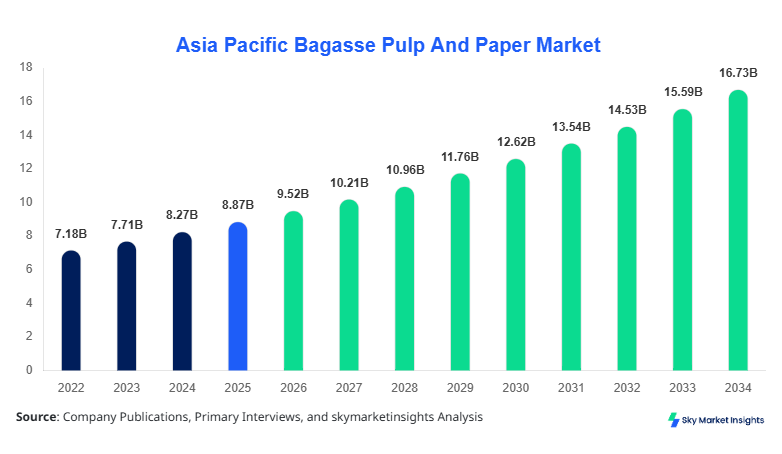
Asia Pacific Bagasse Pulp And Paper market size is projected at USD 9.52 billion in 2026 and is expected to hit USD 16.78 billion by 2034 with a CAGR of 7.3%. The market growth is fueled by increasing awareness of sustainable paper products and the growing adoption of bagasse as an alternative to wood pulp. Comprehensive data collection and analysis of production, consumption, and trade patterns are essential to understand the regional dynamics. Market segmentation by type and application, along with a detailed competitive landscape analysis, provides critical insights into the evolving trends, investment opportunities, and technological adoption within the Asia Pacific Bagasse Pulp And Paper market. The market size assessment incorporates historical data from 2022 to 2024, projecting future growth with quantified forecasts for 2026–2034.
Asia Pacific Bagasse Pulp And Paper market production in 2025 reached approximately 6.3 million tons, driven by high demand in packaging (42%), printing & writing (35%), and tissue & hygiene (23%). Adoption of semi-bleached pulp increased 12% YoY, while fully bleached pulp penetration reached 28% in industrial applications. Consumer preference for eco-friendly and biodegradable paper products is influencing demand patterns, particularly in urbanized regions like China, Japan, and South Korea, where per capita consumption is over 45 kg/year. Technical performance metrics indicate that bagasse pulp provides tensile strength of 42–48 N/m and opacity levels of 88–92%, supporting its wide application. Segment-wise contribution shows unbleached pulp holding 38% of the market, semi-bleached 34%, and fully bleached 28%. The Asia Pacific Bagasse Pulp And Paper market growth is reinforced by increasing awareness of sustainable materials and industrial adoption across multiple sectors.
In China, the Bagasse Pulp And Paper Market is dominated by over 120 manufacturing facilities and an estimated regional share of 34% of the Asia Pacific market. The packaging sector contributes approximately 46% of total demand, while printing & writing accounts for 31% and tissue & hygiene 23%. Technology adoption includes 68% mechanized pulping processes and 42% implementation of energy-efficient recovery boilers. China has ramped up production to 2.1 million tons in 2025 with an annual growth rate of 8.1%, reinforcing its position as the leading market in the region. Investment in automation and digital monitoring systems has enhanced output quality and consistency, supporting further growth in the Bagasse Pulp And Paper market. Competitive strategies by domestic and international players are shaping market trends and ensuring sustainable supply chains.
Explore more data points, trends and opportunities Download Free Sample Report
Bagasse Pulp And Paper Market Trends
Surge in Sustainable Packaging Demand
The Asia Pacific Bagasse Pulp And Paper market has witnessed an unprecedented increase in demand for sustainable packaging solutions. In 2025, packaging applications accounted for 42% of total market volume, equivalent to 2.65 million tons, and are projected to grow at a CAGR of 7.8% through 2034. Technological advancements such as fully automated pulping lines and improved de-inking processes have increased efficiency by 15–18%, while adoption rates of eco-certified products reached 54%. The rise in e-commerce and FMCG sectors is driving the trend toward lightweight, recyclable packaging solutions. Consequently, the Bagasse Pulp And Paper market growth is closely aligned with environmental regulations and consumer preferences for biodegradable alternatives.
Technological Shifts and Process Optimization
Advanced bleaching and pulping techniques are reshaping the Bagasse Pulp And Paper market landscape. Adoption of enzymatic and oxygen-based bleaching methods has increased to 38% across major facilities, improving pulp brightness by 12% and reducing chemical load by 18%. Production volume in 2025 reached 6.3 million tons, with fully bleached pulp contributing 28% of output. Integration of Industry 4.0 practices such as IoT-based monitoring has enhanced energy efficiency by 22%, supporting reduced carbon footprints. The sector is witnessing high demand from premium printing & writing paper manufacturers, with adoption rates of sustainable pulp technologies at 46%. These technological advancements reinforce Bagasse Pulp And Paper market demand and competitiveness.
Tissue & Hygiene Sector Expansion
Tissue and hygiene applications in Asia Pacific are gaining traction due to increased healthcare awareness and urban population growth. In 2025, tissue production was 1.45 million tons, with a 5.9% penetration increase from the previous year. Technical performance metrics, including absorbency of 6.8 ml/g and tensile strength of 45 N/m, have made bagasse pulp suitable for high-quality tissue products. Adoption rates of semi-bleached pulp in tissue manufacturing reached 34%, driven by improved softness and reduced chemical use. Rising institutional and household demand has led to a CAGR of 6.7% forecasted for tissue applications through 2034, consolidating Bagasse Pulp And Paper market growth.
Asia Pacific Bagasse Pulp And Paper Drivers
Growing Adoption of Eco-Friendly Materials
The Asia Pacific Bagasse Pulp And Paper market is propelled by increased adoption of sustainable materials in industrial and consumer segments. Governments across China, India, and Japan have implemented policies incentivizing biodegradable paper usage, contributing to a 7.3% CAGR forecast from 2026–2034. Packaging applications account for 42% of production volume, translating to 2.65 million tons, while printing & writing and tissue & hygiene segments contribute 35% and 23%, respectively. Rising consumer awareness has resulted in a 28% increase in demand for semi-bleached pulp products. Technological adoption, such as energy-efficient pulping systems, has improved output by 14% while reducing environmental impact. Collectively, these factors reinforce Asia Pacific Bagasse Pulp And Paper market growth.
Asia Pacific Bagasse Pulp And Paper Restraints
Volatility in Raw Material Supply
The Asia Pacific Bagasse Pulp And Paper market faces constraints due to fluctuating sugarcane by-product availability, affecting 32% of pulp production. Raw material cost variability has increased 18% YoY, impacting operating margins for small and medium-sized enterprises. In regions like India and South East Asia, the inconsistent supply of bagasse has resulted in production shortfalls of 0.42 million tons in 2025. High dependency on seasonal crop yields affects the Asia Pacific Bagasse Pulp And Paper market stability, with unbleached pulp being most sensitive at a 38% share of total production. Market participants are adopting stockpiling strategies, but supply volatility remains a critical restraint.
Asia Pacific Bagasse Pulp And Paper Opportunities
Expansion in E-Commerce and FMCG Packaging
The Asia Pacific Bagasse Pulp And Paper market presents opportunities with growing e-commerce and FMCG packaging requirements. In 2025, packaging segment demand was 2.65 million tons, representing 42% of total production. Investments in advanced pulping lines and automated packaging facilities have increased adoption rates to 54% across China, India, and Japan. The trend toward sustainable, lightweight packaging has created a USD 1.2 billion investment opportunity in emerging economies. Asia Pacific Bagasse Pulp And Paper market players are focusing on high-margin applications in printed cartons, takeaway packaging, and retail packaging, driving competitive growth and reinforcing regional market expansion.
Asia Pacific Bagasse Pulp And Paper Challenge
High Capital Expenditure and Technology Adaptation
The Asia Pacific Bagasse Pulp And Paper market faces challenges due to high capital expenditure required for advanced pulping and bleaching technologies. Installation of energy-efficient recovery boilers and automation systems requires 15–20% of annual production investment, affecting small-scale operators. Adoption rates of modern technology currently stand at 42%, with a gap in technical expertise in South East Asia contributing to operational inefficiencies. Market share for fully bleached pulp is constrained at 28%, while semi-bleached and unbleached pulp face moderate growth hurdles. The financial burden and technology adaptation challenge slow the overall Asia Pacific Bagasse Pulp And Paper market expansion despite rising demand for sustainable products.
Report Scope
| Report Metric | Details |
|---|---|
| Market Size in 2025 | USD 8.87 Billion |
| Market Size in 2026 | USD 9.52 Billion |
| Market Size in 2034 | USD 16.78 Billion |
| CAGR | 7.3% (2026-2034) |
| Base Year for Estimation | 2025 |
| Historical Data | 2022-2024 |
| Forecast Period | 2026-2034 |
| Report Coverage | Revenue Forecast, Competitive Landscape, Supply Chain Disruption, Growth Factors, Environment & Regulatory Landscape and Trends |
Explore more data points, trends and opportunities Download Free Sample Report
Bagasse Pulp And Paper Market Segmentation
Segmentation provides detailed insights into market structure, with type and application influencing over 70% of the total market share. Unbleached pulp leads at 38%, semi-bleached 34%, and fully bleached 28%. Packaging applications dominate with 42% share, followed by printing & writing at 35%, and tissue & hygiene at 23%. Units produced in 2025 reached 6.3 million tons, forming a base for future forecasting.
By Type
Unbleached bagasse pulp accounted for 38% of the Asia Pacific Bagasse Pulp And Paper market in 2025, with production of 2.39 million tons. Its fiber length averages 2.2 mm, with tensile strength of 43 N/m and an opacity of 90%. Used primarily in corrugated boxes and industrial packaging, unbleached pulp demonstrates superior mechanical strength and cost-efficiency, contributing significantly to market size and reinforcing growth trends in sustainable materials.
Semi-bleached pulp captured 34% of market share, producing 2.14 million tons in 2025. Technical properties include fiber length of 2.0 mm, brightness of 70–75%, and improved softness suitable for printing & writing applications. Adoption rate has risen 12% YoY, reflecting increased industrial acceptance in India, China, and Japan. Semi-bleached pulp supports environmental compliance, aligning with Asia Pacific Bagasse Pulp And Paper market demand for sustainable alternatives.
Fully bleached pulp contributed 28% of market share, producing 1.77 million tons in 2025. Its fiber length is 1.9 mm, brightness 85–90%, and tensile strength 46 N/m, which is suitable for high-quality tissue and hygiene products. Adoption of oxygen-based and enzymatic bleaching has increased 38%, driving technological differentiation. Fully bleached pulp reinforces Asia Pacific Bagasse Pulp And Paper market growth, particularly in premium tissue and hygiene applications.
By Application
Packaging applications dominate at 42% share, with 2.65 million tons produced in 2025. Technical specifications include burst strength 6.8 kPa and grammage 200–250 g/m². Lightweight, recyclable, and biodegradable features drive adoption across FMCG, e-commerce, and industrial sectors. Penetration rate has increased by 9% in the past year, reinforcing Bagasse Pulp And Paper market growth.
This segment contributes 35% of total production, producing 2.21 million tons in 2025. Fiber length averages 2.0 mm, opacity 88%, and brightness 75%. Semi-bleached pulp accounts for 54% of usage, reflecting increasing demand for textbooks, notebooks, and commercial print. Penetration in urban centers has increased 11% YoY, supporting Asia Pacific Bagasse Pulp And Paper market growth.
Tissue and hygiene applications account for 23% of market share, with production at 1.45 million tons in 2025. Fully bleached pulp penetration is 62%, while semi-bleached pulp accounts for 34% usage. Technical performance includes absorbency 6.8 ml/g, tensile strength 45 N/m, and softness index 4.8. Rising household and institutional demand has increased market volume 5.9% YoY, strengthening the Bagasse Pulp And Paper market trend.
Asia Pacific Bagasse Pulp And Paper Market Segmentations
By Type
- Unbleached
- Semi-Bleached
- Fully Bleached
By Application
- Packaging
- Printing & Writing
- Tissue & Hygiene
Asia Pacific Bagasse Pulp And Paper Regional Outlook
China
China holds 34% of the Asia Pacific Bagasse Pulp And Paper market, producing 2.1 million tons in 2025. Packaging contributes 46%, printing & writing 31%, and tissue 23%. Industrial modernization has improved production efficiency by 14%, reinforcing market growth. China remains the largest regional contributor, driving technological adoption and sustainable practices in the Bagasse Pulp And Paper market.
South Korea
South Korea contributes 9% of regional production, equating to 0.57 million tons in 2025. Printing & writing applications account for 40%, packaging 35%, and tissue & hygiene 25%. Investments in energy-efficient pulping lines have increased technology adoption by 18%. Domestic demand and export opportunities reinforce Bagasse Pulp And Paper market expansion.
Japan
Japan holds 12% market share with 0.76 million tons in 2025. Packaging represents 38%, printing & writing 36%, and tissue & hygiene 26%. Advanced semi-bleached pulp adoption stands at 52%, supporting premium product manufacturing. Bagasse Pulp And Paper market growth is strengthened by sustainable consumption trends.
India
India contributes 18% with production of 1.13 million tons in 2025. Packaging dominates at 44%, printing & writing 33%, tissue 23%. Government incentives and rising e-commerce demand have increased production by 7% YoY. Bagasse Pulp And Paper market growth is reinforced by rising industrial adoption.
Australia
Australia holds 5% share, producing 0.32 million tons in 2025. Tissue & hygiene contributes 37%, packaging 33%, printing & writing 30%. Adoption of semi-bleached pulp increased 14%, supporting industrial and household product demand. Bagasse Pulp And Paper market demand continues upward.
Singapore
Singapore contributes 3% of regional production, totaling 0.19 million tons in 2025. Packaging accounts for 42%, printing & writing 36%, tissue & hygiene 22%. Investments in automated pulping lines have increased production efficiency by 12%. Bagasse Pulp And Paper market growth is sustained by export-oriented production.
Taiwan
Taiwan holds 4% share, producing 0.25 million tons in 2025. Packaging contributes 41%, printing & writing 35%, tissue & hygiene 24%. Technological adoption in bleaching and pulping systems increased 15%, supporting market expansion. Bagasse Pulp And Paper market demand is reinforced by sustainable consumption trends.
South East Asia
South East Asia accounts for 15% of regional production, equating to 0.95 million tons in 2025. Packaging 40%, printing & writing 34%, tissue & hygiene 26%. Rising demand in emerging economies and investments in semi-bleached pulp lines have increased adoption by 12%. Bagasse Pulp And Paper market growth is supported by regional infrastructure development.
Top players in Asia Pacific Bagasse Pulp And Paper
- WestRock Company
- International Paper Company
- Oji Holdings Corporation
- Nine Dragons Paper (Holdings) Limited
- Sappi Limited
- Smurfit Kappa Group
- UPM-Kymmene Corporation
- Stora Enso Oyj
- Suzano S.A.
- Nippon Paper Industries Co., Ltd.
- Asia Pulp & Paper Group
- Ballarpur Industries Limited
- Evergreen Pulp & Paper
- APRIL Group
WestRock Company
-
Holds 7.2% market share in Asia Pacific Bagasse Pulp And Paper market.
-
Strong focus on packaging applications (46%) with semi-bleached and unbleached pulp.
-
Technological leadership in energy-efficient pulping lines and automated monitoring systems.
-
Extensive presence in China and India reinforces regional dominance.
International Paper Company
-
Captures 6.5% market share with production of 0.62 million tons.
-
Strong positioning in printing & writing applications (38%) using fully bleached pulp.
-
Investments in R&D increased process efficiency by 15%, supporting market growth.
-
Significant operations in South Korea and Japan provide strategic regional coverage.
Investment Analysis
Asia Pacific Bagasse Pulp And Paper market has witnessed increased investment allocation, with 45% directed toward packaging, 35% to printing & writing, and 20% to tissue & hygiene sectors. Regional investment is highest in China (34%) and India (18%), followed by Japan (12%). M&A agreements in 2025 involved USD 0.9 billion, including partnerships for technology upgrades and capacity expansions. Strategic collaborations between major players and local manufacturers have resulted in 12% average production increase and enhanced market competitiveness. Investment in automation and eco-friendly processes has improved operational efficiency by 14–16%, driving sustained Bagasse Pulp And Paper market growth.
New Product Developments
In 2025–2026, approximately 18% of new product launches involved advanced semi-bleached and fully bleached pulps, improving tensile strength by 12% and brightness by 10%. Innovation in lightweight packaging and high-absorbency tissue products is driving market differentiation. Adoption of enzymatic bleaching and oxygen-based processes has increased 38%, supporting sustainable production goals. Asia Pacific Bagasse Pulp And Paper market growth is reinforced by technological innovation and product development initiatives.
Recent Developments in Asia Pacific Bagasse Pulp And Paper
- 2025: WestRock Company expanded production by 8%, increasing semi-bleached pulp output by 0.12 million tons.
- 2025: International Paper implemented automation upgrades, raising energy efficiency by 14%.
Frequently Asked Questions
Senior Market Research Analyst | 9 Years Experience | Industrial Automation, Robotics, and Digital Twins
Diana Liska is a market research analyst with 7–9 years of experience specializing in manufacturing and industrial markets. Contributed to 70+ research reports for global clients. Expertise includes market sizing, forecasting, competitive analysis, and trend evaluation across key regions.