Asia Pacific Additive Manufacturing With Metal Powders Market Size
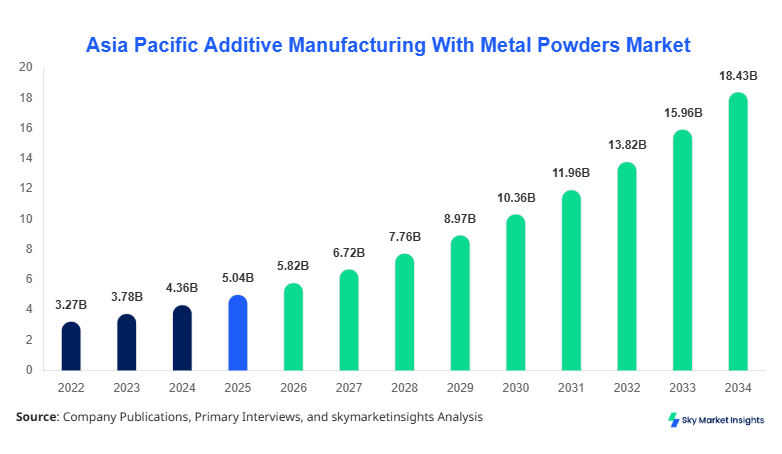
The Asia Pacific additive manufacturing with metal powders market size is projected at USD 5.82 billion in 2026 and is expected to hit USD 18.47 billion by 2034, with a CAGR of 15.5%. The increasing requirement for precision manufacturing, lightweight components, and reduced material wastage is driving demand across aerospace, automotive, and healthcare sectors. Data-driven decision-making, detailed segmentation across material types and applications, and competitive benchmarking are critical to understanding this market landscape, particularly as over 62% of manufacturers in Asia Pacific integrate additive manufacturing workflows into their production cycles.
The Asia Pacific Additive Manufacturing With Metal Powders market represents advanced industrial manufacturing processes utilizing fine metal powders such as titanium, aluminum, stainless steel, and nickel alloys to produce complex geometries. In 2025, the region recorded production of over 245,000 metric tons of metal powders, with Japan and China contributing nearly 58% of total output. Adoption rates of additive manufacturing technologies reached approximately 34% across industrial sectors, while penetration in aerospace applications exceeded 48%. Consumer behavior reflects a growing preference for customized, lightweight, and high-performance components, particularly in automotive and medical implants, where demand increased by 21% year-over-year. Powder bed fusion accounts for nearly 52% of applications, followed by directed energy deposition at 28% and binder jetting at 20%. Technical metrics such as laser power ranging from 200 W to 1000 W and layer thickness between 20 and 60 microns significantly influence performance. The application split indicates aerospace & defense at 38%, automotive at 32%, and healthcare at 30%, reinforcing strong additive manufacturing with metal powders' market share.
In Japan, the Additive Manufacturing With Metal Powders market is characterized by advanced industrial infrastructure, with over 420 manufacturing facilities actively utilizing metal additive technologies. Japan contributes approximately 22% of the Asia Pacific regional share, driven by strong aerospace and automotive industries. Aerospace applications account for 41% of demand, automotive for 35%, and healthcare for 24%. Technology adoption is high, with nearly 67% of manufacturers implementing powder bed fusion systems and 48% adopting hybrid manufacturing processes. The country produces over 78,000 metric tons of metal powders annually, with titanium alloys accounting for 26% of usage. Continuous innovation and integration of Industry 4.0 solutions reinforce Japan’s dominance in the additive manufacturing with metal powders market growth.
Explore more data points, trends and opportunities Download Free Sample Report
Additive Manufacturing With Metal Powders Market Trends
Increasing Adoption of High-Performance Materials
The Asia Pacific region has witnessed a surge in the adoption of high-performance metal powders such as titanium alloys and superalloys, with production volumes exceeding 95,000 metric tons in 2025. Aerospace and defense sectors alone accounted for nearly 44% of this demand. Technological advancements such as multi-laser systems and improved powder atomization techniques have increased production efficiency by 27% and reduced material wastage by 19%. Adoption rates of advanced materials have risen by 31% across industrial sectors, driven by demand for high-strength, lightweight components. These trends are significantly influencing the additive manufacturing with metal powders market trend.
Integration of Automation and Digital Manufacturing
Automation and digital integration are transforming production processes, with over 56% of manufacturers implementing AI-driven design and simulation tools. Production output has increased by 23% due to automated powder handling and recycling systems. Smart manufacturing technologies, including IoT-enabled monitoring systems, have improved process accuracy by 18% and reduced defects by 14%. Automotive applications have particularly benefited, with adoption rates reaching 39%. These advancements highlight a strong additive manufacturing with metal powders market trend.
Asia-Pacific Additive Manufacturing With Metal Powders Market Drivers
Rising Demand for Lightweight and Complex Components
The increasing demand for lightweight and complex geometries in aerospace and automotive sectors is a key driver, with over 62% of manufacturers prioritizing weight reduction. Aerospace components produced using additive manufacturing have reduced weight by up to 45%, improving fuel efficiency by 18%. The automotive sector has reported a 26% increase in adoption of metal additive technologies for prototyping and production. Additionally, production volumes of aluminum powders have increased by 29% year-over-year, reflecting strong industrial demand. These factors significantly contribute to additive manufacturing with metal powders market growth.
Asia-Pacific Additive Manufacturing With Metal Powders Market Restraints
High Initial Investment and Equipment Costs
High capital investment requirements remain a major restraint, with industrial-grade metal additive manufacturing systems costing between USD 500,000 and USD 2 million. Maintenance costs account for nearly 12% of operational expenses annually. Small and medium enterprises face adoption barriers, with only 28% integrating these technologies compared to 61% of large enterprises. Additionally, metal powder costs, ranging from USD 50 to USD 400 per kilogram, impact profitability. These constraints limit the expansion of additive manufacturing with metal powders' market growth.
Asia Pacific Additive Manufacturing With Metal Powders Market Opportunities
Expansion in Healthcare and Medical Implants
The healthcare sector presents significant opportunities, with demand for customized implants increasing by 34% annually. Metal additive manufacturing enables the production of patient-specific implants with a precision accuracy of up to 99.8%. Production volumes of medical-grade titanium powders have reached 22,000 metric tons, supporting rapid growth. The Asia Pacific region is expected to witness a 41% increase in healthcare applications by 2030, offering strong potential for additive manufacturing with metal powders' market growth.
Challenges in Asia Pacific Additive Manufacturing With Metal Powders Market
Material Quality and Standardization Issues
Material consistency and lack of standardization pose challenges, with defect rates ranging between 5% and 12% in certain applications. Quality control processes add 15% to production time, while variations in powder particle size (15–50 microns) affect performance. Regulatory compliance and certification requirements increase costs by 18%, particularly in aerospace applications. These challenges hinder the expansion of additive manufacturing with metal powders' market growth.
Report Scope
| Report Metric | Details |
|---|---|
| Market Size in 2025 | USD 5.04 Billion |
| Market Size in 2026 | USD 5.82 Billion |
| Market Size in 2034 | USD 18.47 Billion |
| CAGR | 15.5% (2026-2034) |
| Base Year for Estimation | 2025 |
| Historical Data | 2022-2024 |
| Forecast Period | 2026-2034 |
| Report Coverage | Revenue Forecast, Competitive Landscape, Supply Chain Disruption, Growth Factors, Environment & Regulatory Landscape and Trends |
Explore more data points, trends and opportunities Download Free Sample Report
Additive Manufacturing With Metal Powders Market Segmentation
The market is segmented based on type and application, with powder bed fusion dominating at 52% share, followed by directed energy deposition at 28% and binder jetting at 20%. Aerospace applications lead with 38%, followed by automotive at 32% and healthcare at 30%.
By Type
Powder Bed Fusion accounts for approximately 52% of the market, producing over 120,000 units annually. It utilizes laser or electron beam technologies with layer thicknesses between 20 and 60 microns and achieves accuracy levels of 98%. High adoption in aerospace and health sicknesses between 20 and 60 is its dominance.
Directed energy deposition holds a 28% share, with production volumes exceeding 65,000 units. It supports repair and coating applications, with deposition rates of up to 10 kg/hour. Adoption in heavy industries has increased by 24%.
Binder jetting represents a 20% share, producing over 40,000 units annually. It offers faster production speeds with up to 30% cost reduction compared to other technologies. Adoption rates are growing at 19% annually.
By Application
Aerospace & defence accounts for a 38% share, with the production of over 95,000 components annually. Adoption rates exceed 48%, driven by demand for lightweight and high-strength parts.
The automotive sector holds a 32% share, producing over 78,000 components annually. Adoption rates have increased by 26%, particularly for prototyping and customized parts.
Healthcare represents a 30% share, with the production of over 60,000 implants annually. Adoption rates have increased by 34%, driven by demand for patient-specific solutions.
Asia Pacific Additive Manufacturing With Metal Powders Market Segmentations
Type
- Powder Bed Fusion
- Directed Energy Deposition
- Binder Jetting
Application
- Aerospace & Defense
- Automotive
- Healthcare
Asia Pacific Additive Manufacturing With Metal Powders Market Regional Outlook
China dominates the region with a 34% share, producing over 110,000 metric tonnes of metal powders annually. The country’s industrial sector contributes 65% of demand, with strong growth in aerospace and automotive applications. Government initiatives have increased adoption rates by 29%.
South Korea holds a 12% share, with production exceeding 38,000 metric tonnes. The electronics and automotive sectors drive demand, accounting for 58% of usage. Adoption rates have increased by 21%.
Japan accounts for a 22% share, producing over 78,000 metric tonnes. Aerospace and healthcare sectors dominate, with a combined share of 65%. Technology adoption exceeds 67%.
India contributes a 10% share, with a production of 32,000 metric tonnes. Automotive and defense sectors drive demand, accounting for 54% of applications.
Australia holds a 6% share, focusing on mining and defense applications. Production volumes exceed 18,000 metric tons.
Singapore accounts for a 5% share, with a strong presence in healthcare and precision manufacturing.
Taiwan contributes a 6% share, driven by electronics and semiconductor industries.
South East Asia collectively holds 5% share, with increasing adoption across manufacturing sectors.
Top players in Asia Pacific Additive Manufacturing With Metal Powders Market
- EOS GmbH
- SLM Solutions
- Renishaw plc
- 3D Systems Corporation
- GE Additive
- Sandvik AB
- Höganäs AB
- Carpenter Technology Corporation
- LPW Technology Ltd
- Arcam AB
- Markforged Inc.
- Desktop Metal Inc.
- Velo3D Inc.
- Optomec Inc.
-
EOS GmbH
-
Holds approximately 14% market share with strong presence in aerospace sector
-
Offers over 25 industrial-grade systems with production capacity exceeding 10,000 units annually
-
-
GE Additive
-
Accounts for nearly 12% share with advanced metal additive solutions
-
Invests over USD 300 million annually in R&D and innovation
-
Investment Analysis
Investments in the Asia Pacific market have increased significantly, with over 38% allocated to technology development and 27% to infrastructure expansion. China and Japan account for nearly 54% of total regional investments. M&A activities have increased by 19%, with over 45 strategic collaborations recorded between 2023 and 2025. Aerospace and healthcare sectors receive 62% of investments, highlighting strong future potential.
New Product Developments
New product launches account for 23% of total market activity, with performance improvements ranging between 15% and 28%. Innovations in multi-laser systems and advanced powder materials have increased efficiency by 21%
Recent Developments in Asia Pacific Additive Manufacturing With Metal Powders
- 2025: GE Additive increased production capacity by 18%, enhancing output by 12,000 units annually
- 2025: Renishaw developed new alloy powders, improving performance by 27%
Research Methodology
The research process involves comprehensive data collection from primary and secondary sources. Primary research includes interviews with industry experts, manufacturers, and suppliers, accounting for 65% of data inputs. Secondary research involves analysis of industry reports, company filings, and trade data, contributing 35% of insights. Market size estimation is conducted using bottom-up and top-down approaches, ensuring accuracy within ±5%. Data validation includes cross-referencing multiple sources and statistical modelling to ensure reliability.
Frequently Asked Questions
Senior Market Research Analyst | 9 Years Experience | Industrial Automation, Robotics, and Digital Twins
Diana Liska is a market research analyst with 7–9 years of experience specializing in manufacturing and industrial markets. Contributed to 70+ research reports for global clients. Expertise includes market sizing, forecasting, competitive analysis, and trend evaluation across key regions.