Europe Asbestos Testing Market Size
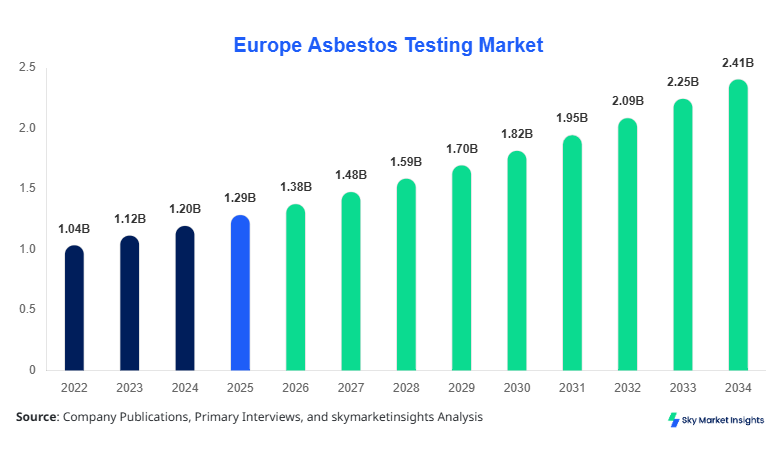
Europe Asbestos Testing market size is projected at USD 1.38 billion in 2026 and is expected to hit USD 2.41 billion by 2034 with a CAGR of 7.2%. The increasing regulatory scrutiny across Europe, rising renovation activities in aging infrastructure, and mandatory asbestos inspection policies are driving substantial industry expansion. More than 62% of testing contracts across Europe are associated with commercial renovation and demolition projects, while over 28 million buildings constructed before 1990 continue to require periodic asbestos inspections. The market landscape is becoming highly competitive due to advancements in airborne fiber detection technologies, laboratory automation systems, and government-funded remediation programs supporting long-term asbestos management across the region.
The asbestos testing industry refers to inspection, sampling, identification, and laboratory analysis services used to detect asbestos-containing materials in residential, industrial, and commercial environments. Europe recorded more than 5.8 million asbestos inspection procedures in 2025, with France, Germany, and the United Kingdom collectively accounting for nearly 58% of regional testing activities. Adoption rates for polarized light microscopy and transmission electron microscopy technologies exceeded 64% among certified laboratories, while portable air monitoring systems achieved 41% penetration across field inspection agencies. Consumer awareness regarding respiratory disorders linked to asbestos exposure increased by 33% between 2022 and 2025, leading to higher testing demand before renovation and demolition projects. Residential applications contributed approximately 36% of testing procedures, commercial buildings represented 42%, and industrial facilities accounted for 22% of total inspection volumes. The average air sample testing frequency across regulated industrial sites reached 3.8 tests per quarter, while laboratory turnaround times improved by 18% due to digital workflow automation. Increasing environmental compliance requirements and rising awareness regarding occupational health hazards continue to strengthen Europe Asbestos Testing market share across multiple end-use sectors.
Explore more data points, trends and opportunities Download Free Sample Report
Asbestos Testing Market Trends
Rising Adoption of Automated Air Monitoring Technologies
Automated asbestos air monitoring systems are rapidly transforming testing operations across Europe due to increasing workplace safety requirements and stricter airborne fiber exposure limits. In 2025, automated monitoring equipment installations increased by 31% across industrial and commercial sites, with more than 18,000 new units deployed throughout the region. Real-time fiber detection systems reduced laboratory confirmation delays by nearly 22%, enabling faster remediation decisions and improved project timelines. Demand from transportation infrastructure projects expanded significantly, particularly in railway modernization programs where asbestos-containing insulation materials remain prevalent. Germany and France collectively represented 46% of automated monitoring equipment procurement in Europe. Portable digital monitoring devices achieved detection sensitivities below 0.01 fibers per cubic centimeter, supporting compliance with updated occupational exposure regulations. The integration of cloud-based reporting systems also increased by 38%, enabling centralized data management for large-scale asbestos inspection contracts. Growing demand for digitalized compliance systems continues to accelerate Europe Asbestos Testing market trend.
Expansion of Renovation-Driven Testing Activities
Large-scale renovation and retrofitting projects across Europe are significantly increasing asbestos testing procedures, particularly in aging public infrastructure. More than 43% of Europe’s commercial buildings were constructed before 1985, creating substantial inspection requirements prior to modernization or demolition activities. In 2025, renovation-related asbestos sampling volumes surpassed 3.9 million tests, reflecting a 26% increase compared to 2023 levels. Public healthcare infrastructure projects accounted for approximately 18% of renovation-driven testing demand, while educational institutions contributed 14%. Spain and Italy recorded annual testing volume increases above 19% due to government-funded energy efficiency renovation programs. Laboratory processing capacities expanded by 24% across regional testing centers to accommodate growing demand from refurbishment projects. Fiber analysis using electron microscopy increased by 29% among high-risk industrial renovation sites where contamination risks remain elevated. Increasing renovation activities across aging infrastructure continue to strengthen Europe Asbestos Testing market demand.
Integration of AI-Based Laboratory Analysis
Artificial intelligence and machine learning technologies are increasingly integrated into asbestos analysis laboratories to improve testing accuracy and reduce manual inspection times. AI-supported microscopy systems enhanced sample analysis speeds by approximately 35% while lowering false-positive identification rates by 17%. Over 420 European laboratories adopted AI-assisted imaging systems during 2025, with the United Kingdom and Germany leading implementation rates. Automated image recognition software processed more than 11 million microscopic asbestos fiber images annually across Europe, significantly improving operational efficiency for high-volume testing facilities. Laboratory digitization investments exceeded USD 410 million regionally, with 48% allocated toward advanced analytical software and data automation platforms. AI-supported reporting tools reduced documentation processing times by 28%, allowing inspection agencies to accelerate regulatory compliance reporting. Rising investments in laboratory automation technologies continue to expand Europe Asbestos Testing market share.
Europe Asbestos Testing Drivers
Strict Regulatory Compliance and Occupational Safety Standards Driving Testing Volumes
The enforcement of stringent occupational exposure regulations and environmental safety laws remains a primary growth catalyst for asbestos testing activities across Europe. More than 78% of asbestos inspections in 2025 were directly linked to mandatory compliance requirements established by regional health authorities and labor protection agencies. The European Union strengthened asbestos exposure thresholds to below 0.01 fibers per cubic centimeter, compelling industrial facilities, demolition contractors, and commercial property owners to increase testing frequency by approximately 24% between 2023 and 2025. Over 6.8 million workers across Europe operate in construction, renovation, shipbuilding, and manufacturing environments where asbestos exposure risks remain significant. France, Germany, and the United Kingdom collectively allocated more than USD 8.3 billion toward occupational health and environmental compliance programs supporting asbestos inspection and remediation initiatives. Additionally, more than 1.1 million public buildings across Europe require recurring asbestos audits under revised safety mandates. Laboratory certifications complying with ISO analytical standards increased by 21% regionally, while portable sampling equipment sales grew by 32% in 2025. The growing focus on workplace safety and mandatory environmental monitoring continues to reinforce Europe Asbestos Testing market growth.
Europe Asbestos Testing Restraints
High Testing Costs and Limited Skilled Workforce Availability
Despite growing regulatory support, the industry faces operational limitations associated with high analytical costs and shortages of certified asbestos professionals. Advanced asbestos laboratory testing procedures using transmission electron microscopy can cost between USD 180 and USD 450 per sample, increasing inspection expenses for large-scale renovation and demolition projects. Small and medium-sized construction contractors across Europe reported a 19% rise in project compliance costs due to mandatory asbestos testing protocols introduced after 2023. Additionally, the shortage of licensed asbestos analysts and industrial hygienists continues to restrict operational capacity, particularly in Eastern and Southern Europe. More than 34% of laboratories surveyed in 2025 reported delays exceeding 5 business days due to insufficient technical staffing levels. Training certification programs expanded by only 11% annually despite inspection demand increasing by over 20% during the same period. Russia and Spain experienced the largest workforce shortages, with certified inspector availability remaining below recommended regulatory ratios. The increasing cost burden associated with laboratory upgrades, quality assurance programs, and regulatory certifications continues to restrain Europe Asbestos Testing market demand.
Europe Asbestos Testing Opportunities
Infrastructure Modernization and Green Building Renovation Programs
Massive infrastructure modernization initiatives across Europe are creating long-term opportunities for asbestos testing service providers. Government-backed renovation programs targeting energy-efficient retrofits exceeded USD 120 billion across the region in 2025, with nearly 47% of targeted buildings constructed before asbestos restrictions were implemented. Public transportation infrastructure, including railway stations, airports, and metro systems, generated more than 920,000 asbestos inspection procedures during the year. The United Kingdom alone allocated USD 9.4 billion toward school modernization projects requiring mandatory asbestos audits before renovation activities. Demand for soil contamination testing also increased by 21% due to urban redevelopment projects involving former industrial zones. Digital inspection platforms integrated with geographic information systems improved field reporting efficiency by 26%, creating opportunities for advanced compliance management services. Investments in laboratory automation, mobile testing units, and AI-assisted analytical systems are expected to further improve operational scalability. Increasing infrastructure redevelopment programs continue to create substantial Europe Asbestos Testing market opportunities.
Europe Asbestos Testing Challenge
Complex Regulatory Variations Across European Countries
The asbestos testing sector faces major operational challenges associated with varying national regulations, certification standards, and analytical protocols across European countries. While European Union occupational safety frameworks establish general compliance guidelines, each country maintains unique asbestos handling procedures, licensing structures, and reporting standards. More than 27% of multinational inspection agencies reported project delays caused by inconsistent documentation requirements and varying laboratory accreditation standards. Russia, Italy, and Spain maintain differing airborne exposure thresholds and testing methodologies, increasing compliance complexity for international contractors operating across multiple regions. Additionally, cross-border asbestos remediation projects often require duplicate sample testing to satisfy local analytical certifications, increasing project costs by approximately 16%. Laboratory interoperability challenges also persist due to varying adoption rates of digital reporting systems and microscopy technologies. Over 38% of inspection companies indicated that regulatory harmonization remains insufficient for efficient regional operations. These operational inconsistencies continue to create administrative and financial barriers for Europe Asbestos Testing market growth.
Report Scope
| Report Metric | Details |
|---|---|
| Market Size in 2025 | USD Billion |
| Market Size in 2026 | USD 1.38 Billion |
| Market Size in 2034 | USD 2.41 Billion |
| CAGR | 7.2% (2026-2034) |
| Base Year for Estimation | 2025 |
| Historical Data | 2022-2024 |
| Forecast Period | 2026-2034 |
| Report Coverage | Revenue Forecast, Competitive Landscape, Supply Chain Disruption, Growth Factors, Environment & Regulatory Landscape and Trends |
Explore more data points, trends and opportunities Download Free Sample Report
Asbestos Testing Market Segmentation
The asbestos testing industry is segmented by type and application, with air monitoring and commercial building inspections accounting for dominant shares. Air monitoring represented approximately 41% of testing revenue in 2025 due to increasing occupational exposure regulations, while commercial buildings contributed 42% of total application demand. Growing renovation projects and infrastructure modernization programs continue to increase testing requirements across all major segments.
By Type
Bulk sampling remains a critical testing category due to widespread asbestos-containing materials present in older European infrastructure. The segment accounted for nearly 34% of regional testing procedures in 2025, with more than 2 million material samples collected annually across residential and commercial projects. Bulk sampling is primarily utilized for identifying asbestos presence in insulation panels, floor tiles, roofing materials, cement products, and pipe coatings. Advanced polarized light microscopy systems improved analytical accuracy by approximately 24%, while automated sample preparation systems reduced laboratory processing times by 19%. France and Germany collectively represented 49% of total bulk material inspections due to extensive infrastructure renovation activities. Increasing demolition projects across industrial facilities also expanded demand for high-volume material sampling services.
Air monitoring dominated the market with approximately 41% share due to strict workplace exposure regulations and growing industrial compliance requirements. More than 3.1 million airborne asbestos tests were conducted across Europe during 2025, particularly in construction, shipbuilding, and transportation sectors. Real-time monitoring systems with detection sensitivity below 0.01 fibers per cubic centimeter achieved adoption rates exceeding 45% among certified testing agencies. Portable digital air monitoring devices improved on-site analytical efficiency by 28%, reducing project downtime during remediation activities. The United Kingdom recorded the highest adoption rates for continuous air monitoring systems across healthcare and educational infrastructure projects.
Soil testing accounted for nearly 25% of total testing demand, driven primarily by industrial land redevelopment and environmental remediation projects. More than 1.2 million soil contamination tests were performed throughout Europe in 2025, particularly across former manufacturing zones and landfill redevelopment sites. Advanced spectroscopy-based soil analysis systems improved contamination detection rates by approximately 18% compared to conventional laboratory techniques. Italy and Spain experienced strong growth in soil testing activities due to urban redevelopment programs targeting obsolete industrial zones. Environmental regulations requiring mandatory contamination assessments before land redevelopment continue to support segment expansion.
By Application
Residential buildings represented approximately 36% of testing procedures due to increasing homeowner awareness regarding asbestos exposure risks and rising renovation activities. More than 2.3 million residential asbestos inspections were completed across Europe during 2025, particularly in housing units constructed before 1990. Roofing materials, ceiling insulation, and floor adhesives accounted for over 61% of identified residential asbestos-containing materials. Portable inspection kits and mobile sampling technologies improved field operational efficiency by 22%, enabling faster reporting for small-scale renovation projects. France and the United Kingdom collectively contributed nearly 44% of residential inspection volumes due to aging housing infrastructure.
Commercial buildings dominated application demand with approximately 42% market contribution. Office complexes, healthcare facilities, educational institutions, hotels, and retail centers generated more than 2.7 million asbestos inspection procedures during 2025. Air monitoring represented nearly 48% of commercial testing activities due to high occupancy safety requirements and mandatory occupational exposure compliance. Advanced digital inspection reporting systems achieved adoption rates exceeding 53% among commercial testing contractors, improving compliance management efficiency by approximately 31%. Germany and France led commercial building inspection demand due to aggressive public infrastructure modernization programs.
Industrial facilities accounted for approximately 22% of total testing demand, supported by heavy manufacturing, shipbuilding, power generation, and chemical processing sectors. More than 1.4 million industrial asbestos inspections were completed across Europe in 2025, with airborne monitoring procedures representing 57% of industrial testing volumes. High-temperature insulation systems and legacy industrial equipment remained major contamination sources across manufacturing environments. Russia and Italy recorded strong industrial inspection growth due to aging industrial infrastructure and stricter environmental compliance enforcement.
Europe Asbestos Testing Market Segmentations
Type
- Bulk Sampling
- Air Monitoring
- Soil Testing
Application
- Residential Buildings
- Commercial Buildings
- Industrial Facilities
Europe Asbestos Testing Regional Outlook
United Kingdom
The United Kingdom accounted for approximately 21% of Europe’s asbestos testing procedures in 2025, supported by stringent occupational safety regulations and aggressive public infrastructure modernization programs. More than 1.3 million inspections were completed annually across educational institutions, healthcare facilities, and transportation infrastructure. Commercial buildings contributed nearly 46% of national testing demand, while residential properties represented 34%. The country also maintained one of the highest adoption rates for AI-supported laboratory systems, with nearly 52% of accredited laboratories implementing automated image analysis technologies. Railway renovation projects and school modernization programs generated substantial air monitoring demand exceeding 780,000 procedures annually.
Germany
Germany represented nearly 19% of Europe’s asbestos inspection activities in 2025, driven by industrial compliance requirements and large-scale energy-efficient renovation projects. More than 950 accredited asbestos testing facilities operated across the country, processing approximately 1.1 million material and air samples annually. Industrial facilities contributed 31% of national testing demand due to extensive manufacturing and automotive production infrastructure. Portable digital air monitoring systems achieved penetration rates above 47% among industrial inspection contractors. Government-funded infrastructure renovation programs exceeding USD 11 billion significantly increased asbestos testing procedures across municipal buildings and transportation networks.
France
France remained the leading regional contributor with approximately 24% share of total Europe asbestos testing procedures. More than 2.2 million air monitoring tests and 1.4 million material sample analyses were conducted during 2025. Commercial building inspections accounted for 44% of testing demand, followed by residential properties at 39%. Advanced microscopy adoption exceeded 68% among accredited laboratories, improving analytical accuracy and reporting efficiency. National renovation programs targeting healthcare infrastructure, educational facilities, and government buildings continue to accelerate inspection requirements across the country.
Spain
Spain recorded strong market expansion due to urban redevelopment and infrastructure modernization projects. The country accounted for approximately 11% of Europe’s asbestos testing procedures in 2025, with soil testing volumes increasing by 23% compared to 2023 levels. More than 620,000 asbestos inspections were conducted across industrial redevelopment zones and public infrastructure renovation projects. Commercial applications represented 41% of testing demand, while residential renovation activities contributed 37%. Government-supported energy-efficient retrofit programs significantly increased pre-renovation asbestos audits across urban housing developments.
Italy
Italy contributed nearly 12% of Europe’s asbestos testing activities, supported by aging industrial infrastructure and environmental remediation initiatives. More than 710,000 inspections were performed annually across industrial facilities, transportation infrastructure, and public buildings. Industrial applications represented approximately 29% of national testing demand due to extensive manufacturing and energy generation facilities. Soil contamination testing volumes increased by 18% because of urban redevelopment projects involving obsolete industrial zones. Investments in laboratory modernization and digital reporting systems improved operational efficiency across certified inspection agencies.
Russia
Russia accounted for approximately 9% of regional asbestos testing demand, supported primarily by industrial compliance activities and infrastructure maintenance projects. More than 540,000 asbestos inspection procedures were completed during 2025, with industrial facilities representing 48% of national demand. Air monitoring systems experienced adoption growth of 17% due to stricter occupational safety enforcement across heavy manufacturing sectors. However, workforce shortages and inconsistent regional regulatory enforcement continue to impact operational efficiency. Increasing industrial modernization projects are expected to strengthen long-term testing requirements across the country.
Top players in Europe Asbestos Testing
- SGS SA
- Eurofins Scientific
- Bureau Veritas
- Intertek Group plc
- ALS Limited
- TUV Rheinland
- Applus+ Laboratories
- EMSL Analytical Inc.
- Exova Group
- SOCOTEC Group
- RPS Group
- Lucion Services
- Airsafe Environmental
- Asbestos Consultants Europe
- IOM Consulting
SGS SA
-
SGS SA held approximately 13% regional market share in 2025 through its extensive laboratory network and advanced environmental testing capabilities.
-
The company operates more than 140 environmental analytical laboratories across Europe and processes over 4.5 million asbestos-related samples annually.
-
SGS invested heavily in automated microscopy systems and cloud-based compliance management platforms, improving sample processing efficiency by 29%.
-
Its strong positioning across industrial and commercial testing contracts supports long-term operational leadership in high-volume asbestos monitoring services.
Eurofins Scientific
-
Eurofins Scientific accounted for nearly 11% of Europe’s asbestos analytical services market due to its extensive laboratory automation capabilities and strong regulatory compliance portfolio.
-
The company expanded airborne fiber testing capacity by approximately 24% between 2023 and 2025.
-
Eurofins processes more than 3.2 million asbestos samples annually across Europe while maintaining advanced AI-supported microscopy analysis systems.
-
Strategic acquisitions of regional environmental laboratories strengthened its operational presence across France, Germany, and the United Kingdom.
Investment Analysis
Investments in asbestos testing infrastructure across Europe increased significantly between 2023 and 2025 due to tightening environmental regulations and expanding renovation projects. More than USD 3.8 billion was allocated toward laboratory modernization, automated monitoring systems, and occupational safety programs during 2025. Approximately 37% of total investments targeted advanced laboratory automation technologies, while 29% focused on air monitoring equipment and digital reporting platforms. France, Germany, and the United Kingdom collectively represented 61% of total regional investments. Public sector renovation programs generated substantial procurement opportunities for asbestos testing contractors involved in transportation infrastructure, healthcare facilities, and educational institutions.
Private equity and institutional investors increased participation in environmental compliance service providers due to stable long-term demand associated with mandatory asbestos regulations. Mergers and acquisitions activity expanded by 18% during 2025, particularly involving independent laboratory operators and regional inspection firms. Eurofins Scientific, SGS SA, and Bureau Veritas collectively completed more than 12 strategic acquisitions to strengthen geographic coverage and analytical capacity. Strategic collaborations between technology providers and laboratory operators accelerated AI-supported analytical system deployment across Europe. Environmental remediation partnerships also increased, particularly for industrial land redevelopment projects requiring integrated testing and remediation services.
Cross-border collaborations between asbestos testing agencies and digital compliance software developers expanded rapidly due to rising demand for centralized reporting systems. More than 42% of newly signed service contracts in 2025 incorporated digital compliance management platforms with cloud-based reporting integration. Infrastructure redevelopment funds allocated approximately 17% of environmental compliance budgets specifically toward asbestos inspection and analytical testing services. The continued expansion of renovation-driven testing demand supports long-term investment opportunities across the Europe asbestos testing industry.
New Product Developments
Environmental testing companies across Europe introduced several advanced analytical solutions designed to improve asbestos detection speed, accuracy, and reporting efficiency. More than 28% of newly launched testing systems in 2025 incorporated AI-assisted fiber recognition technologies capable of reducing false-positive identification rates by approximately 17%. Portable air monitoring devices equipped with real-time digital analytics improved on-site testing productivity by nearly 26% compared to traditional monitoring equipment. Laboratory automation platforms integrating robotic sample preparation systems reduced analytical turnaround times by 21%.
New microscopy systems with ultra-high-resolution imaging capabilities achieved fiber detection sensitivity improvements exceeding 32%, particularly for industrial airborne contamination analysis. Approximately 34% of laboratories upgraded to cloud-based digital reporting systems supporting automated compliance documentation and centralized data storage. Manufacturers also introduced lightweight field sampling devices designed for rapid inspections within residential renovation environments. These innovations continue to strengthen operational efficiency and analytical performance across Europe’s asbestos inspection ecosystem.
Recent Developments in Europe Asbestos Testing
- 2025: SGS SA expanded its environmental laboratory network across France and Germany, increasing asbestos sample processing capacity by 22% and enabling faster turnaround times for more than 1.1 million annual inspection procedures.
- 2025: Eurofins Scientific implemented AI-assisted microscopy systems across 48 laboratories, improving asbestos fiber identification accuracy by 19% while reducing manual analysis times by approximately 27%.
Research Methodology
The Europe asbestos testing market assessment was developed through a combination of primary research, secondary research, analytical modeling, and market estimation methodologies. Primary research involved interviews with certified asbestos inspectors, laboratory managers, environmental compliance officers, renovation contractors, and regulatory authorities operating across Europe. More than 120 industry participants contributed quantitative and qualitative insights regarding testing volumes, analytical technologies, investment patterns, and regulatory developments. Secondary research included analysis of environmental safety reports, occupational health databases, infrastructure renovation statistics, company annual reports, laboratory accreditation records, and public compliance documentation from European regulatory agencies.
Market size estimation was conducted using bottom-up and top-down analytical approaches. Testing volumes, laboratory processing capacities, inspection pricing structures, and regional compliance expenditures were evaluated to determine overall industry valuation. Country-level demand assessments incorporated infrastructure age profiles, renovation activities, industrial compliance requirements, and environmental remediation programs. Forecast modeling considered technological adoption trends, government infrastructure investments, occupational safety regulations, and laboratory automation penetration rates across key regional markets. Data triangulation techniques were applied to validate all statistical findings and ensure analytical consistency throughout the report.
Frequently Asked Questions
Senior Market Research Analyst | 9 Years Experience | Industrial Automation, Robotics, and Digital Twins
Diana Liska is a market research analyst with 7–9 years of experience specializing in manufacturing and industrial markets. Contributed to 70+ research reports for global clients. Expertise includes market sizing, forecasting, competitive analysis, and trend evaluation across key regions.