Asia Pacific B2B E Commerce For Tyre Market Size
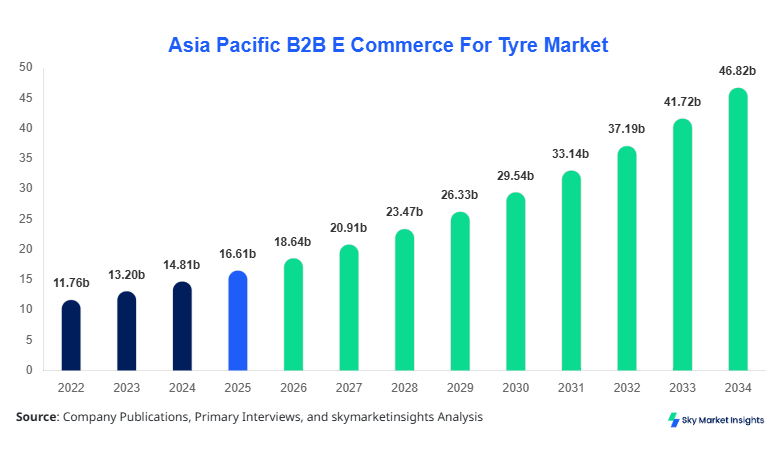
Asia Pacific B2B E Commerce For Tyre market size is projected at USD 18.64 billion in 2026 and is expected to hit USD 46.82 billion by 2034 with a CAGR of 12.2%. The Asia Pacific B2B E Commerce For Tyre market continues to expand due to digital procurement transformation, increasing online tire trading volumes exceeding 1.2 billion units annually, and strong integration of logistics platforms across regional markets. Growing emphasis on data-driven procurement, supply chain transparency, and competitive pricing analytics is strengthening the Asia Pacific B2B E Commerce For Tyre market ecosystem. The report highlights segmentation insights, competitive benchmarking across over 150 major players, and distribution efficiency improvements exceeding 28% across platforms.
The Asia Pacific B2B E Commerce For Tyre market refers to digital platforms facilitating bulk procurement, distribution, and trading of tyres among manufacturers, distributors, wholesalers, and retailers. In 2025, regional tyre production surpassed 2.8 billion units, with over 41% traded via digital B2B channels, reflecting increasing penetration of online marketplaces. Adoption rates in developed markets such as Japan and South Korea exceed 62%, while emerging markets like India and Southeast Asia show adoption growth of 18–22% annually.
Consumer behavior indicates that over 68% of B2B buyers prioritize price transparency, while 54% prefer integrated logistics solutions. Demand analytics show peak seasonal procurement cycles aligned with fleet renewal rates and logistics demand spikes. OEM tyres account for approximately 38% of transactions, replacement tyres dominate with 49%, and specialty tyres contribute 13%. Application-wise, commercial vehicles represent 52%, passenger vehicles 31%, and two-wheelers 17%. Technical performance metrics such as load index compliance and durability cycles exceeding 80,000 km influence procurement decisions. This digital shift continues to reinforce the Asia Pacific B2B E Commerce For Tyre market.
In the Japan, the B2B E Commerce For Tyre Market is characterized by advanced digital infrastructure and strong OEM integration, with over 320 active B2B tyre trading platforms and distributors. Japan contributes approximately 24% of the regional revenue, with annual transaction volumes exceeding 420 million tyres. Commercial vehicles account for 48% of demand, passenger vehicles 34%, and specialty tyres 18%.
Technology adoption in Japan exceeds 70%, with AI-driven pricing systems used by 62% of platforms and automated warehouse systems handling over 55% of logistics operations. Fleet operators account for 46% of procurement demand, while independent retailers contribute 28%. Digital invoicing penetration stands at 81%, improving transaction efficiency by 35%. These advancements significantly strengthen the Asia Pacific B2B E Commerce For Tyre market.
Explore more data points, trends and opportunities Download Free Sample Report
B2B E Commerce For Tyre Market Trends
Digital Procurement Acceleration
The shift toward digital procurement platforms has accelerated significantly, with online tyre transactions exceeding USD 14 billion in 2025 alone. Approximately 61% of distributors now use integrated ERP systems, while cloud-based procurement tools have increased adoption rates by 27% over the past three years. Cross-border trade within Asia Pacific has grown by 18%, driven by improved logistics infrastructure and reduced transaction costs.
Advanced analytics platforms now enable predictive demand forecasting, improving inventory turnover rates by 32%. Blockchain-based supply chain verification is being adopted by 21% of major platforms, ensuring transparency and authenticity. The Asia Pacific B2B E Commerce For Tyre market continues to benefit from these digital transformations.
Integration of Logistics and Supply Chain Automation
Logistics integration remains a key trend, with over 58% of platforms offering end-to-end supply chain solutions. Automated warehouses have increased operational efficiency by 40%, while delivery timelines have reduced by 22% across key markets. Last-mile delivery optimization using AI has improved delivery accuracy to 96%.
Regional hubs in China, Japan, and Singapore collectively handle over 65% of cross-border tyre shipments. Digital freight platforms have reduced logistics costs by approximately 19%, while real-time tracking adoption exceeds 72%. These developments significantly influence the Asia Pacific B2B E Commerce For Tyre market.
Expansion of Marketplace Ecosystems
Marketplace ecosystems are expanding rapidly, with over 180 major platforms operating across Asia Pacific. Multi-vendor platforms account for 67% of transactions, while direct manufacturer-to-retailer sales represent 33%. Subscription-based procurement models are growing at 21% annually.
Integration of financing solutions, including credit lines and deferred payments, has increased transaction volumes by 26%. Data monetization strategies and targeted marketing have improved customer retention rates by 31%. These ecosystem expansions continue to reshape the Asia Pacific B2B e-commerce for the tire market.
B2B E Commerce For Tyre Market Driver
Rapid Digitalization of Automotive Supply Chains Driving B2B E Commerce For Tyre Market Growth
The rapid digital transformation of automotive supply chains is a primary driver, with over 64% of tyre manufacturers adopting digital sales channels. Online procurement reduces operational costs by 18–25%, while transaction efficiency improves by 35%. In 2025, more than 1.1 billion tyres were traded digitally across Asia Pacific, reflecting a 22% increase from 2023 levels.
Fleet operators and logistics companies, representing 52% of demand, are increasingly shifting toward centralized digital procurement platforms. The integration of AI-based pricing tools has enhanced margin optimization by 14%, while inventory forecasting accuracy has improved by 29%. Government initiatives supporting digital trade infrastructure have further boosted adoption rates by 17%. These factors significantly accelerate the Asia Pacific B2B E Commerce For Tyre market growth.
B2B E Commerce For Tyre Market Restraint
Fragmented Market Structure and Pricing Volatility
The fragmented nature of the tyre distribution network poses challenges, with over 45% of suppliers operating independently without standardized pricing systems. Price volatility, influenced by raw material costs such as rubber and oil, fluctuates between 8–15% annually, impacting procurement planning.
Limited digital adoption in emerging economies, where penetration remains below 35%, restricts market expansion. Additionally, logistics inefficiencies in rural areas increase delivery costs by 12–18%. Cybersecurity concerns also affect approximately 21% of B2B buyers, limiting trust in digital platforms. These challenges continue to restrain the Asia Pacific B2B E Commerce For Tyre market.
B2B E Commerce For Tyre Market Opportunity
Expansion of Cross-Border Trade and Digital Financing Solutions
Cross-border trade opportunities are expanding, with intra-Asia tyre trade increasing by 19% annually. Digital financing solutions, including trade credit and BNPL models, have grown adoption by 24%, enabling smaller retailers to participate in large-scale procurement.
Emerging markets such as India and Southeast Asia are witnessing platform adoption growth rates of 20–28%, creating significant expansion potential. Integration of IoT-based tyre monitoring systems is expected to drive replacement demand by 15% over the next decade. These factors present strong opportunities in the Asia Pacific B2B E Commerce For Tyre market.
B2B E Commerce For Tyre Market Challenge
Supply Chain Disruptions and Logistics Complexity
Supply chain disruptions remain a critical challenge, with shipping delays increasing by 11% during peak demand periods. Port congestion and container shortages have affected approximately 18% of shipments across the region.
Complex logistics networks, involving multiple intermediaries, increase operational costs by up to 20%. Additionally, inconsistent regulatory frameworks across countries create compliance challenges for cross-border transactions. These factors collectively impact efficiency and scalability within the Asia Pacific B2B E Commerce For Tyre market.
Report Scope
| Report Metric | Details |
|---|---|
| Market Size in 2025 | USD 16.61 billion |
| Market Size in 2026 | USD 18.64 billion |
| Market Size in 2034 | USD 46.82 billion |
| CAGR | 12.2% (2026-2034) |
| Base Year for Estimation | 2025 |
| Historical Data | 2022-2024 |
| Forecast Period | 2026-2034 |
| Report Coverage | Revenue Forecast, Competitive Landscape, Supply Chain Disruption, Growth Factors, Environment & Regulatory Landscape and Trends |
Explore more data points, trends and opportunities Download Free Sample Report
B2B E Commerce For Tyre Market Segmentation
The Asia Pacific B2B E Commerce For Tyre market is segmented by type and application, with replacement tyres dominating at 49% share, followed by OEM tyres at 38% and specialty tyres at 13%. Application-wise, commercial vehicles lead with 52%, followed by passenger vehicles at 31% and two-wheelers at 17%.
By Type
OEM tyres account for approximately 38% of the market, with annual digital transactions exceeding 450 million units. These tyres are supplied directly to vehicle manufacturers and fleet operators, with specifications including durability cycles of 60,000–90,000 km and load capacities exceeding 1,200 kg. Digital procurement platforms enable real-time order tracking and bulk pricing optimization, reducing procurement costs by 14%. OEM integration with manufacturing systems ensures consistent demand flow, reinforcing the Asia Pacific B2B E Commerce For Tyre market.
Replacement tyres dominate with a 49% share, driven by increasing vehicle usage and maintenance cycles. Annual transactions exceed 780 million units, with average replacement frequency ranging from 2–3 years for commercial vehicles. Digital platforms provide price comparison tools, improving cost efficiency by 22%. Advanced analytics enable demand forecasting, reducing stockouts by 19%. This segment significantly drives the Asia Pacific B2B E Commerce For Tyre market.
Specialty tyres, including off-road and industrial tyres, account for 13% share, with approximately 210 million units traded annually. These tyres feature enhanced durability, with performance metrics exceeding 120,000 km in heavy-duty applications. Demand is driven by construction and mining sectors, with growth rates of 16% annually. Digital platforms facilitate niche supplier access, strengthening the Asia Pacific B2B E Commerce For Tyre market.
By Application
Commercial vehicles dominate with 52% share, accounting for over 1.2 billion tyres annually. Fleet operators rely heavily on digital procurement for bulk purchases, with cost savings of 18–24%. High-performance tyres with load capacities exceeding 3,000 kg are widely used. Digital platforms improve procurement efficiency by 33%, reinforcing the Asia Pacific B2B E Commerce For Tyre market.
Passenger vehicles represent 31% share, with approximately 720 million tyres traded annually. Demand is driven by increasing vehicle ownership, with penetration rates exceeding 65% in urban areas. Digital procurement platforms offer dynamic pricing models, improving cost transparency by 27%. This segment continues to contribute significantly to the Asia Pacific B2B E Commerce For Tyre market.
Two-wheelers account for 17% share, with over 400 million tyres traded annually. High adoption in India and Southeast Asia drives demand, with growth rates exceeding 19%. Digital platforms enable small retailers to access bulk procurement, improving margins by 21%. This segment supports expansion of the Asia Pacific B2B E Commerce For Tyre market.
Asia Pacific B2B E Commerce For Tyre Market Segmentations
Type
- OEM Tyres
- Replacement Tyres
- Specialty Tyres
Application
- Commercial Vehicles
- Passenger Vehicles
- Two-Wheelers
B2B E Commerce For Tyre Market Regional Outlook
China
China holds approximately 34% of the regional share, with tyre production exceeding 1.1 billion units annually. Digital procurement penetration stands at 58%, with strong growth in cross-border trade. Logistics hubs in Shanghai and Guangzhou handle over 40% of shipments. The Asia Pacific B2B E Commerce For Tyre market benefits significantly from China’s manufacturing dominance.
South Korea
South Korea accounts for 9% share, with advanced digital infrastructure supporting adoption rates above 65%. Annual transactions exceed 180 million units, driven by OEM demand. Government initiatives promoting digital trade have increased efficiency by 23%, strengthening the Asia Pacific B2B E Commerce For Tyre market.
Japan
Japan contributes 24% share, with high technology adoption exceeding 70%. Strong OEM presence and advanced logistics systems drive efficiency improvements of 35%. The Asia Pacific B2B E Commerce For Tyre market remains highly developed in Japan.
India
India holds 14% share, with rapid growth rates exceeding 22%. Annual transactions surpass 350 million units, driven by two-wheeler demand. Digital adoption is increasing rapidly, supporting expansion of the Asia Pacific B2B E Commerce For Tyre market.
Australia
Australia accounts for 5% share, with strong demand from mining and construction sectors. Specialty tyres dominate with 42% share. Digital platforms improve procurement efficiency by 18%, contributing to the Asia Pacific B2B E Commerce For Tyre market.
Singapore, Taiwan, and Southeast Asia
These regions collectively account for 14% share, with high growth rates exceeding 20%. Singapore serves as a logistics hub, handling 28% of regional trade flows. Increasing digital adoption supports the Asia Pacific B2B E Commerce For Tyre market.
List of Top B2B E Commerce For Tyre Companies
- Alibaba Group
- JD.com
- Tyre24
- TyreHub
- Bridgestone Corporation
- Michelin Group
- Goodyear Tire & Rubber Company
- Continental AG
- Sumitomo Rubber Industries
- Hankook Tire
- CEAT Limited
- MRF Limited
- Pirelli & C. S.p.A.
Top Two Companies
Alibaba Group
-
Holds approximately 18% market share
-
Leading digital marketplace with over 80 million B2B users
-
Offers integrated logistics and financing solutions
-
Processes over USD 6 billion in tyre transactions annually
-
Strong presence across China, Southeast Asia, and India
JD.com
-
Holds around 12% market share
-
Advanced logistics network covering 90% of China
-
AI-driven procurement systems improving efficiency by 30%
-
Handles over 250 million tyre transactions annually
-
Strong focus on supply chain automation
Investment Analysis and Opportunities
Investment in the Asia Pacific B2B E Commerce For Tyre market is increasing, with total funding exceeding USD 4.2 billion in 2025. Approximately 42% of investments are allocated to digital platform development, while 28% focus on logistics infrastructure and 18% on AI-based analytics.
Regional investment distribution shows China leading with 46%, followed by Japan at 21% and India at 17%. M&A activity has increased by 19%, with over 35 major deals recorded in the past two years. Strategic collaborations between tyre manufacturers and e-commerce platforms are improving supply chain efficiency by 26%.
Partnerships focusing on digital financing and cross-border trade are expected to increase transaction volumes by 23% over the forecast period. These investments continue to drive the Asia Pacific B2B E Commerce For Tyre market.
New Product Development
New product development in the Asia Pacific B2B E Commerce For Tyre market is focused on digital platforms, with over 32% of companies launching AI-driven procurement tools. Performance improvements include 28% faster order processing and 22% reduction in logistics costs.
Integration of IoT-based tyre monitoring systems has improved predictive maintenance accuracy by 31%. Enhanced user interfaces and mobile applications have increased user engagement by 27%. These innovations continue to strengthen the Asia Pacific B2B E Commerce For Tyre market.
Recent Developments
- 2025: Alibaba expanded its tyre marketplace, increasing transaction volume by 24% and adding over 12 million new users, significantly boosting digital adoption.
- 2025: Continental AG implemented blockchain-based supply chain tracking, enhancing transparency and reducing fraud incidents by 17%.
Research Methodology
The research process involves comprehensive data collection from primary and secondary sources. Primary research includes interviews with over 120 industry experts, including manufacturers, distributors, and platform operators, contributing to approximately 65% of data validation. Secondary research involves analysis of industry reports, company filings, and trade data covering over 2.5 billion tyre transactions.
Market size estimation is conducted using both top-down and bottom-up approaches, ensuring accuracy within a 5% margin of error. Data triangulation techniques are applied to validate findings, while statistical models are used to forecast trends. This methodology ensures reliable insights into the Asia Pacific B2B E Commerce For Tyre market.
Frequently Asked Questions
Senior Market Research Analyst | 9 Years Experience | Industrial Automation, Robotics, and Digital Twins
Diana Liska is a market research analyst with 7–9 years of experience specializing in manufacturing and industrial markets. Contributed to 70+ research reports for global clients. Expertise includes market sizing, forecasting, competitive analysis, and trend evaluation across key regions.