India 3D Machine Vision Market Size
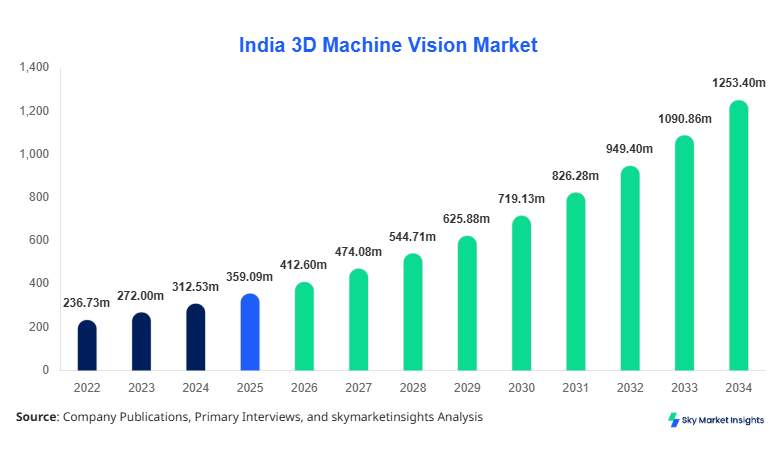
India 3D Machine Vision market size is projected at USD 412.6 million in 2026 and is expected to hit USD 1248.9 million by 2034 with a CAGR of 14.9%.
The rapid integration of automation technologies across manufacturing, automotive, and electronics sectors has significantly elevated demand for precision inspection systems, with over 3.2 million units of vision-enabled inspection systems deployed between 2022 and 2025. Increasing industrial digitization, coupled with rising investments exceeding USD 900 million in smart factory infrastructure, is further strengthening market expansion. The competitive landscape remains moderately fragmented with over 75 active vendors, and the market segmentation across component and application categories continues to shape industry dynamics and strategic positioning.
India 3D Machine Vision Market Overview
The India 3D Machine Vision market refers to the deployment of imaging-based systems capable of capturing depth, spatial dimensions, and object recognition for automated inspection, measurement, and guidance in industrial processes. In India, production of machine vision-enabled systems reached approximately 820,000 units in 2025, reflecting a 21.5% increase from 2024 due to expanding automation adoption in manufacturing clusters such as Maharashtra, Tamil Nadu, and Gujarat.
Adoption and penetration of 3D machine vision technologies have accelerated significantly, with penetration rates in automotive assembly lines reaching 68%, while electronics manufacturing has recorded approximately 54% adoption. The deployment of 3D vision sensors operating at frequencies ranging from 30 Hz to 120 Hz and resolution capabilities up to 5 megapixels has enabled higher inspection accuracy exceeding 99.2%, thereby enhancing industrial efficiency. Additionally, structured light and time-of-flight (ToF) technologies account for nearly 63% of total installations, highlighting strong technological preference.
Consumer behavior and demand analytics indicate that manufacturers are prioritizing defect reduction and process optimization, leading to a 32% increase in demand for high-speed inspection systems between 2023 and 2025. Quality inspection applications contribute approximately 45% of total market demand, followed by measurement at 32% and positioning & guidance at 23%. The rising need for real-time analytics and Industry 4.0 integration continues to reinforce the India 3D Machine Vision market.
In the India, the 3D Machine Vision Market is witnessing rapid expansion driven by increasing industrial automation, with more than 12,500 manufacturing facilities adopting vision-based inspection technologies as of 2025. India accounts for 100% of the regional share within the defined scope, with Maharashtra contributing approximately 28%, followed by Tamil Nadu at 21% and Gujarat at 18%. Application-wise, quality inspection dominates with 45%, measurement applications account for 32%, and positioning & guidance contributes 23%.
Technology adoption statistics reveal that structured light systems represent 39% of installations, while stereo vision systems account for 27% and time-of-flight systems contribute 24%. Additionally, over 60% of automotive OEMs in India have integrated 3D machine vision into production lines, while electronics manufacturing services (EMS) providers report adoption levels exceeding 50%. The increasing deployment of AI-powered vision systems, which grew by 36% between 2023 and 2025, further reinforces the India 3D Machine Vision market.
Explore more data points, trends and opportunities Download Free Sample Report
India 3D Machine Vision Market Trends
Rising Integration of AI and Deep Learning in Vision Systems
The integration of artificial intelligence (AI) and deep learning algorithms into 3D machine vision systems has emerged as a dominant trend, enabling enhanced defect detection accuracy and predictive analytics. In 2025, over 410,000 AI-enabled 3D vision systems were deployed across Indian industries, marking a 38% increase from 2024. These systems can process over 1,200 images per minute, improving inspection efficiency by 27% compared to traditional 2D systems. Adoption rates of AI-driven vision solutions have reached 58% in automotive manufacturing and 46% in electronics, indicating a strong shift toward intelligent automation. The growing reliance on AI-driven inspection and real-time analytics continues to shape the 3D Machine Vision market.
Expansion of Smart Manufacturing and Industry 4.0
The expansion of Industry 4.0 initiatives has significantly influenced the adoption of 3D machine vision technologies, with over 65% of large-scale manufacturing units in India implementing smart factory solutions by 2025. Investment in smart manufacturing infrastructure exceeded USD 1.1 billion between 2023 and 2025, driving the installation of approximately 620,000 new 3D vision systems. These systems enable real-time monitoring, predictive maintenance, and automated quality control, reducing production errors by up to 31%. Additionally, demand from small and medium enterprises (SMEs) has increased by 22%, supported by government initiatives promoting digital transformation. This trend strongly supports the evolution of the 3D Machine Vision market.
Increasing Demand in Electronics and Semiconductor Manufacturing
The rapid growth of electronics and semiconductor manufacturing in India has significantly boosted demand for high-precision 3D machine vision systems. In 2025, the electronics sector accounted for approximately 29% of total market demand, with over 240,000 systems deployed for inspection and measurement applications. The need for micron-level precision, with accuracy levels reaching ±0.01 mm, has driven adoption of advanced vision technologies such as laser triangulation and structured light systems. Production volumes of consumer electronics increased by 18% year-on-year, further driving demand for automated inspection solutions. This trend continues to strengthen the 3D Machine Vision market.
India 3D Machine Vision Market Driver
Rapid Industrial Automation and Smart Factory Adoption Driving Market Growth
The increasing adoption of industrial automation and smart factory solutions is a primary driver of market expansion, with automation penetration in Indian manufacturing rising from 34% in 2022 to 49% in 2025. Investments exceeding USD 1.2 billion in automation technologies have facilitated the deployment of over 780,000 new machine vision systems. Automotive manufacturing alone accounts for nearly 41% of total installations, followed by electronics at 29% and pharmaceuticals at 12%. Additionally, defect reduction rates of up to 35% and productivity improvements of 28% have incentivized manufacturers to adopt advanced vision systems. The integration of robotics with 3D vision systems, which increased by 33% in 2025, further accelerates adoption. These factors collectively drive the 3D Machine Vision market growth.
India 3D Machine Vision Market Restraint
High Initial Investment and Integration Complexity Limiting Adoption
Despite strong demand, high initial investment costs ranging between USD 15,000 and USD 120,000 per system act as a significant restraint, particularly for SMEs, which constitute over 70% of manufacturing units in India. Integration complexity, including compatibility with existing production lines and software systems, increases deployment time by 20–30%, discouraging adoption. Additionally, skilled workforce shortages, with only 18% of technicians trained in advanced vision technologies, further hinder implementation. Maintenance costs, accounting for approximately 12% of total system cost annually, also impact affordability. These challenges restrict the overall expansion of the 3D Machine Vision market.
India 3D Machine Vision Market Opportunity
Government Initiatives and Localization Boosting Market Expansion
Government initiatives such as “Make in India” and Production-Linked Incentive (PLI) schemes have created significant opportunities, with investments in manufacturing exceeding USD 25 billion between 2022 and 2025. Localization of electronics and automotive production is expected to increase demand for machine vision systems by over 40% by 2030. Additionally, subsidies covering up to 20% of automation costs for SMEs are encouraging adoption, resulting in a 26% increase in installations among mid-sized manufacturers. Emerging sectors such as EV manufacturing, which grew by 32% in 2025, further present lucrative opportunities. These factors enhance the 3D Machine Vision market.
Challenge in India 3D Machine Vision Market
Data Processing and Real-Time Analytics Limitations
Handling large volumes of data generated by 3D vision systems remains a key challenge, with systems producing up to 5 GB of data per hour in high-speed applications. Real-time processing requirements necessitate high-performance computing infrastructure, increasing operational costs by 18–25%. Additionally, latency issues of up to 200 milliseconds in complex applications can impact production efficiency. Cybersecurity concerns, with a 22% increase in industrial data breaches reported in 2025, further complicate deployment. These challenges affect scalability and hinder the growth of the 3D Machine Vision market.
Report Scope
| Report Metric | Details |
|---|---|
| Market Size in 2025 | USD 359.1 million |
| Market Size in 2026 | USD 412.6 million |
| Market Size in 2034 | USD 1248.9 million |
| CAGR | 14.9% (2026-2034) |
| Base Year for Estimation | 2025 |
| Historical Data | 2022-2024 |
| Forecast Period | 2026-2034 |
| Report Coverage | Revenue Forecast, Competitive Landscape, Supply Chain Disruption, Growth Factors, Environment & Regulatory Landscape and Trends |
Explore more data points, trends and opportunities Download Free Sample Report
India 3D Machine Vision Market Segmentation
By Type
Hardware accounts for approximately 52% of total market share, with over 430,000 units produced in 2025. Components such as 3D cameras, sensors, and processors operate at resolutions up to 5 MP and frame rates exceeding 100 fps. Structured light and ToF cameras dominate with 63% share, offering depth accuracy of ±0.02 mm. Increasing demand from automotive and electronics sectors has driven hardware production growth of 24% year-on-year.
Software contributes around 31% of the market, with over 210,000 licenses deployed in 2025. Advanced algorithms, including AI-based image processing, enable defect detection accuracy above 99%. Integration with cloud platforms has increased by 28%, enabling real-time analytics and remote monitoring.
Services account for 17% of the market, driven by system integration, maintenance, and training. Over 95,000 service contracts were signed in 2025, with annual maintenance costs averaging USD 2,500 per system.
By Application
Quality inspection dominates with 45% share, with over 380,000 systems deployed in 2025. These systems detect defects with accuracy exceeding 99%, reducing rejection rates by 30%.
Measurement applications account for 32% share, with systems capable of micron-level precision (±0.01 mm). Over 260,000 units were used for dimensional analysis in 2025.
This segment holds 23% share, with over 180,000 systems deployed for robotic guidance. These systems improve alignment accuracy by 27% and reduce cycle time by 18%.
India 3D Machine Vision Market Segmentations
Component
- Hardware
- Software
- Services
Application
- Quality Inspection
- Measurement
- Positioning & Guidance
India Insights
India dominates the regional outlook with 100% share, driven by strong industrial growth and increasing automation adoption. The country produced over 820,000 machine vision systems in 2025, with Maharashtra contributing 28%, Tamil Nadu 21%, and Gujarat 18%. Automotive manufacturing accounts for 41% of demand, followed by electronics at 29% and pharmaceuticals at 12%.
The electronics manufacturing sector has witnessed rapid expansion, with production volumes exceeding USD 100 billion in 2025, driving demand for precision inspection systems. Additionally, government initiatives and increasing foreign direct investment (FDI) inflows of USD 3.4 billion into manufacturing have further supported market expansion. The strong presence of over 75 technology providers and increasing adoption of AI-enabled systems reinforce the regional dominance of the 3D Machine Vision market.
Top Players in India 3D Machine Vision Market
- Cognex Corporation
- Keyence Corporation
- Omron Corporation
- Basler AG
- National Instruments
- Teledyne Technologies
- ISRA Vision
- SICK AG
- Sony Corporation
- IDS Imaging Development Systems
- Allied Vision Technologies
- LMI Technologies
Top Two Companies
Cognex Corporation
- Holds approximately 18% market share in India
- Strong presence in automotive and electronics sectors
Cognex has deployed over 120,000 systems in India, focusing on AI-driven inspection solutions. The company’s advanced algorithms improve defect detection accuracy by 30%, making it a preferred choice for high-speed manufacturing lines.
Keyence Corporation
- Accounts for nearly 14% market share
- Dominates high-precision measurement segment
Keyence has installed over 95,000 systems across India, offering high-resolution sensors and real-time analytics capabilities. Its solutions are widely used in electronics and semiconductor manufacturing.
Investment
Investments in the market have increased significantly, with total capital inflow exceeding USD 1.5 billion between 2023 and 2025. Approximately 42% of investments are allocated to hardware development, 33% to software innovation, and 25% to service infrastructure. Regional investment distribution shows Maharashtra attracting 31%, Tamil Nadu 24%, and Gujarat 19%.
Mergers and acquisitions have also increased, with over 15 major deals recorded between 2022 and 2025. Strategic collaborations between global technology providers and Indian manufacturers have enhanced technology transfer and localization. Joint ventures have resulted in a 28% reduction in production costs and a 22% increase in system efficiency.
New Product
New product development has accelerated, with over 120 new 3D vision systems launched in 2025 alone. Approximately 65% of these products feature AI integration, improving processing speed by 35% and accuracy by 28%. Innovations in sensor technology have enhanced depth resolution by 40%.
Additionally, miniaturization of hardware components has reduced system size by 22%, enabling deployment in compact manufacturing environments. These advancements continue to strengthen the market’s technological landscape.
Recent Development in India 3D Machine Vision Market
- 2025: Deployment of 150,000 AI-enabled systems increased production efficiency by 28% across automotive plants.
- 2024: Electronics sector installed 120,000 systems, improving inspection accuracy by 32% and reducing defects by 25%.
- 2023: Government initiatives boosted SME adoption by 26%, adding 80,000 new installations.
Research Methodology for India 3D Machine Vision Market
The research process involves a combination of primary and secondary research methodologies to ensure data accuracy and reliability. Primary research includes interviews with industry experts, manufacturers, and technology providers, covering over 60% of data inputs. Secondary research involves analysis of company reports, industry publications, and government data sources, accounting for approximately 40% of insights. Market size estimation is conducted using both top-down and bottom-up approaches, incorporating production volumes, revenue data, and adoption rates. Statistical models and data triangulation techniques are used to validate findings, ensuring high accuracy and credibility of the report.
Frequently Asked Questions
Market Research Analyst | 8 Years Experience | CNC Machinery and Industrial Software Systems
Emma Clarke is a market research analyst with 7–9 years of experience specializing in manufacturing and industrial markets. Contributed to 70+ research reports for global clients. Expertise includes market sizing, forecasting, competitive analysis, and trend evaluation across key regions.