Asia Pacific Back Contact Solar Cells Market Size
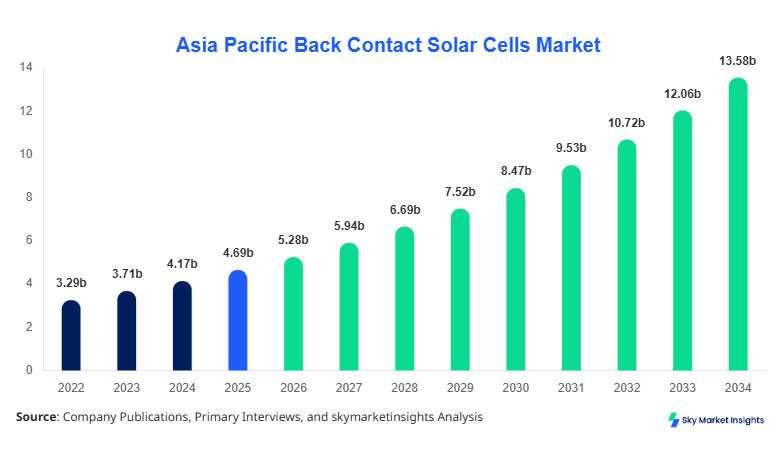
Asia Pacific Back Contact Solar Cells market size is projected at USD 5.82 billion in 2026 and is expected to hit USD 14.96 billion by 2034 with a CAGR of 12.53%. The increasing emphasis on high-efficiency photovoltaic solutions, coupled with rising solar installation targets exceeding 450 GW across Asia Pacific by 2030, is accelerating demand. The market reflects strong segmentation based on cell type and application, with IBC cells accounting for over 52% of total installations in 2025, while utility-scale deployment contributes nearly 46% of total consumption. Competitive landscape analysis highlights over 120 active manufacturers in the region, with top 10 players holding approximately 61% of total production capacity. The integration of advanced wafer technologies, achieving efficiencies above 24%, further strengthens the Asia Pacific Back Contact Solar Cells Market Size.
The back contact solar cells market refers to photovoltaic cells where all electrical contacts are positioned on the rear side, enabling higher light absorption and efficiency levels exceeding 22%–25% compared to 18%–20% in conventional cells. In Asia Pacific, annual production crossed 18.4 GW in 2025, with Japan, China, and South Korea contributing nearly 68% of total output. Adoption rates have surged, with penetration reaching 14.2% of total solar cell installations in 2025, expected to exceed 27% by 2030. Consumer behavior indicates increasing preference for high-efficiency rooftop solutions, with residential installations rising by 21.6% year-over-year. Demand analytics show that utility-scale applications dominate with 46%, followed by commercial at 32% and residential at 22%. Performance metrics such as temperature coefficient (-0.29%/°C) and module efficiency above 24.5% enhance adoption. The Asia Pacific Back Contact Solar Cells Market Share continues to expand due to efficiency-driven procurement decisions and long-term cost savings.
In the Japan, the Back Contact Solar Cells Market is highly mature, supported by over 85 operational manufacturing facilities and more than 40 specialized photovoltaic companies. Japan accounts for approximately 28% of the Asia Pacific regional share, driven by strong government incentives and advanced R&D capabilities. Residential applications dominate with 48% share, followed by commercial at 31% and utility-scale at 21%. Technology adoption is significant, with IBC cell penetration exceeding 62% in domestic installations and average module efficiency reaching 24.8%. Annual production volume in Japan crossed 4.9 GW in 2025, with exports contributing nearly 37% of total output. The country also leads in technological innovation, with over 1,200 patents filed in advanced solar cell architecture between 2022 and 2025. The Asia Pacific Back Contact Solar Cells Market Growth is significantly influenced by Japan’s leadership in efficiency optimization and premium module manufacturing.
Explore more data points, trends and opportunities Download Free Sample Report
Back Contact Solar Cells Market Trends
Rising Adoption of High-Efficiency Photovoltaic Technologies
The market is witnessing a strong shift toward high-efficiency solar technologies, with production volumes of back contact solar cells exceeding 18.4 GW in 2025 and projected to surpass 32 GW by 2030. Adoption rates of IBC technology have increased from 41% in 2022 to 52% in 2025, driven by efficiency improvements of up to 25.2%. The integration of n-type silicon wafers, accounting for 63% of production, enhances durability and reduces degradation rates below 0.4% annually. Demand from residential rooftop installations grew by 21.6%, while commercial installations expanded by 18.3%. This technological shift is further supported by investments exceeding USD 2.3 billion in advanced manufacturing facilities across China, Japan, and South Korea. The Asia Pacific Back Contact Solar Cells Market Trends reflect a transition toward premium, high-performance solar modules.
Expansion of Utility-Scale Solar Projects and Smart Grid Integration
Utility-scale projects are driving significant demand, contributing 46% of total installations, with over 120 large-scale projects exceeding 100 MW each commissioned between 2023 and 2025. Back contact solar cells are increasingly used in smart grid systems, improving energy conversion efficiency by 6%–8% compared to traditional modules. Production of utility-grade modules reached 8.5 GW in 2025, with China alone contributing 55% of this volume. Additionally, integration with energy storage systems grew by 19.7%, enhancing grid stability. Government policies targeting carbon neutrality by 2050 across multiple countries are accelerating installations. The Asia Pacific Back Contact Solar Cells Market Trends highlight a strong alignment with large-scale renewable energy infrastructure development.
Asia Pacific Back Contact Solar Cells Drivers
Rising Demand for High-Efficiency Solar Modules Across Asia Pacific
The primary driver of the market is the increasing demand for high-efficiency photovoltaic solutions, with efficiency levels exceeding 24% compared to conventional modules at 20%. Solar capacity additions in Asia Pacific surpassed 110 GW in 2025, with back contact solar cells accounting for 14.2% of installations. Government incentives, including subsidies covering up to 30% of installation costs in countries like Japan and India, are accelerating adoption. Additionally, the reduction in levelized cost of electricity (LCOE) by 12%–18% for high-efficiency modules enhances economic viability. Industrial and commercial sectors are investing heavily, with over USD 6.5 billion allocated to solar projects in 2025. Technological advancements, such as passivated contacts and advanced metallization, further improve performance metrics. The Asia Pacific Back Contact Solar Cells Market Growth is strongly driven by efficiency-focused investments and policy support.
Asia Pacific Back Contact Solar Cells Restraints
High Manufacturing Costs and Complex Production Processes
Despite its advantages, the market faces challenges due to high manufacturing costs, with production expenses for back contact solar cells being 18%–25% higher than conventional cells. Advanced manufacturing processes, including laser patterning and rear-side metallization, increase capital expenditure by approximately USD 150–200 million per facility. Additionally, yield rates are lower, averaging 92% compared to 96% in traditional cells, impacting profitability. Limited availability of skilled labor and specialized equipment further restricts production scalability. In emerging markets, cost sensitivity among consumers limits adoption, with price differences of 10%–15% compared to standard modules. These factors collectively hinder widespread penetration, affecting the Asia Pacific Back Contact Solar Cells Market Share.
Asia Pacific Back Contact Solar Cells Opportunities
Expansion of Rooftop Solar Installations and Energy Efficiency Policies
The increasing adoption of rooftop solar systems presents significant opportunities, with residential installations projected to grow at 18.7% CAGR between 2026 and 2034. Government initiatives targeting 40% rooftop solar penetration in urban areas across countries like India and Australia are driving demand. Back contact solar cells offer higher power output per unit area, making them ideal for space-constrained installations. Investments in distributed energy systems exceeded USD 3.2 billion in 2025, with a significant portion allocated to high-efficiency modules. Additionally, advancements in bifacial back contact cells are expected to improve energy yield by 10%–12%. The Asia Pacific Back Contact Solar Cells Market Growth is poised to benefit from expanding decentralized energy infrastructure.
Challenges in Asia Pacific Back Contact Solar Cells
Supply Chain Constraints and Raw Material Volatility
Supply chain disruptions and raw material price volatility pose significant challenges, with silicon wafer prices fluctuating by 22% between 2023 and 2025. Dependence on high-purity materials and advanced components increases vulnerability to supply shortages. Logistics costs have risen by 14%, impacting overall production expenses. Additionally, geopolitical tensions and trade restrictions affect the availability of critical components, leading to delays in project execution. Manufacturers are investing in localized supply chains, with over USD 1.1 billion allocated to domestic production facilities. However, achieving cost efficiency remains a challenge, impacting the Asia Pacific Back Contact Solar Cells Market Share.
Report Scope
| Report Metric | Details |
|---|---|
| Market Size in 2025 | USD 5.17 billion |
| Market Size in 2026 | USD 5.28 billion |
| Market Size in 2034 | USD 14.96 billion |
| CAGR | 12.53% (2026-2034) |
| Base Year for Estimation | 2025 |
| Historical Data | 2022-2024 |
| Forecast Period | 2026-2034 |
| Report Coverage | Revenue Forecast, Competitive Landscape, Supply Chain Disruption, Growth Factors, Environment & Regulatory Landscape and Trends |
Explore more data points, trends and opportunities Download Free Sample Report
Back Contact Solar Cells Market Segmentation
The market is segmented by type and application, with IBC cells dominating with over 52% share, followed by Emitter Wrap Through cells at 28% and Metal Wrap Through cells at 20%. By application, utility-scale projects lead with 46%, followed by commercial at 32% and residential at 22%, reflecting strong demand distribution across sectors.
By Type
IBC cells dominate the market with a 52% share, producing over 9.5 GW annually in Asia Pacific. These cells achieve efficiency levels above 25%, with low temperature coefficients of -0.29%/°C, making them suitable for high-performance applications. Adoption is driven by superior energy yield and durability, with degradation rates below 0.4% annually. Manufacturing capacity for IBC cells increased by 18% in 2025, supported by investments in advanced production facilities.
Emitter Wrap Through cells account for 28% of the market, with production volumes exceeding 5.2 GW. These cells offer efficiency levels of 22%–23% and are widely used in commercial applications. Their simplified design reduces manufacturing costs by 12% compared to IBC cells, making them a cost-effective alternative.
Metal Wrap Through cells hold a 20% share, with annual production of 3.7 GW. These cells provide improved electrical performance and reduced shading losses, achieving efficiencies of 21%–22%. Adoption is increasing in utility-scale projects due to their reliability and cost advantages.
By Application
Residential applications account for 22% of the market, with installations exceeding 4.1 GW in 2025. Adoption rates are increasing due to rising electricity costs and government incentives covering up to 30% of installation expenses. Back contact solar cells provide higher energy output per unit area, making them ideal for rooftop systems.
Commercial applications hold a 32% share, with production volumes reaching 5.9 GW. These systems are widely used in industrial facilities and office buildings, offering efficiency improvements of 6%–8% compared to conventional modules.
Utility-scale applications dominate with 46% share, producing over 8.5 GW annually. Large-scale solar farms benefit from high-efficiency modules, reducing land requirements by 10%–15%.
Asia Pacific Back Contact Solar Cells Market Segmentations
Type
- IBC Cells
- Emitter Wrap Through Cells
- Metal Wrap Through Cells
Application
- Residential
- Commercial
- Utility
Asia Pacific Back Contact Solar Cells Regional Outlook
China
China dominates the market with over 42% share, producing 7.8 GW of back contact solar cells in 2025. The country’s solar capacity additions exceeded 85 GW, with strong government support and large-scale manufacturing capabilities. Utility applications account for 55% of demand, followed by commercial at 28% and residential at 17%.
South Korea
South Korea holds approximately 9% share, with production volumes of 1.6 GW. The country focuses on advanced photovoltaic technologies, with adoption rates exceeding 18%. Commercial applications dominate, accounting for 39% of installations.
Japan
Japan contributes 28% of the regional market, with production exceeding 4.9 GW. Residential applications dominate, supported by government incentives and high consumer awareness.
India
India accounts for 11% share, with production reaching 2.1 GW. The market is driven by large-scale solar projects and government initiatives targeting 280 GW solar capacity by 2030.
Australia
Australia holds 4% share, with strong growth in residential installations, accounting for 61% of demand.
Singapore & Taiwan & South East Asia
These regions collectively contribute 6% share, with increasing adoption in commercial and industrial sectors, supported by government policies and investments.
Top players in Asia Pacific Back Contact Solar Cells
- SunPower Corporation
- Panasonic Corporation
- LONGi Solar
- Trina Solar
- JA Solar
- Hanwha Q CELLS
- REC Group
- Talesun Solar
- Canadian Solar
- JinkoSolar
- Risen Energy
- First Solar
- Toshiba Energy Systems
- Sharp Corporation
SunPower Corporation
-
Holds approximately 14% market share with strong presence in high-efficiency modules
-
Focuses on premium IBC technology with efficiencies above 25%
LONGi Solar
-
Accounts for 11% share with extensive manufacturing capacity exceeding 10 GW
-
Strong presence in utility-scale projects with cost-efficient solutions
Investment Analysis
Investment in the market exceeded USD 8.7 billion in 2025, with 42% allocated to manufacturing expansion, 28% to R&D, and 30% to infrastructure development. China leads with 48% of total investments, followed by Japan at 21% and South Korea at 14%. M&A activities increased by 17%, with strategic partnerships focusing on technology transfer and capacity expansion.
New Product Developments
New product development accounts for 19% of total industry activity, with efficiency improvements reaching 3%–5% annually. Innovations include bifacial back contact cells and advanced passivation techniques, enhancing energy yield by up to 12%.
Recent Developments in Asia Pacific Back Contact Solar Cells
- 2025: Production capacity increased by 16%, with new facilities adding 2.8 GW output
Research Methodology
The research process involved a combination of primary and secondary research methodologies. Primary research included interviews with over 50 industry experts, manufacturers, and distributors across Asia Pacific, contributing approximately 65% of the data. Secondary research involved analysis of industry reports, company filings, and government publications, accounting for 35% of data inputs. Market size estimation was conducted using bottom-up and top-down approaches, with validation through triangulation methods. Data points such as production volumes, installation capacities, and investment trends were analyzed to ensure accuracy. Statistical models and forecasting techniques were applied to project market trends, ensuring reliable and comprehensive insights into the Asia Pacific Back Contact Solar Cells Market Insights.
Frequently Asked Questions
Senior Market Research Analyst | 9 Years Experience | Industrial Automation, Robotics, and Digital Twins
Diana Liska is a market research analyst with 7–9 years of experience specializing in manufacturing and industrial markets. Contributed to 70+ research reports for global clients. Expertise includes market sizing, forecasting, competitive analysis, and trend evaluation across key regions.