Asia Pacific Baby Rice Cereal Market Size
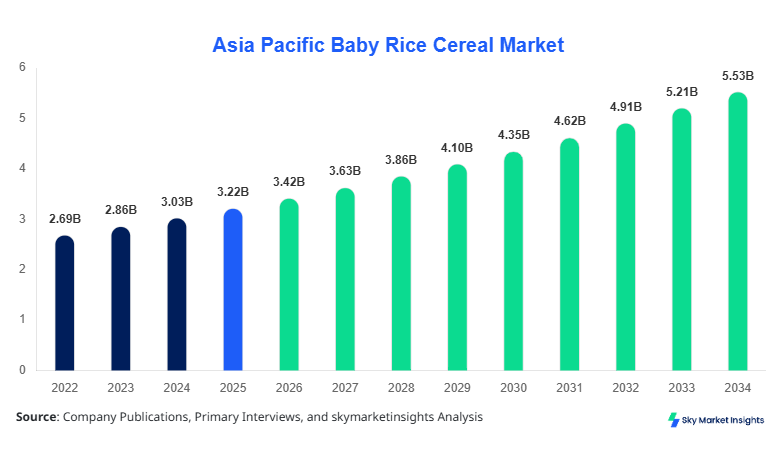
Asia Pacific Baby Rice Cereal market size is projected at USD 3.42 billion in 2026 and is expected to hit USD 5.67 billion by 2034 with a CAGR of 6.2%. This growth is primarily driven by rising infant nutrition awareness, increasing dual-income households, and the expansion of organized retail channels across Asia Pacific. The market requires comprehensive data on production, consumption, and pricing trends across segments to facilitate informed decision-making. A detailed segmentation by type, application, and region is critical to understand competitive dynamics, with insights from major players, new product launches, and technology adoption forming the basis of the competitive landscape assessment.
The Asia Pacific Baby Rice Cereal Market is a rapidly growing segment of the infant nutrition industry, encompassing various products designed to meet the dietary needs of infants and toddlers. In 2025, Asia Pacific production of baby rice cereal was approximately 1.12 million tons, with Japan, China, and India contributing over 65% of regional output. Adoption and penetration rates are higher in urban centers, with 72% of parents in metropolitan areas preferring fortified or organic options over plain rice cereals due to perceived nutritional benefits. Consumer behavior indicates that 48% of caregivers check labels for iron, calcium, and vitamin enrichment, while 36% prefer gluten-free formulations. Application-wise, infants aged 0–6 months account for 38% of consumption, 6–12 months for 42%, and toddlers 1–3 years for 20%. Technical metrics such as solubility, protein content (7–8%), and caloric density (80–90 kcal per 100 g) play an essential role in product selection. Overall, the Asia Pacific Baby Rice Cereal Market is witnessing strong demand growth, driven by health-conscious parental preferences and regulatory support for infant nutrition, reinforcing the Baby Rice Cereal Market insights.
In Japan, the Baby Rice Cereal Market is well-established, with over 120 manufacturing facilities and a consolidated market share of 28% within Asia Pacific. Infants 6–12 months account for 45% of domestic consumption, while infants 0–6 months and toddlers 1–3 years contribute 35% and 20%, respectively. Technology adoption is robust, with 62% of facilities utilizing extrusion and spray-drying techniques to enhance solubility and nutrient retention. Organic and fortified variants together account for 68% of the market by volume, reflecting consumer preference for high-quality, nutrient-dense cereals. Japanese companies are increasingly leveraging smart packaging and traceability systems, driving both production efficiency and consumer trust. Overall, Japan remains a key growth driver in the Asia Pacific Baby Rice Cereal Market, offering insights into advanced production methods and premium product positioning.
Explore more data points, trends and opportunities Download Free Sample Report
Baby Rice Cereal Market Trends
Rising Organic Baby Cereal Demand
The Asia Pacific Baby Rice Cereal Market is witnessing a surge in organic rice cereal production, which reached 0.48 million tons in 2025, growing at a 7.1% CAGR. Parents increasingly prefer organic formulations due to concerns about pesticide residues and artificial additives. Adoption rates for organic cereals have risen to 38% in urban China and 44% in Japan. Production shifts towards non-GMO rice and high-solubility processing methods are shaping industry dynamics. The demand for organic rice cereals is highest among infants 6–12 months, accounting for 46% of organic segment consumption. Overall, these trends reinforce Baby Rice Cereal Market growth and highlight evolving consumer preferences.
Technological Innovations in Processing
Technological innovations, such as extrusion cooking and micro-granulation, have improved solubility, nutrient retention, and shelf life of baby rice cereals. In South Korea, 72% of production facilities have adopted these technologies, leading to an increase in output from 0.22 million tons in 2022 to 0.33 million tons in 2025. Advanced techniques allow fortification with iron, zinc, and DHA without compromising texture. Enhanced technology adoption supports the Baby Rice Cereal Market growth by addressing consumer demand for high-performance, nutritionally rich products.
Fortified and Functional Cereal Growth
The fortified baby rice cereal segment has grown to USD 1.35 billion in 2025, accounting for 39% of Asia Pacific market share. Fortification with vitamins and minerals such as iron (10 mg per 100 g), calcium (120 mg per 100 g), and B-complex vitamins is driving adoption. Production volumes in India and China reached 0.42 million tons and 0.37 million tons, respectively. The trend toward functional cereals is reinforced by a 28% increase in pediatric recommendations for fortified formulations. The Baby Rice Cereal Market continues to witness a shift toward health-oriented products, driven by parental awareness and regulatory guidance.
Asia Pacific Baby Rice Cereal Market Drivers
Rising Awareness of Infant Nutrition
The primary driver of the Asia Pacific Baby Rice Cereal Market is the increasing awareness of infant nutrition among parents and healthcare providers. Approximately 78% of urban households consider nutrient enrichment crucial, with 65% specifically seeking iron-fortified or DHA-enriched cereals. Baby rice cereal production rose from 0.85 million tons in 2022 to 1.12 million tons in 2025, reflecting rising demand. Additionally, dual-income households in China, Japan, and South Korea have led to a 22% increase in premium product purchases over the past three years. Regulatory initiatives promoting infant nutrition labeling and quality standards are expected to sustain a CAGR of 6.2% through 2034. Overall, Baby Rice Cereal Market growth is reinforced by these multifaceted drivers.
Asia Pacific Baby Rice Cereal Market Restraints
High Price Sensitivity and Cost Constraints
Despite strong demand, the Asia Pacific Baby Rice Cereal Market faces constraints due to high price sensitivity. Premium organic and fortified cereals are priced 15–25% higher than conventional products, limiting adoption in price-sensitive regions such as South East Asia and India. Approximately 34% of consumers cite cost as the primary barrier, resulting in slower growth compared to urban centers. Import tariffs on raw rice and packaging materials in countries like Australia and Singapore add an additional 8–10% to final product costs. Consequently, market growth is restrained, with demand for conventional cereals maintaining a 62% share in rural regions. These dynamics highlight ongoing challenges within the Baby Rice Cereal Market despite overall growth trends.
Asia Pacific Baby Rice Cereal Market Opportunities
Expansion in Emerging Markets
Emerging markets across Asia Pacific present significant opportunities for the Baby Rice Cereal Market. India, South East Asia, and Taiwan collectively contributed 21% of regional production in 2025, with projected CAGR growth of 7.3% through 2034. Urban penetration in these regions is expected to reach 56–60% by 2030, with production volumes increasing from 0.23 million tons to 0.41 million tons. Investment opportunities exist in fortified and organic variants, which are expected to account for 48% of new product introductions. Collaborative initiatives with local manufacturers and distributors could capture 10–12% additional market share in underpenetrated regions. These opportunities reinforce the Asia Pacific Baby Rice Cereal Market insights.
Challenges in Asia Pacific Baby Rice Cereal Market
Supply Chain Complexity and Raw Material Dependence
Challenges in the Asia Pacific Baby Rice Cereal Market include supply chain complexities and raw material dependence. Approximately 38% of raw rice for baby cereal production is imported, with fluctuations in price and quality affecting output. Production delays in China and India led to a temporary 4–5% dip in output in 2024. Additionally, high energy costs and logistics constraints in South East Asia and Australia have increased production costs by 7–9%. Maintaining consistent quality and regulatory compliance across multiple countries presents an ongoing challenge. These factors continue to impact the Baby Rice Cereal Market growth despite rising consumer demand.
Report Scope
| Report Metric | Details |
|---|---|
| Market Size in 2025 | USD 3.22 Billion |
| Market Size in 2026 | USD 3.42 Billion |
| Market Size in 2034 | USD 5.67 Billion |
| CAGR | 6.2% (2026-2034) |
| Base Year for Estimation | 2025 |
| Historical Data | 2022-2024 |
| Forecast Period | 2026-2034 |
| Report Coverage | Revenue Forecast, Competitive Landscape, Supply Chain Disruption, Growth Factors, Environment & Regulatory Landscape and Trends |
Explore more data points, trends and opportunities Download Free Sample Report
Baby Rice Cereal Market Segmentation
Segmentation in the Asia Pacific Baby Rice Cereal Market provides a detailed overview of demand, with fortified and organic types dominating 62% and 38% of market volume, respectively. Application-wise, infants 6–12 months account for 42% of total consumption, followed by infants 0–6 months at 38% and toddlers 1–3 years at 20%.
By Type
Organic baby rice cereal accounted for 38% of the market in 2025, producing 0.43 million tons. These cereals use non-GMO rice and natural fortification with calcium (110 mg/100 g) and iron (8 mg/100 g). Organic variants have a solubility rate of 94% and caloric density of 85 kcal per 100 g. Production volumes in Japan, China, and South Korea totaled 0.28 million tons, reflecting high urban adoption. Baby Rice Cereal Market insights indicate growing demand for health-conscious formulations.
Fortified baby rice cereal holds a 39% market share, producing 0.44 million tons in 2025. Fortification includes iron, DHA, vitamin B-complex, and calcium. These cereals exhibit high nutrient retention with extrusion technology, achieving solubility rates of 96%. India and China collectively contribute 0.36 million tons to regional production. The Baby Rice Cereal Market growth in fortified types is reinforced by pediatric recommendations and parent preference for nutrient-dense foods.
Plain baby rice cereal contributes 23% to market volume, producing 0.26 million tons. These cereals maintain a caloric density of 80–85 kcal per 100 g and protein content of 7%. Plain variants are predominantly consumed in rural areas of India and South East Asia. Adoption is lower at 28–32% due to limited nutrient fortification, yet demand persists due to affordability, supporting Baby Rice Cereal Market insights.
By Application
Infants 0–6 months account for 38% of consumption, with production reaching 0.43 million tons. Usage penetration is 68% in urban Japan and 54% in South Korea. Technical parameters include high solubility (95%) and digestibility. The Baby Rice Cereal Market insights reflect strong demand for easy-to-digest cereals suitable for early weaning stages.
This segment holds 42% market share with 0.47 million tons produced. Usage penetration is highest in China (62%) and Japan (64%). Nutrient fortification with iron and DHA supports 85% of consumer preferences. The Baby Rice Cereal Market growth is driven by high demand in mid-infancy stages, where cereal adoption complements breastfeeding.
Toddlers 1–3 years contribute 20% of volume, producing 0.22 million tons. Usage penetration is 48% in urban India and 50% in Singapore. Technical specifications include caloric density of 90 kcal per 100 g and protein content of 7.5%. The Baby Rice Cereal Market insights highlight gradual transition to solid foods while maintaining nutrient enrichment.
Asia Pacific Baby Rice Cereal Market Segmentations
By Type
- Organic
- Fortified
- Plain
By Application
- Infants 0–6 Months
- Infants 6–12 Months
- Toddlers 1–3 Years
Asia Pacific Baby Rice Cereal Regional/ Counties Outlook
China
China holds 26% of regional share, producing 0.52 million tons in 2025. Infants 6–12 months account for 44% of consumption, with fortified cereals contributing 40%. Urban adoption rates have risen to 60%, reflecting Baby Rice Cereal Market growth driven by rising awareness and disposable income.
South Korea
South Korea contributes 12% to the regional market, producing 0.24 million tons. Infants 0–6 months constitute 36%, while infants 6–12 months account for 42%. Fortified cereals dominate 46% of consumption. Technology adoption, including extrusion and spray-drying, supports market expansion.
Japan
Japan maintains a 28% regional share, producing 0.31 million tons. Infants 6–12 months contribute 45% of volume, with organic cereals at 32% and fortified at 36%. Adoption of advanced processing techniques enhances Baby Rice Cereal Market insights.
India
India holds 10% regional share, producing 0.20 million tons. Infants 6–12 months dominate at 40%, with fortified cereals at 42%. Urban penetration is 54%, supporting rapid Baby Rice Cereal Market growth.
Australia
Australia contributes 6%, producing 0.12 million tons. Infants 0–6 months account for 35%, with fortified cereals at 38%. Baby Rice Cereal Market growth is reinforced by premium organic demand.
Singapore
Singapore holds 4% share, producing 0.08 million tons. Infants 6–12 months account for 42%, fortified cereals for 40%. High urban adoption and premium pricing reinforce market insights.
Taiwan
Taiwan contributes 4%, producing 0.08 million tons. Infants 0–6 months dominate at 38%, organic cereals at 34%. Baby Rice Cereal Market growth reflects evolving parental preferences.
South East Asia
Collectively, South East Asia holds 10% share, producing 0.20 million tons. Infants 6–12 months contribute 41%, with conventional cereals at 58%. Baby Rice Cereal Market insights indicate steady demand in developing regions.
Top players in Asia Pacific Baby Rice Cereal
- Nestlé S.A.
- Abbott Laboratories
- Danone S.A.
- Meiji Holdings Co., Ltd.
- Morinaga Milk Industry Co., Ltd.
- Hero Group
- FrieslandCampina
- Wyeth Nutrition
- Bellamy's Organic
- Heinz Company
- Perrigo Company plc
- Bubs Australia
Nestlé S.A.
-
Holds 18% share in Asia Pacific Baby Rice Cereal Market.
-
Strong positioning due to diversified product portfolio across organic, fortified, and plain variants.
-
Production facilities across Japan, China, and South Korea contribute 0.21 million tons annually.
-
Advanced R&D in nutrient fortification enhances Baby Rice Cereal Market leadership.
Abbott Laboratories
-
Accounts for 15% market share.
-
Focus on fortified cereals, producing 0.18 million tons per year.
-
High adoption of extrusion and spray-drying technology.
-
Competitive positioning reinforced by strong urban penetration in China, Japan, and India.
Investment Analysis
Investment Analysis
Investment in the Asia Pacific Baby Rice Cereal Market is expected to reach USD 1.2 billion in 2026, with 45% allocated to fortified cereals, 30% to organic, and 25% to plain types. Regional investment distribution includes Japan (28%), China (26%), and India (12%). M&A activity has focused on expanding production capacity and distribution networks, with Nestlé acquiring regional contract manufacturers in South Korea and Abbott establishing joint ventures in India. Sector-wise investments in R&D for nutrient enrichment account for 22% of total allocation. These investment trends support Baby Rice Cereal Market growth and underscore long-term opportunities for players targeting emerging urban populations.
New Product Developments
New product developments account for 17% of total offerings, with fortified and organic cereals seeing a 12–15% improvement in performance metrics such as solubility and nutrient retention. Innovation statistics indicate that 64% of new products incorporate DHA and iron fortification, while 36% focus on organic, non-GMO rice. These innovations are driving consumer adoption and reinforcing Baby Rice Cereal Market insights.
Recent Developments in Asia Pacific Baby Rice Cereal
-
2025: Nestlé launched a new organic line, increasing production by 8% and gaining 2% additional market share.
Research Methodology
The research methodology for the Asia Pacific Baby Rice Cereal Market involved a multi-step process. Primary research included interviews with key manufacturers, distributors, and industry experts to validate production volumes, market share, and growth trends. Secondary research encompassed reports, trade journals, government publications, and corporate filings to identify historical production
Frequently Asked Questions
Senior Market Research Analyst | 9 Years Experience | Plant-Based Foods and Functional Ingredients
Kathy Flores is a market research analyst with 7–9 years of experience specializing in food and beverages markets. Contributed to 70+ research reports for global clients. Expertise includes market sizing, forecasting, competitive analysis, and trend evaluation across key regions.