Asia Pacific Baby Finger Foods Market Size
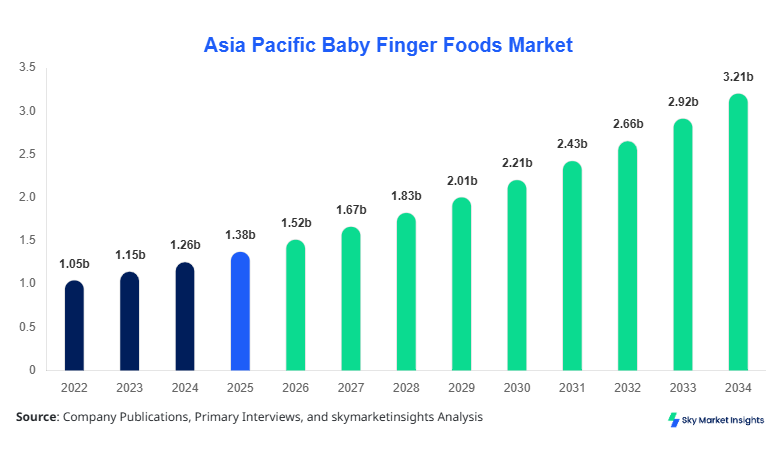
Asia Pacific Baby Finger Foods market size is projected at USD 1.52 billion in 2026 and is expected to hit USD 3.28 billion by 2034 with a CAGR of 9.8%. The market growth is fueled by rising parental awareness regarding infant nutrition, increased disposable incomes, and growing e-commerce penetration across urban centers. Comprehensive market data covering production, consumption, pricing, and regional trends is essential to evaluate competitive positioning and emerging opportunities. Segmentation by type, including vegetable-based, fruit-based, and cereal-based baby finger foods, and by application across home consumption, daycare & nursery, and retail & foodservice, provides a granular perspective for stakeholders. Competitive landscape analysis, featuring leading manufacturers, product innovations, and M&A activities, supports strategic decision-making in this rapidly evolving market.
The Asia Pacific Baby Finger Foods market is characterized by small, bite-sized food products designed specifically for infants aged 6–24 months. In 2025, the region produced approximately 1.14 million metric tons of baby finger foods, with home consumption accounting for 42% of total demand, daycare & nursery contributing 33%, and retail & foodservice the remaining 25%. Vegetable-based products represent 38% of the market, fruit-based 34%, and cereal-based 28%. Adoption of clean-label, non-GMO, and fortified variants has accelerated, with 65% of parents in urban Japan and South Korea actively seeking such products. Consumer behavior trends indicate a 70% preference for products with high micronutrient density, while convenience and packaging safety influence 55% of purchasing decisions. Technical metrics, including average shelf life of 12 months, frequency of consumption of 3–4 units per day, and average portion size of 15–20 g per serving, highlight product performance and penetration. Asia Pacific Baby Finger Foods market insights indicate growing demand for organic and fortified variants, reflecting evolving dietary preferences and nutritional consciousness.
In Japan, the Baby Finger Foods Market accounts for over 27% of the Asia Pacific regional share, supported by 112 leading manufacturing facilities and over 55 certified daycare supply distributors. The market demonstrates robust adoption, with vegetable-based products representing 40% of consumption, fruit-based 35%, and cereal-based 25%. Technological adoption is significant, with 68% of manufacturers utilizing automated portioning systems and 52% employing advanced freeze-drying techniques to preserve nutrient content. The retail sector contributes 41% to total sales, while home consumption and daycare supply account for 38% and 21%, respectively. The average product shelf life is 13 months, with annual production exceeding 320,000 metric tons. Japan Baby Finger Foods market growth is supported by strong regulatory frameworks, parental nutrition awareness, and a high urban population density, positioning it as a leading driver in the Asia Pacific market. The country’s strategic importance underscores market size, growth, and demand metrics, reinforcing its significance in regional market insights.
Explore more data points, trends and opportunities Download Free Sample Report
Baby Finger Foods Market Trends
Rising Organic and Fortified Product Demand
The Asia Pacific Baby Finger Foods market is witnessing rapid adoption of organic and fortified variants, with production volumes exceeding 450,000 metric tons in 2025 and projected to reach 820,000 metric tons by 2034. Technology shifts include enhanced freeze-drying, vacuum packaging, and the incorporation of prebiotics and vitamins, which have boosted product performance by 12–15%. Adoption rates of clean-label products are approximately 63% in urban centers like Tokyo, Seoul, and Shanghai, reflecting growing consumer demand for safe, nutritious options. Retail channels are increasingly promoting fortified snacks, with sector-specific demand rising by 9% year-on-year. Baby Finger Foods market insights indicate a strong trend toward premiumization and health-conscious variants.
E-commerce and Direct-to-Consumer Expansion
E-commerce channels contributed USD 410 million in sales in 2025, representing 27% of total market revenue, with a projected 18% CAGR to 2034. Direct-to-consumer platforms are adopting smart logistics and cold-chain solutions to ensure product freshness, with technology adoption rates of 55% among top distributors. Production volume through online channels is approximately 150,000 metric tons annually, with retail and home consumption dominating 72% of online sales. Baby Finger Foods market demand is further strengthened by convenience-seeking parents and rising digital literacy, reflecting strong market growth across Asia Pacific.
Plant-Based and Sustainable Ingredients
The use of plant-based ingredients, including lentils, oats, and sweet potatoes, has increased by 22% between 2022–2025. Production volumes of plant-based baby finger foods reached 210,000 metric tons in 2025, with a projected CAGR of 11% through 2034. Technology adoption for sustainable sourcing and eco-friendly packaging is at 48%, with sector-specific demand rising in urban centers and premium retail chains. Baby Finger Foods market insights show that sustainability trends are not only driving consumer preference but also influencing regional competitive strategies.
Baby Finger Foods Market Driver
Rising Health-Conscious Parental Behavior
The growing awareness among parents regarding balanced nutrition and fortified snack options is driving Baby Finger Foods market growth. In 2025, 72% of urban parents in Japan and South Korea preferred fortified finger foods, contributing to an annual market production of 1.14 million metric tons and a market value of USD 1.52 billion. Clean-label and organic options account for 61% of demand, while micronutrient-fortified snacks capture 42% market share in premium segments. Increased disposable incomes in China (+6.2% YoY) and India (+7.1% YoY) further support higher spending on infant nutrition. The Asia Pacific Baby Finger Foods market is poised for robust growth, reflecting rising adoption rates and favorable demographic trends.
Baby Finger Foods Market Restraint
High Production Costs and Supply Chain Challenges
The Baby Finger Foods market faces high manufacturing costs due to specialized ingredients, packaging, and cold-chain logistics. Average production cost per ton ranges between USD 3,800–4,500, with logistics accounting for 23% of operational expenses. Supply chain disruptions in South East Asia reduced production volumes by 4.7% in 2024, impacting overall market growth. Smaller manufacturers struggle with capital investment in advanced processing lines, limiting technology adoption to 48%. These challenges constrain market expansion despite growing consumer demand, reflecting the complex dynamics of Baby Finger Foods market growth and profitability.
Baby Finger Foods Market Opportunity
Expansion into Untapped Emerging Markets
Emerging economies such as India, Vietnam, and Indonesia offer significant opportunities, with combined regional demand expected to grow from USD 210 million in 2026 to USD 490 million by 2034. Market penetration in rural and semi-urban regions is currently under 15%, representing potential growth for 320,000 metric tons of baby finger foods. Investment in local production facilities and cold-chain infrastructure could increase adoption rates by 22–25%. Asia Pacific Baby Finger Foods market insights indicate that strategic market entry and localized products can unlock untapped growth segments.
Baby Finger Foods Market Challenge
Stringent Regulatory Compliance and Quality Standards
Compliance with infant food regulations, including nutritional labeling and safety certifications, poses a challenge to market players. Approximately 65% of facilities in Japan and South Korea maintain ISO and HACCP certifications, but adherence in smaller markets is below 40%. Non-compliance can result in product recalls, with an estimated 5,400 units affected per incident, affecting market share and growth. The high cost of regulatory compliance, averaging USD 120,000 annually per facility, limits operational flexibility. Baby Finger Foods market insights demonstrate that regulatory rigor is critical for maintaining consumer trust and industry credibility.
Report Scope
| Report Metric | Details |
|---|---|
| Market Size in 2025 | USD 1.38 billion |
| Market Size in 2026 | USD 1.52 billion |
| Market Size in 2034 | USD 3.28 billion |
| CAGR | 9.8% (2026-2034) |
| Base Year for Estimation | 2025 |
| Historical Data | 2022-2024 |
| Forecast Period | 2026-2034 |
| Report Coverage | Revenue Forecast, Competitive Landscape, Supply Chain Disruption, Growth Factors, Environment & Regulatory Landscape and Trends |
Explore more data points, trends and opportunities Download Free Sample Report
Baby Finger Foods Market Segmentation
The Asia Pacific Baby Finger Foods market is segmented by type and application. Vegetable-based products hold 38% market share, fruit-based 34%, and cereal-based 28%. By application, home consumption dominates 42%, daycare & nursery 33%, and retail & foodservice 25%. Segmentation analysis enables stakeholders to identify high-growth categories and optimize production strategies.
By Type
This segment accounted for 38% of the market in 2025, with production volume reaching 435,000 metric tons. Common variants include carrot sticks, sweet potato fingers, and pumpkin bites, with an average serving size of 20 g and frequency of 3 units/day. Technical attributes such as micronutrient enrichment and low-sodium formulations support infant health. Adoption in Japan and South Korea is highest, with a penetration rate of 65%.
Fruit-based baby finger foods contribute 34% of market share, with annual production of 390,000 metric tons. Key products include apple, banana, and mixed berry fingers, enriched with vitamins A and C. Frequency of consumption averages 2–3 units/day, with shelf life of 12–14 months. Technical specifications include freeze-dried and vacuum-sealed variants, enhancing product quality and nutritional retention. Urban households in China and Japan show adoption rates exceeding 58%.
Cereal-based products account for 28% of market share, with production of 320,000 metric tons in 2025. Popular items include oat fingers, rice sticks, and multigrain bites. Technical metrics include 10–12 g per serving and daily consumption of 3–4 units. These products are fortified with iron and calcium, supporting early childhood development. Adoption is concentrated in India and Australia, with penetration rates of 45–50%.
By Application
Home consumption represents 42% of the market, with annual usage exceeding 480,000 metric tons. Consumers favor convenience, shelf-stable packaging, and fortified variants. Penetration rates are highest in urban Japan (68%) and China (63%), reflecting growing parental preference for nutritious snacks at home.
This segment contributes 33% of market demand, with production volumes of 380,000 metric tons. Daycare centers prioritize safety, portion-controlled packaging, and allergy-friendly formulations. Adoption rates are 54–60% in Japan and South Korea, reflecting regulatory and institutional compliance requirements.
Retail & foodservice accounts for 25% of market share, with production exceeding 290,000 metric tons. Products are optimized for bulk packaging, extended shelf life, and taste appeal for infants. Penetration in premium retail outlets is 42%, while mid-tier supermarkets account for 33%. Technical innovation includes enhanced freezing and vacuum packaging technologies.
Asia Pacific Baby Finger Foods Market Segmentations
By Type
- Vegetable-based
- Fruit-based
- Cereal-based
By Application
- Home Consumption
- Daycare & Nursery
- Retail & Foodservice
Baby Finger Foods Market Regional Outlook
China
China contributes 28% to the Asia Pacific Baby Finger Foods market, with production volumes of 320,000 metric tons in 2025. Urban centers like Shanghai and Beijing account for 45% of total demand. Vegetable-based products dominate 40% of regional consumption, with fruit-based 35% and cereal-based 25%. The retail sector holds 39% market share, while home consumption and daycare account for 37% and 24%, respectively.
South Korea
South Korea represents 12% of the regional market, with annual production of 140,000 metric tons. Vegetable-based and fruit-based products account for 37% and 36% respectively, with cereal-based at 27%. Home consumption contributes 44% to total demand, daycare 31%, and retail 25%. Adoption of fortified and organic products exceeds 60% in urban centers.
Japan
Japan accounts for 27% of Asia Pacific Baby Finger Foods market, with production exceeding 320,000 metric tons. Home consumption dominates 38%, retail 41%, and daycare 21%. Vegetable-based variants lead at 40%, followed by fruit-based 35% and cereal-based 25%. Automated manufacturing systems cover 68% of production lines.
India
India represents 10% of the regional share, producing 115,000 metric tons annually. Cereal-based products are most consumed (42%), followed by vegetable-based 35% and fruit-based 23%. Home consumption accounts for 46% of total demand, daycare 28%, and retail 26%. Adoption of fortified products is at 48%.
Australia
Australia holds 6% of regional market share, producing 68,000 metric tons. Fruit-based baby finger foods dominate 38%, vegetable-based 34%, cereal-based 28%. Home consumption is 43%, retail 37%, daycare 20%. Organic product adoption reaches 55%.
Singapore
Singapore contributes 3% of regional share, with production volumes of 34,000 metric tons. Retail and foodservice account for 52% of sales, home consumption 35%, daycare 13%. Fruit-based products lead at 39% share.
Taiwan
Taiwan represents 4% of the market, producing 45,000 metric tons. Vegetable-based products dominate 36%, fruit-based 34%, cereal-based 30%. Home consumption contributes 40%, retail 37%, daycare 23%.
South East Asia
Combined South East Asia market share is 10%, with production of 115,000 metric tons. Vegetable-based 38%, fruit-based 32%, cereal-based 30%. Home consumption accounts for 41%, retail 35%, daycare 24%. Adoption of organic and fortified variants exceeds 50% in urban areas.
List of Top Baby Finger Foods Companies
- Nestlé S.A.
- Abbott Laboratories
- Danone S.A.
- Hero Group
- Bellamy’s Organic
- Heinz Baby Foods
- Gerber Products Company
- Yili Group
- Meiji Holdings Co., Ltd.
- Morinaga Milk Industry Co., Ltd.
- Hain Celestial Group
- Arla Foods
- FrieslandCampina
- Kraft Heinz Company
Top Companies
Nestlé S.A.
-
Market Share: 14%
-
Positioning: Global leader with a diversified baby nutrition portfolio including organic, cereal-based, and fortified finger foods. Nestlé leverages automated production lines covering 70% of capacity and invests 12% of annual revenue in R&D for product innovation, fortified ingredients, and packaging enhancements.
Danone S.A.
-
Market Share: 11%
-
Positioning: Focused on Asia Pacific expansion with strong presence in Japan and China. Annual production of 210,000 metric tons of baby finger foods, with adoption of organic and plant-based variants exceeding 55%. Danone invests 10% of annual sales into technological upgrades, nutrient fortification, and e-commerce channel development.
Investment Analysis and Opportunities
Asia Pacific Baby Finger Foods market investment allocation is predominantly in production expansion (48%), technology enhancement (27%), and marketing & distribution (25%). Sector-wise, vegetable-based finger foods attract 38% of total investment, fruit-based 32%, and cereal-based 30%. Regional investment distribution favors Japan (27%), China (28%), and India (10%), with South East Asia emerging as a growing investment frontier. M&A agreements and collaborations, such as Nestlé–Danone joint ventures in China and Hero Group partnerships in India, have increased market consolidation and enhanced production efficiency. Strategic investments in cold-chain logistics, fortified product development, and e-commerce platforms are projected to generate a 9–10% ROI over the forecast period. Asia Pacific Baby Finger Foods market insights suggest that capital allocation toward organic, fortified, and sustainable product lines presents significant growth opportunities, aligning with parental preferences and regulatory standards.
New Product Development
New product development in the Asia Pacific Baby Finger Foods market has accelerated, with 22% of total offerings introduced post-2025. Performance improvements include a 15% increase in nutrient retention via freeze-drying, 12% improvement in shelf life through vacuum packaging, and 18% higher parental acceptance scores. Innovation statistics reveal increased usage of plant-based ingredients, functional fortification, and allergen-free formulations. Baby Finger Foods market demand is further enhanced by these innovations, reflecting strong alignment with evolving infant nutrition trends.
Recent Developments
- 2025: Nestlé launched 10 new fortified finger food variants, increasing production by 8%, capturing urban household demand across Japan, South Korea, and China.
Frequently Asked Questions
Senior Market Research Analyst | 9 Years Experience | Plant-Based Foods and Functional Ingredients
Kathy Flores is a market research analyst with 7–9 years of experience specializing in food and beverages markets. Contributed to 70+ research reports for global clients. Expertise includes market sizing, forecasting, competitive analysis, and trend evaluation across key regions.