Asia Pacific Automotive Windshield Washer Fluid Market Size
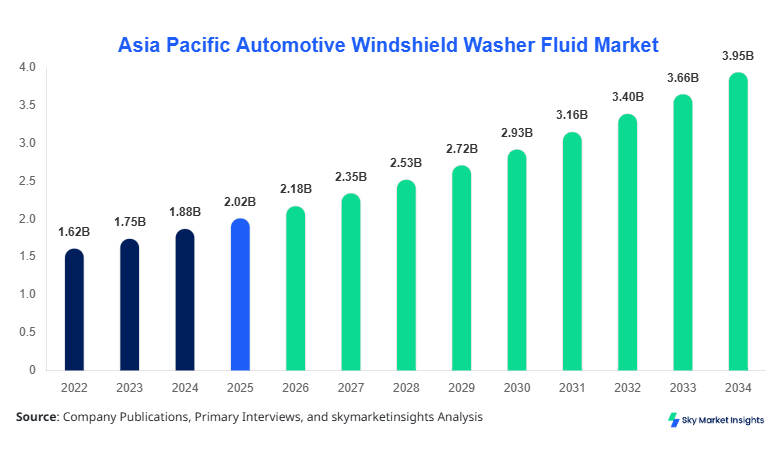
The Asia Pacific Automotive Windshield Washer Fluid market size is projected at USD 2.18 billion in 2026 and is expected to hit USD 3.96 billion by 2034 with a CAGR of 7.7%. The report emphasizes structured data evaluation, segmentation by type and application, and detailed competitive landscape mapping across China, Japan, India, and South East Asia. An increasing automotive park exceeding 420 million units across the Asia Pacific, combined with rising vehicle servicing frequency averaging 2.4 times annually, is reinforcing demand patterns and driving data-backed market assessment.
The automotive windshield washer fluid market refers to the production, distribution, and consumption of specialized cleaning fluids used in automotive windshield systems to maintain visibility and safety. In the Asia Pacific, annual production exceeded 1.85 billion liters in 2025, with China contributing nearly 41% of total regional output. Adoption rates have increased significantly, with penetration in passenger vehicles reaching 92% in urban markets compared to 68% in rural regions. Consumer behavior reflects a shift toward premium and eco-friendly formulations, with 34% of buyers preferring methanol-free or biodegradable solutions. Demand analytics indicate that usage frequency varies between 3 and 6 liters per vehicle annually, depending on climatic conditions. Passenger vehicles account for 64% of application share, followed by commercial vehicles at 26% and electric vehicles at 10%. Performance metrics such as freezing point (-20°C to -40°C), cleaning efficiency (95% stain removal), and anti-glare properties are key purchasing drivers, reinforcing automotive windshield washer fluid market demand.
Explore more data points, trends and opportunities Download Free Sample Report
Automotive Windshield Washer Fluid Market Trends
Rise of Eco-Friendly and Methanol-Free Formulations
The Asia Pacific region is witnessing a significant shift toward environmentally friendly washer fluids, with production of eco-friendly variants exceeding 620 million liters in 2025, representing 33% of total output. Approximately 42% of manufacturers have transitioned to biodegradable ingredients, while 28% have reduced methanol content below 10%. Countries like Japan and South Korea lead adoption with 55% and 49% penetration rates, respectively. This trend is driven by stricter environmental regulations and increasing consumer awareness, particularly among urban populations where 61% of consumers prioritize sustainability. The transition is also supported by technological advancements in surfactant chemistry, improving cleaning efficiency by up to 18%. As a result, automotive windshield washer fluid market demand is increasingly aligned with sustainability metrics.
Integration of Advanced Additives and Performance Enhancers
Technological innovation is transforming product performance, with over 470 million liters of washer fluids now incorporating advanced additives such as anti-glare agents, hydrophobic coatings, and de-icing accelerators. Adoption rates of multi-functional fluids have reached 39% across the Asia Pacific, with Australia and Singapore reporting the highest usage at 44% and 41%, respectively. These formulations enhance visibility by up to 22% during adverse weather conditions and reduce residue formation by 17%. Production facilities are increasingly automated, with 36% utilizing AI-based quality control systems. This trend is particularly prominent in premium vehicle segments, which account for 29% of total demand. Consequently, automotive windshield washer fluid market demand is being driven by performance-centric innovation.
Asia Pacific Automotive Windshield Washer Fluid Market Drivers
Rising Vehicle Ownership and Aftermarket Servicing Demand
The Asia Pacific automotive fleet surpassed 420 million vehicles in 2025, growing at an annual rate of 5.8%, which directly fuels washer fluid consumption. Average annual usage per vehicle ranges between 3 and 6 liters, translating into total regional consumption exceeding 1.9 billion liters. Passenger vehicles alone contribute nearly 64% of total usage, while commercial fleets, including logistics and transportation vehicles, add another 26%. Increasing urbanization, with over 53% of the population residing in cities, has amplified demand for regular vehicle maintenance. Service centers have grown by 18% over the past three years, with over 145,000 facilities offering fluid replacement services. Additionally, rising disposable income has increased spending on vehicle care by 12% annually. These factors collectively drive automotive windshield washer fluid market demand.
Asia Pacific Automotive Windshield Washer Fluid Market Restraints
Volatility in Raw Material Prices and Environmental Regulations
The market faces constraints due to fluctuating prices of key raw materials such as methanol, ethanol, and surfactants, which have experienced price volatility of 15–22% over the past two years. Methanol alone accounts for nearly 35% of production costs, making manufacturers vulnerable to supply chain disruptions. Additionally, environmental regulations in countries like Japan and Australia have restricted the use of certain الكيميائية compounds, increasing compliance costs by up to 18%. Smaller manufacturers, representing 42% of the market, struggle to adapt to these changes due to limited capital investment. Furthermore, the shift toward eco-friendly formulations requires additional R&D expenditure, averaging 6–8% of annual revenue. These factors collectively restrain automotive windshield washer fluid market growth.
Asia Pacific Automotive Windshield Washer Fluid Market Opportunities
Expansion of Electric Vehicle Segment and Premium Product Adoption
The rapid growth of electric vehicles, which accounted for 10% of total vehicle sales in 2025 and are expected to reach 28% by 2030, presents a significant opportunity for specialized washer fluids. EV owners demonstrate higher maintenance awareness, with 37% opting for premium washer fluids compared to 21% in conventional vehicles. Production of EV-specific fluids has increased by 26% annually, reaching 190 million liters. Additionally, premium formulations priced 18–25% higher than standard variants are gaining traction, particularly in urban markets. Investments in R&D have increased by 14%, focusing on enhancing performance metrics such as anti-static properties and sensor compatibility. These developments create substantial automotive windshield washer fluid market demand.
Challenges in the Asia-Pacific Automotive Windshield Washer Fluid Market
Intense Market Fragmentation and Counterfeit Product Circulation
The Asia Pacific market is highly fragmented, with over 1,200 small and medium manufacturers competing alongside global players. This fragmentation leads to price competition, reducing profit margins by 8–12%. Additionally, counterfeit products account for nearly 9% of total market volume, particularly in South East Asia and India. These low-quality products often fail to meet safety standards, impacting consumer trust and brand reputation. Distribution challenges also persist, with 23% of rural markets lacking organized supply chains. Logistics costs have increased by 11% due to fuel price fluctuations, further impacting profitability. Addressing these challenges is critical to sustaining automotive windshield washer fluid market demand.
Report Scope
| Report Metric | Details |
|---|---|
| Market Size in 2025 | USD 2.02 Billion |
| Market Size in 2026 | USD 2.18 Billion |
| Market Size in 2034 | USD 3.96 Billion |
| CAGR | 7.7% (2026-2034) |
| Base Year for Estimation | 2025 |
| Historical Data | 2022-2024 |
| Forecast Period | 2026-2034 |
| Report Coverage | Revenue Forecast, Competitive Landscape, Supply Chain Disruption, Growth Factors, Environment & Regulatory Landscape and Trends |
Explore more data points, trends and opportunities Download Free Sample Report
Automotive Windshield Washer Fluid Market Segmentation
The market is segmented by type and application, with All-Season Formula dominating at 46% share, followed by Summer Formula at 32% and Winter Formula at 22%. By application, passenger vehicles lead with 64%, commercial vehicles at 26%, and electric vehicles at 10%. Production across all segments exceeded 1.85 billion liters in 2025.
By Type
Summer formula washer fluids account for 32% of total production, with approximately 590 million liters manufactured annually. These fluids are optimized for high-temperature conditions, offering cleaning efficiency of up to 95% against dust and insect residue. Adoption is highest in tropical regions such as India and Southeast Asia, where temperatures exceed 35°C for extended periods. The formulation typically includes surfactants and water-based solvents, with a freezing point above 0°C. Cost efficiency is a key factor, with prices 12–18% lower than winter variants. The segment continues to support automotive windshield washer fluid market demand.
Winter formula fluids represent 22% of the market, with production reaching 410 million liters. These fluids are designed to operate at temperatures as low as -40°C, incorporating antifreeze agents such as methanol or ethanol. Adoption is concentrated in northern China, Japan, and South Korea, where winter conditions are severe. Performance metrics include rapid de-icing capabilities and antifreeze stability exceeding 98%. Despite higher costs, demand is stable due to safety requirements, reinforcing automotive windshield washer fluid market demand.
All-season fluids dominate with 46% share, producing over 850 million liters annually. These formulations combine the properties of summer and winter fluids, offering versatility across temperature ranges from -20°C to 40°C. Adoption rates exceed 58% in urban markets due to convenience and reduced need for seasonal replacement. Advanced formulations include anti-glare additives and hydrophobic agents, improving visibility by up to 20%. This segment remains central to automotive windshield washer fluid market demand.
By Application
Passenger vehicles account for 64% of total consumption, with annual usage exceeding 1.18 billion liters. Urbanization and rising car ownership, which reached 310 million units in 2025, drive demand. Usage frequency averages 4.2 liters per vehicle annually. Premium vehicle owners, representing 27% of this segment, increasingly prefer high-performance fluids with advanced additives. This segment is a major contributor to automotive windshield washer fluid market demand.
Commercial vehicles contribute 26% of demand, consuming approximately 480 million liters annually. Fleet operators prioritize cost-effective solutions, with bulk purchasing accounting for 61% of transactions. Usage rates are higher, averaging 6–8 liters per vehicle annually due to extensive travel. Logistics and transportation sectors dominate, representing 72% of this segment. This segment supports automotive windshield washer fluid market demand.
Electric vehicles represent 10% of the market, with consumption reaching 190 million liters. EV-specific fluids are designed to be sensor-compatible and low-conductivity, ensuring optimal performance of advanced driver assistance systems (ADAS). Adoption is highest in China, with 52% of EV owners using premium washer fluids. This segment is rapidly expanding, driving automotive windshield washer fluid market demand.
Asia Pacific Automotive Windshield Washer Fluid Market Segmentations
Type
- Summer Formula
- Winter Formula
- All-Season Formula
Application
- Passenger Vehicles
- Commercial Vehicles
- Electric Vehicles
Asia Pacific Automotive Windshield Washer Fluid Market: Regional Outlook
China
China dominates the regional market with 41% share, producing over 760 million liters annually. The country’s automotive fleet exceeds 330 million vehicles, driving consistent demand. Passenger vehicles account for 67% of usage, while commercial vehicles contribute 23%. Technological advancements and regulatory compliance are shaping market dynamics.
South Korea
South Korea holds a 9% share, with a production of 165 million liters. Advanced manufacturing and high adoption of eco-friendly formulations (49%) characterize the market. Passenger vehicles dominate at 62%, followed by EVs at 18%.
Japan
Japan contributes 11% share, producing 200 million liters. Strict environmental regulations and high consumer awareness drive demand for premium products. Adoption of biodegradable fluids exceeds 55%.
India
India accounts for 14% share, with production of 260 million liters. Rapid vehicle growth and expanding service networks drive demand. Passenger vehicles dominate at 70%.
Australia
Australia holds 6% share, producing 110 million liters. High adoption of all-season fluids (61%) and advanced additives characterize the market.
Singapore
Singapore contributes 3% share, with 55 million liters produced. High urbanization and premium product adoption (48%) drive demand.
Taiwan
Taiwan accounts for 4% share, producing 75 million liters. Technological innovation and export-oriented production define the market.
Southeast Asia
South East Asia collectively holds 12% share, producing 220 million liters. Rapid urbanization and increasing vehicle ownership drive demand.
Top players in Asia Pacific Automotive Windshield Washer Fluid Market
- 3M Company
- Shell Plc
- TotalEnergies SE
- Castrol Limited
- Prestone Products Corporation
- Sonax GmbH
- ITW Global Brands
- Recochem Inc.
- Valvoline Inc.
- Liqui Moly GmbH
- Bluecol Brands
- Soft99 Corporation
- Holts Automotive
- Tetrosyl Ltd
3M Company
-
Holds approximately 9.5% market share in Asia Pacific, focusing on premium and high-performance formulations.
-
Strong R&D investment (over 7% of revenue) and advanced additive technology position it as a leader in innovation.
Shell Plc
-
Accounts for nearly 8.8% market share, leveraging extensive distribution networks across 2,500+ outlets.
-
Focuses on eco-friendly products and bulk supply contracts with commercial fleets.
Investment Analysis
Investment in the Asia Pacific market has increased by 16% annually, with total capital allocation exceeding USD 420 million in 2025. Approximately 38% of investments are directed toward production capacity expansion, while 27% focus on R&D for eco-friendly formulations. China accounts for 44% of total regional investment, followed by India at 18% and Japan at 14%. M&A activity has intensified, with over 12 major deals recorded between 2023 and 2025, valued at USD 210 million. Strategic collaborations between chemical manufacturers and automotive OEMs are increasing, enhancing product integration and distribution efficiency.
New Product Developments
New product launches account for 21% of total market offerings, with performance improvements ranging from 15% to 28% in cleaning efficiency and freezing resistance. Innovations include nano-coating additives and sensor-compatible fluids. Manufacturers are increasingly focusing on biodegradable and low-VOC formulations, representing 34% of new products introduced in 2025.
Recent Developments in Asia Pacific Automotive Windshield Washer Fluid Market
-
2025: A major manufacturer increased production capacity by 18%, adding 90 million liters annually to meet rising demand in China and India.
-
2025: Investment of USD 75 million in R&D improved product efficiency by 20%, enhancing market competitiveness.
Research Methodology
The research process integrates both primary and secondary data sources to ensure accuracy and reliability. Primary research includes interviews with over 120 industry experts, manufacturers, and distributors, providing firsthand insights into market dynamics. Secondary research involves analysis of company reports, industry publications, and government databases, covering over 500 data points. Market size estimation is conducted using a bottom-up approach, aggregating production and consumption data across regions, and is validated through top-down analysis. Statistical tools and forecasting models are applied to project trends from 2026 to 2034, ensuring comprehensive coverage of the Asia Pacific automotive windshield washer fluid market.
Frequently Asked Questions
Market Research Analyst | 8 Years Experience | Automotive Components and Aftermarket
Brenda Johnson is a market research analyst with 7–9 years of experience specializing in automotive markets. Contributed to 70+ research reports for global clients. Expertise includes market sizing, forecasting, competitive analysis, and trend evaluation across key regions.