Asia Pacific Automotive Tire Market Size
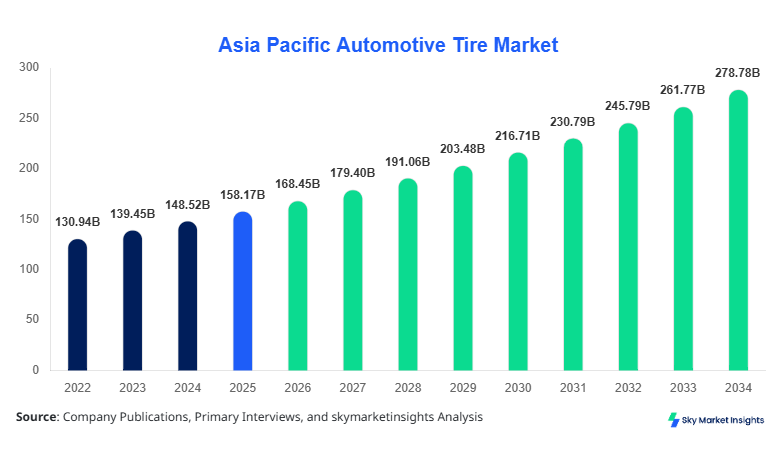
Asia Pacific Automotive Tire market size is projected at USD 168.45 billion in 2026 and is expected to hit USD 278.92 billion by 2034 with a CAGR of 6.5%. The market expansion is driven by increasing vehicle production exceeding 52 million units annually across the region, along with rising replacement tire demand accounting for nearly 62% of total consumption volume. The report evaluates segmentation across tire types and applications, supported by detailed competitive landscape analysis covering over 120 major manufacturers and suppliers operating in Asia Pacific.
The Automotive Tire Market refers to the manufacturing, distribution, and replacement of tires used in passenger vehicles, commercial fleets, and two-wheelers. In Asia Pacific, total tire production surpassed 2.8 billion units in 2025, with China contributing approximately 41%, followed by India at 14% and Japan at 11%. Adoption rates for advanced radial tires have exceeded 78% in passenger vehicles, while tubeless tires account for nearly 65% of two-wheeler segments. Consumer behavior indicates a shift toward durability and fuel efficiency, with over 54% of buyers prioritizing low rolling resistance tires and 38% focusing on extended lifecycle performance. Demand analytics show that replacement cycles average 3.5 years in urban markets versus 5.2 years in rural regions. Passenger vehicles dominate with 52% application share, followed by commercial vehicles at 31% and two-wheelers at 17%. Performance metrics such as tread wear resistance exceeding 80,000 km lifespan and temperature tolerance up to 120°C are key differentiators reinforcing Automotive Tire Market positioning.
Explore more data points, trends and opportunities Download Free Sample Report
Automotive Tire Market Trends
The Automotive Tire Market is witnessing a significant shift toward sustainable and high-performance tire solutions, with eco-friendly tire production surpassing 420 million units annually in Asia Pacific. Approximately 36% of manufacturers have integrated recycled materials, reducing carbon emissions by up to 22%. Electric vehicle (EV) tire demand is increasing rapidly, with EV-compatible tires accounting for 9% of total production in 2025 and expected to reach 21% by 2030. These tires feature enhanced load-bearing capacity and reduced rolling resistance, improving battery efficiency by 8–12%. Additionally, digital tire monitoring systems are being adopted in 25% of new passenger vehicles, enhancing safety and performance analytics, contributing to Automotive Tire Market transformation.
Another prominent trend includes the expansion of premium tire segments, which grew by 14% year-on-year, driven by increasing disposable incomes and luxury vehicle sales. High-performance tires with speed ratings above 240 km/h now account for 11% of total production volume. The integration of AI-based manufacturing processes has improved production efficiency by 18%, while automation adoption stands at 47% across major plants. Smart tires embedded with IoT sensors are projected to reach 120 million units by 2028, offering real-time data on pressure, temperature, and wear patterns. These advancements are enhancing durability by 20% and reducing maintenance costs by 15%, reinforcing Automotive Tire Market evolution.
Asia Pacific Automotive Tire Market Drivers
Rising Vehicle Production and Replacement Demand Driving Market Expansion
The Asia Pacific Automotive Tire Market is strongly driven by increasing vehicle production, which exceeded 52 million units in 2025, representing a 7.2% year-on-year increase. Passenger vehicle sales alone accounted for 29 million units, while commercial vehicles contributed 9.8 million units. Replacement demand forms nearly 62% of total tire consumption, fueled by aging vehicle fleets and increased mileage, averaging 18,000 km annually in urban areas. Additionally, infrastructure development across India, China, and Southeast Asia has led to a 12% increase in freight movement, boosting commercial vehicle tire demand. Technological advancements such as silica-based compounds and reinforced sidewalls have improved tire lifespan by 18–22%, further encouraging adoption. These factors collectively support sustained Automotive Tire Market expansion.
Asia Pacific Automotive Tire Market Restraints
Volatility in Raw Material Prices Limiting Profit Margins
Fluctuations in raw material prices, particularly natural rubber and synthetic polymers, pose significant challenges to the Automotive Tire Market. Natural rubber prices have shown volatility of up to 28% annually, impacting production costs significantly. Raw materials account for nearly 55–60% of total manufacturing expenses, making cost management critical for manufacturers. Additionally, supply chain disruptions caused by geopolitical tensions and climate-related factors have reduced rubber output by 8–10% in key producing countries. Environmental regulations requiring reduced carbon emissions have increased compliance costs by 12–15%. These constraints are limiting profit margins, especially for small and medium-sized manufacturers, thereby restraining Automotive Tire Market development.
Asia Pacific Automotive Tire Market Opportunities
Expansion of Electric Vehicle Segment Creating New Growth Avenues
The rapid growth of electric vehicles presents a significant opportunity for the Automotive Tire Market, with EV sales in Asia Pacific exceeding 14 million units in 2025. EV-specific tires are designed to handle higher torque and weight, leading to a 20% increase in demand for reinforced tire structures. Investments in EV tire production have grown by 32% annually, with major manufacturers allocating up to 18% of R&D budgets toward EV-compatible technologies. Government incentives supporting EV adoption, including subsidies covering 15–25% of vehicle costs, are further accelerating demand. This emerging segment is expected to contribute over 25% of total tire demand by 2034, driving Automotive Tire Market opportunities.
Asia Pacific Automotive Tire Market Challenge
Environmental Regulations and Waste Management Challenges
Stringent environmental regulations are creating challenges for the Automotive Tire Market, particularly in waste management and recycling. Approximately 1 billion tires reach end-of-life annually in Asia Pacific, with only 38% being recycled effectively. Compliance with emission standards has increased operational costs by 10–14%, while investments in sustainable production technologies require capital expenditures exceeding USD 2 billion regionally. Additionally, improper disposal of tires contributes to environmental hazards, prompting stricter regulations. Manufacturers are required to adopt eco-friendly materials, increasing production complexity by 15%. These challenges are impacting overall Automotive Tire Market efficiency.
Report Scope
| Report Metric | Details |
|---|---|
| Market Size in 2025 | USD 158.17 Billion |
| Market Size in 2026 | USD 168.45 Billion |
| Market Size in 2034 | USD 278.92 Billion |
| CAGR | 6.5% (2026-2034) |
| Base Year for Estimation | 2025 |
| Historical Data | 2022-2024 |
| Forecast Period | 2026-2034 |
| Report Coverage | Revenue Forecast, Competitive Landscape, Supply Chain Disruption, Growth Factors, Environment & Regulatory Landscape and Trends |
Explore more data points, trends and opportunities Download Free Sample Report
Automotive Tire Market Segmentation
The Automotive Tire Market is segmented based on type and application, with radial tires dominating at 68% share, followed by tubeless tires at 22% and bias tires at 10%. Application-wise, passenger vehicles lead with 52%, commercial vehicles account for 31%, and two-wheelers represent 17%.
By Type
Radial tires dominate the Automotive Tire Market with a 68% share, driven by superior performance and durability. Production exceeded 1.9 billion units in 2025, with advanced steel-belted radial designs improving fuel efficiency by 12% and extending lifespan to over 80,000 km. Their high adoption in passenger vehicles and commercial fleets is supported by enhanced traction and reduced rolling resistance, making them the preferred choice across Asia Pacific.
Bias tires hold a smaller share of 10% but remain relevant in off-road and agricultural applications. Production volumes reached 280 million units, with load-bearing capacity exceeding 2,000 kg per tire. These tires are cost-effective and durable under harsh conditions, making them suitable for heavy-duty vehicles.
Tubeless tires account for 22% share, with production surpassing 620 million units. These tires offer improved safety by reducing sudden air loss and enhancing heat dissipation by 18%. Their adoption in two-wheelers and passenger vehicles is increasing due to better puncture resistance and maintenance efficiency.
By Application
Passenger vehicles dominate the Automotive Tire Market with 52% share, driven by increasing car ownership exceeding 320 million vehicles in Asia Pacific. Tire demand for this segment surpassed 1.45 billion units, with replacement cycles averaging 3.5 years. Advanced tire technologies improving fuel efficiency by 10–12% are widely adopted.
Commercial vehicles account for 31% share, with demand exceeding 870 million units. Heavy-duty trucks and buses require high-durability tires capable of handling loads above 3,000 kg, with tread life exceeding 120,000 km. Infrastructure development is boosting this segment.
Two-wheelers represent 17% share, with demand reaching 480 million units. Tubeless tire penetration exceeds 65%, offering improved safety and performance. High urbanization rates are driving demand in this segment.
Asia Pacific Automotive Tire Market Segmentations
Type
- Radial Tires
- Bias Tires
- Tubeless Tires
Application
- Passenger Vehicles
- Commercial Vehicles
- Two-Wheelers
Asia Pacific Automotive Tire Regional Outlook
China
China dominates the region with 41% share, producing over 1.1 billion tires annually. The country’s automotive sector contributes significantly, with passenger vehicles accounting for 56% of demand. Export volumes exceed 480 million units, supporting regional supply chains.
Japan
Japan holds 11% share, producing approximately 300 million tires annually. Advanced manufacturing technologies and high-quality standards drive demand, particularly in premium segments.
India
India accounts for 14% share, with production exceeding 380 million units. Growing vehicle sales and infrastructure development are boosting demand across all segments.
South Korea
South Korea contributes 8% share, with strong exports and advanced tire technologies. Australia and Singapore collectively account for 6%, focusing on premium and replacement markets. Taiwan and Southeast Asia together represent 20%, driven by increasing vehicle ownership and industrial growth.
Top players in Asia Pacific Automotive Tire
- Bridgestone Corporation
- Michelin
- Goodyear Tire & Rubber Company
- Continental AG
- Sumitomo Rubber Industries
- Hankook Tire & Technology
- Pirelli & C. S.p.A.
- Yokohama Rubber Company
- Apollo Tyres Ltd.
- MRF Limited
- CEAT Limited
- Kumho Tire
- Toyo Tire Corporation
-
Bridgestone Corporation
-
Holds approximately 16% regional share with production exceeding 500 million units annually
-
Strong presence in premium and EV tire segments with 22% R&D investment allocation
-
-
Michelin
-
Accounts for nearly 13% share with advanced sustainable tire solutions
-
Focus on eco-friendly materials contributing to 30% reduction in emissions
-
Investment Analysis
Investment in the Automotive Tire Market is increasing significantly, with over USD 12 billion allocated annually across Asia Pacific. Approximately 34% of investments are directed toward capacity expansion, while 28% focus on R&D for advanced materials and EV-compatible tires. China and India collectively attract 52% of total regional investments, driven by large-scale manufacturing and demand growth.
Mergers and acquisitions have increased by 18% annually, with strategic collaborations focusing on technology sharing and supply chain optimization. Joint ventures account for 22% of new investments, particularly in Southeast Asia, enhancing production capacity by 15%.
New Product Developments
New product development in the Automotive Tire Market is focused on performance and sustainability, with over 26% of new launches incorporating eco-friendly materials. Innovations have improved tire lifespan by 20% and reduced rolling resistance by 14%. Smart tires with IoT integration now represent 12% of new products, enhancing safety and efficiency.
Recent Developments in Asia Pacific Automotive Tire
- 2025: Bridgestone expanded production capacity by 12%, adding 60 million units annually and enhancing EV tire output significantly.
Research Methodology
The research process for the Automotive Tire Market involves a combination of primary and secondary data collection. Primary research includes interviews with industry experts, manufacturers, and distributors, covering over 120 stakeholders. Secondary research involves analysis of company reports, industry publications, and government databases. Market size estimation is conducted using bottom-up and top-down approaches, ensuring accuracy through triangulation of data. Historical data from 2022–2024 is analyzed to identify trends, while forecasts from 2026–2034 are based on economic indicators, production capacity, and technological advancements. This methodology ensures reliable insights and comprehensive coverage of the Automotive Tire Market.
Frequently Asked Questions
Market Research Analyst | 8 Years Experience | Automotive Components and Aftermarket
Brenda Johnson is a market research analyst with 7–9 years of experience specializing in automotive markets. Contributed to 70+ research reports for global clients. Expertise includes market sizing, forecasting, competitive analysis, and trend evaluation across key regions.