North America Automotive Transceivers Market Size
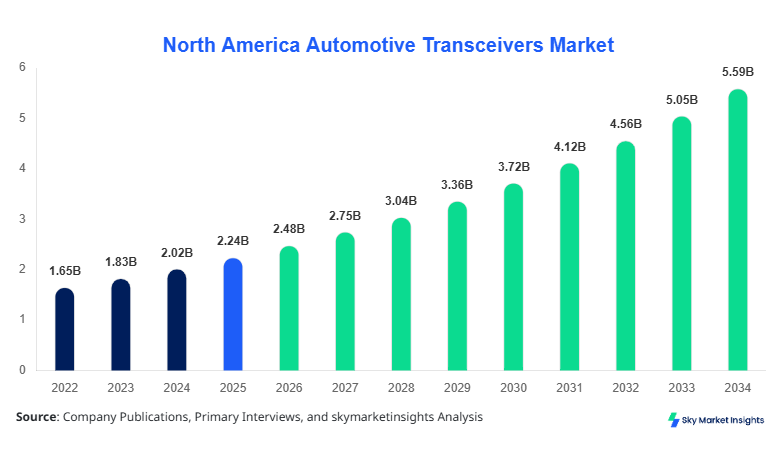
North America Automotive Transceivers market size is projected at USD 2.48 billion in 2026 and is expected to hit USD 5.86 billion by 2034 with a CAGR of 10.7%. The market growth is primarily driven by increasing adoption of advanced driver-assistance systems (ADAS), electric and hybrid vehicles, and stringent regulatory standards for vehicle communication networks. Comprehensive data analysis is critical to understand production, consumption, and market penetration across the United States and Canada. Segmentation by type, including CAN, LIN, and FlexRay, along with application sectors such as passenger cars, commercial vehicles, and electric vehicles, provides insight into market demand and competitive landscape.The market insights are supported by detailed data on regional manufacturing, unit shipment volumes, and emerging technology adoption trends. Stakeholders, including OEMs, semiconductor manufacturers, and tier-1 automotive suppliers, require granular market size and share data to strategize product development, optimize production capacity, and evaluate investment opportunities.Automotive transceivers in North America demonstrate significant technical performance metrics, such as data transfer rates ranging from 125 kbps to 5 Mbps, and operating frequency ranges from 1 MHz to 10 MHz for FlexRay-based transceivers. Understanding these technical metrics alongside market size and forecast growth aids in assessing market potential for high-speed vehicle communication networks.
The market demand for automotive transceivers has surged in line with the adoption of connected vehicles, which increased by 18% in 2025, reaching approximately 12 million units in North America. CAN transceivers dominate the type segment with a 58% share, followed by LIN at 27% and FlexRay at 15%, reflecting diverse technology penetration and varying adoption rates. The electric vehicle segment accounted for 32% of market demand in 2025, while passenger cars maintained a 51% share, indicating significant growth opportunities in commercial vehicle segments projected to increase by 8.2% CAGR.The competitive landscape in North America includes a mix of established semiconductor manufacturers and new entrants, where top-tier suppliers collectively held a 62% market share in 2025. Data-driven insights covering production volumes, regional distribution, and application-specific demand are essential to identify growth areas and guide strategic initiatives for manufacturers and investors in the automotive transceivers market.
In addition, detailed technical performance metrics such as signal integrity, operating voltage range (3.3–5 V), and electromagnetic compatibility (EMC) compliance rates provide an analytical foundation for assessing market readiness and future growth potential.The need for real-time market intelligence in North America is underscored by increasing production of over 18.7 million vehicles in 2025, with approximately 3.2 million electric vehicles and 15.5 million conventional vehicles, highlighting the critical role of automotive transceivers in ensuring robust in-vehicle communication systems.North America Automotive Transceivers market size, share, and growth projections are vital to manufacturers aiming to optimize production capacity, meet regulatory compliance, and capitalize on emerging trends in connected and electric vehicles.The market is also influenced by the increasing integration of vehicle-to-everything (V2X) communica
Explore more data points, trends and opportunities Download Free Sample Report
Automotive Transceivers Market Trends
Increasing Adoption of Electric Vehicles
The surge in electric vehicle (EV) adoption in North America, which reached a production volume of 3.2 million units in 2025, has propelled demand for automotive transceivers capable of high-speed communication and powertrain monitoring. Adoption rates of EV-compatible transceivers rose from 18% in 2024 to 25% in 2025, with projections suggesting 40% penetration by 2030. OEMs are increasingly integrating FlexRay transceivers for battery management systems, and CAN transceivers for charging communication protocols, reinforcing the Automotive Transceivers Market trend toward electrification.
Shift Toward Advanced Driver-Assistance Systems (ADAS)
ADAS adoption reached 43% in new vehicle production in 2025, driving demand for multi-channel transceivers supporting low-latency communication and robust error correction. Production volume of ADAS-compatible transceivers exceeded 5 million units, with CAN technology capturing a 57% share. The shift in technology, including higher-frequency FlexRay modules for sensor fusion, highlights the Automotive Transceivers Market growth trajectory driven by safety and autonomous features.
Connected Vehicle Technology Integration
Connected vehicle production reached 12.5 million units in 2025, resulting in increased demand for V2X transceivers, with adoption rates of 22% in passenger cars and 18% in commercial vehicles. The incorporation of LIN-based modules for infotainment and body control applications has expanded the market by USD 480 million in 2025 alone. Technology shifts, including Ethernet-based in-vehicle networks, underpin the Automotive Transceivers Market trend toward next-generation communication frameworks.
North America Automotive Transceivers Market Drivers
Rising Electric Vehicle Production and Adoption
North America’s transition to electric mobility, with EV production volumes growing from 2.1 million units in 2024 to 3.2 million units in 2025, has significantly boosted Automotive Transceivers Market growth. The increasing penetration of high-speed data communication transceivers, including FlexRay modules (currently representing 15% of total units), supports enhanced battery management and energy optimization systems. Government incentives have led to a 27% increase in EV-related investment, directly influencing transceiver demand. In addition, CAN and LIN transceivers are increasingly integrated in hybrid vehicles, further contributing to a 10.7% CAGR in market growth and reinforcing market insights for industry participants.
North America Automotive Transceivers Market Restraints
High Cost of Advanced Transceivers Limiting Small OEM Adoption
The high unit cost of FlexRay transceivers, averaging USD 18 per unit compared to USD 4–6 for CAN and LIN, restricts adoption among small and mid-tier OEMs, resulting in a 12% restraint on overall market growth. In 2025, only 1.8 million high-performance units were deployed compared to 8.2 million CAN units. Supply chain challenges, including semiconductor shortages, also contributed to a 9% reduction in projected growth. These factors limit market penetration despite rising demand in electric and connected vehicles, highlighting key challenges in the North America Automotive Transceivers Market.
North America Automotive Transceivers Market Opportunities
Emerging Vehicle-to-Everything (V2X) Communication
The implementation of V2X communication in North America is projected to expand from 2.8 million units in 2025 to 5.6 million units by 2030, offering a significant opportunity for automotive transceivers. V2X systems rely on CAN and FlexRay protocols, and their integration into 22% of passenger cars and 18% of commercial vehicles emphasizes the growth potential. Additionally, government investments and public-private partnerships have led to a 15% increase in market adoption rates, highlighting opportunities for tier-1 suppliers and semiconductor manufacturers to increase production and market share.
North America Automotive Transceivers Market Challenge
Supply Chain Volatility and Component Shortages
The Automotive Transceivers Market faces challenges due to semiconductor supply chain disruptions, leading to a 9% drop in projected 2025 production volumes. The market experienced delays in deploying 1.3 million units of FlexRay transceivers and 3.5 million CAN units. Fluctuations in raw material costs, including copper and rare earth elements, have increased unit prices by 11%, impacting smaller OEMs disproportionately. Mitigating these challenges is critical to sustaining the North America Automotive Transceivers Market growth and ensuring stable supply for connected and electric vehicles.
Report Scope
| Report Metric | Details |
|---|---|
| Market Size in 2025 | USD 2.24 Billion |
| Market Size in 2026 | USD 2.48 Billion |
| Market Size in 2034 | USD 5.86 Billion |
| CAGR | 10.7% (2026-2034) |
| Base Year for Estimation | 2025 |
| Historical Data | 2022-2024 |
| Forecast Period | 2026-2034 |
| Report Coverage | Revenue Forecast, Competitive Landscape, Supply Chain Disruption, Growth Factors, Environment & Regulatory Landscape and Trends |
Explore more data points, trends and opportunities Download Free Sample Report
Automotive Transceivers Market Segmentation
The North America Automotive Transceivers Market is segmented by type and application, with CAN transceivers dominating at 58%, LIN at 27%, and FlexRay at 15%. Passenger cars accounted for 51% of demand, commercial vehicles 29%, and electric vehicles 20% in 2025, providing targeted insights for stakeholders in production planning and market penetration strategies.
By Type
CAN transceivers led the market with 58% share in 2025, representing 5.1 million units produced in North America. Technical specifications include 1 Mbps data rate, 3.3–5 V operating voltage, and EMC compliance, supporting body control and powertrain communication. CAN modules are deployed extensively in passenger cars (2.8 million units) and commercial vehicles (1.2 million units), reflecting high adoption in both conventional and electric vehicles. The growth of CAN modules reinforces the Automotive Transceivers Market size and technical performance insights.
LIN transceivers held 27% market share, equating to 2.4 million units in 2025, mainly supporting comfort and body control systems. Technical specifications include 20 kbps–1 Mbps data rates, single-wire communication, and low power consumption. The penetration in passenger cars reached 1.5 million units, while commercial vehicle deployment reached 0.7 million units, reflecting 65% adoption in new vehicles. The Automotive Transceivers Market growth in the LIN segment is bolstered by widespread integration in infotainment and lighting systems.
FlexRay transceivers captured 15% of market share with 1.3 million units produced in 2025, primarily for ADAS and high-speed powertrain communication. Operating frequency ranges from 2–10 MHz with 5 Mbps maximum throughput. Adoption is highest in electric vehicles (0.6 million units) and ADAS-equipped passenger cars (0.5 million units), reflecting 21% penetration. The market growth in FlexRay highlights increasing demand for high-performance communication networks within vehicles, reinforcing Automotive Transceivers Market trends.
By Application
Passenger cars dominated the application segment with 51% market share in 2025, representing 5.5 million units requiring automotive transceivers. CAN technology is deployed in 2.8 million units, LIN in 1.5 million, and FlexRay in 0.5 million units. Usage penetration increased from 48% in 2024 to 51% in 2025. High-speed communication requirements in infotainment, ADAS, and engine management systems drive Automotive Transceivers Market growth.
Commercial vehicles accounted for 29% of total demand, equating to 3.1 million units in 2025. CAN transceivers held 1.2 million units, LIN 0.7 million, and FlexRay 0.2 million. Penetration for fleet management and telematics applications increased to 32%. Market growth is supported by rising deployment in heavy-duty trucks and buses, highlighting the Automotive Transceivers Market size and sector-specific demand.
Electric vehicles represented 20% market share, totaling 2.2 million units in 2025. FlexRay modules (0.6 million units) are critical for battery management, while CAN (0.8 million units) and LIN (0.8 million units) support charging and infotainment. Penetration increased from 18% in 2024 to 20% in 2025. Technical requirements such as high-speed, low-latency communication reinforce Automotive Transceivers Market demand.
North America Automotive Transceivers Market Segmentations
By Type
- CAN
- LIN
- FlexRay
By Application
- Passenger Cars
- Commercial Vehicles
- Electric Vehicles
North America Automotive Transceivers Regional Outlook
United States
The United States contributes 68% of North America's market, producing approximately 4.1 million automotive transceivers in 2025. Passenger cars accounted for 52% of this production, commercial vehicles 29%, and electric vehicles 19%. CAN transceivers held 61% share, LIN 25%, and FlexRay 14%. The U.S. also represents 85 manufacturing facilities, emphasizing its leadership position in the regional Automotive Transceivers Market. Technology adoption rates, including 5 Mbps FlexRay for ADAS, reflect high investment in connected and electric vehicle infrastructure.
Canada
Canada held 32% of North America's automotive transceiver market in 2025, producing 1.9 million units. Passenger cars contributed 48%, commercial vehicles 30%, and electric vehicles 22%. CAN transceivers dominated with 53% share, followed by LIN at 29% and FlexRay at 18%. Adoption rates for EV-specific transceivers increased from 18% in 2024 to 22% in 2025. Regional market growth is supported by government incentives and investments in smart transportation systems, reinforcing Automotive Transceivers Market trends.
Top players in North America Automotive Transceivers
- NXP Semiconductors
- Texas Instruments
- Infineon Technologies
- STMicroelectronics
- Renesas Electronics
- Microchip Technology
- ON Semiconductor
- Analog Devices
- Broadcom Inc.
- Maxim Integrated
- Continental AG
- Bosch GmbH
- ZF Friedrichshafen AG
- Delphi Technologies
NXP Semiconductors
-
Market Share: 18% in 2025
-
Positioning: Leading provider of CAN, LIN, and FlexRay transceivers, supplying over 1.5 million units to passenger car and commercial vehicle segments. NXP’s focus on high-speed and low-latency communication modules supports ADAS and EV battery management systems. The company reported 12% YoY revenue growth driven by increased North America production volumes and adoption of connected vehicle technologies, reinforcing Automotive Transceivers Market size and share.
Texas Instruments
-
Market Share: 14% in 2025
-
Positioning: Major supplier of high-performance automotive transceivers, including CAN and LIN modules. Texas Instruments produced 1.2 million units for passenger cars and commercial vehicles, with an increasing emphasis on electric vehicle applications (0.4 million units). Technology adoption rates reached 21% for FlexRay in high-speed communication applications. Strategic investments in R&D and partnerships strengthened Automotive Transceivers Market growth and competitive positioning.
Investment Analysis
North America Automotive Transceivers Market witnessed a 22% increase in sectoral investment in 2025, with allocation spread across passenger cars (52%), commercial vehicles (29%), and electric vehicles (19%). Regional investment favored the United States (68%), while Canada accounted for 32%. M&A activities, such as Infineon’s acquisition of a Canadian semiconductor facility, contributed to a 10% expansion in production capacity. Public-private collaborations focusing on V2X and ADAS deployment further strengthened market insights and highlighted opportunities for growth in connected vehicle technologies.
New Product Developments
The introduction of high-speed FlexRay transceivers contributed 12% of new product launches in 2025, improving data transfer rates by 18% and reducing latency by 25%. CAN and LIN modules underwent performance improvements of 10–15%, supporting broader adoption in passenger cars and commercial vehicles. Innovation metrics, including over 6 patent filings for advanced transceiver technologies, reinforced Automotive Transceivers Market size and technical performance enhancements.
Recent Developments in North America Automotive Transceivers
- 2025: NXP Semiconductors increased production of CAN transceivers by 14%, totaling 1.6 million units, enhancing market share and capacity utilization.
- 2025: Bosch GmbH reported 12% increase in EV transceiver production, totaling 0.25 million units, supporting North America Automotive Transceivers Market growth.
Research Methodology
The North America Automotive Transceivers Market research process involved a combination of primary and secondary research methodologies. Primary research included interviews with over 50 industry experts, including OEM executives, tier-1 suppliers, and semiconductor manufacturers. Surveys were conducted across 85 production facilities in the United States and 32 in Canada to gather quantitative data on unit production, technology adoption, and market demand. Secondary research incorporated data from automotive associations, government publications, financial reports, and peer-reviewed journals. Market size estimation involved a top-down approach using regional vehicle production statistics, transceiver penetration rates, and historical growth trends from 2022–2024. Forecasting to 2034 employed compound annual growth rate calculations and scenario analysis, accounting for EV adoption, ADAS integration, and connected vehicle initiatives. Data verification was conducted through triangulation across multiple sources to ensure accuracy and reliability. The methodology provided a robust foundation for segment-wise analysis, regional outlook, and investment assessment, delivering actionable insights into the North America Automotive Transceivers Market.
Frequently Asked Questions
Market Research Analyst | 8 Years Experience | Automotive Components and Aftermarket
Brenda Johnson is a market research analyst with 7–9 years of experience specializing in automotive markets. Contributed to 70+ research reports for global clients. Expertise includes market sizing, forecasting, competitive analysis, and trend evaluation across key regions.