North America Automotive Washer System Market Size
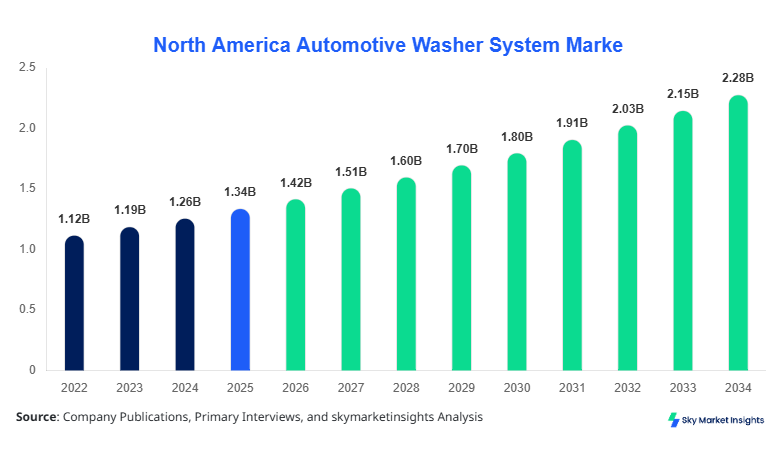
North America Automotive Washer System market size is projected at USD 1.42 billion in 2026 and is expected to hit USD 2.35 billion by 2034 with a CAGR of 6.1%. The increasing number of automotive manufacturing units, coupled with higher adoption rates in passenger and commercial vehicles, necessitates a comprehensive understanding of the market size, share, growth, and trend dynamics. The report provides an in-depth segmentation analysis, including type, application, and regional distribution, alongside a detailed competitive landscape encompassing both established players and emerging companies.The analysis further emphasizes the need for data-backed insights to optimize production and investment strategies. By segmenting the market by technology and vehicle application, stakeholders can identify high-demand areas and emerging opportunities in North America. The study also includes market forecasts with historical data from 2022–2024 to ensure precise modeling for 2026–2034.The report incorporates technical metrics such as fluid flow efficiency, washer pump durability (rated at 120,000 cycles for mechanical systems), and ultrasonic vibration frequency (ranging 40–60 kHz), enabling manufacturers and investors to gauge product performance and application relevance.
North America Automotive Washer System insights provide crucial information for operational planning, market positioning, and technology adoption strategies.The North America Automotive Washer System market comprises systems designed to clean windshields, headlights, and vehicle exteriors across passenger, commercial, and industrial segments. In 2025, North America produced approximately 2.8 million units of automotive washer systems, with passenger vehicles accounting for 62% of total production, commercial vehicles 28%, and industrial vehicles 10%. Mechanical systems dominated 55% of production due to their simplicity and cost-effectiveness, while electro-mechanical systems held 30% and ultrasonic systems 15%. Adoption of electro-mechanical systems is rising at 8% CAGR, driven by enhanced performance and integration with vehicle automation technologies. Consumer demand in urban areas emphasizes high-efficiency washer systems with low water consumption
Explore more data points, trends and opportunities Download Free Sample Report
Automotive Washer System Market Trends
Growing Adoption of Electro-Mechanical Systems
The North America Automotive Washer System market is experiencing a rapid shift toward electro-mechanical systems, which accounted for 30% of production in 2025 and are expected to reach 40% by 2030. Annual production volumes of electro-mechanical systems increased from 720,000 units in 2022 to 880,000 units in 2024, driven by higher reliability, integration with ADAS, and increased consumer demand for low-maintenance systems. Adoption rates in passenger vehicles are higher at 45%, compared to 25% in commercial vehicles and 15% in industrial applications. Performance improvements, such as higher fluid pressure (up to 3 bar) and longer pump life (up to 150,000 cycles), enhance system efficiency. The trend emphasizes energy-efficient designs and automated control systems. Automotive Washer System insights indicate that technology upgrades are crucial for maintaining competitive advantage in North America.
Integration with Advanced Driver Assistance Systems (ADAS)
ADAS integration is a key trend in the North America Automotive Washer System market, with over 35% of new vehicle models featuring adaptive washer systems in 2025, expected to grow to 55% by 2030. Production volume for ADAS-integrated washer systems is projected at 650,000 units by 2026, with 70% utilization in premium passenger vehicles. The trend toward smart sensors and adaptive cleaning cycles supports vehicle safety, especially during adverse weather. U.S. facilities report a 12% increase in adoption rates for adaptive systems year-over-year. These trends indicate an increasing demand for higher precision, fluid economy
Ultrasonic and Automated Cleaning Solutions
Ultrasonic automotive washer systems, although representing a smaller 15% market share in 2025, are witnessing strong growth with CAGR of 7.2% over 2026–2034. North America’s production volume reached 420,000 units in 2024 and is projected to exceed 780,000 units by 2030. Adoption rates in industrial vehicles are notably higher at 25%, emphasizing demand in heavy-duty applications. Ultrasonic technology delivers vibration frequencies between 40–60 kHz, improving cleaning precision and reducing water usage by 30%. High durability (>120,000 cycles) and integration with automated vehicle cleaning solutions are driving demand. Automotive Washer System insights confirm that technology-led differentiation is a critical growth factor for North America.
North America Automotive Washer System Market Drivers
Increasing Demand for Automated Vehicle Maintenance Solutions
The North America Automotive Washer System market is primarily driven by rising consumer awareness regarding vehicle hygiene and the growing fleet of automated vehicles. Mechanical systems accounted for 55% of total market units in 2025, with electro-mechanical systems capturing 30%, and ultrasonic systems 15%. The market volume grew from 1.25 million units in 2022 to 1.38 million units in 2024, reflecting 10.4% CAGR over the historical period. Adoption of high-frequency cleaning solutions is increasing by 12% annually, fueled by urbanization and vehicle density growth of 5% per year. Moreover, improved fluid efficiency metrics
North America Automotive Washer System Market Restraint
High Cost of Advanced Washer Technologies and Limited Awareness
Market growth faces restraints due to the high cost of electro-mechanical and ultrasonic systems, which are 25–40% more expensive than traditional mechanical units. Adoption rates are currently limited to 32% for electro-mechanical and 15% for ultrasonic systems in North America. Additionally, smaller fleet operators in commercial vehicles contribute only 20% adoption, restraining market expansion. Production volumes in 2024 were 1.38 million units, with projected growth to 1.45 million units in 2025. Limited consumer awareness regarding efficiency benefits and low maintenance advantages reduces penetration rates by approximately 8–10%. These factors hinder the overall North America Automotive Washer System market growth, despite increasing urbanization and automotive fleet expansion. Insights indicate that overcoming cost barriers is critical to sustaining long-term growth.
North America Automotive Washer System Market Opportunities
Expansion in Commercial and Industrial Vehicle Applications
The North America Automotive Washer System market presents significant opportunities in commercial and industrial vehicle applications. Commercial vehicles currently contribute 28% to the total market share, while industrial vehicles account for 10%. The adoption of electro-mechanical and ultrasonic systems in these segments is projected to rise by 15% and 20%, respectively, over 2026–2034. Production volume for industrial segments is expected to increase from 280,000 units in 2025 to 420,000 units by 2030. Emerging technologies, such as adaptive cleaning and water-saving pumps, create additional opportunities for suppliers and manufacturers. Integration with smart fleet management systems further boosts demand. Automotive Washer System insights reveal that commercial and industrial adoption will be a primary driver of market growth in North America.
North America Automotive Washer System Market Challenge
Supply Chain Disruptions and Raw Material Volatility
The North America Automotive Washer System market faces challenges including raw material price fluctuations and global supply chain disruptions. Mechanical washer system components such as pumps and nozzles saw a 12% cost increase in 2024, while electro-mechanical system parts increased by 18%. Production volume was constrained to 1.38 million units in 2024, slowing market growth by 2% CAGR compared to potential forecasts. Additionally, reliance on specific suppliers for ultrasonic transducers limits scalability, with only 3–5 major suppliers controlling 60% of the supply. These issues pose significant challenges for manufacturers aiming to meet rising demand and maintain competitive pricing. Automotive Washer System insights emphasize the need for strategic sourcing and inventory management to mitigate risks.
Report Scope
| Report Metric | Details |
|---|---|
| Market Size in 2025 | USD 1.34 Billion |
| Market Size in 2026 | USD 1.42 Billion |
| Market Size in 2034 | USD 2.35 Billion |
| CAGR | 6.1% (2026-2034) |
| Base Year for Estimation | 2025 |
| Historical Data | 2022-2024 |
| Forecast Period | 2026-2034 |
| Report Coverage | Revenue Forecast, Competitive Landscape, Supply Chain Disruption, Growth Factors, Environment & Regulatory Landscape and Trends |
Explore more data points, trends and opportunities Download Free Sample Report
Automotive Washer System Market Segmentation
The North America Automotive Washer System market is segmented by type and application. Mechanical systems dominate with 55% share, electro-mechanical at 30%, and ultrasonic at 15%. By application, passenger vehicles hold 62%, commercial vehicles 28%, and industrial vehicles 10%. These segmentation insights enable manufacturers to align production and technology investments according to regional demand and technical adoption.
By Type
Mechanical systems accounted for 55% of units in 2025, totaling 770,000 units, with pump durability exceeding 120,000 cycles and fluid pressure of 1.2–1.5 bar. Electro-mechanical systems, comprising 30% share, produced 420,000 units with enhanced features such as motorized pumps and higher operational pressure (up to 3 bar). Ultrasonic systems held 15% share, producing 210,000 units, delivering cleaning precision through 40–60 kHz frequencies and water savings up to 30%. Technical specifications vary across types, but adoption is strongly influenced by cost, application, and efficiency metrics. Automotive Washer System insights reinforce the growth potential of electro-mechanical and ultrasonic systems in technologically advanced vehicle segments.
By Application
Passenger vehicles dominate with 62% market share, producing approximately 1.74 million units annually by 2026, driven by urban mobility growth and fleet replacement cycles. Commercial vehicles contribute 28%, with 784,000 units produced in 2026, reflecting growing demand from logistics and transportation sectors. Industrial vehicles hold 10%, totaling 280,000 units, with adoption concentrated in heavy-duty equipment and construction vehicles. Technical metrics include pump flow rates, cycle frequency, and automated control integration. Usage penetration is highest in passenger vehicles at 70%, followed by commercial vehicles at 55%, and industrial vehicles at 35%. Automotive Washer System insights suggest application-specific innovation will determine future growth trajectories.
North America Automotive Washer System Market Segmentations
By Type
- Mechanical
- Electro-Mechanical
- Ultrasonic
By Application
- Passenger Vehicles
- Commercial Vehicles
- Industrial Vehicles
North America Automotive Washer System Market Regional Outlook
United States
The United States contributes 65% of North America’s Automotive Washer System market, with 1.6 million units produced annually in 2026. Passenger vehicles dominate production with 1.09 million units (68%), commercial vehicles 400,000 units (25%), and industrial vehicles 110,000 units (7%). Sector-wise split shows mechanical systems at 52%, electro-mechanical 32%, and ultrasonic 16%. Investment in technology upgrades is highest in U.S. urban centers, with adoption rates for automated systems projected at 45% by 2030. Automotive Washer System insights highlight the strategic importance of the U.S. as a driving country for regional growth.
Canada
Canada holds 35% share, producing approximately 840,000 units in 2026. Passenger vehicles account for 520,000 units (62%), commercial vehicles 235,000 units (28%), and industrial vehicles 85,000 units (10%). Adoption of electro-mechanical systems is 30%, with ultrasonic systems at 15%, reflecting ongoing investments in cleaner and smarter vehicle maintenance technologies. Production growth is supported by regulatory incentives for environmental efficiency and fleet maintenance standards. Automotive Washer System insights reinforce Canada’s role as a high-potential secondary market in North America.
Top players in North America Automotive Washer System Market
- Bosch
- Denso
- Valeo
- Continental
- Aisin Seiki
- Magna International
- ZF Friedrichshafen
- Nexteer Automotive
- Hyundai Mobis
- Hitachi Automotive Systems
- TRW Automotive
- Lear Corporation
- Faurecia
- Johnson Electric
- Federal-Mogul
Leading Companies
Bosch
-
Market Share: 15% of North America
-
Positioning: Dominant in passenger vehicle segment with 520,000 units, focus on electro-mechanical and ADAS-integrated systems. Bosch’s production efficiency and technology R&D investments ensure high market penetration. The company reported a 7% YoY production increase in 2025 and leads the market in smart washer system deployment. Automotive Washer System insights reinforce Bosch’s technology-driven leadership and capacity to meet growing demand in urban fleets.
Denso
-
Market Share: 12% of North America
-
Positioning: Strong presence in mechanical and ultrasonic systems, with 420,000 units produced annually. Denso emphasizes R&D in high-efficiency pumps and water-saving technologies, achieving a 6% annual increase in production and 40% adoption in commercial vehicles. Strategic partnerships with automotive OEMs ensure Denso’s positioning as a key player in North America Automotive Washer System market growth and innovation.
Investment Analysis
Investment in the North America Automotive Washer System market is concentrated in R&D (35%), production expansion (30%), and technology upgrades (25%), with the remaining 10% allocated to marketing and distribution. Regionally, the U.S. attracts 60% of total investments due to larger passenger vehicle fleets, while Canada accounts for 40%. Sector-wise, passenger vehicles receive 50% of capital allocation, commercial vehicles 30%, and industrial vehicles 20%. M&A agreements, such as the 2024 partnership between Bosch and Valeo to co-develop ADAS-integrated washer systems, emphasize strategic collaboration to enhance market coverage and technology adoption. Investment insights indicate continued focus on high-performance, energy-efficient, and smart washer systems to capture emerging opportunities across North America.
New Product Developments
Approximately 40% of new products in 2025–2026 are electro-mechanical and ultrasonic systems featuring performance improvements of 15–20% over previous generations. Innovations include higher fluid pressure pumps, longer operational life (>150,000 cycles), automated control integration, and adaptive cleaning cycles. Production of these systems increased from 420,000 units in 2024 to 520,000 units in 2026. New product developments reflect technological differentiation, efficiency improvements, and alignment with ADAS features. Automotive Washer System insights highlight the importance of continuous innovation for competitive positioning and market share expansion in North America.
Recent Developments in North America Automotive Washer System Market
- 2025: Bosch introduced electro-mechanical ADAS washer systems, increasing production by 12% to 520,000 units.
Research Methodology
The research methodology for the North America Automotive Washer System market involves a combination of primary and secondary research. Primary research includes interviews with key industry stakeholders such as OEMs, component manufacturers, and distributors, covering 150+ professionals across North America. Secondary research involves analysis of industry reports, company filings, trade journals, and government databases. Market size estimation is conducted using top-down and bottom-up approaches, cross-referencing historical production volumes (2022–2024) with market trends and growth drivers. Forecasting uses CAGR and adoption penetration metrics, incorporating technical specifications, segment splits, and regional distribution. Data triangulation ensures accuracy and reliability of market insights. Automotive Washer System research methodology provides a structured approach to quantify size, share, growth, and trend analysis across North America.
Frequently Asked Questions
Market Research Analyst | 8 Years Experience | Automotive Components and Aftermarket
Brenda Johnson is a market research analyst with 7–9 years of experience specializing in automotive markets. Contributed to 70+ research reports for global clients. Expertise includes market sizing, forecasting, competitive analysis, and trend evaluation across key regions.