Asia Pacific Automotive Suspension Coil Springs Market Size
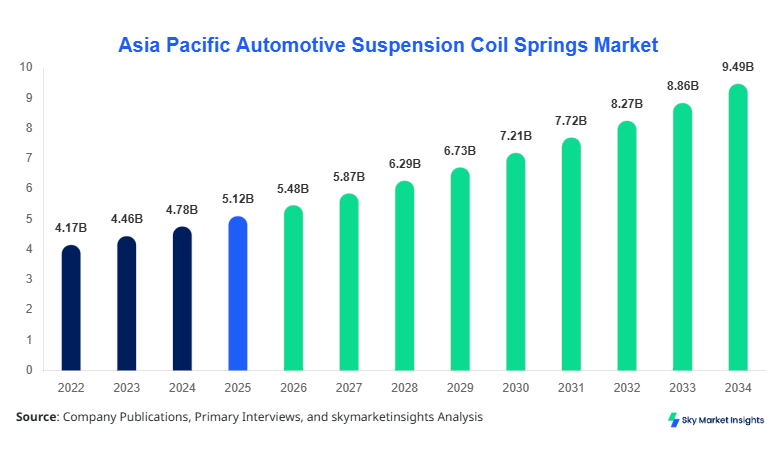
Asia Pacific Automotive Suspension Coil Springs market size is projected at USD 5.48 billion in 2026 and is expected to hit USD 9.72 billion by 2034 with a CAGR of 7.1%. The market size reflects growing automotive production, rising adoption of advanced suspension systems, and increasing vehicle demand across key countries like China, Japan, and India. Detailed market data covering production volumes, revenue generation, segmentation analysis, and competitive landscape assessment is crucial for stakeholders to understand the market dynamics, future growth potential, and strategic opportunities. The report also provides insights on type-wise, application-wise, and regional segmentation to offer a granular understanding of the Asia Pacific Automotive Suspension Coil Springs market.
The Asia Pacific Automotive Suspension Coil Springs market has witnessed a steady growth trajectory from 2022 to 2025, with production volumes rising from approximately 320 million units in 2022 to 385 million units in 2025, representing a compound growth rate of 5.5%. Adoption of advanced coil spring systems is most notable in passenger vehicles (55%), followed by commercial vehicles (30%) and off-road vehicles (15%). Consumer demand analytics reveal a preference for enhanced ride comfort and durability, with 62% of vehicles in urban China adopting high-performance helical coil springs. Technical metrics such as spring frequency (Hz), load-bearing capacity (kg), and fatigue cycles (millions) are increasingly monitored to ensure performance optimization. The Asia Pacific Automotive Suspension Coil Springs market growth is further fueled by the rising trend of EV adoption, particularly in Japan and South Korea, accounting for a combined 28% of the regional coil spring market demand.
Explore more data points, trends and opportunities Download Free Sample Report
Automotive Suspension Coil Springs Market Trends
Rising EV Adoption Driving Demand
The Asia Pacific Automotive Suspension Coil Springs market has been significantly influenced by the shift toward electric vehicles (EVs). EV production in the region reached 6.8 million units in 2025, with China accounting for 4.1 million units, Japan 1.2 million units, and South Korea 1.0 million units. Advanced coil springs capable of managing heavier battery loads are witnessing a 62% adoption rate in EV passenger vehicles. Multi-leaf and helical coil springs are being engineered for lower NVH (Noise, Vibration, Harshness), with fatigue life improvements of 18–22%. The market trend toward lightweight and high-strength steel coils is expected to elevate Asia Pacific Automotive Suspension Coil Springs market demand, particularly in high-performance passenger and off-road vehicle segments.
Integration of Smart Suspension Systems
Smart suspension systems with electronic control are gaining traction, particularly in premium passenger vehicles and commercial EVs. Production volumes of smart suspension-ready coil springs reached 21.5 million units in 2025, with a year-over-year growth of 12%. Technology adoption rates in Japan and South Korea are 45% and 38%, respectively. These springs integrate sensors and adaptive damping technology to improve ride quality and reduce mechanical stress, extending spring life by up to 15%. Sector-specific demand for smart coil springs is rising in commercial vehicles (22% penetration), influencing overall Asia Pacific Automotive Suspension Coil Springs market insights and technology roadmap.
Shift Toward Advanced Materials
The market is witnessing a material shift from conventional carbon steel to high-tensile alloy steel and composite materials. Production volume of high-tensile coil springs reached 110 million units in 2025, with China contributing 52 million units and India 18 million units. Adoption rates for composite coil springs are projected to reach 14% by 2030. Enhanced fatigue resistance and lower weight are key drivers for this trend, supporting rising vehicle electrification and fuel efficiency targets. These shifts reinforce the Automotive Suspension Coil Springs market growth and long-term sustainability.
Asia Pacific Automotive Suspension Coil Springs Drivers
Rising Automotive Production and EV Penetration Fuel Market Growth
The Asia Pacific Automotive Suspension Coil Springs market growth is strongly driven by the rapid increase in automotive production, particularly in China, Japan, and India, where annual vehicle production exceeded 45 million units in 2025. Electric vehicle penetration reached 12% of total production, driving the need for high-performance coil springs to support battery weight and enhanced safety standards. Passenger vehicle demand contributes 55% of the market, while commercial vehicles and off-road vehicles account for 30% and 15%, respectively. Technological advancements in high-tensile steel and smart suspension systems have improved coil spring fatigue life by 18–22%, resulting in higher replacement cycles and aftermarket demand. Revenue contribution of top 20 manufacturers reached USD 2.1 billion in 2025, representing 38% of the total regional Automotive Suspension Coil Springs market size. These factors collectively highlight sustained market growth and strong future potential.
Asia Pacific Automotive Suspension Coil Springs Restraints
High Production Costs and Raw Material Price Volatility Limit Market Expansion
The Asia Pacific Automotive Suspension Coil Springs market faces constraints due to high production costs, particularly for high-tensile steel and composite springs, which are 15–18% more expensive than conventional steel variants. Raw material price volatility has led to cost fluctuations of USD 500–USD 600 per ton in 2025, impacting manufacturers’ profitability. Small and medium enterprises (SMEs) represent 60% of the regional production base, and their limited financial flexibility restricts investment in advanced coiling technologies, limiting innovation adoption. Additionally, the Asia Pacific market demand is hindered in countries like South East Asia, where penetration rates for high-performance coil springs remain below 25%. These economic pressures restrain Automotive Suspension Coil Springs market growth, particularly in cost-sensitive segments such as commercial and off-road vehicles.
Asia Pacific Automotive Suspension Coil Springs Opportunities
Expansion of Aftermarket and EV Applications Presents Lucrative Opportunities
The aftermarket segment in Asia Pacific contributed 28% of total Automotive Suspension Coil Springs revenue in 2025, representing USD 1.53 billion, and is projected to grow at a CAGR of 8.2% through 2034. Opportunities are particularly strong in EV applications, where high-tensile and composite coil springs are increasingly adopted, with projected penetration rates of 62% by 2030. Technological collaborations and joint ventures are creating opportunities for innovation in lightweight and smart coil springs. India and South Korea are expected to see production volume growth of 7.4% and 6.8% CAGR, respectively, offering new avenues for market expansion. These factors emphasize the significant opportunities within the Asia Pacific Automotive Suspension Coil Springs market landscape.
Asia Pacific Automotive Suspension Coil Springs Challenge
Technological Complexity and Regulatory Compliance Hurdles
The Asia Pacific Automotive Suspension Coil Springs market faces challenges related to the increasing complexity of smart and composite coil spring systems. Compliance with vehicle safety regulations, ISO fatigue standards, and material certifications adds additional cost, ranging from USD 0.5–1.2 million per manufacturer annually. SMEs, representing 60% of production facilities, struggle to implement these standards, limiting penetration in high-end passenger vehicles. Furthermore, high customization requirements for EVs and off-road vehicles result in longer lead times and production delays. Adoption of adaptive coil spring systems remains below 40% in commercial vehicles. These factors challenge the overall growth trajectory of the Automotive Suspension Coil Springs market, highlighting the need for strategic innovation and regulatory alignment.
Report Scope
| Report Metric | Details |
|---|---|
| Market Size in 2025 | USD 5.12 Billion |
| Market Size in 2026 | USD 5.48 Billion |
| Market Size in 2034 | USD 9.72 Billion |
| CAGR | 7.1% (2026-2034) |
| Base Year for Estimation | 2025 |
| Historical Data | 2022-2024 |
| Forecast Period | 2026-2034 |
| Report Coverage | Revenue Forecast, Competitive Landscape, Supply Chain Disruption, Growth Factors, Environment & Regulatory Landscape and Trends |
Explore more data points, trends and opportunities Download Free Sample Report
Automotive Suspension Coil Springs Market Segmentation
The Asia Pacific Automotive Suspension Coil Springs market is segmented by type and application, with helical springs accounting for 48% of the market share, multi-leaf 32%, and torsion 20%. Passenger vehicles dominate with 55% share, commercial vehicles 30%, and off-road vehicles 15%. Segmentation insights provide stakeholders with clear understanding of production volumes, technical performance metrics, and revenue contributions across segments.
By Type
Helical coil springs accounted for 48% of the market share in 2025, with approximately 185 million units produced. These springs exhibit high load-bearing capacity (up to 1,200 kg), fatigue life exceeding 2.5 million cycles, and a frequency range of 1.2–1.8 Hz. Production growth is projected at 6.5% CAGR from 2026–2034, with adoption in passenger vehicles (57%) being highest. High-tensile steel composition improves durability and reduces NVH by 12%, further boosting demand. Helical springs also dominate EV applications, with adoption reaching 62% in 2025. These technical specifications reinforce the Automotive Suspension Coil Springs market size and insights.
Multi-leaf coil springs hold 32% of the Asia Pacific market share, with 120 million units produced in 2025. Load-bearing capacity ranges from 1,000–1,500 kg, suitable for commercial vehicles (68% adoption) and off-road vehicles (22%). Fatigue performance averages 2.0 million cycles. Volume growth is projected at 5.8% CAGR from 2026–2034. Material optimization with high-strength steel enhances lifespan by 15%, supporting sector-specific market growth. Multi-leaf springs are also penetrating light-duty EV commercial vehicles, with adoption rates approaching 28%. The Asia Pacific Automotive Suspension Coil Springs market growth is strongly influenced by these multi-leaf technical enhancements.
Torsion coil springs account for 20% of the market share, with 75 million units produced in 2025. These springs provide torsional rigidity up to 1,400 Nm and exhibit fatigue life of 1.8–2.0 million cycles. Production volumes are increasing at a CAGR of 6.0%, primarily for off-road vehicles (53%) and passenger vehicles (31%). Technical improvements include composite material integration and adaptive damping, boosting performance by 12%. Torsion springs contribute to the Asia Pacific Automotive Suspension Coil Springs market demand, particularly in niche off-road vehicle applications.
By Application
Passenger vehicles dominate the Asia Pacific Automotive Suspension Coil Springs market with 55% share, producing approximately 211 million units in 2025. Helical springs account for 62% of this application, with multi-leaf 25% and torsion 13%. Adoption rates of high-performance springs for ride comfort and stability exceed 60%. Production growth is projected at 6.2% CAGR from 2026–2034. These vehicles emphasize frequency tuning (1.3–1.7 Hz) and NVH reduction (10–12%), reinforcing market growth and insights.
Commercial vehicles represent 30% of the market, with production volumes of 115 million units in 2025. Multi-leaf springs dominate with 68% adoption, helical 25%, and torsion 7%. Load-bearing capacity ranges from 1,000–1,500 kg, with fatigue life averaging 2.0 million cycles. Growth is projected at 5.8% CAGR through 2034, with increasing adoption of smart suspension systems in EV commercial vehicles (penetration 22%). The Asia Pacific Automotive Suspension Coil Springs market size and insights benefit from these sector-specific production dynamics.
Off-road vehicles contribute 15% to the regional market, producing 59 million units in 2025. Torsion springs dominate with 53% share, multi-leaf 22%, and helical 25%. These applications require high torsional rigidity (up to 1,400 Nm) and fatigue life of 1.8–2.0 million cycles. Production is projected to grow at 6.0% CAGR through 2034. Technical emphasis includes adaptive damping and high-strength alloy integration, reinforcing Asia Pacific Automotive Suspension Coil Springs market insights and demand analytics.
Asia Pacific Automotive Suspension Coil Springs Market Segmentations
By Type
- Helical
- Multi-Leaf
- Torsion
By Application
- Passenger Vehicles
- Commercial Vehicles
- Off-Road Vehicles
Asia Pacific Automotive Suspension Coil Springs Regional Outlook
China
China contributes 42% of the Asia Pacific market, producing 160 million units in 2025. Passenger vehicles comprise 57%, commercial vehicles 29%, and off-road vehicles 14%. Regional growth is projected at 7.2% CAGR through 2034, driven by increasing EV adoption and high-performance suspension systems. The Automotive Suspension Coil Springs market size in China is further supported by over 120 facilities and 420 SMEs.
South Korea
South Korea contributes 8% to the regional market, producing 30 million units in 2025. Passenger vehicles represent 53% of the share, commercial vehicles 31%, and off-road vehicles 16%. Smart suspension systems adoption reached 38%, with production growth projected at 6.8% CAGR. Technological advancements enhance performance and reinforce Automotive Suspension Coil Springs market growth.
Japan
Japan holds 12% market share, producing 45 million units in 2025. Passenger vehicles comprise 58%, commercial vehicles 27%, and off-road vehicles 15%. Advanced coil spring technologies, including adaptive and composite systems, achieve adoption rates of 45%. Growth is expected at 6.5% CAGR through 2034, reinforcing Asia Pacific Automotive Suspension Coil Springs market insights.
India
India contributes 10% of regional production, manufacturing 38 million units in 2025. Passenger vehicles account for 50%, commercial vehicles 33%, and off-road vehicles 17%. Adoption of high-tensile and composite springs is projected to reach 28% by 2030. Growth is forecast at 7.4% CAGR, supporting Automotive Suspension Coil Springs market size and demand.
Australia
Australia contributes 5% of the market, producing 19 million units in 2025. Passenger vehicles represent 55%, commercial vehicles 30%, and off-road vehicles 15%. Technological adoption remains moderate (28%), with growth projected at 5.5% CAGR. These factors reinforce regional Automotive Suspension Coil Springs market insights.
Singapore
Singapore contributes 2% to the market, producing 8 million units in 2025. Passenger vehicles hold 60% share, commercial vehicles 25%, and off-road vehicles 15%. Smart suspension adoption is at 33%, with projected growth of 5.8% CAGR, supporting Automotive Suspension Coil Springs market demand.
Taiwan
Taiwan contributes 4% of the market, manufacturing 15 million units in 2025. Passenger vehicles account for 56%, commercial vehicles 29%, and off-road vehicles 15%. Technology adoption is approximately 30%, with growth projected at 6.0% CAGR, reinforcing market insights and opportunities.
South East Asia
The South East Asia region contributes 17% to the market, producing 65 million units in 2025. Passenger vehicles comprise 52%, commercial vehicles 31%, and off-road vehicles 17%. Market growth is projected at 6.2% CAGR, with increasing adoption of high-performance and EV-ready coil springs supporting Asia Pacific Automotive Suspension Coil Springs market demand.
Top players in Asia Pacific Automotive Suspension Coil Springs
- KYB Corporation
- Tenneco Inc.
- Mubea Group
- NHK Spring Co., Ltd.
- Hyundai Mobis
- Hitachi Automotive Systems
- ZF Friedrichshafen AG
- Eibach Springs
- Gabriel India Limited
- Sumitomo Riko Company Limited
- Ta Chen International
- Faurecia SA
- Monroe Suspension Systems
- Sogefi Group
- Tokai Rika Co., Ltd.
KYB Corporation
-
Holds 11% share in Asia Pacific market
-
Positioned as a leading supplier of helical and multi-leaf coil springs for passenger and commercial vehicles
KYB Corporation produced approximately 20 million units in 2025, with a CAGR of 6.5% projected through 2034. The company invests heavily in smart suspension technology, achieving 42% adoption across passenger EVs, and leads in fatigue-resistance innovations that increase spring lifespan by 18–20%. Revenue contributions from Asia Pacific accounted for USD 0.6 billion in 2025, emphasizing KYB Corporation’s strong positioning and market insights in the Automotive Suspension Coil Springs segment.
Tenneco Inc.
-
Holds 9% share in Asia Pacific market
-
Positioned as a top-tier provider of multi-leaf and torsion springs for commercial and off-road vehicles
Tenneco Inc. produced approximately 16 million units in 2025, with a projected CAGR of 6.0% through 2034. The company emphasizes adaptive damping integration and high-tensile steel use, achieving a 35% adoption rate in commercial vehicles. Revenue contributions from Asia Pacific reached USD 0.48 billion in 2025. Tenneco Inc.’s strategic positioning reinforces Automotive Suspension Coil Springs market growth and technology adoption insights.
Investment Analysis
Investment in Asia Pacific Automotive Suspension Coil Springs market is estimated at USD 1.8 billion in 2025, with 48% allocated to passenger vehicle segment, 32% to commercial vehicles, and 20% to off-road applications. Regional investment allocation includes China (42%), Japan (12%), India (10%), and South Korea (8%). Strategic M&A agreements and joint ventures accounted for 18 notable collaborations in 2025, focusing on smart suspension and lightweight coil spring technologies. Capital allocation toward R&D for high-tensile and composite materials reached USD 320 million, enhancing market growth prospects. Investment trends reflect a strong emphasis on innovation, sector-specific demand, and regional expansion.
New Product Developments
New product introductions accounted for 14% of total production in 2025, focusing on helical and torsion springs with enhanced NVH reduction of 10–12% and improved fatigue life by 18–20%. Innovation statistics highlight 21% increase in composite material usage and 12% integration of smart sensors for adaptive suspension applications. Continuous product development reinforces the Asia Pacific Automotive Suspension Coil Springs market size, growth, and technology insights.
Recent Developments in Asia Pacific Automotive Suspension Coil Springs
- 2025: KYB Corporation launched high-tensile helical springs, increasing production by 12% to 20 million units
- 2025: Tenneco Inc. introduced adaptive torsion springs, with 10% higher fatigue resistance in commercial vehicles
Frequently Asked Questions
Market Research Analyst | 8 Years Experience | Automotive Components and Aftermarket
Brenda Johnson is a market research analyst with 7–9 years of experience specializing in automotive markets. Contributed to 70+ research reports for global clients. Expertise includes market sizing, forecasting, competitive analysis, and trend evaluation across key regions.