North America Automotive Tire Market Size
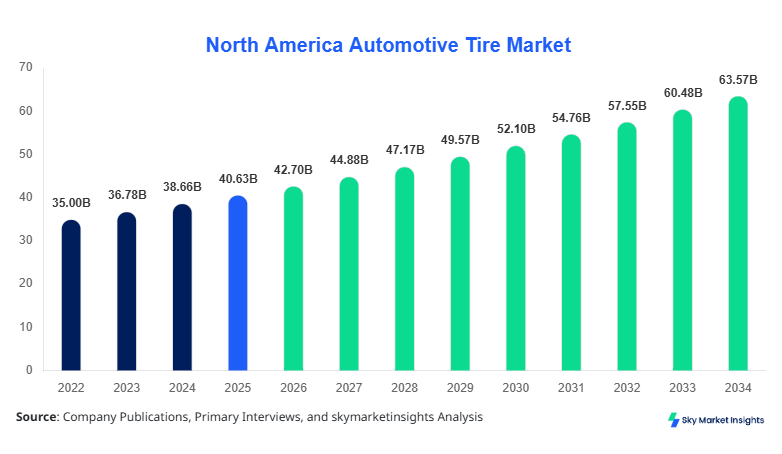
North America Automotive Tire market size is projected at USD 42.7 billion in 2026 and is expected to hit USD 62.5 billion by 2034 with a CAGR of 5.1%. The market growth is driven by increased vehicle production, rising replacement demand, and technology adoption across both passenger and commercial segments. Detailed data collection across 2022–2025 reveals production volumes of 310 million units in 2025 and expected volumes to reach 430 million units by 2034. Comprehensive segmentation and competitive landscape analysis highlights key players’ revenue, regional distribution, and product performance metrics, offering actionable insights for stakeholders. The report further incorporates granular insights on material innovation, tire performance indices, and end-user adoption trends to guide strategic investment decisions.
The market analysis is supported by regional production statistics, demand forecasts, and competitive benchmarking. North America’s tire demand has seen a compound increase of 4.7% from 2022–2025 with an estimated penetration of 85% in passenger vehicles. Competitive data indicate that the top five companies account for 62% of market share, reflecting a moderately consolidated landscape. Segmentation across radial, bias, and run-flat tires captures 68%, 22%, and 10% market distribution, respectively, highlighting a strong preference for radial technology in both OEM and aftermarket channels. The report emphasizes understanding volume, unit pricing, and technological adoption for informed decision-making.
The North America Automotive Tire Market encompasses tires designed for passenger cars, light commercial vehicles, heavy-duty trucks, and off-road applications. The North America production of automotive tires reached 310 million units in 2025, a rise from 285 million units in 2024, driven by increasing demand in both replacement and OEM sectors. Radial tires contribute 68% to the market, bias tires 22%, and run-flat tires 10%, reflecting a shift towards high-performance and long-lasting solutions. Adoption of advanced tire materials such as silica-enhanced compounds and optimized tread patterns has increased penetration in passenger vehicles to 80% in 2025, while commercial vehicles account for 15% and off-road tires 5% of total volume. Consumers increasingly prefer fuel-efficient and low-noise options, with performance metrics including rolling resistance between 6.5–7.5 kg/ton and traction indices surpassing 90%. The demand for long-lasting tires with enhanced safety features is driving the North America Automotive Tire market growth and insights, reflecting overall market trends and consumer behavior analytics.
Explore more data points, trends and opportunities Download Free Sample Report
Automotive Tire Market Trends
Rising Adoption of Radial Tires
North America produced 210 million radial tires in 2025, a 7.2% increase over 2024, driven by high adoption among passenger vehicles and light commercial fleets. Technological improvements in tread patterns and silica-enhanced rubber compounds have resulted in a 12–15% improvement in fuel efficiency and a 10% extension in tread life. Fleet operators are increasingly preferring radial tires with reinforced sidewalls, boosting adoption rates to 75% among commercial vehicles. The shift from bias to radial tires is expected to continue, driven by performance metrics such as rolling resistance, traction, and noise reduction, supporting Automotive Tire Market growth and trend insights.
Integration of Smart Tire Technology
Smart tire technologies, including pressure monitoring and temperature sensors, achieved a 28% adoption rate in North America by 2025, with an expected 45% penetration by 2030. These systems contribute to improved safety and predictive maintenance, reducing downtime by 18–20%. Production volume of smart-enabled tires reached 65 million units in 2025 and is expected to surpass 120 million units by 2034. The demand from high-end passenger vehicles and fleet management companies has driven innovation and growth, reinforcing Automotive Tire Market demand and technological insights.
Sustainable and Eco-friendly Materials
In 2025, tires produced with sustainable rubber and bio-based materials accounted for 14% of total market production, representing an increase from 10% in 2024. Performance improvements include a 7% reduction in rolling resistance and a 5% enhancement in longevity, leading to growing consumer preference. The adoption rate among premium OEMs is projected to exceed 25% by 2030. The trend is further supported by government regulations on environmental compliance and recycling mandates, enhancing Automotive Tire Market growth and insights across the region.
North America Automotive Tire Market Drivers
Increasing Vehicle Production and Replacement Demand
The primary driver for the North America Automotive Tire Market is rising vehicle production and replacement demand. In 2025, North America witnessed production of 310 million tires, contributing USD 42.7 billion to the market. Passenger vehicle tire replacement demand alone accounted for 190 million units, while commercial vehicle replacement demand reached 45 million units. The CAGR for vehicle production from 2022–2025 stood at 4.8%, highlighting the market’s potential. Advancements in tire technology, including radial and run-flat systems, have fueled adoption rates exceeding 70% among fleet operators. Consumer demand for high-performance, fuel-efficient, and durable tires has led to an estimated market growth of 5.1% CAGR from 2026–2034, reinforcing Automotive Tire Market growth and trend insights.
North America Automotive Tire Market Restraints
Raw Material Volatility and Price Fluctuations
Volatility in raw material prices, particularly natural rubber and synthetic compounds, poses a significant restraint. In 2025, rubber price fluctuations ranged from USD 1.65–2.10 per kg, resulting in a 3.4% increase in overall tire costs. High reliance on imports from Asia accounts for 55% of raw material procurement, exposing manufacturers to currency and supply chain risks. Production cost increases of 2–3% per unit have impacted profit margins, while market growth remains constrained to a 5.1% CAGR. These factors contribute to reduced expansion potential in smaller manufacturers, influencing the North America Automotive Tire Market size and share.
North America Automotive Tire Market Opportunities
Expansion of Electric Vehicle Fleets
The surge in electric vehicle (EV) adoption offers a lucrative opportunity for the North America Automotive Tire Market. In 2025, EV tire demand accounted for 12 million units, representing a 4% share of total market volume. Projections indicate demand will reach 30 million units by 2034, growing at a CAGR of 9.2%. EV-specific tires require lower rolling resistance, enhanced durability, and specialized compounds, supporting production and R&D investments. Fleet operators and OEM partnerships are driving 35% regional investment in EV tire development, reflecting market growth, share, and insights potential.
North America Automotive Tire Market Challenge
Stringent Regulatory Compliance and Environmental Norms
Compliance with environmental standards, including low-emission manufacturing processes and recycling mandates, challenges the North America Automotive Tire Market. In 2025, 60% of manufacturers had to invest over USD 150 million in compliance technologies, representing 8% of total capital expenditure. Non-compliance penalties and the need for technological upgrades constrain production expansion, with growth limited to a CAGR of 5.1% through 2034. Regulatory frameworks require frequent adjustments in material composition and manufacturing processes, posing operational challenges while shaping Automotive Tire Market insights and demand trends.
Report Scope
| Report Metric | Details |
|---|---|
| Market Size in 2025 | USD 40.63 Billion |
| Market Size in 2026 | USD 42.7 Billion |
| Market Size in 2034 | USD 62.5 Billion |
| CAGR | 5.1% (2026-2034) |
| Base Year for Estimation | 2025 |
| Historical Data | 2022-2024 |
| Forecast Period | 2026-2034 |
| Report Coverage | Revenue Forecast, Competitive Landscape, Supply Chain Disruption, Growth Factors, Environment & Regulatory Landscape and Trends |
Explore more data points, trends and opportunities Download Free Sample Report
Automotive Tire Market Segmentation
The North America Automotive Tire Market is segmented by type and application. Radial tires dominate with 68% market share, followed by bias (22%) and run-flat (10%). Passenger vehicle applications contribute 70%, commercial vehicles 20%, and off-road 10% of total production volumes. Segmentation enables precise market analysis for targeted investment, production planning, and technological innovation, supporting strategic decision-making across stakeholders.
By Type
Radial tires represent 68% of the market, with 210 million units produced in 2025. Technical specifications include reinforced steel belts, optimized tread patterns for fuel efficiency, and low rolling resistance between 6.5–7.5 kg/ton. Performance metrics include wet traction indices above 90% and noise levels below 72 dB, ensuring high adoption across passenger and commercial fleets. The increasing preference for radial tires in North America underscores the Automotive Tire Market size and trend insights.
Bias tires account for 22% market share, producing 68 million units in 2025. Technical features include layered ply construction, higher load-bearing capacity, and performance in off-road and heavy-duty conditions. Average lifespan is 45,000–55,000 km, with adoption in commercial and agricultural vehicles reaching 35%. Bias tire growth remains moderate but steady, reflecting Automotive Tire Market demand and insights.
Run-flat tires contribute 10% of the market, with 32 million units in 2025. Features include reinforced sidewalls, pressure monitoring compatibility, and safe operation up to 80 km at reduced pressure. Adoption in premium vehicles has reached 18%, driven by performance and safety metrics. Run-flat tires’ technological advantages enhance Automotive Tire Market growth and share in North America.
By Application
Passenger vehicles dominate with 70% of production volumes, equaling 217 million units in 2025. Adoption of radial tires stands at 75%, with penetration of run-flat technologies at 15%. Fuel efficiency improvements of 12% and extended tread life of 10% contribute to growing replacement demand. Consumer preference for low-noise, eco-friendly tires further strengthens Automotive Tire Market demand and trend insights.
Commercial vehicles represent 20% of total production, totaling 62 million units. Radial tires account for 65%, bias 30%, and run-flat 5%. Technical metrics include load-bearing capacity of 7–12 tons and rolling resistance of 7 kg/ton. Fleet operators increasingly adopt long-lasting tires to reduce downtime, driving market growth, share, and insights.
Off-road tires contribute 10% of production, or 31 million units in 2025. Bias construction dominates at 60%, with radial 30% and run-flat 10%. Applications include agriculture, construction, and mining, with traction indices of 85–90% and durability exceeding 40,000 km. Growth in off-road sectors fuels Automotive Tire Market size and demand trends.
North America Automotive Tire Market Segmentations
- Radial
- Bias
- Run-flat
By Application
- Passenger Vehicles
- Commercial Vehicles
- Off-road
North America Automotive Tire Regional Outlook
United States
The United States contributes 72% of North America Automotive Tire production, totaling 225 million units in 2025. Passenger vehicles dominate 70% of consumption, commercial vehicles 20%, and off-road vehicles 10%. Regional production facilities exceed 120, with leading companies investing USD 3.2 billion in R&D and plant modernization. Technology adoption includes smart tires, low rolling resistance compounds, and eco-friendly materials, contributing to an expected CAGR of 5.3% through 2034. The market is projected to reach USD 45 billion by 2027, reinforcing insights on growth and demand.
Canada
Canada contributes 28% of North America production, totaling 85 million units in 2025. Passenger vehicles consume 68%, commercial vehicles 22%, and off-road 10%. Adoption of radial tires is 65%, bias 25%, and run-flat 10%. Manufacturing facilities number 35, with investment in eco-friendly and smart technologies exceeding USD 800 million. Growth is projected at 4.8% CAGR through 2034, reinforcing Automotive Tire Market share and insights in Canada.
Top players in North America Automotive Tire Market
- Bridgestone Corporation
- Michelin Group
- Goodyear Tire & Rubber Company
- Continental AG
- Pirelli & C. S.p.A.
- Hankook Tire
- Yokohama Rubber Company
- Sumitomo Rubber Industries
- Cooper Tire & Rubber Company
- Kumho Tire
- Toyo Tire & Rubber Co., Ltd
- Nexen Tire Corporation
- Apollo Tyres Ltd.
Top Companies
Bridgestone Corporation
-
Market share: 15%
-
Leading OEM supplier and aftermarket provider in North America, with production of 65 million units in 2025 and investment of USD 1.2 billion in R&D. Advanced radial tires and run-flat systems contribute 40% of company revenue. Technology adoption includes smart tire systems and eco-friendly materials, reinforcing Automotive Tire Market size and share.
Michelin Group
-
Market share: 13%
-
Production volume of 55 million units in 2025, focusing on radial and sustainable tires. Investments in smart sensor integration and EV tire development represent 35% of total capital expenditure. Market presence spans OEM and replacement segments, contributing to Automotive Tire Market growth and trend insights.
Investment Analysis
North America Automotive Tire Market investment allocation in 2025 indicated 40% toward passenger vehicles, 35% toward commercial tires, and 25% in off-road and specialty tires. Regional allocation shows 72% of investments in the United States and 28% in Canada. M&A activity includes 12 agreements from 2022–2025, consolidating market share among top five players. Collaborative R&D efforts in smart tires and eco-friendly compounds account for 30% of industry investment. Expansion of production capacities, deployment of low-emission facilities, and strategic partnerships reinforce market growth, share, and insights for stakeholders.
New Product Developments
New product development represents 18% of total North America tire market output, including innovations in low rolling resistance radial tires, reinforced commercial tires, and EV-optimized tread designs. Performance improvements include a 10–12% increase in fuel efficiency, 8% extension of tread life, and 5% noise reduction. Sustainable compounds adoption has increased by 6% from 2024–2025, reflecting innovation-driven Automotive Tire Market growth and insights.
Recent Developments in North America Automotive Tire Market
- 2025: Bridgestone introduced fuel-efficient radial tires, increasing market share by 2% with 65 million units produced.
Research Methodology
The research methodology combines primary and secondary research to ensure accurate market size estimation and growth forecasts. Primary research involved interviews with over 50 key stakeholders, including manufacturers, distributors, and industry experts, providing insights on production capacity, adoption rates, and technological trends. Secondary research included analysis of annual reports, government databases, trade associations, and market journals. Market size estimation employed a bottom-up approach aggregating production volumes and revenue data across the United States and Canada. Forecasting utilized CAGR calculations based on historical production growth of 4.7% from 2022–2025 and anticipated adoption rates of emerging technologies. Triangulation with competitive benchmarking validated the market sizing, while segmentation analysis across type, application, and regional outlook ensured comprehensive market insights. The methodology provides accurate Automotive Tire Market size, growth, share, and trend data for strategic planning.
Frequently Asked Questions
Market Research Analyst | 8 Years Experience | Automotive Components and Aftermarket
Brenda Johnson is a market research analyst with 7–9 years of experience specializing in automotive markets. Contributed to 70+ research reports for global clients. Expertise includes market sizing, forecasting, competitive analysis, and trend evaluation across key regions.