United States Automotive Seat Cover Market Size
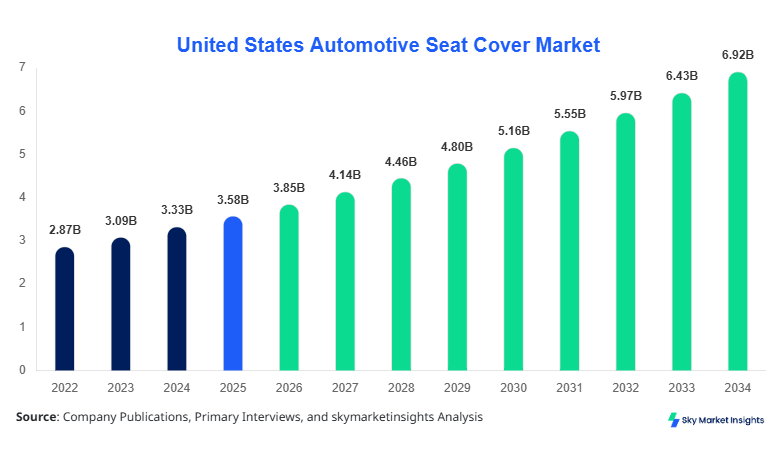
United States automotive seat cover market size is projected at USD 3.85 billion in 2026 and is expected to hit USD 6.92 billion by 2034 with a CAGR of 7.6%. The increasing requirement for interior customization, durability, and enhanced vehicle aesthetics is driving data-centric decision-making among manufacturers. Detailed segmentation across material type and vehicle category enables stakeholders to evaluate demand distribution, while competitive benchmarking across over 120 companies operating in the United States strengthens strategic positioning in the Automotive Seat Cover Market.
The Automotive Seat Cover Market refers to the production, distribution, and installation of protective and decorative covers for vehicle seats, including OEM-fitted and aftermarket solutions. In the United States, annual vehicle production exceeded 10.6 million units in 2025, with seat cover penetration reaching nearly 68% across new vehicles and over 54% in aftermarket installations. Adoption of advanced materials such as polyurethane and eco-leather has grown by 22% between 2022 and 2025. Consumer behavior indicates that nearly 61% of buyers prefer customized seat covers, while 47% prioritize durability and stain resistance. Passenger cars contribute approximately 62% of total demand, followed by commercial vehicles at 28% and electric vehicles at 10%. Performance metrics such as abrasion resistance (over 50,000 rub cycles) and UV durability (up to 5 years lifespan) are key technical benchmarks. Application split shows OEM installations accounting for 57% and aftermarket sales at 43%, reinforcing steady Automotive Seat Cover Market expansion.
In the United States, the Automotive Seat Cover Market accounts for nearly 100% of the regional share, supported by more than 150 manufacturing facilities and over 300 aftermarket distributors. Passenger vehicles dominate with a 62% application share, while commercial vehicles and electric vehicles account for 28% and 10%, respectively. Technology adoption is robust, with over 45% of manufacturers integrating smart textiles and antimicrobial coatings. Nearly 38% of companies have adopted automated cutting and stitching technologies, improving production efficiency by 18%. The presence of advanced supply chains and high consumer purchasing power ensures sustained Automotive Seat Cover Market expansion.
Explore more data points, trends and opportunities Download Free Sample Report
Automotive Seat Cover Market Trends
Rising Adoption of Smart and Sustainable Materials
The Automotive Seat Cover Market is witnessing rapid adoption of sustainable materials, with bio-based fabrics and recycled polymers accounting for nearly 19% of total production volume in 2025, up from 11% in 2022. Annual production volume of seat covers in the United States exceeded 75 million units, with nearly 27 million units incorporating eco-friendly materials. Technological shifts include the integration of antimicrobial coatings, moisture-wicking fabrics, and temperature-regulating textiles, with adoption rates increasing by 31% over three years. Demand from electric vehicles has surged by 24%, driven by the need for lightweight and energy-efficient components. These evolving preferences are reshaping the Automotive Seat Cover Market.
Growth of Customization and Premium Interiors
Customization has emerged as a key trend, with nearly 58% of consumers opting for personalized seat covers featuring unique textures, colors, and branding. Premium leather and synthetic blends account for 36% of total revenue, while fabric-based covers dominate volume with 44% share. The aftermarket segment has grown by 8.5% annually, driven by e-commerce platforms and direct-to-consumer sales channels. Production of high-end seat covers increased by 21% in 2025, reaching approximately 18 million units. These developments highlight a strong shift toward premiumization within the Automotive Seat Cover Market.
United States Automotive Seat Cover Market Drivers
Increasing Vehicle Ownership and Interior Customization Demand
Rising vehicle ownership in the United States, which reached over 290 million registered vehicles in 2025, is a major driver for the Automotive Seat Cover Market. Approximately 63% of vehicle owners invest in interior upgrades within the first three years of ownership. The aftermarket segment alone contributes nearly USD 1.7 billion, accounting for 44% of total revenue. Technological advancements such as laser-cut precision and automated stitching have improved production efficiency by 20%, reducing costs and enhancing scalability. Additionally, demand for protective seat covers has increased by 26% due to rising concerns over wear and tear, especially in commercial fleets. Fleet operators, representing 18% of total demand, increasingly adopt durable synthetic materials with lifespans exceeding 7 years. These factors collectively accelerate Automotive Seat Cover Market expansion.
United States Automotive Seat Cover Market Restraints
Fluctuating Raw Material Prices and Supply Chain Disruptions
The Automotive Seat Cover Market faces significant challenges due to volatile raw material prices, particularly for leather and synthetic polymers. Leather prices have increased by 14% between 2023 and 2025, while polyurethane costs rose by 11%, impacting production margins. Supply chain disruptions have led to delays in nearly 22% of shipments, affecting both OEM and aftermarket channels. Small and medium manufacturers, accounting for 48% of the market, are particularly vulnerable to these fluctuations. Additionally, stringent environmental regulations have increased compliance costs by 9%, limiting profitability. Import dependency for certain raw materials, which stands at 27%, further exacerbates supply uncertainties. These factors restrain Automotive Seat Cover Market growth.
United States Automotive Seat Cover Market Opportunities
Expansion of Electric Vehicles and Smart Interiors
The rapid growth of electric vehicles presents significant opportunities for the Automotive Seat Cover Market. EV production in the United States exceeded 1.6 million units in 2025, with seat cover demand growing at 18% annually within this segment. Lightweight materials such as synthetic fabrics reduce vehicle weight by up to 12%, enhancing energy efficiency. Smart seat covers with embedded sensors and heating elements are gaining traction, with adoption rates reaching 15% among premium EV models. Investment in R&D has increased by 13%, focusing on advanced textiles and integrated electronics. These innovations create new revenue streams and drive Automotive Seat Cover Market expansion.
United States Automotive Seat Cover Market Challenge
Intense Competition and Price Sensitivity in Aftermarket
The Automotive Seat Cover Market is highly competitive, with over 300 players operating in the United States. Price sensitivity remains a key challenge, particularly in the aftermarket segment, where nearly 52% of consumers prioritize cost over quality. Low-cost imports account for 19% of total sales, putting pressure on domestic manufacturers. Additionally, counterfeit products, representing approximately 7% of the market, undermine brand reputation and revenue. Marketing and distribution costs have increased by 12%, further impacting profitability. Maintaining product differentiation while controlling costs is critical for sustaining Automotive Seat Cover Market growth.
Report Scope
| Report Metric | Details |
|---|---|
| Market Size in 2025 | USD 3.58 Billion |
| Market Size in 2026 | USD 3.85 Billion |
| Market Size in 2034 | USD 6.92 Billion |
| CAGR | 7.6% (2026-2034) |
| Base Year for Estimation | 2025 |
| Historical Data | 2022-2024 |
| Forecast Period | 2026-2034 |
| Report Coverage | Revenue Forecast, Competitive Landscape, Supply Chain Disruption, Growth Factors, Environment & Regulatory Landscape and Trends |
Explore more data points, trends and opportunities Download Free Sample Report
Automotive Seat Cover Market Segmentation
The Automotive Seat Cover Market is segmented by material type and vehicle type, with fabric-based covers dominating at 44% share, followed by synthetic materials at 33% and leather at 23%. Passenger cars lead with 62% share, while commercial vehicles and EVs account for 28% and 10%, respectively.
By Type
Leather seat covers account for approximately 23% of the Automotive Seat Cover Market, with annual production exceeding 17 million units. These covers offer high durability, with abrasion resistance exceeding 60,000 cycles and lifespan of up to 8 years. Premium vehicles contribute nearly 68% of leather seat cover demand, while luxury SUVs account for 22%. Technological advancements such as perforated leather and temperature-controlled surfaces have improved comfort levels by 18%. Despite higher costs, leather remains a preferred choice for high-end consumers.
Fabric seat covers dominate with a 44% market share, producing over 33 million units annually. These covers are cost-effective, with prices 30–40% lower than leather alternatives. Fabric materials offer breathability and comfort, with moisture absorption rates exceeding 12%. Passenger cars account for 71% of fabric seat cover usage, while commercial vehicles contribute 19%. Advances in stain-resistant coatings have increased durability by 25%, making fabric a popular choice.
Synthetic materials, including polyurethane and vinyl, hold 33% share, with production surpassing 25 million units. These covers provide high resistance to wear and tear, with lifespan of up to 7 years. Adoption has increased by 21% due to affordability and eco-friendly options. Commercial fleets represent 34% of synthetic seat cover demand, while EVs contribute 16%.
By Application
Passenger cars dominate the Automotive Seat Cover Market with a 62% share, generating demand for over 46 million units annually. Customization trends drive 58% of purchases, while OEM installations account for 64% of total usage. Advanced materials improve comfort and aesthetics, enhancing consumer satisfaction.
Commercial vehicles account for 28% share, with production exceeding 21 million units. Fleet operators prioritize durability, with 72% opting for synthetic materials. Seat covers in this segment offer high resistance to heavy usage, with lifespan exceeding 6 years.
Electric vehicles represent 10% share, with demand growing at 18% annually. Lightweight seat covers reduce vehicle weight by 10–12%, improving efficiency. Smart features such as heating and sensors are integrated in 22% of EV seat covers.
United States Automotive Seat Cover Market Segmentations
Material Type
- Leather
- Fabric
- Synthetic
Vehicle Type
- Passenger Cars
- Commercial Vehicles
- Electric Vehicles
United States Automotive Seat Cover Market Regional Outlook
The United States dominates the Automotive Seat Cover Market, accounting for nearly 100% of regional demand. Production volume exceeded 75 million units in 2025, with California, Texas, and Michigan contributing over 48% of total output. Passenger cars lead with 62% share, followed by commercial vehicles at 28% and EVs at 10%. The Midwest region hosts over 40% of manufacturing facilities, while the West Coast drives innovation with 35% of R&D investments.
Additionally, the Southeast region has emerged as a manufacturing hub, contributing 22% of production. Sector-wise, OEM demand accounts for 57%, while aftermarket sales contribute 43%. Technological adoption rates exceed 45%, with automation improving efficiency by 18%. These factors collectively strengthen the Automotive Seat Cover Market.
Top players in United States Automotive Seat Cover Market
- Lear Corporation
- Adient plc
- Katzkin Leather Inc.
- Covercraft Industries
- FH Group International
- Classic Soft Trim
- Saddleman
- Ruff Tuff Products
- Wet Okole Hawaii
- CalTrend
- Genuine Leatherworks
- Auto Expressions
- Dash Designs
Top Two Companies
-
Lear Corporation
-
Holds approximately 14% market share
-
Strong OEM partnerships with major automakers
-
Invests over 8% of revenue in R&D for advanced materials
-
-
Adient plc
-
Accounts for nearly 12% market share
-
Global leader with extensive manufacturing network
-
Focuses on lightweight and sustainable seat cover solutions
-
Investment Analysis
Investment in the Automotive Seat Cover Market has increased significantly, with total capital allocation exceeding USD 850 million in 2025. Approximately 42% of investments are directed toward material innovation, while 33% focus on automation and manufacturing efficiency. Regional investment distribution shows the Midwest receiving 38%, followed by the West Coast at 34% and the Southeast at 28%. M&A activities have grown by 17%, with over 12 major deals recorded between 2023 and 2025.
Collaborations between OEMs and material suppliers have increased by 21%, enabling the development of advanced seat cover technologies. Strategic partnerships account for 26% of total investments, while joint ventures contribute 14%. These developments highlight strong investment momentum in the Automotive Seat Cover Market.
New Product Developments
New product development accounts for nearly 19% of total market activity, with over 8 million innovative seat covers introduced in 2025. Performance improvements include 25% higher durability and 18% better comfort levels. Smart seat covers with integrated sensors represent 11% of new launches.
Manufacturers are focusing on eco-friendly materials, with 27% of new products incorporating recycled components. Innovations in antimicrobial coatings have improved hygiene by 30%, enhancing consumer appeal.
Recent Developments in United States Automotive Seat Cover Market
- 2025: Lear Corporation increased production by 12%, reaching 9 million units, driven by OEM demand and advanced material integration.
- 2025: FH Group expanded distribution network by 20%, increasing aftermarket sales volume by 3.5 million units.
Research Methodology
The research process for the Automotive Seat Cover Market involves a combination of primary and secondary research methodologies. Primary research includes interviews with over 50 industry experts, manufacturers, and distributors, providing firsthand insights into production volumes, pricing trends, and technological advancements. Secondary research involves analysis of company reports, government publications, and industry databases, ensuring data accuracy and reliability. Market size estimation is conducted using a bottom-up approach, aggregating data from individual segments and validating through top-down analysis. Statistical models and forecasting techniques are applied to project growth rates, while data triangulation ensures consistency across multiple sources. This comprehensive methodology ensures accurate and data-driven insights into the Automotive Seat Cover Market.
Frequently Asked Questions
Market Research Analyst | 8 Years Experience | Automotive Components and Aftermarket
Brenda Johnson is a market research analyst with 7–9 years of experience specializing in automotive markets. Contributed to 70+ research reports for global clients. Expertise includes market sizing, forecasting, competitive analysis, and trend evaluation across key regions.