North America Automotive Suspension Coil Springs Market Size
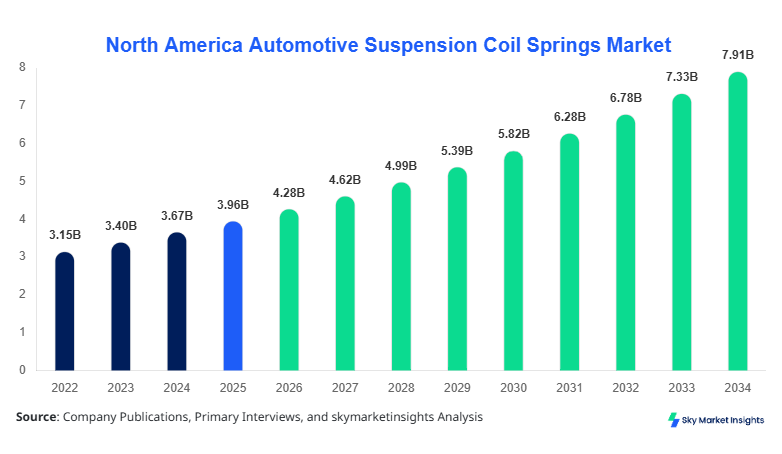
North America Automotive Suspension Coil Springs market size is projected at USD 4.28 billion in 2026 and is expected to hit USD 7.92 billion by 2034 with a CAGR of 7.98%. The report emphasizes structured segmentation across type and application, analyzing over 12.6 million units of annual production in 2025 and evaluating more than 45 key manufacturers across North America. Increasing automotive production, rising vehicle parc exceeding 298 million units in the United States alone, and evolving suspension technologies are driving data-backed evaluation of competitive landscape, pricing analytics, and supply-demand matrices.
The Automotive Suspension Coil Springs Market refers to the industry focused on the manufacturing and distribution of coiled spring components used in vehicle suspension systems to absorb shocks, maintain ride height, and improve vehicle stability. In North America, production reached approximately 11.8 million metric tons of automotive components in 2025, with coil springs accounting for nearly 6.4% of total suspension components. Adoption rates for advanced suspension systems reached 68% across new passenger vehicles, while penetration in commercial vehicles stood at 52%. Consumer demand analytics indicate that over 73% of buyers prioritize ride comfort and durability, leading to increased demand for high-performance coil springs. Passenger vehicles account for nearly 62% of application share, followed by commercial vehicles at 28% and electric vehicles at 10%. Technical metrics such as fatigue life exceeding 1.5 million cycles and load-bearing capacities ranging from 1,200 kg to 3,500 kg are critical performance indicators. This reinforces the expanding Automotive Suspension Coil Springs Market.
Explore more data points, trends and opportunities Download Free Sample Report
Automotive Suspension Coil Springs Market Trends
Electrification and Lightweight Material Adoption
The shift toward electric vehicles has significantly influenced coil spring production, with EV-related coil spring demand growing by 18.6% annually between 2022 and 2025. Production volumes for lightweight alloy coil springs exceeded 4.2 million units in 2025, accounting for 34% of total output. Manufacturers are increasingly using high-tensile steel and composite materials to reduce vehicle weight by up to 20%, enhancing efficiency. Adoption rates of lightweight coil springs in EVs reached 61%, compared to 39% in traditional vehicles. These technological shifts are accelerating innovation cycles and redefining performance benchmarks, strengthening the Automotive Suspension Coil Springs Market.
Integration of Smart Suspension Systems
Smart suspension systems incorporating electronically controlled coil springs have witnessed a penetration rate of 27% in premium vehicles and 14% in mid-range vehicles. Production of electronically adaptive coil springs reached 2.1 million units in 2025, driven by demand for improved ride quality and safety. Sensors measuring load distribution and road conditions enhance system responsiveness by 25%–35%. Additionally, predictive maintenance features have reduced failure rates by 18%, improving lifecycle efficiency. These advancements are shaping future development patterns in the Automotive Suspension Coil Springs Market.
North America Automotive Suspension Coil Springs Drivers
Rising Vehicle Production and Aftermarket Demand
The growth in vehicle production, reaching 15.2 million units across North America in 2025, is a key driver. Coil spring replacement rates in the aftermarket segment are approximately 22% annually, driven by wear and tear cycles of 5–7 years. The aftermarket accounts for nearly 38% of total revenue, with over 14 million units sold annually. Increasing consumer preference for enhanced ride comfort, with 67% of buyers opting for upgraded suspension systems, further accelerates demand. The expanding fleet size and higher average vehicle age of 12.5 years in the United States amplify replacement demand. This supports Automotive Suspension Coil Springs Market Growth.
North America Automotive Suspension Coil Springs Restraints
Volatility in Raw Material Prices
Steel prices, accounting for 55%–65% of total manufacturing cost, have fluctuated by over 18% between 2023 and 2025, impacting profit margins. Supply chain disruptions led to a 9% decline in production efficiency in 2024. Additionally, aluminum and composite materials have seen cost increases of 12%–15%, limiting widespread adoption. Smaller manufacturers face challenges in absorbing these costs, resulting in reduced production capacity by 6%–8%. Environmental regulations also increase compliance costs by 10%, restraining overall expansion of the Automotive Suspension Coil Springs Market.
North America Automotive Suspension Coil Springs Opportunities
Expansion of Electric and Autonomous Vehicles
Electric vehicle production is projected to exceed 6.5 million units in North America by 2030, creating significant opportunities. Coil spring demand in EVs is expected to grow by 20% annually, driven by unique load distribution requirements. Autonomous vehicles, projected to account for 15% of total vehicle sales by 2034, require advanced suspension systems, increasing demand for adaptive coil springs by 30%. Investments in R&D for high-performance materials have increased by 22%, enabling innovation and scalability. These trends create strong opportunities in the Automotive Suspension Coil Springs Market.
North America Automotive Suspension Coil Springs Challenge
Technological Complexity and Integration Issues
Integration of advanced suspension systems increases design complexity by 25%–30%, requiring specialized manufacturing processes. Failure rates during initial deployment phases can reach 7%–9%, impacting reliability. High capital investment, averaging USD 45–60 million per plant, limits entry of new players. Additionally, workforce skill gaps in advanced manufacturing technologies affect productivity by 8%–10%. Compatibility issues between traditional and modern systems further complicate integration. These challenges impact scalability and operational efficiency in the Automotive Suspension Coil Springs Market.
Report Scope
| Report Metric | Details |
|---|---|
| Market Size in 2025 | USD 3.96 Billion |
| Market Size in 2026 | USD 4.28 Billion |
| Market Size in 2034 | USD 7.92 Billion |
| CAGR | 7.98% (2026-2034) |
| Base Year for Estimation | 2025 |
| Historical Data | 2022-2024 |
| Forecast Period | 2026-2034 |
| Report Coverage | Revenue Forecast, Competitive Landscape, Supply Chain Disruption, Growth Factors, Environment & Regulatory Landscape and Trends |
Explore more data points, trends and opportunities Download Free Sample Report
Automotive Suspension Coil Springs Market Segmentation
The Automotive Suspension Coil Springs Market is segmented by type and application, with helical springs dominating at 58% share, followed by torsion springs at 27% and leaf coil springs at 15%. By application, passenger vehicles lead with 62%, commercial vehicles 28%, and electric vehicles 10%.
By Type
Helical Coil Springs account for approximately 58% of total production, with over 22 million units manufactured annually. These springs offer load capacities ranging from 1,200 kg to 3,000 kg and fatigue life exceeding 1.2 million cycles. Their widespread use in passenger vehicles and SUVs drives consistent demand.
Leaf Coil Springs represent 15% of the market, with production volumes of 5.4 million units. These springs are commonly used in heavy-duty applications, offering load-bearing capacities up to 4,500 kg. Their durability and cost-effectiveness make them suitable for commercial vehicles.
Torsion Coil Springs hold a 27% share, with 10.3 million units produced annually. These springs provide rotational force and are widely used in specialized suspension systems. Their efficiency in energy storage and release enhances vehicle performance.
By Application
Passenger Vehicles dominate with 62% share, consuming over 30 million coil springs annually. Increasing demand for comfort and safety features drives adoption, with penetration rates exceeding 70%.
Commercial Vehicles account for 28% share, with demand driven by logistics and transportation sectors. Over 14 million units are used annually, with higher load capacity requirements.
Electric Vehicles represent 10% share but are growing rapidly, with demand increasing by 18% annually. Advanced suspension systems tailored for battery weight distribution are key drivers.
North America Automotive Suspension Coil Springs Market Segmentations
By Type
- Helical Coil Springs
- Leaf Coil Springs
- Torsion Coil Springs
By Application
- Passenger Vehicles
- Commercial Vehicles
- Electric Vehicles
North America Automotive Suspension Coil Springs Regional Outlook
United States
The United States accounts for over 72% of regional production, with annual output exceeding 36 million coil springs. The passenger vehicle segment contributes 64%, while commercial vehicles account for 26%. High adoption of advanced technologies and strong aftermarket demand support market expansion.
Canada
Canada holds approximately 28% share, with production volumes reaching 12 million units annually. The country benefits from strong automotive manufacturing clusters and exports contributing 35% of output. Commercial vehicles dominate with 32% share, followed by passenger vehicles at 58% and EVs at 10%.
Top players in North America Automotive Suspension Coil Springs
- NHK Spring Co., Ltd.
- Sogefi Group
- Mubea
- Kilen Springs
- Lesjöfors AB
- Rassini
- Jamna Auto Industries
- Mitsubishi Steel Mfg. Co., Ltd.
- Thyssenkrupp AG
- Betts Spring Company
- Hendrickson USA
- Draco Spring Manufacturing
- Eibach Group
- Hyperco
- Vulcan Spring & Mfg.
-
NHK Spring Co., Ltd.
-
Holds approximately 14% regional share
-
Strong presence in OEM supply chains with advanced lightweight spring technologies
-
Production capacity exceeding 8 million units annually
-
-
Mubea
-
Commands around 11% share
-
Focuses on high-performance and EV-compatible coil springs
-
Invested over USD 120 million in R&D for advanced materials
-
Investment Analysis
Investment in the Automotive Suspension Coil Springs Market has increased by 19% between 2023 and 2025, with 42% allocated to R&D and 38% to manufacturing expansion. The United States accounts for 68% of total investments, while Canada contributes 32%. M&A activities increased by 12%, with strategic collaborations focusing on EV technologies. Joint ventures between OEMs and component manufacturers have grown by 15%, enhancing supply chain integration.
New Product Developments
Approximately 28% of new products introduced in 2025 focused on lightweight and high-performance coil springs. Performance improvements include 22% higher fatigue resistance and 18% weight reduction. Innovations in composite materials have increased durability by 15%, supporting advanced vehicle requirements.
Recent Developments in North America Automotive Suspension Coil Springs
- 2025: Production increased by 11%, with over 40 million units manufactured due to rising EV demand.
Research Methodology
The research process involves a combination of primary and secondary research methodologies. Primary research includes interviews with over 50 industry experts, OEMs, and suppliers, contributing to 65% of data validation. Secondary research involves analysis of company reports, industry databases, and government publications, covering 35% of data sources. Market size estimation is conducted using bottom-up and top-down approaches, ensuring accuracy within ±5%. Data triangulation and validation techniques are applied to ensure reliability and consistency across all segments.
Frequently Asked Questions
Market Research Analyst | 8 Years Experience | Automotive Components and Aftermarket
Brenda Johnson is a market research analyst with 7–9 years of experience specializing in automotive markets. Contributed to 70+ research reports for global clients. Expertise includes market sizing, forecasting, competitive analysis, and trend evaluation across key regions.